

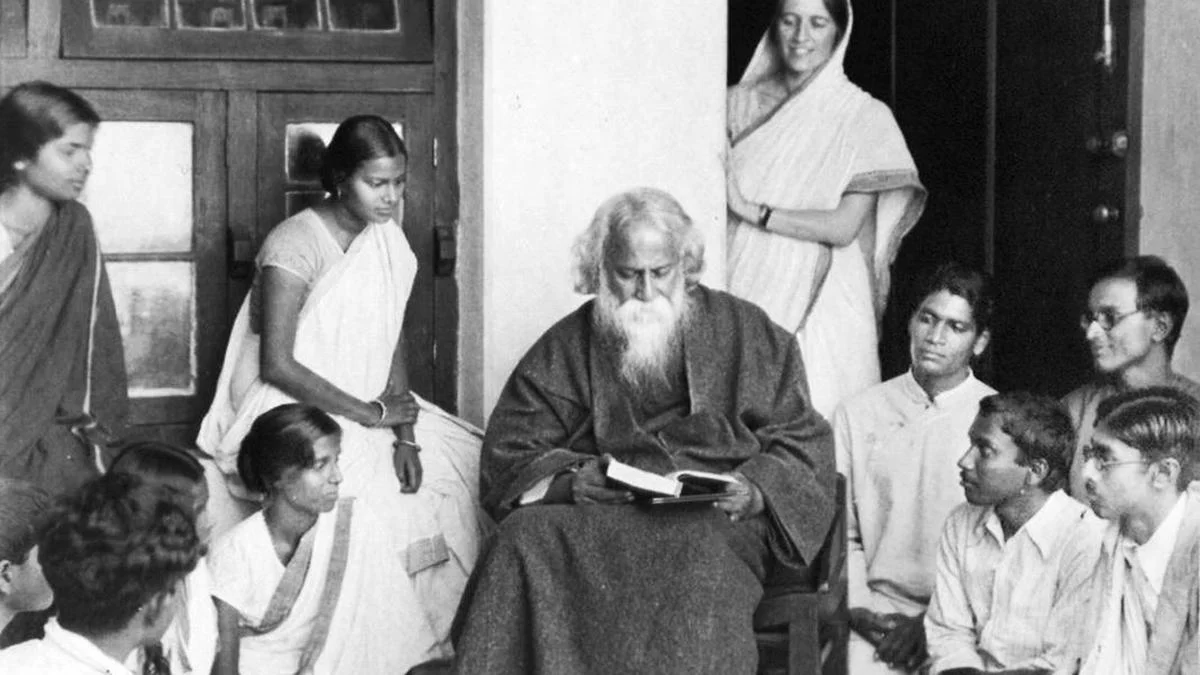
Every year, on May 7th, the world remembers Rabindranath Tagore, the Nobel laureate whose genius spanned poetry, drama, music, and intellectual thought. While his artistic and literary contributions are celebrated with grand retrospectives, exhibitions, and performances, a subtler aspect of his legacy often remains in the shadows: his culinary world. The kitchens of Jorasanko Thakurbari, Tagore’s ancestral home in Kolkata, were not merely places for sustenance, but vibrant laboratories of taste, where culinary traditions met with innovation, creating a unique gastronomic landscape that is now, in many ways, a lost art.
This article delves into the fascinating, often elusive, culinary universe of Rabindranath Tagore and his family, exploring how their experiments with food reflected the broader cultural and historical shifts of their time. It aims to bring back into public consciousness these forgotten flavours, guided by the contemporary efforts of individuals dedicated to reconstructing this rich, yet fragmented, heritage.
The Unfolding Tapestry of Bengali Cuisine: A Historical Canvas
To truly appreciate the culinary experiments within the Tagore household, it is crucial to understand the historical context that shaped Bengali cuisine. Bengal’s fertile lands and abundant agricultural produce have always been the bedrock of a diverse and rich culinary tradition. However, the story of Bengali food is not one of static tradition; it is a narrative of constant evolution, influenced by trade, conquest, and cultural exchange.
The 18th and 19th centuries, particularly in Kolkata, marked a significant period of culinary confluence. As the British Raj solidified its presence, European ingredients, techniques, and culinary philosophies began to seep into the local gastronomic landscape. Indian cooks, often referred to as bawarchis, who served in European households or elite Indian homes, acquired a sophisticated understanding of continental cooking. This resulted in the creation of hybrid dishes, where familiar Bengali ingredients were prepared using Western methods, or vice versa.
This exchange was not confined to Kolkata alone. Culinary influences travelled between cities like Dhaka, with its aristocratic Nawabi traditions, and the burgeoning urban palate of Kolkata. This dynamic interplay of flavours, textures, and presentation created a unique culinary identity for Bengal, one characterized by its adaptability and openness to new ideas. It was within this vibrant and ever-evolving culinary milieu that the Tagore family carved out their distinctive gastronomic niche.
Jorasanko Thakurbari: A Crucible of Culinary Innovation
The Tagore household, situated in the heart of North Kolkata, was more than just a residence; it was a cultural epicenter that profoundly influenced Bengali society in virtually every sphere – art, literature, music, and even social customs. Food, naturally, was an integral part of this multifaceted life.
Rabindranath Tagore himself was known to be a discerning diner, with a palate that appreciated both the comforting familiarity of traditional Bengali fare and the sophisticated allure of European cuisine. His meals often reflected this dual inclination. While he might have savored traditional Bengali dishes during the day, evenings often called for European delicacies such as pies, steaks, pastries, and cutlets.
This culinary duality was made possible by the Tagore family’s considerable affluence. In colonial Calcutta, while imported ingredients like vinegar and bottled sauces were available in select shops, they were prohibitively expensive for the average household. However, for the Tagore family, these ingredients were not luxuries but regular components of their kitchen. This access allowed them to experiment with recipes that blended local produce with novel techniques, creating dishes that were both innovative and rooted in their heritage.
References to these culinary explorations can be found in historical texts, most notably in "Thakurbarir Ranna" (Recipes from the Tagore Household) by Purnima Thakur and the writings of Pragya Sundari Devi. These accounts reveal dishes like "vinegar fish" and "maccher sauce curry" (fish in tomato sauce curry), which exemplify the fusion of Bengali ingredients with Western culinary concepts.
The experimentation within the Tagore household kitchen was often spearheaded by Mrinalini Devi, Tagore’s wife, a renowned cook in her own right. Accounts suggest that she was instrumental in bringing many of these unique dishes to life. Tagore himself was not a passive observer; he was known to suggest unusual ingredient combinations and request dishes prepared with specific items, sometimes leading to unexpected yet delightful outcomes. One such instance involved the incorporation of kochu (taro) into jalebi, a sweet confection, showcasing a daring departure from conventional recipes.

The Curious Case of "Elo Jhelo Mishti" and "Poribondho"
One particularly charming anecdote that highlights the playful nature of culinary experimentation in the Tagore household involves a sweetmeat known as "elo jhelo mishti" (haphazard sweet). This dessert, resembling a type of gaja (a fried sweetmeat made from flour and clarified butter), was created by Mrinalini Devi. Upon hearing the name, Rabindranath Tagore, with his characteristic poetic sensibility, is said to have expressed mild disdain, questioning the appropriateness of such a moniker.
In response to the poet’s critique, the dish was thoughtfully renamed "poribondho." While the word itself might not have a direct culinary meaning, scholars like Subhajit Bhattacharyya, a culinary historian and co-founder of "Lost and Rare Recipes," suggest that Tagore might have been inspired by the visual resemblance of the sweet to a pointed gourd (potol) closed at its tips. The sweet’s construction, with multiple slits on its body, could have evoked the image of a cage-like jalebi, a connection that "poribondho" might have subtly alluded to. This story underscores the intellectual and creative engagement with food that permeated the Tagore household, where even a simple sweetmeat could become a subject of poetic contemplation and linguistic refinement.
Culinary Diplomacy and the "Khamkheyali Sabha"
Beyond the confines of the domestic kitchen, food played a significant role in fostering intellectual and cultural exchange within a wider social circle. Tagore was a central figure in the khamkheyali (whimsical) sabha (gathering), an informal assembly of prominent contemporaries. This esteemed group included luminaries such as Bengali composer Atul Prasad Sen, poet and playwright Dwijendralal Ray, physicist Jagadish Chandra Bose, and freedom fighter Chittaranjan Das, among others.
These gatherings, held in rotation at the homes of its members, were evenings dedicated to music, lively conversation, and, crucially, unconventional culinary offerings. Each host was bound by a peculiar stipulation: the meal served had to be out of the ordinary, pushing the boundaries of conventional taste and presentation.
From these convivial yet intellectually stimulating evenings emerged dishes that defied easy categorization. Creations like "mangsher machher curry" (meat’s fish curry) and "machher mangsher curry" (fish in meat curry) exemplify this playful subversion of culinary norms, blurring the lines between traditional categories.
A particularly intriguing dish that emerged from this era is "piyanj er payesh" (onion rice pudding). Purnima Thakur, who was closely associated with the renowned children’s literature writer Leela Majumdar, recounts Majumdar’s initial encounter with this dessert. Mistaking it for a litchi-based confection, Majumdar was surprised to learn of its primary ingredient: onions. The preparation of "piyanj er payesh" involves a meticulous process of peeling and washing the outer layers of the onion multiple times in warm water. This thorough cleansing effectively neutralizes the pungent aroma, ensuring that when cooked with rice and milk, the payesh (rice pudding) develops a flavour remarkably reminiscent of litchis. This dish stands as a testament to the culinary ingenuity and willingness to experiment that characterized the Tagore household and its associated circles.
Beyond the Exotic: Simplicity and Subtle Innovations
While the more elaborate and experimental dishes often capture the imagination, the Tagore kitchen also embraced simpler, yet equally significant, culinary practices. These were dishes that, while perhaps less flamboyant, still reflected a departure from rigid culinary conventions.
Examples include rice served with ground beetroot, adding a vibrant hue and earthy sweetness to a staple. "Murgir Rosholla," a straightforward chicken curry seasoned with onion and bay leaves, showcases a subtle yet flavourful approach. "Sorshe mangsho," a dish where mustard paste infuses the meat, defining its character, highlights the effective use of traditional Bengali spices in novel applications.
These dishes, while not necessarily complex in their preparation, indicate a kitchen that valued creativity and flavor over strict adherence to form. They represent a pragmatic approach to cooking, where familiar ingredients were elevated through thoughtful combinations and techniques.
Reclaiming the Lost Flavours: The Work of "Lost and Rare Recipes"
In the contemporary landscape, the task of reconstructing these lost culinary narratives falls to dedicated individuals and organizations. Subhajit Bhattacharyya, a former media and event management professional, along with his colleague Amit Ghosh Dastidar, has taken up this vital mission through their online initiative, "Lost and Rare Recipes."

Operating across platforms like YouTube, Instagram, and Facebook, Bhattacharyya and Ghosh Dastidar are meticulously documenting and recreating recipes that have faded from everyday use. Their approach is deeply rooted in storytelling, using historical texts, regional traditions, and personal anecdotes to bring these forgotten dishes back into public consciousness. They not only provide detailed methods and measurements but also weave narratives that connect the food to its historical and cultural context.
Their work includes the meticulous reconstruction of "Thakurbari ranna" (cooking from the Tagore household), alongside numerous other culinary legacies. Bhattacharyya explains that the "incompleteness" of these historical recipes – the scattered references, the missing details – is precisely what draws him in. It presents a challenge and an opportunity to engage in a form of culinary archaeology, piecing together fragments of the past to create a more complete picture.
Among the dishes they have documented are intriguing preparations like "pagalkhana mangsho" (mad house mutton), a mutton curry that was reportedly prepared in the paglagarod (psychological rehabilitation homes) of Bengal. Another fascinating example is "mangsher jemon temon" (meat any which way), mentioned in Renuka Devi Choudhurani’s book "Rakmari Amish Ranna." This is an unusual mutton curry prepared without garlic, a significant omission given garlic’s indispensable role in most Bengali meat preparations. These examples highlight the sheer diversity and unconventionality that characterized Bengali cuisine, even in its more humble or institutionalized forms.
The Comfort of "Panthar Bangla": A Culinary Anchor in Illness
The impact of food on well-being is a timeless concern, and even within the annals of Tagore’s life, culinary creations played a role in offering solace and recovery. Towards the end of his life, when Tagore was unwell and suffering from a loss of appetite, a dish prepared by Pratima Devi is said to have brought him significant comfort.
This dish, known as "panthar bangla," which translates to "Lamb’s Bengal," was a simple yet nourishing stew of lamb and potatoes. It is believed that after consuming this light and flavourful preparation, Tagore’s appetite returned. In his final days, he reportedly enjoyed this stew on multiple occasions, underscoring its restorative qualities and its ability to provide comfort during times of physical weakness. This anecdote serves as a poignant reminder that even the simplest of dishes can hold profound significance, offering sustenance not just to the body, but also to the spirit.
The Enduring Legacy: More Than Just Recipes
The exploration of Rabindranath Tagore’s culinary world reveals a legacy far richer than a mere collection of recipes. It speaks to a period of immense cultural dynamism, where tradition and innovation danced in harmony. The Tagore household, with its intellectual vibrancy and affluence, served as a unique incubator for culinary experimentation, reflecting the broader societal shifts of colonial India.
The efforts of individuals like Subhajit Bhattacharyya are crucial in preserving and disseminating this heritage. By meticulously reconstructing these "lost and rare recipes," they are not just reviving forgotten flavours; they are also reintroducing the stories, the context, and the spirit behind them.
Ultimately, the Tagore we connect with through his culinary legacy is not solely the literary giant or the artistic visionary. He is also the individual who sat down to meals, who expressed curiosity about new tastes, who sought comfort in familiar dishes even in illness, and who, through his household, contributed to a vibrant tapestry of Bengali culinary history. What survives is not necessarily a complete and perfectly documented culinary canon, but a testament to continuity, adaptation, and the enduring power of food to connect us to our past and to each other. The echoes of Tagore’s table, though sometimes faint, continue to resonate, inviting us to taste and remember a significant chapter of cultural heritage.
