

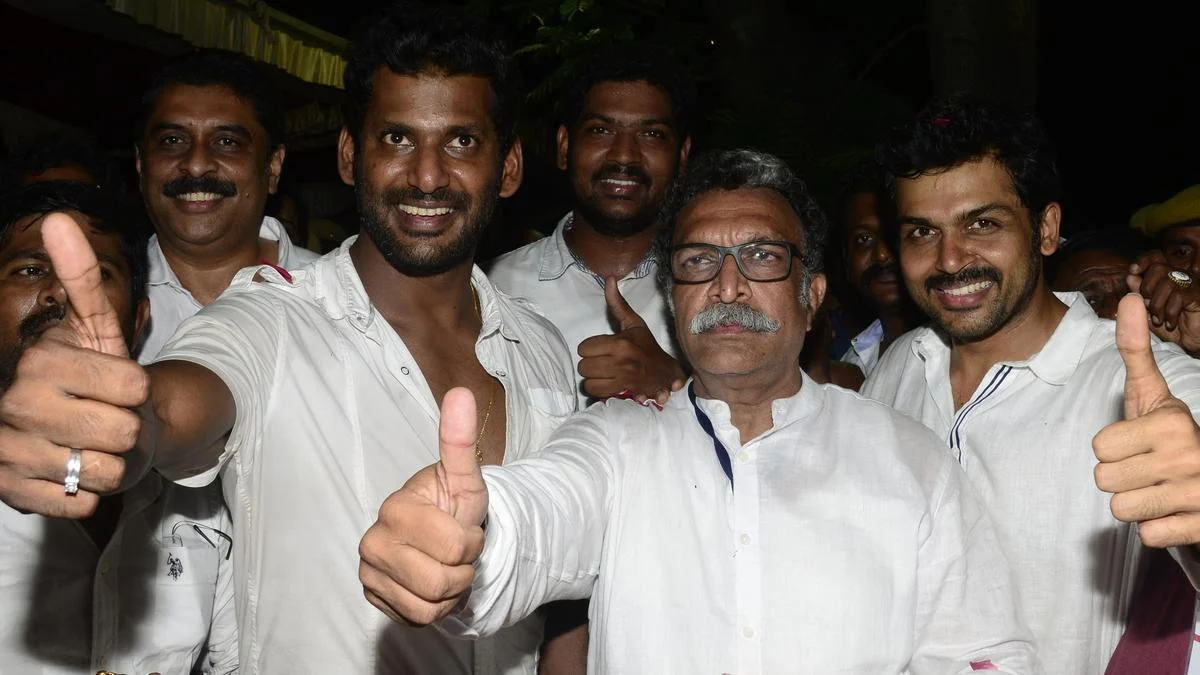
Chennai, India – June 28, 2026 – The Madras High Court is poised to deliver a significant judgment on July 1, 2026, concerning the tenure of the current office-bearers of the South Indian Artistes Association, popularly known as Nadigar Sangam. The court’s decision will address a plea seeking the rejection of a civil suit that challenges the continuation of actors Nasser, Vishal Krishna, and Karthi in their respective roles as president, general secretary, and treasurer, even after their elected three-year term concluded on March 19, 2025.
The legal battle hinges on a resolution passed at the 68th Annual General Meeting (AGM) of the association on September 8, 2024, which extended the office-bearers’ tenure. However, the Tamil Nadu government subsequently issued a Government Order (G.O.) on October 14, 2025, which appears to validate this extension. Justice A.D. Maria Clete, presiding over the case, has expressed skepticism about the plaintiff’s potential benefit from the suit, particularly in light of the government’s subsequent order.
This protracted legal challenge raises crucial questions about governance, membership rights, and the operational continuity of one of the most influential bodies in the South Indian film industry. The court’s final verdict is anticipated to set a precedent for similar disputes within registered societies and associations, impacting how their leadership transitions and decisions are managed in the future.
The Core of the Dispute: An Extended Mandate
The crux of the legal contention lies in the interpretation and validity of the resolution extending the tenure of the current Nadigar Sangam office-bearers. The suit was filed by V. Nambirajan, a member of the association, who argues that the bylaws mandate elections every three years. According to Nambirajan, the current office-bearers, elected on March 21, 2022, should have vacated their posts by March 20, 2025, and new elections should have been conducted. Instead, they continued in their positions based on the resolution passed at the 2024 AGM.
Nambirajan’s plea specifically challenges the AGM resolution, but notably, it does not directly contest the subsequent Government Order (G.O.) issued by the Tamil Nadu government. This G.O., issued under Section 54 of the Tamil Nadu Societies Registration Act, 1975, is understood to have extended the tenure of the elected office-bearers. The Nadigar Sangam counsel, Krishna Ravindran, highlighted this fact, suggesting a potential flaw in the plaintiff’s legal strategy.

A Chronology of Events Leading to the Legal Stalemate
Understanding the timeline of events is critical to grasping the complexities of this legal battle:
- March 21, 2022: The current office-bearers, including President Nasser, General Secretary Vishal Krishna, and Treasurer Karthi, are elected for a three-year term.
- March 19, 2025: The elected three-year term of the office-bearers officially expires.
- September 8, 2024: The 68th Annual General Meeting (AGM) of Nadigar Sangam is held. A resolution is proposed and passed to extend the tenure of the existing office-bearers. The proposal, initially made on August 23, 2024, was reportedly signed by 311 members and passed unanimously.
- October 14, 2025: The Tamil Nadu government issues a Government Order (G.O.) extending the tenure of the Nadigar Sangam office-bearers. The G.O., issued under Section 54 of the Tamil Nadu Societies Registration Act, 1975, is understood to have extended their term until March 19, 2028.
- Undisclosed Date (post-October 14, 2025): V. Nambirajan, a member of Nadigar Sangam, files a civil suit challenging the continuance of the office-bearers.
- Undisclosed Date (following the filing of the suit): S.R. Sekar, another member, files an application in the Madras High Court seeking the rejection of Nambirajan’s plaint.
- June 28, 2026: The Madras High Court announces its decision to pass orders on July 1, 2026, on the plea to reject the civil suit.
This sequence reveals a critical point: the government’s G.O. came after the AGM resolution was passed and after the plaintiff filed his suit challenging the resolution. This temporal aspect significantly influences the legal arguments.
Supporting Data and Arguments: The Nadigar Sangam’s Defense
The Nadigar Sangam, represented by its counsel, has presented a robust defense against Nambirajan’s suit. Key arguments include:
- The Purpose of the Extension: The primary justification for extending the office-bearers’ tenure, as articulated by the association, is to ensure the uninterrupted progress of the convention centre construction. This project is described as a "dream project" of the association, and its completion is considered vital for the welfare and future of its members. The estimated cost of conducting fresh elections, reportedly around ₹40 lakh, was also cited as a factor in seeking an exemption.
- Unanimous Support at the AGM: The resolution to extend the tenure was reportedly passed unanimously at the 68th AGM, with 311 members endorsing the proposal. This indicates broad support within the general body for the current leadership to continue their work.
- Plaintiff’s Alleged Lack of Engagement: The Nadigar Sangam has questioned the plaintiff’s locus standi and his genuine interest in the association’s affairs. They claim that Mr. Nambirajan, aged 79, has not attended any AGM since becoming a member in 2015. This has led the association to suspect that he might be acting as a "proxy litigant" for disgruntled elements aiming to disrupt the association’s functioning and hinder the convention centre’s completion.
- Government’s Acknowledgment and Exemption: The association highlighted that the State government had previously accepted Nadigar Sangam’s request to exempt it from conducting elections. This exemption, coupled with the subsequent G.O., lends significant weight to the office-bearers’ argument that their continued tenure is legally sanctioned. The government’s acceptance of the request to allow existing office-bearers to continue until March 19, 2028, is a crucial piece of evidence in their favor.
Official Responses and Judicial Scrutiny
The Madras High Court’s approach to this case is marked by a pragmatic assessment of the legal landscape. Justice A.D. Maria Clete’s observation about the plaintiff’s potential benefit, even if the suit were decreed, underscores the court’s focus on the practical implications of its decisions. The judge’s query about how the plaintiff would gain from a declaration that the AGM resolution was illegal, especially when a subsequent G.O. exists, suggests a judicial inclination to consider the overarching legal framework rather than isolated resolutions.
The Tamil Nadu government’s G.O. plays a pivotal role. By extending the tenure of the office-bearers under the Societies Registration Act, the government has effectively provided a legal basis for their continued leadership. This intervention by the state authority introduces a layer of complexity, as the court must now reconcile Nambirajan’s challenge to the AGM resolution with the government’s subsequent sanctioning of the extended term.

The filing of an application by S.R. Sekar to reject Nambirajan’s plaint indicates a proactive move by members of Nadigar Sangam to protect the association’s interests and prevent what they perceive as frivolous litigation. This application will be heard alongside the main suit, and its outcome could significantly influence the court’s final decision.
Implications for Nadigar Sangam and Beyond
The Madras High Court’s upcoming judgment on July 1, 2026, carries substantial implications for Nadigar Sangam and potentially for other registered societies in Tamil Nadu:
- Governance and Stability: A ruling in favor of the Nadigar Sangam’s current leadership would reinforce the legitimacy of their extended tenure, allowing them to focus on completing their developmental projects, particularly the convention centre. This would ensure operational stability and prevent potential disruptions to the association’s activities. Conversely, a ruling against them could trigger immediate calls for fresh elections and potentially lead to a period of uncertainty.
- Membership Rights and Participation: The case raises questions about the balance between the rights of individual members to challenge decisions and the need for smooth functioning of an organization. The court’s decision will shed light on how such disputes are adjudicated and the weight given to arguments about proxy litigation and the broader interests of the association.
- The Role of Government Orders: The intervention of the Tamil Nadu government through its G.O. highlights the influence that state authorities can wield in the governance of registered societies. The court’s interpretation of this G.O. in relation to the association’s bylaws and the plaintiff’s challenge will be closely watched.
- Precedent for Future Disputes: This case could set a significant precedent for how similar situations are handled in the future. It will provide guidance on the validity of extending tenures through AGM resolutions, the role of government intervention, and the criteria for challenging such decisions in court. The court’s reasoning will be crucial in establishing parameters for good governance and dispute resolution within member-based organizations.
As the legal clock ticks down to July 1, 2026, the South Indian film fraternity and members of Nadigar Sangam will be keenly awaiting the Madras High Court’s verdict. The decision promises to be a landmark one, shaping the future governance of the association and offering insights into the intricate interplay of membership rights, organizational bylaws, and governmental oversight. The ultimate outcome will likely hinge on the court’s assessment of the legal validity of the extended tenure in the face of both internal resolutions and external governmental sanction.
