

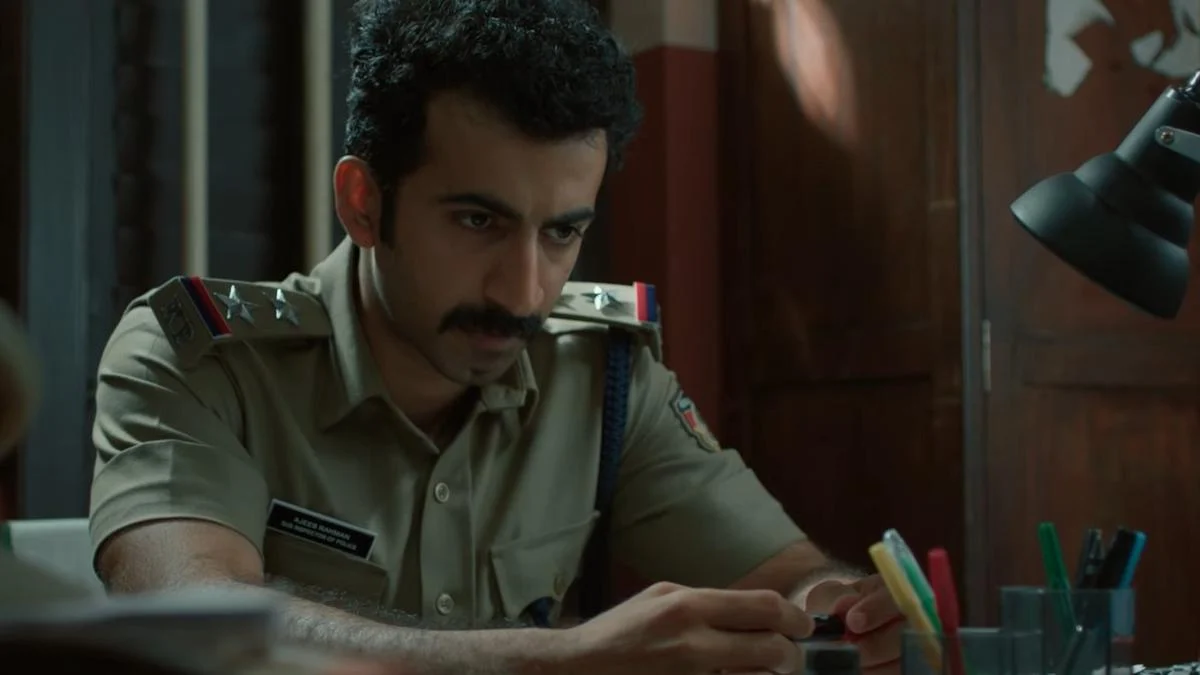
Kochi, Kerala – The Malayalam film industry continues its prolific output of police procedurals, with M. Padmakumar’s latest offering, Uyir, hitting screens this month. Based on a real-life incident and co-written by police officer Shaji Maarad and Nikhil M. Menon, the film aims to delve into the complexities of a baffling investigation. While the premise holds significant promise, drawing from the inherent drama of actual law enforcement challenges, Uyir ultimately falters in its execution, failing to translate its compelling source material into a truly impactful cinematic experience.
The film centers on Ajeeb Rahman, a probationary sub-inspector portrayed by Roshan Mathew, who is tasked with unraveling the mystery surrounding the death of an unidentified woman. Her body is discovered in an abandoned well, a discovery that initially hints at suicide but quickly morphs into a far more intricate and sinister case. As Ajeeb navigates leads across multiple states, the investigation reveals layers of deception and human tragedy.
The Allure of Real-Life Crime in Malayalam Cinema
The consistent emergence of police procedurals from the Malayalam film industry is not without reason. The daily operations of the police force present a rich tapestry of uncommon situations, ethical dilemmas, and the raw spectrum of human emotions. This inherent drama appears to be a significant draw for officers like Shaji Maarad, who transition from law enforcement to screenwriting, bringing an insider’s perspective to the narratives. This trend suggests a growing recognition of the cinematic potential within the often-unseen world of police work, offering audiences a glimpse into the dedication and challenges faced by those who uphold the law.
Uyir‘s strength lies in its foundation – a remarkable real-life story that, in theory, should offer ample scope for exploring a plethora of human emotions and intricate plotlines. However, the transition from the factual to the fictional, and then to the screen, proves to be a stumbling block. The filmmakers, despite having this strong foundation, have struggled to translate the inherent drama and suspense of the actual events into a cohesive and engaging film.
A Case of Missed Opportunities: Plot and Execution
The narrative of Uyir unfolds with the discovery of the unidentified woman’s body. The initial stages of the investigation are helmed by the young and eager Ajeeb Rahman. As the case progresses, it becomes apparent that this is no simple suicide. The investigation takes Ajeeb on a journey across state borders, hinting at a deeper conspiracy.
Director M. Padmakumar, known for his previous works like Vasthavam and the critically acclaimed Joseph, adopts a measured pace for the crime. This unhurried approach, while allowing for character development, also introduces a common trope in modern police procedurals: the personal trauma of the investigating officer. In Uyir, this element is initially presented as a backdrop to Ajeeb’s professional life. However, it resurfaces towards the film’s conclusion, attempting to draw a faint connection between Ajeeb’s personal struggles and the case he is investigating. While the intention is to add emotional depth, the execution feels somewhat disconnected and lacks the desired resonance.
The Writing Deficiencies: Pacing, Narration, and Impact
A significant critique leveled against Uyir is its screenplay, which fails to deliver the intended emotional punch, even when dealing with inherently shocking revelations. The writing, it seems, carries a substantial portion of the blame for this lack of impact. This issue is not entirely new to screenwriter Shaji Maarad, as a similar deficiency was noted in his previous police procedural, Paathirathri (2025).

One of the most peculiar narrative choices in Uyir is the depiction of multiple versions of a story told by an unreliable narrator. When the second narration closely mirrors the first, with only minor character alterations, the filmmakers opt for a lengthy, scene-by-scene re-enactment rather than a more concise montage. This laboured approach dilutes the narrative momentum and fails to effectively convey the intended nuance of the unreliable narration.
The overall structure of the screenplay suffers from a fundamental flaw: it neither allows the shock of the crime to register with the audience nor adequately conveys the emotional weight of the human story. This dated approach is further exacerbated by the ill-timed inclusion of songs. In a film that relies on building suspense and emotional depth, the insertion of songs at inappropriate junctures disrupts the flow and detracts from the narrative’s seriousness. The uninspiring background score further contributes to this sense of datedness, failing to enhance the mood or amplify the dramatic tension.
Performances in a Constrained Narrative
Despite the limitations imposed by the script, actor Roshan Mathew manages to effectively portray the eagerness and vulnerability of a rookie police officer. His performance offers a glimpse of potential, but even his efforts are constrained by the material provided. The supporting cast, including Baiju Santhosh, Shruthy Menon, Vineeth Thattil, and Athulya Chandra, are similarly hampered. While they deliver competent performances, the lack of substantial character development and compelling dialogue prevents them from making a lasting impression. The actors are left with insufficient material to truly shine, rendering their contributions largely functional rather than memorable.
A Familiar Echo: The "Run-of-the-Mill" Procedural
In its unimaginative and dated approach, Uyir unfortunately fails to break any new ground in the genre. It falls squarely into the category of a run-of-the-mill police procedural, offering little in terms of novelty or compelling storytelling. While the real-life inspiration provided a strong foundation, the film’s execution—from its pacing and writing to its directorial choices—ultimately undermines its potential. The film’s 138-minute runtime feels extended by the lack of narrative drive and the repetitive nature of some sequences.
The film’s release on June 26, 2026, places it within a context of heightened anticipation for engaging crime thrillers. However, Uyir ultimately disappoints, serving as a reminder that a compelling real-life story requires skillful cinematic adaptation to truly resonate with audiences. The missed opportunity lies not in the source material, but in the filmmaking process itself, which failed to capture the inherent drama and emotional complexity of the events it sought to portray. The film’s predictable trajectory and lack of innovative storytelling leave viewers with a sense of unfulfilled promise, a sentiment that echoes the many unanswered questions that often surround real-life criminal investigations.
The film’s shortcomings highlight a broader challenge within the genre: the balance between authenticity and cinematic entertainment. While drawing from real cases can lend a sense of gravitas, it also imposes a responsibility to translate those events in a way that is both truthful and engaging. Uyir, in its current form, suggests that this balance was not adequately achieved, resulting in a film that, despite its promising premise, ultimately fades into the background of the ever-growing Malayalam film landscape.
