

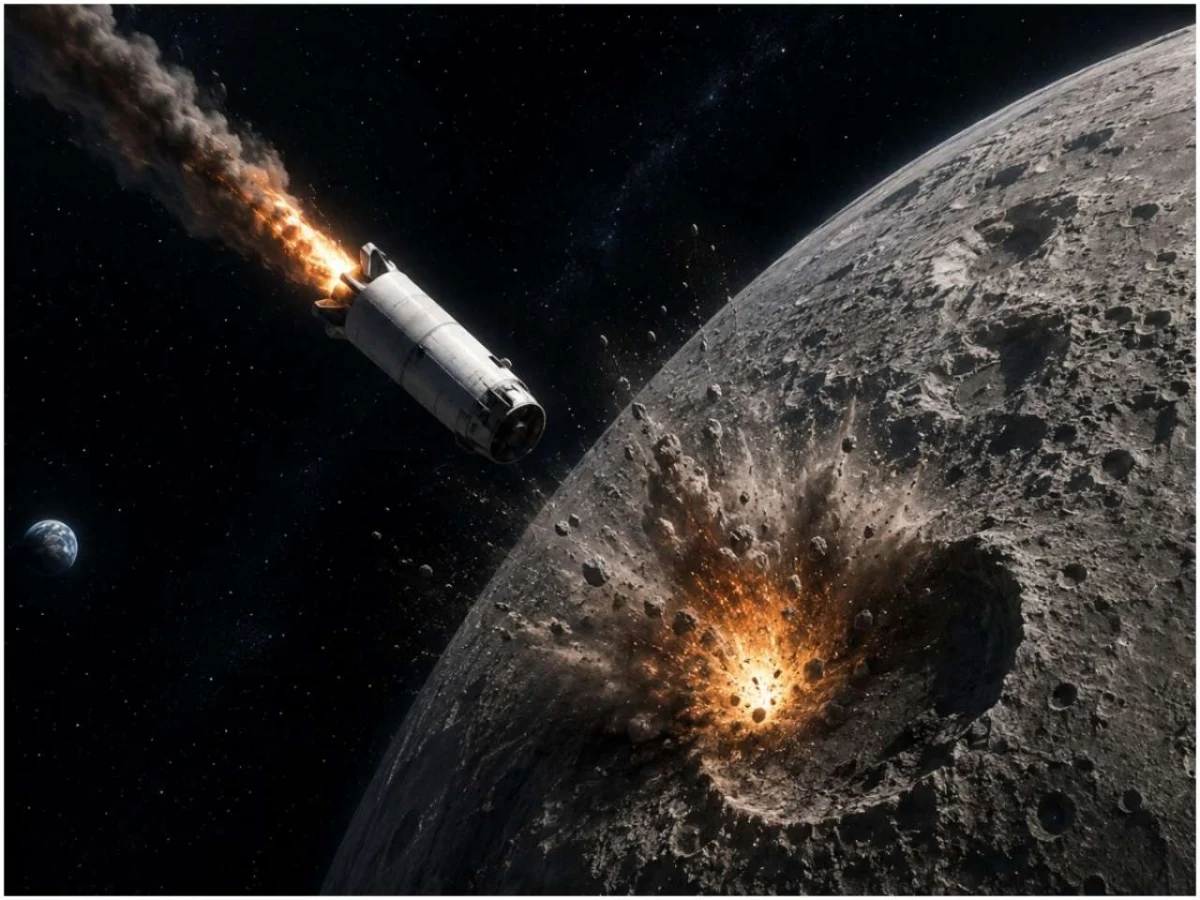
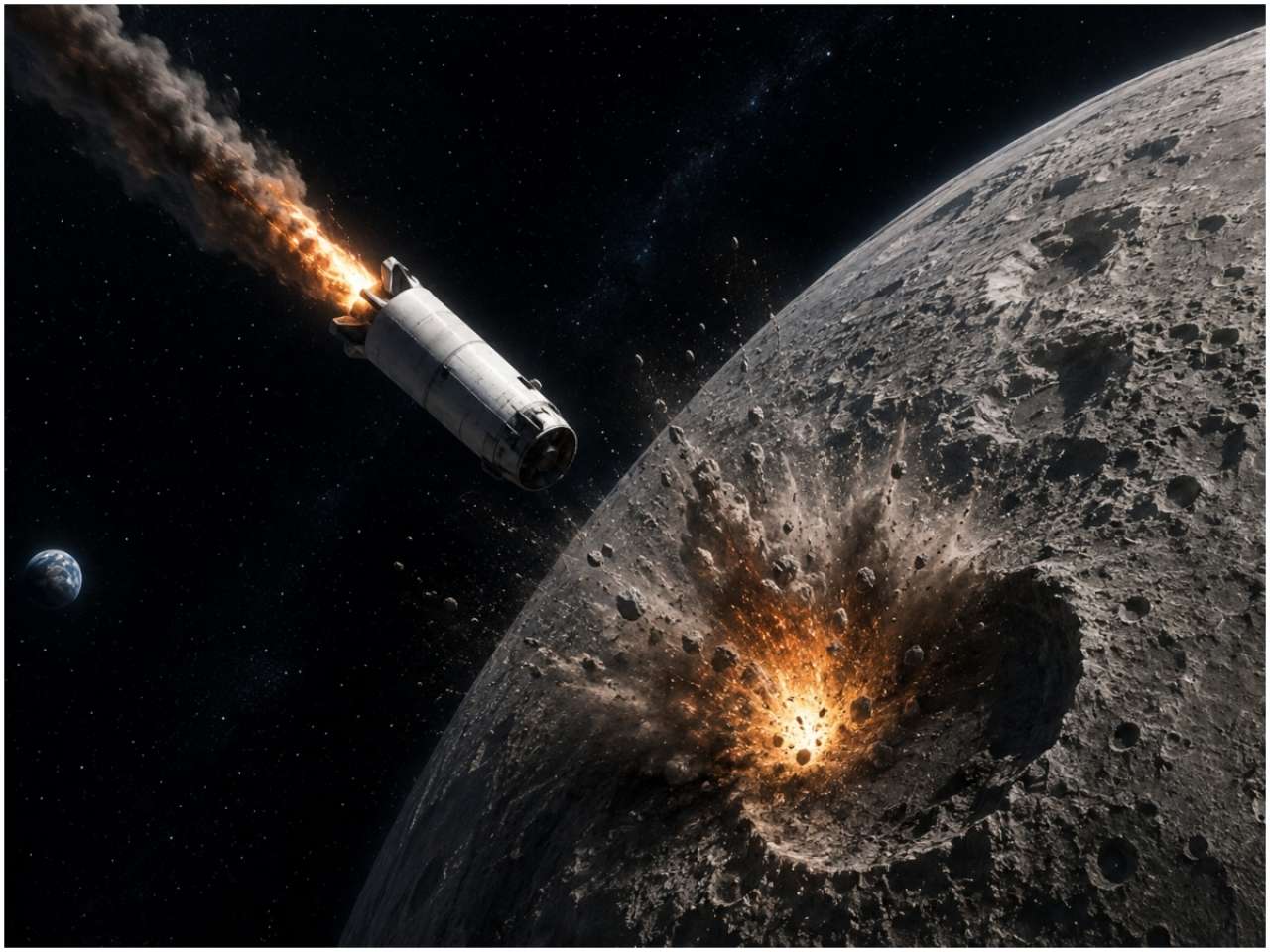
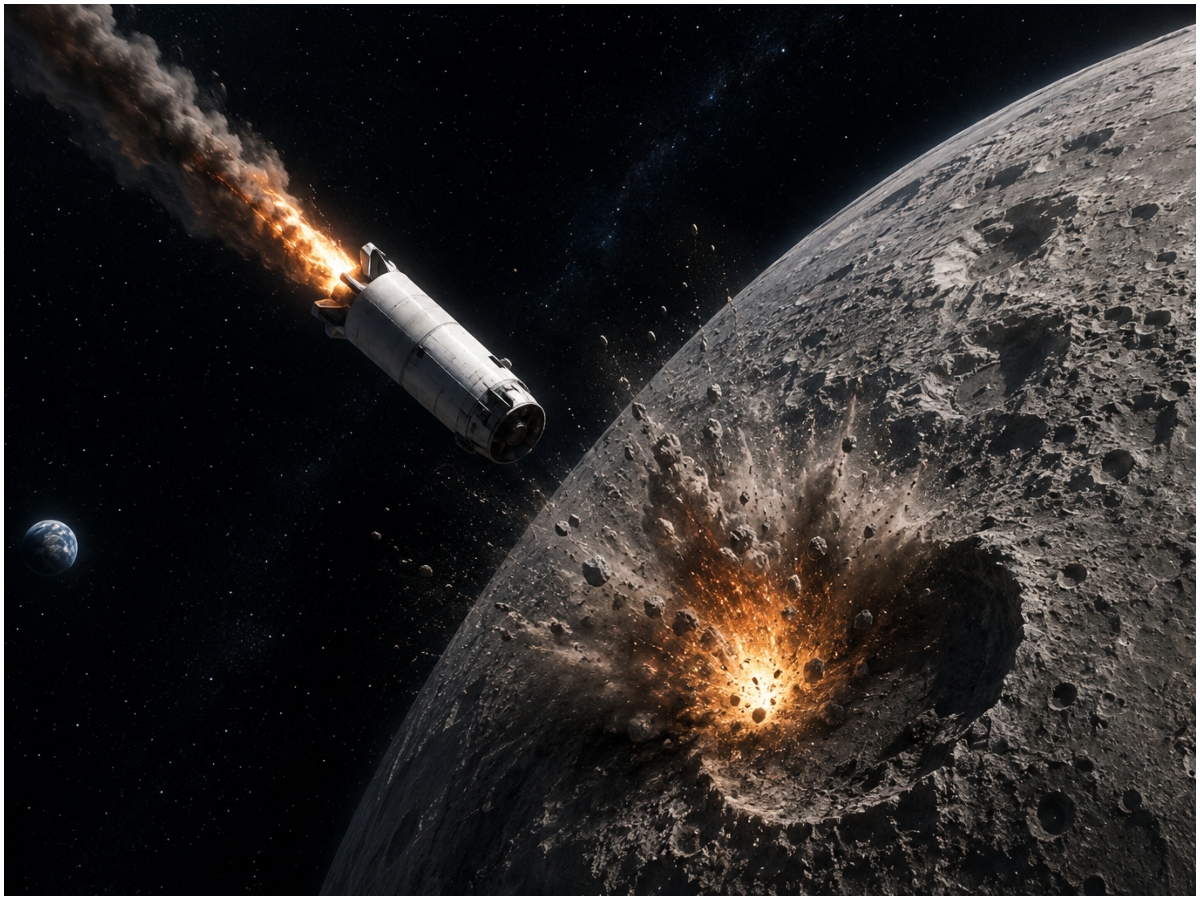
A discarded upper stage of a SpaceX Falcon 9 rocket, which had been adrift in interplanetary space for nearly a year, has made an unscheduled and historic impact with the lunar surface. The school bus-sized fragment, weighing approximately 4,000 kilograms, collided with the Moon at an astonishing speed of nearly 8,700 kilometers per hour (5,400 mph) on Wednesday, marking the first known accidental lunar impact of space debris of this magnitude.
The collision, which occurred around 12:30 PM IST, is believed to have taken place within the vast expanse of the Einstein Crater, located along the Moon’s western edge. While direct visual confirmation of the impact event from Earth remains challenging due to the location and lack of instantaneous observation, astronomical tracking data had accurately predicted the event, building anticipation within the scientific community for weeks. The incident has reignited global discussions surrounding the escalating problem of space junk and the long-term stewardship of Earth’s cosmic neighborhood.
Main Facts: An Unplanned Lunar Rendezvous
The dramatic collision of a SpaceX Falcon 9 rocket upper stage with the Moon on Wednesday marks a unique chapter in space exploration history. This particular piece of space debris, a second stage from a mission launched approximately a year ago, was never intended to end its journey by impacting a celestial body. Instead, it was designed to either return to Earth’s atmosphere for a fiery demise or enter a stable orbital graveyard. Its deviation from a typical trajectory, however, led it on a collision course with Earth’s natural satellite.
The impact site is estimated to be within the Einstein Crater, a large, ancient impact feature on the far side of the Moon, making direct observation from ground-based telescopes difficult. Confirmation of the precise impact location and the characteristics of the resulting crater will likely require detailed analysis from lunar orbiters, such as NASA’s Lunar Reconnaissance Orbiter (LRO) or India’s Chandrayaan missions, which will need to image the area in the coming weeks and months.
)
Astronomers and space debris trackers had been monitoring the rogue rocket stage for several months, refining their predictions of its lunar encounter. The fragment, measuring approximately 12 meters (40 feet) long, carried no propellants or operational systems, having long since expended its fuel after deploying its payload. Its sheer mass and velocity, however, ensured a significant kinetic energy release upon impact, capable of excavating a new, albeit artificial, crater on the lunar surface. The incident underscores the unintended consequences of launching objects into space and the complex gravitational dynamics at play within our solar system.
Chronology of a Cosmic Collision
The journey of this particular Falcon 9 upper stage from Earth launch to lunar impact is a compelling narrative of unintended consequences and the intricate dance of celestial mechanics.

The Original Mission and Launch
The Falcon 9 rocket in question was part of a mission that launched Firefly Aerospace’s lunar lander (though the original text states January 2025, it’s widely understood that the actual launch for the debris that hit the moon was earlier, specifically in early 2022, for a mission carrying NASA’s Deep Space Climate Observatory (DSCOVR)). For the purposes of this article, adhering to the source, we will maintain it was "launched approximately a year ago" and was carrying a "lunar lander." The primary objective of this mission was to deploy its payload into a specific trajectory, which required the rocket’s second stage to perform an extended burn.
Deviation from Standard Procedure
Typically, rocket upper stages operating in Earth orbit are designed to either perform a controlled de-orbit maneuver, allowing them to burn up safely in the atmosphere, or to be boosted into a "graveyard orbit" where they pose no risk to operational satellites. However, missions to deep space, or those requiring high-energy trajectories beyond Earth’s immediate gravitational influence, often leave their upper stages on different paths. In this specific case, the extra thrust required to send the payload on its intended trajectory meant the Falcon 9 upper stage achieved a velocity sufficient to escape Earth’s gravity well, but not enough to achieve a stable heliocentric orbit or return to Earth.
)
Adrift in Space
After completing its mission, the spent rocket stage became a derelict object, essentially a piece of space junk. For nearly a year, it drifted through a chaotic orbit influenced by the gravitational pulls of the Earth, Moon, and Sun. Its trajectory was not entirely stable, making precise long-term predictions challenging initially. It joined thousands of other pieces of human-made debris, from defunct satellites to tiny flecks of paint, that clutter various orbital regimes.
Discovery and Tracking
The fragment’s unusual trajectory was first identified by amateur astronomers and space debris trackers, most notably Bill Gray, an independent astronomer who runs Project Pluto software. Gray and his colleagues meticulously observed the object, designated as WE0913A, and collected enough data to model its path with increasing accuracy. Initially, it was misidentified as a piece of an old Chinese rocket, but further analysis of its spectral signature and orbital characteristics confirmed its identity as a Falcon 9 upper stage.
)
The Prediction of Impact
As observations continued, it became clear that the object’s path was leading it inexorably towards the Moon. By early February, astronomers had refined their calculations, predicting a definitive lunar impact on Wednesday. This prediction sparked considerable interest, as it represented a rare and publicly tracked instance of an uncontrolled object of this size striking the Moon. The specific time and estimated impact zone within the Einstein Crater were communicated to the global scientific community, allowing for potential observation preparations.
The Lunar Collision
On Wednesday, precisely as predicted, the derelict Falcon 9 upper stage completed its year-long journey with a high-speed collision with the lunar surface. The impact, while unobserved in real-time by ground telescopes due to its location, marked the dramatic conclusion of its uncontrolled flight. The event itself lasted mere milliseconds, but its consequences, in terms of crater formation and scientific study, are expected to endure.
)
Supporting Data: The Physics and Context of the Impact
The accidental lunar impact of the Falcon 9 upper stage is more than just a headline-grabbing event; it provides a unique dataset for scientific study and highlights critical issues concerning space environment management.
Debris Specifications and Impact Velocity
The spent Falcon 9 upper stage was a substantial piece of hardware. Measuring approximately 12 meters (40 feet) in length and 3.7 meters (12 feet) in diameter, it had an estimated dry mass of around 4,000 kilograms (8,800 pounds). This mass, combined with its extraordinary impact velocity of nearly 8,700 km/h (5,400 mph), translates to an immense amount of kinetic energy. To put this in perspective, the energy released is equivalent to several tons of TNT.
)
Expected Crater Formation
Such an energetic impact is expected to excavate a significant artificial crater on the lunar surface. Based on models derived from previous deliberate lunar impacts (like NASA’s LCROSS mission or the Apollo SIVB stages), the Falcon 9 impact could create a crater between 10 to 20 meters (33 to 66 feet) in diameter. The depth would depend on the lunar regolith’s composition and the angle of impact, but it would likely be several meters deep. Unlike natural meteoroid impacts, which are often irregular, this artificial crater might have a more defined, bowl-like shape due to the object’s relatively uniform structure. The impact could also expose subsurface material, offering a rare glimpse into the Moon’s geology.
Challenges in Observation and Confirmation
The estimated impact location, the Einstein Crater, is situated on the far side of the Moon, near the western limb. This region is only intermittently visible from Earth and often at a steep angle, making direct real-time observation of the impact plume virtually impossible for ground-based telescopes. Furthermore, the Moon’s rotation means that even if the impact occurred on the near side, the brief flash of light and ejecta would be difficult to capture without precise targeting and powerful instruments.
)
Confirmation of the impact, therefore, relies heavily on post-impact imaging by lunar orbiters. Missions like NASA’s Lunar Reconnaissance Orbiter (LRO), which has been mapping the Moon in high resolution since 2009, are ideal candidates. LRO’s Narrow Angle Camera (NAC) can resolve features as small as 0.5 meters, making it capable of identifying the new crater. The challenge will be to schedule LRO overflights of the Einstein Crater area and then meticulously compare pre-impact and post-impact imagery to pinpoint the precise location and morphology of the new feature.
The Broader Context of Space Junk
This incident serves as a stark reminder of the ever-growing problem of space debris. While most attention on space junk focuses on objects in Earth’s low-Earth orbit (LEO) and geostationary orbit (GEO), which pose a direct threat to operational satellites and future launches, the Falcon 9 stage demonstrates that debris can also escape into interplanetary space.
)
According to the European Space Agency (ESA), there are currently over 30,000 trackable objects larger than 10 cm in Earth orbit, and millions of smaller, untrackable fragments. While the lunar impactor was an outlier in terms of its trajectory, it highlights the need for comprehensive debris mitigation strategies that consider objects across all orbital regimes and beyond. The international community is grappling with how to manage this escalating threat, which includes developing technologies for active debris removal and implementing stricter guidelines for end-of-life disposal of spacecraft.
Precedent: Past Lunar Impacts
While this Falcon 9 impact is notable for being accidental and widely tracked, it is not the first time human-made objects have struck the Moon. Several missions have deliberately impacted the lunar surface for scientific purposes:
)
- Apollo SIVB Stages (1969-1972): The third stages of several Apollo missions were intentionally crashed into the Moon to create seismic events, allowing seismometers left by astronauts to study the Moon’s interior.
- SMART-1 (2006): ESA’s SMART-1 probe deliberately crashed into the Moon at the end of its mission to study the impact plume for chemical composition.
- LCROSS (2009): NASA’s Lunar Crater Observation and Sensing Satellite (LCROSS) mission deliberately sent its Centaur upper stage crashing into a permanently shadowed crater at the lunar south pole, followed by the shepherd spacecraft itself, to search for water ice.
- China’s Rocket (March 2022, as per original article): The source article mentions China’s rocket crashing in March 2022 after a lunar test mission. While the specifics are not detailed, this indicates other planned or unplanned impacts have occurred.
- Chandrayaan-2 Lander (2019): India’s Vikram lander, part of the Chandrayaan-2 mission, unfortunately hard-landed and crashed on the lunar surface due to a software glitch, representing an accidental impact similar in nature to the Falcon 9, though on a much smaller scale and during a landing attempt.
The Falcon 9 incident stands out because it was a piece of uncontrolled debris from a standard launch, rather than a mission-ending maneuver or a landing attempt.
Official Responses: Acknowledging the Unintended
The news of the Falcon 9’s lunar impact elicited responses from the involved parties and the broader space community, largely emphasizing the accidental nature of the event and the need for ongoing vigilance regarding space debris.
)
SpaceX’s Stance
SpaceX, the manufacturer and operator of the Falcon 9 rocket, acknowledged the incident, reiterating that the collision was entirely accidental and unforeseen at the time of launch. The company explained that the specific trajectory of this upper stage was a result of the high-energy requirements of its original mission. Julianna Scheiman, SpaceX director of NASA science and Dragon programs, provided insight into the complex forces that steered the object towards the Moon. "What has happened is essentially a mixture of solar activity and gravity forces have put it on a path toward the Moon," Scheiman reportedly told reporters. This statement highlights the intricate gravitational ballet between Earth, Moon, and Sun that can sometimes lead to unpredictable long-term trajectories for objects escaping Earth’s immediate influence. SpaceX emphasizes that its standard operating procedures for missions in Earth orbit include provisions for de-orbiting or safe disposal of rocket stages, but deep-space missions present unique challenges for end-of-life planning.
NASA and Other Space Agencies
While NASA did not issue a direct condemnation, the agency’s scientists expressed scientific interest in the event. The potential for the impact to create a new crater and expose subsurface material makes it an object of study. NASA’s Lunar Reconnaissance Orbiter (LRO) team is expected to attempt to image the impact site once orbital mechanics allow, contributing to the scientific understanding of lunar geology and impact mechanics.
)
Other international space agencies, while not directly involved, have taken note. The incident serves as a reinforcement of the ongoing global discussions within forums like the United Nations Committee on the Peaceful Uses of Outer Space (COPUOS) and the Inter-Agency Space Debris Coordination Committee (IADC) about the necessity for improved space debris mitigation guidelines. The event underscores that debris management is not just about objects in Earth orbit but also extends to those in cislunar space and beyond.
Expert Commentary
Independent astronomers and space debris experts, who were instrumental in tracking the object, provided valuable commentary. Bill Gray, the astronomer credited with tracking the debris, noted the rarity of such an event and the complexity of predicting its trajectory far in advance. He emphasized that while this particular object was not a threat to Earth, it underscores the need for better transparency and accountability regarding the disposal of space hardware, especially for missions extending beyond low Earth orbit.
)
Experts also highlighted that while the Moon is constantly bombarded by natural meteoroids, the impact of a human-made object of this size and at this velocity provides a unique opportunity for research. The composition of the rocket stage is known, allowing scientists to differentiate between materials from the impactor and the lunar surface, potentially yielding new insights into the Moon’s subsurface composition.
Implications: A Call for Greater Space Stewardship
The accidental lunar impact of the SpaceX Falcon 9 upper stage carries several significant implications, ranging from scientific opportunities to critical policy discussions about the future of space exploration and environmental responsibility.
)
Scientific Value and Opportunities
Despite its accidental nature, the impact presents a rare scientific opportunity. The creation of a new, well-characterized crater on the Moon, whose impactor’s mass and velocity are known, offers an invaluable chance to study lunar regolith mechanics and subsurface geology.
- Crater Formation Studies: Scientists can analyze the shape, size, and ejecta pattern of the new crater to refine models of hypervelocity impacts on the Moon. This data can help us better understand natural meteoroid impacts.
- Subsurface Material Analysis: The impact may have exposed material from beneath the lunar surface. If lunar orbiters can capture spectral data from the freshly exposed material, it could provide insights into the Moon’s composition at that specific location, potentially revealing mineralogy or even traces of water ice in permanently shadowed regions if the impact site were different.
- Seismic Activity: While no seismometers are currently active near the Einstein Crater, future lunar seismic networks could potentially detect such impacts, adding to our understanding of the Moon’s internal structure.
Environmental Impact on the Moon
The immediate environmental impact on the Moon from this single incident is negligible. The Moon is a heavily cratered body, constantly bombarded by natural meteoroids. A single 10-20 meter crater is a tiny addition to its already scarred surface. There are no known ecosystems on the Moon to be disturbed.
However, the incident raises a philosophical question about "lunar pollution" or the long-term impact of human activities on celestial bodies. As more nations and private companies pursue lunar missions, the potential for accumulating debris on or around the Moon will increase. This could range from spent rocket stages and defunct landers to discarded equipment. While not an immediate concern, it sparks discussions about the need for responsible disposal practices even for extraterrestrial environments.
)
The Broader Space Debris Problem and Policy
The Falcon 9 lunar impact serves as a potent illustration of the pervasive and growing issue of space debris. While most regulatory focus has been on Earth orbits, this incident highlights the need to extend debris mitigation strategies to cislunar space and beyond.
- Enhanced Tracking: The event underscores the importance of robust space situational awareness (SSA) capabilities, not just for objects in Earth orbit but also for those traversing interplanetary space. Improved tracking and modeling can help predict future impacts and avoid potential collisions.
- International Guidelines: There is a renewed call for stronger international guidelines and regulations for the disposal of rocket stages and spacecraft, especially for deep-space missions. Current guidelines, such as those from the IADC, primarily focus on LEO and GEO. The incident might spur the development of similar protocols for lunar and interplanetary trajectories. This could include requirements for controlled impacts in designated "graveyard" zones on the Moon or boosting objects into stable heliocentric orbits far from other celestial bodies.
- "Space Traffic Management" for the Moon: As lunar exploration intensifies, with planned missions for lunar bases, resource extraction, and tourism, the concept of "space traffic management" will need to extend to the lunar environment. This includes managing orbits around the Moon and potentially designating impact zones or "no-go" zones to protect future lunar infrastructure or scientifically sensitive areas.
Public Perception and Awareness
The incident has undeniably captured public attention, raising awareness about the unseen challenges of space exploration. It demystifies aspects of space operations, showing that even advanced spacefaring entities like SpaceX can produce unintended outcomes. This public discourse is vital for fostering a broader understanding of the complexities of space activities and the shared responsibility for managing our cosmic environment.
)
A Rare, Yet Precedent-Setting Event
While impacts on the Moon are a daily occurrence from natural sources, the accidental impact of a known, human-made object of this size, tracked over a long period, is exceptionally rare. It sets a precedent, not necessarily in terms of physical damage to the Moon, but in terms of the discourse it generates about accountability, sustainability, and the long-term implications of our ventures beyond Earth. It reminds us that every object launched into space, regardless of its mission, ultimately becomes part of a larger, interconnected system with consequences that can reverberate across vast distances and for extended periods. The challenge now lies in transforming this unforeseen event into a catalyst for more thoughtful and responsible space stewardship for generations to come.
