


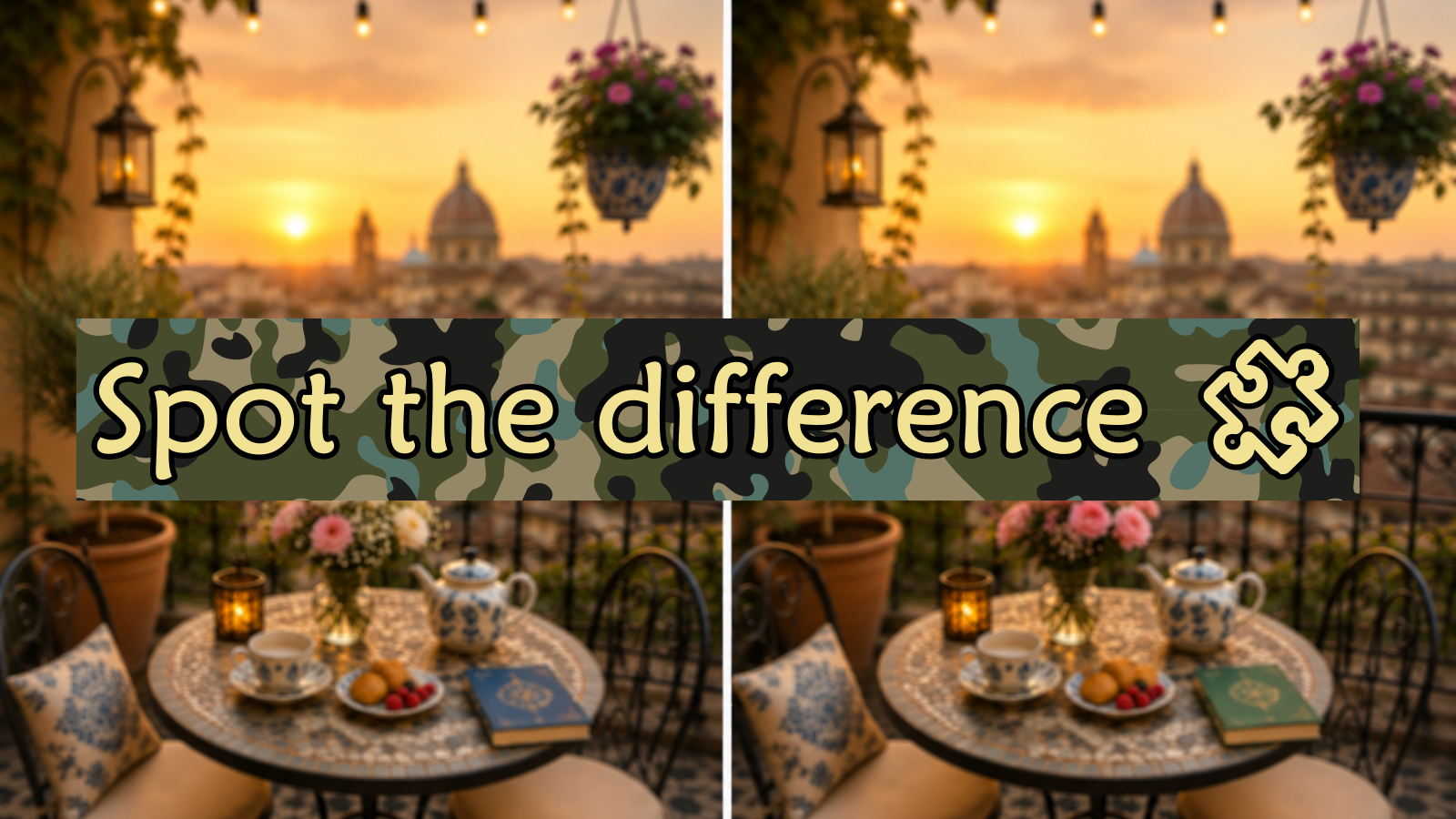
New Delhi, September 10, 2026 – In an era saturated with rapid-fire information and fleeting digital distractions, a weekly dose of focused visual engagement is proving to be a welcome respite. The Indian Express’s popular "Spot the Difference" series continues to capture the attention of readers, offering a brief yet stimulating challenge designed to sharpen observational skills and provide a moment of playful cognitive exercise. This week’s installment, featuring an intricately rendered European balcony, presents a compelling test of visual acuity, inviting participants to uncover seven subtle discrepancies within a tight 60-second timeframe.
The series, designed to offer a much-needed break from the relentless flow of online content, aims to reawaken a sense of childlike wonder and analytical engagement. As the article states, "all you need is 60 seconds and a sharp eye. So give your doomscrolling a break and get ready for that childlike excitement to come back." This sentiment resonates with a growing awareness of the cognitive benefits derived from engaging with puzzles that demand focused attention and meticulous detail-seeking.
The Challenge: A European Balcony Under Scrutiny
This week’s visual puzzle transports participants to what is described as a "Pinterest-coded European balcony." The scene is meticulously crafted, evoking a sense of idyllic charm, yet it harbors seven carefully concealed alterations. The appeal of the puzzle lies in its deceptive simplicity; at first glance, the two images appear almost identical, a testament to the skill of the AI artist responsible for their creation. However, this initial impression quickly gives way to the realization that a deeper, more focused examination is required.
The article prompts readers to engage with the puzzle, emphasizing that while some differences are readily apparent, others are deliberately subtle, demanding a slowing down of perception and an acute awareness of finer details. The instruction to "Take a close look at the two images below. They may appear almost identical at first glance, but don’t let that fool you. Some differences are easy to spot, while others require you to slow down and notice the finer details" sets the stage for a mental scavenger hunt.
The countdown timer, a staple of the series, adds an element of urgency, transforming a leisurely observation into a timed challenge. "You have 60 seconds. Ready? Don’t scroll down too quickly – give yourself a minute to find all eight. 3… 2… 1.. Go!" This call to action injects a sense of excitement and competition, encouraging participants to push their perceptual limits.
The Psychological Dimension: Frustration, Persistence, and Achievement
Beyond the immediate gratification of finding discrepancies, the "Spot the Difference" series taps into deeper psychological aspects of engagement and problem-solving. The article candidly addresses the potential for frustration that arises when the sought-after differences remain elusive. "Did you get a little pumped up, agitated, or frustrated when you couldn’t find that last difference? Or helpless as the timer kept ticking and you were so close yet so far from winning?" This relatable experience highlights a crucial element of the puzzle’s design: it doesn’t just test observation; it tests resilience.
Prerna Pant, a Psychologist at ISIC Multispeciality Hospital in Delhi, provides an expert perspective on the cognitive benefits of such puzzles. She explains, "Another benefit is that solving a puzzle requires patience and persistence. Sometimes the difference is immediately visible, while at other times a person may spend several minutes looking without success. This can create mild frustration, but it also encourages the person to change their approach, look again and keep trying. Finding the answer can then provide a small sense of achievement."
This psychological framework underscores that the value of the puzzle extends beyond a simple game. It cultivates crucial life skills: the ability to persevere in the face of difficulty, to adapt one’s strategy when initial attempts prove unsuccessful, and to derive satisfaction from overcoming a challenge. The article reassures readers that not achieving immediate success is not a failing, but rather an opportunity to develop these valuable traits. "So, if you didn’t manage to find all eight within 60 seconds, don’t worry. The point is not just how quickly you spot them – it’s also about whether you keep looking when the answer doesn’t immediately jump out at you."
The Evolving Landscape of Cognitive Engagement
The "Spot the Difference" series, while seemingly simple, reflects a broader trend in how individuals are seeking out engaging and beneficial digital content. In an environment often characterized by passive consumption, interactive puzzles offer an active form of engagement that stimulates the mind. The increasing sophistication of AI-generated imagery further enhances the appeal of these puzzles, providing novel and visually rich scenarios for participants to explore.
The success of the series can be attributed to its accessibility, its ability to provide a quick cognitive boost, and its inherent replayability. Each week presents a new challenge, ensuring continued interest and sustained engagement from its readership. The invitation to revisit last week’s solutions and anticipate next week’s puzzles creates a consistent rhythm of interaction, fostering a sense of community among participants who share the common goal of honing their visual perception.
Implications for Cognitive Health and Digital Literacy
The rise of such engaging cognitive challenges has significant implications for promoting digital literacy and fostering overall cognitive health. In a world where visual information is paramount, the ability to critically analyze and discern details within images is an increasingly vital skill. "Spot the Difference" puzzles, by their very nature, train the brain to pay closer attention to visual cues, to identify anomalies, and to engage in systematic observation.
Furthermore, these puzzles offer a screen-time activity that is demonstrably beneficial. Unlike passive scrolling, which can lead to mental fatigue and a sense of disconnection, interactive puzzles provide a sense of accomplishment and mental stimulation. This can be particularly important for individuals seeking to balance their digital consumption with activities that promote cognitive well-being.
The expert commentary from Dr. Pant reinforces the idea that engaging in these challenges can contribute to a more resilient and adaptable mindset. The process of encountering a problem, experiencing mild frustration, and then employing persistence to find a solution mirrors the problem-solving processes encountered in many aspects of life. The small sense of achievement derived from successfully completing the puzzle can serve as a positive reinforcement, encouraging further engagement with similar cognitively demanding activities.
As the article concludes, the true measure of success in these puzzles is not solely about speed, but about the willingness to persist and to refine one’s observational approach. This philosophy extends beyond the context of the puzzle itself, offering a valuable lesson in tackling challenges with patience and determination. The anticipation of the next puzzle, and the promise of revealing the solutions to the current one, ensures that this weekly ritual will continue to be a source of intellectual stimulation and engaging content for its dedicated readership.
