

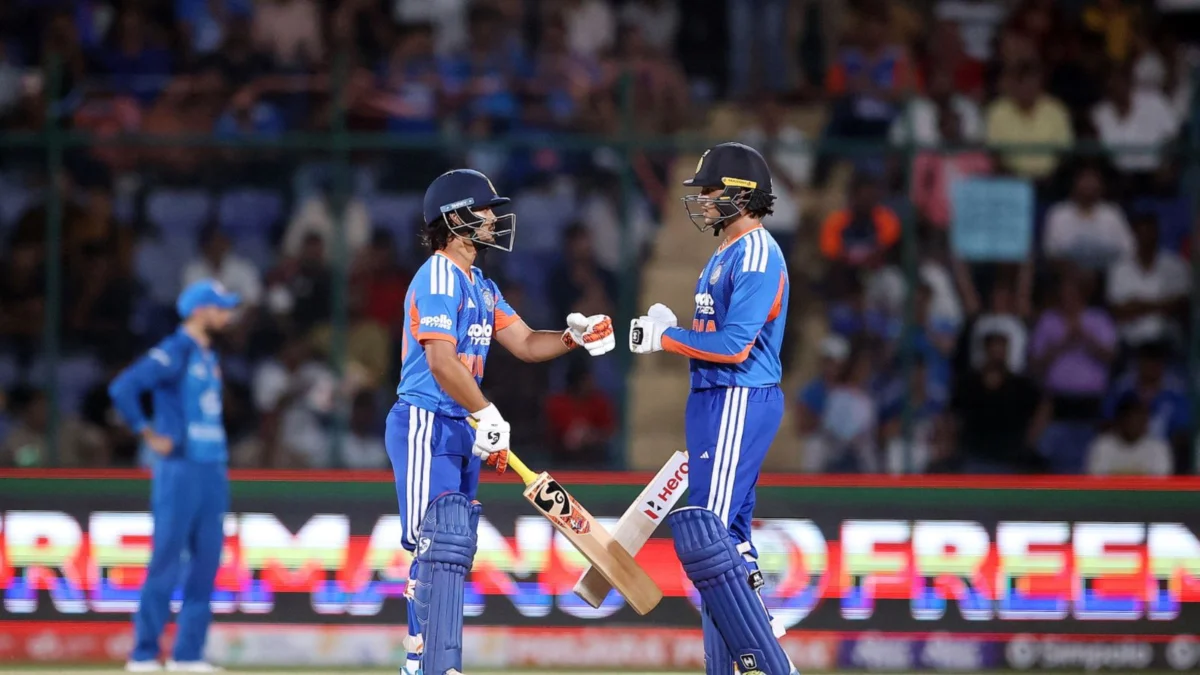
New Delhi, September 13, 2026 – In a resounding declaration of intent, India decisively defeated Afghanistan by seven wickets in the first of a three-match T20 International series at the Arun Jaitley Stadium on Sunday. The victory, achieved with a remarkable 38 balls to spare, not only provided a crucial psychological boost but also heralded the much-anticipated return to form for India’s spin spearheads, Varun Chakaravarthy and Axar Patel, alongside a breathtaking individual performance from opening batsman Abhishek Sharma.
The comprehensive win, coming in the immediate aftermath of a period of uncharacteristic struggle for the reigning T20 World Champions, served as a potent reminder of India’s formidable capabilities on home soil. It underscored a collective effort to address the tactical shortcomings that had plagued them since their triumph in the 2026 T20 World Cup, particularly an inexplicable vulnerability to spin bowling – a facet traditionally considered their strength.
Setting the Stage: India’s T20 Quandary
The 2026 T20 World Cup trophy, proudly displayed in the BCCI cabinet, and India’s unchallenged position atop the ICC T20I rankings, belied a recent downturn in fortunes. Following their global conquest, the team found itself ensnared in a perplexing slump, enduring an unprecedented seven consecutive T20I matches without a win. This barren run was only broken during a recent, albeit less challenging, series in Zimbabwe. The most perplexing aspect of this dip was the sudden faltering of India’s celebrated spin attack.
Varun Chakaravarthy, the enigmatic leggie, and Axar Patel, the dependable left-arm orthodox, had been instrumental in India’s World Cup success. On the grandest stage, they shared a formidable 25 wickets between them, operating at exceptional averages of 8.8 and 19.68 respectively. Their ability to stifle opposition scoring and provide crucial breakthroughs had made them virtually unplayable. However, in the five months following the World Cup, their combined numbers plummeted dramatically. Across various international assignments, their wicket tally dropped to a mere 12, with their averages ballooning to 10.58 and 44.09. This stark contrast had raised significant concerns within the team management and among fans, as India grappled with an "Achilles’ heel" that few could have predicted.
The "Friendship Cup" series against Afghanistan, therefore, arrived at a critical juncture. It was an opportunity for India to recalibrate, regain momentum, and, crucially, for their key players to rediscover their rhythm, especially in conditions that typically favour spin. The air in New Delhi was thick with anticipation, not just for the spectacle of international cricket, but for signs of a definitive Indian resurgence.
Match Report: India vs. Afghanistan, 1st T20I
The evening commenced with a poignant rendition of the national song, Vande Mataram, followed by the national anthem, setting a patriotic tone. Once the ceremonial protocols were complete, the focus shifted entirely to the action on the pitch, where India’s "national treasure," Jasprit Bumrah, was poised to make his eagerly awaited return.
Afghanistan’s Innings: The Spin Web Tightens
Bumrah wasted no time in making his presence felt. It took him just three attempts, and two legal deliveries, to claim his first wicket. Afghanistan’s opener, Rahmanullah Gurbaz, undone by the sheer bounce and pace, succumbed to his 11th T20I duck, a testament to Bumrah’s immediate impact. Despite this early setback, Afghanistan showed flashes of aggression, accumulating 22 runs in the subsequent two overs, briefly hinting at their potential to challenge India’s formidable reputation as Asia’s second-best T20 side.
However, the tide swiftly turned with the introduction of spin in the fourth over. Axar Patel, looking far more confident than in recent outings, was brought into the attack. While his first wicket didn’t come directly from his spin, it was a result of the pressure his presence created. A miscommunication between Afghanistan captain Ibrahim Zadran and Sediqullah Atal led to Zadran’s run-out, a crucial breakthrough that disrupted Afghanistan’s rhythm. Atal himself departed just five deliveries later, leaving Afghanistan reeling at 39/3 after five overs.
At this precarious juncture, Afghanistan desperately needed a period of consolidation, perhaps a few loose deliveries to settle. Instead, they were met with an unrelenting and precise spell of spin bowling. The next four overs yielded a paltry 11 runs and claimed two more vital wickets. Axar Patel accounted for the dangerous Gulbadin Naib, while Varun Chakaravarthy, demonstrating renewed confidence, dismissed Darwish Rasooli. The "spin twins" were back, operating with a control and penetration that had been conspicuously absent in recent months. Their collective economy rate in this crucial phase was stifling, choking the flow of runs and pushing Afghanistan further onto the back foot.
By the halfway mark of their innings, Afghanistan found themselves playing primarily for pride. Yet, they managed to salvage some respect through a valiant 83-run sixth-wicket partnership between the experienced Mohammad Nabi and the emerging Azmatullah Omarzai. Omarzai, in particular, was a revelation, crafting an unbeaten 64 runs off just 44 deliveries. His innings, studded with four boundaries and an equal number of towering sixes, showcased both power and composure under immense pressure. It was his resilience that ultimately allowed Afghanistan to post a competitive, though ultimately insufficient, total of 157 runs.
Despite Omarzai’s heroics, the Indian spinners maintained their grip. While Axar Patel conceded a couple of boundaries to Omarzai, he was also unfortunate not to have claimed the all-rounder’s wicket when Ishan Kishan put down a regulation catch. Nevertheless, the combined figures for Chakaravarthy and Patel were impressive: 43 runs conceded for 2 wickets from their eight overs, an economy rate of just 5.37. Beyond the spinners, left-arm pacer Arshdeep Singh was also highly effective, finishing with excellent figures of 3/19 from his four overs, consistently hitting good lengths and extracting crucial wickets at the death.
India’s Chase: The Abhishek Sharma Blitz
India’s redemption arc was not limited to their spin attack; it also featured a spectacular individual performance from Abhishek Sharma. The young southpaw had been under intense scrutiny regarding his form, having managed a mere 40 runs across his previous six T20I innings, including a modest 11 runs in three matches during the recent Zimbabwe series. Following that series, Abhishek had posted a reflective message on Instagram: "The game always rewards those who keep showing up." Today, Abhishek Sharma unequivocally showed up.
The Indian team management had made a surprising call by resting Vaibhav Sooryavanshi, who had earned the player of the series award in Zimbabwe for his consistent performances. His replacement, Sanju Samson, failed to silence the debate surrounding his inclusion, falling cheaply for 10 runs off eight balls. However, Samson’s early departure did little to derail India’s chase.
From the moment Abhishek Sharma took guard, the chase never once looked anything but comfortable. India cruised on what appeared to be autopilot, powered by a truly blistering innings from Sharma. He launched an assault on the Afghan bowlers, smashing 82 runs off just 32 deliveries. A staggering 70 of those runs came from boundaries alone, a testament to his clean hitting and aggressive intent. Abhishek’s innings was a masterclass in T20 batting, combining brute force with intelligent placement, consistently finding the gaps and clearing the ropes with ease.
Playing the crucial supporting act in this magnificent tango was Ishan Kishan. Fresh off captaining East Zone to a Duleep Trophy victory, Kishan appeared to be in a golden phase of his career. His 33-ball 42 was an anchoring performance, providing stability and rotating the strike while Abhishek unleashed his fury. Kishan’s knock ensured that despite the early loss of Samson, India maintained a relentless scoring rate without taking undue risks.
The partnership between Abhishek and Kishan effectively nullified any pressure Afghanistan might have hoped to exert. India reached their target of 157 with remarkable ease, finishing at 157/3 in just 13.4 overs. While Mohammad Nabi managed to pick up two wickets for Afghanistan, his efforts were overshadowed by India’s dominant batting display.
Statistical Insights and Performance Analysis
India’s comprehensive victory was built on several key statistical pillars, each signaling a positive shift from their recent struggles.
The Spinners’ Redemption
The most significant takeaway was the emphatic return to form of Varun Chakaravarthy and Axar Patel. Their combined figures of 2/43 from 8 overs, at an economy rate of 5.37, directly countered the narrative of their post-World Cup slump. This performance was particularly crucial because it occurred in home conditions, where they are expected to thrive. It suggests that the technical adjustments or mental recalibrations they underwent in the preceding months have borne fruit. Their ability to deliver sustained pressure and pick up wickets in the middle overs is indispensable for India’s T20 strategy, especially against teams that rely on momentum. This performance will instill renewed confidence in the team management regarding their primary spin options.
Abhishek Sharma’s Resurgence
Abhishek Sharma’s 82 off 32 balls was not merely a match-winning innings; it was a statement. His strike rate of 256.25 underscored the destructive potential he brings to the top order. This innings was critical for his personal confidence and for the team, which had been experimenting with opening combinations. The contrast between his pre-match form (40 runs in 6 innings) and this explosive display could not be starker. It validates the team’s continued faith in his abilities and potentially solidifies his position at the top of the order, creating a dynamic opening partnership with Ishan Kishan. His Instagram post about "showing up" now reads like a prophetic declaration, celebrated with a torrent of runs.
The Persistent Fifth Bowler Conundrum
Despite the overwhelming success, a note of caution emerged concerning the fifth bowler. In the absence of Hardik Pandya, whose all-round capabilities provide crucial balance, India experimented with a combination of Nitish Kumar Reddy, Abhishek Sharma, and Shivam Dube to complete the bowling quota. These three combined to leak a significant 59 runs in just four overs. This high economy rate highlights a persistent strategic vulnerability that the team management will need to address. Relying on part-timers for a substantial portion of the innings, particularly in tighter contests, could prove costly. While the batting brilliance masked this issue in New Delhi, it remains an area requiring urgent attention and a more robust solution as India looks ahead to future high-stakes tournaments.
Post-Match Reflections and Expert Commentary
The mood in the Indian dressing room, following the emphatic victory, was understandably buoyant. While no official statements were immediately released, sources close to the team indicated immense satisfaction with the comprehensive nature of the win.
"The team management will be particularly pleased with the performances of Axar and Varun," an anonymous source commented, "Their form post-World Cup had been a concern, but today they looked like their old selves, controlling the middle overs beautifully. This bodes well for the rest of the series and beyond."
On Abhishek Sharma’s explosive innings, a former national selector remarked, "Abhishek has always had that talent, that raw power. What we saw today was a player who has worked hard on his game and overcome a lean patch. That kind of innings, under pressure to perform, speaks volumes about his character and potential. It gives India another dynamic option at the top."
From the Afghan camp, captain Ibrahim Zadran would undoubtedly acknowledge the brilliance of Omarzai’s batting effort, which single-handedly gave his team a fighting chance. However, he would also be keen to address the early collapse and the inability of his bowlers to contain India’s aggressive batting, particularly in the powerplay. The challenge for Afghanistan will be to learn from this experience and adapt their strategies for the remaining matches.
Cricket analysts were quick to praise India’s clinical execution. "This was the kind of performance we expect from a champion side," noted renowned commentator Harsha Bhogle. "They identified their problem areas – spin and aggressive opening – and attacked them head-on. The confidence from this win will be immense." He also echoed concerns about the fifth bowler, stating, "It’s a luxury they can’t always afford. Finding a reliable sixth bowling option, or ensuring their main five can deliver consistently, is still a work in progress."
Implications and Series Outlook
This emphatic victory has several significant implications for both teams and the series at large.
For India:
- Confidence Boost: The win, especially its dominant nature, provides a massive psychological uplift after a challenging period. It re-establishes India’s authority in T20 cricket.
- Validation of Spin Strategy: The resurgence of Chakaravarthy and Patel validates the team’s faith in them and their ability to perform in home conditions. This is critical for India’s long-term T20 plans.
- Abhishek-Kishan Partnership: The dynamic opening stand between Abhishek Sharma and Ishan Kishan offers an exciting new dimension to India’s batting. Their contrasting styles – Abhishek’s aggression and Kishan’s anchoring – complement each other perfectly.
- Ongoing Hardik Pandya Dilemma: The fifth bowler issue underscores the irreplaceable value of Hardik Pandya. Until he returns or a viable alternative emerges, this remains a tactical headache for the team.
For Afghanistan:
- Omarzai’s Emergence: Azmatullah Omarzai’s resilient innings was a major positive. His ability to perform under pressure against a top-tier attack suggests he could be a key player for Afghanistan in the future.
- Top Order Concerns: The early collapse of their top order against India’s pace and spin is an area of concern that needs immediate attention.
- Bowling Strategy: While Mohammad Nabi showed glimpses of his wicket-taking ability, the overall bowling unit struggled to contain the Indian batsmen, particularly the explosive Abhishek Sharma. They will need to devise more effective plans for the remaining matches.
The "Friendship Cup" has begun with a statement from India. While the hosts might consider offering their guests "some respite amid 16 overs of unrelenting pressure" as the series progresses, India’s immediate goal will be to maintain this intensity and secure the series. With two matches remaining, Afghanistan will be eager to bounce back, but India, having rediscovered their winning touch and addressed critical performance gaps, looks formidable. The journey to fully reasserting their undisputed championship status is well underway.
Brief Scores: Afghanistan 156/8 in 20 overs (Azmatullah Omarzai 64 n.o.; Arshdeep Singh 3/19) lost to India 157/3 in 13.4 overs (Abhishek Sharma 82; Mohammad Nabi 2/28) by 7 wickets.
