

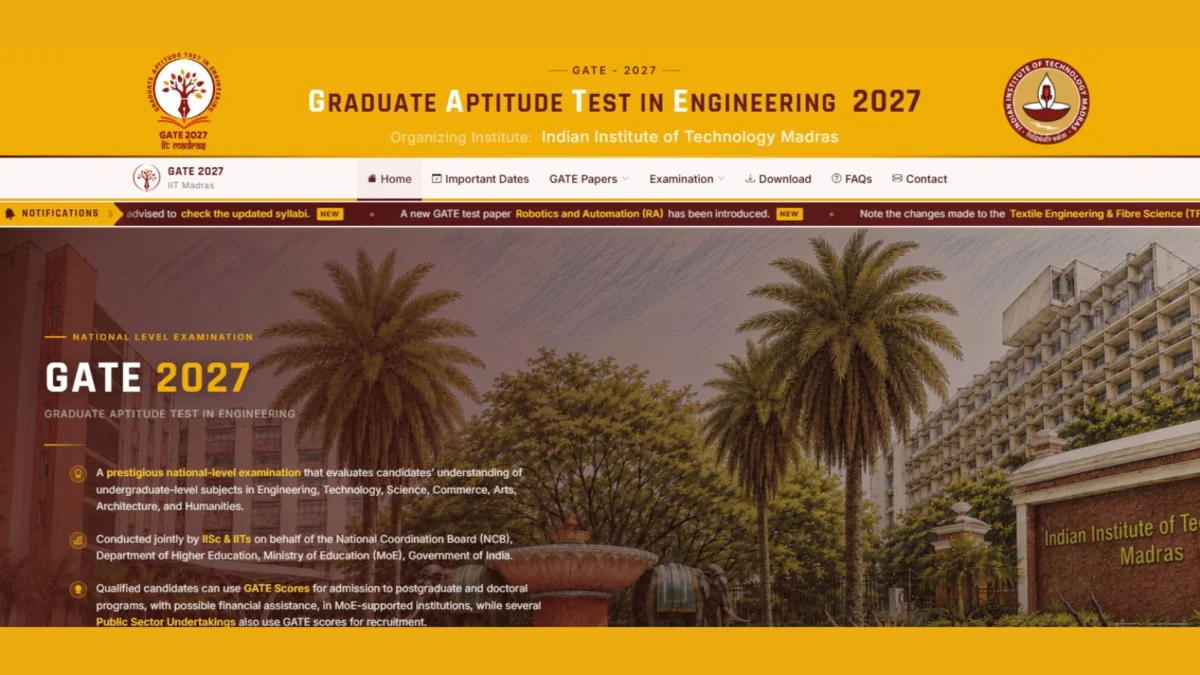
New Delhi, September 27, 2026 – The window for aspiring engineers and scientists to register for the Graduate Aptitude Test in Engineering (GATE) 2027 without incurring a late fee slams shut today, September 27th. This critical deadline marks the culmination of the initial application phase for one of India’s most prestigious examinations, a gateway to postgraduate studies and lucrative career opportunities in engineering, technology, and science. While the regular registration period concludes, candidates will have a brief grace period, with applications accepted until October 5th, albeit with an additional late fee.
Administered this year by the esteemed Indian Institute of Technology (IIT) Madras, GATE 2027 promises to be a comprehensive assessment, featuring an expanded array of 30 distinct test papers. The examination is slated to be conducted in February 2027, serving as a crucial benchmark for candidates seeking admission to Master’s and Doctoral programs across a multitude of disciplines, as well as for recruitment into various public sector undertakings (PSUs) and government organizations.
Key Dates: A Timeline for GATE 2027 Aspirants
For candidates meticulously planning their application journey, understanding the critical dates is paramount. The following timeline provides a clear overview of the GATE 2027 examination process:
- Regular Registration Closes: September 27, 2026
- Registration with Late Fee Closes: October 5, 2026
- City Allotment: January 4, 2027
- Admit Card Release: January 2027
- Examination Dates: February 6, 7, 13, 14, 20, and 21, 2027
- Result Announcement: March 19, 2027
Candidates are strongly advised to visit the official GATE 2027 website, gate2027.iitm.ac.in, for comprehensive details on eligibility criteria and the extensive list of available papers. Navigating the website will provide clarity on the specific requirements for each discipline and aid in making informed decisions regarding paper selection.
Revolutionizing the Application Process: The DigiLocker Mandate
A significant procedural shift for GATE 2027 is the mandatory requirement for Indian nationals to complete their registration through a verified DigiLocker account. This move underscores the digital transformation initiative within academic and governmental processes, aiming to streamline document verification and enhance security.
Candidates are urged to ensure the integrity and continued accessibility of the DigiLocker account used during the application process. All future official communications from GATE 2027 will be channeled through this designated account. Furthermore, the official Frequently Asked Questions (FAQs) explicitly state that candidates with Persons with Disabilities (PwD) status must upload the stipulated PwD documents to the designated GATE 2027 DigiLocker folder, if applicable to their circumstances. This integrated approach aims to create a unified and verifiable digital footprint for each applicant.
Expanding Horizons: The New Robotics and Automation Paper and Syllabus Revisions
This iteration of GATE introduces a notable expansion in its subject offerings with the inclusion of a new test paper: Robotics and Automation (RA). This addition brings the total number of available GATE papers to an impressive 30, reflecting the evolving landscape of engineering and technology and the growing interdisciplinary nature of research and development. The introduction of the RA paper signifies a proactive approach by the organizing committee to cater to emerging fields and provide specialized assessment avenues for candidates interested in this dynamic sector.
Beyond the introduction of a new paper, significant modifications have been made to the sectional paper codes and structures for the XE (Engineering Sciences), XH (Humanities and Social Sciences), and XL (Life Sciences) streams. Concurrently, the syllabi for various GATE 2027 papers have undergone revisions. This necessitates a cautious approach from candidates, who are strongly advised to consult the most up-to-date syllabus for their chosen paper on the official website, rather than relying on previous years’ versions. Staying abreast of these syllabus changes is crucial for effective preparation and to avoid any misdirection in study material.
Strategic Paper Selection: Navigating Combinations and Restrictions
GATE 2027 allows candidates the option to apply for one or two papers. However, the selection of a second paper is not arbitrary; it must adhere to specific combinations meticulously defined by the GATE 2027 organizing committee. The official list of permissible combinations has been updated, with the newly introduced RA paper now featuring in several of these combinations.
Candidates opting for two papers are required to select both in a single application form. This integrated approach ensures that all chosen papers and their corresponding combinations are processed concurrently, simplifying the administrative procedure for both applicants and the examination authorities. Careful consideration of these combinations is essential to maximize the utility of the GATE score for a broader range of academic and professional pursuits.
The GATE Examination: Structure and Evaluation
The GATE 2027 examination will continue to be a rigorous, three-hour computer-based test, carrying a total of 100 marks. The paper comprises 65 questions, a mix of General Aptitude and subject-specific questions pertaining to the candidate’s chosen discipline. The question formats will include Multiple Choice Questions (MCQ), Multiple Select Questions (MSQ), and Numerical Answer Type (NAT) questions.
A critical aspect of the evaluation is the marking scheme. Negative marking will be applied solely to incorrect answers in the MCQ format. Notably, there will be no negative marking for MSQ or NAT questions, encouraging candidates to attempt these question types with greater confidence and strategic thinking. Understanding this marking scheme is vital for developing an effective answering strategy during the examination.
The Enduring Value of GATE Scores
The Graduate Aptitude Test in Engineering (GATE) scores are highly valued and widely recognized across India. They serve as a crucial criterion for admission to postgraduate and doctoral programs at numerous prestigious institutions, including IITs, IISc, and other centrally funded technical institutions. Beyond academia, GATE scores are also a significant factor in the recruitment process for various public sector organizations and government jobs, offering aspiring professionals a direct pathway into esteemed organizations.
The validity of a GATE score remains robust, extending for a period of three years from the date of the announcement of the results. This extended validity period provides candidates with ample opportunity to leverage their scores for their desired academic or career advancements.
A Historical Perspective: The Evolution of GATE
The significance of GATE in shaping engineering education and careers in India cannot be overstated. A fascinating insight into its evolution is provided by a comparative analysis of GATE 1983 and the upcoming GATE 2027. In its nascent stages, the examination was far more streamlined, with candidates typically choosing from just two papers. The scope and complexity have dramatically increased, culminating in the current offering of 30 specialized papers.
Interestingly, the examination landscape has also shifted considerably. Historical accounts suggest that in 1983, calculators were permitted inside the examination halls, a practice that would be unthinkable in today’s digitally controlled testing environments. This comparison highlights the dynamic nature of academic assessments, adapting to technological advancements and evolving pedagogical approaches. The transition from a simpler format to a comprehensive, multi-disciplinary examination underscores GATE’s enduring commitment to identifying and nurturing talent across the vast spectrum of science and engineering disciplines in India.
As the registration deadline for GATE 2027 approaches, candidates are urged to act swiftly, ensuring they have meticulously reviewed all requirements and submitted their applications. The introduction of DigiLocker and the expanded paper offerings signal a progressive and inclusive approach by IIT Madras, aiming to make the GATE examination an even more effective and relevant tool for shaping the future of India’s scientific and engineering workforce.
