

WASHINGTON D.C. & BEIJING – September 26, 2026 – In a significant diplomatic breakthrough, the United States and China announced today an agreement on a reciprocal $30 billion tariff reduction arrangement and the establishment of a dedicated dialogue on artificial intelligence (AI). These pivotal agreements were part of an extensive eight-point consensus reached during Chinese President Xi Jinping’s three-day visit to Washington, which concluded yesterday. The landmark summit, marked by intense personal diplomacy between President Xi and U.S. President Donald Trump, signals a concerted effort by the world’s two largest economies to stabilize their often-turbulent relationship and address burgeoning global challenges.
The reciprocal tariff reduction, a tangible step towards de-escalation in the protracted trade dispute, is expected to provide much-needed relief to businesses and consumers on both sides of the Pacific. Simultaneously, the commitment to launch a high-level dialogue on AI, focusing on its risks and benefits, underscores a shared recognition of the technology’s profound impact and the imperative for responsible governance. Beyond trade and technology, the two nations also agreed to establish a standing trade council, extend the outcomes of prior talks held in Kuala Lumpur, and coordinate on a range of global policy issues, including nuclear non-proliferation and freedom of navigation.
Chinese Foreign Minister Wang Yi hailed the visit as "historic," declaring that it "enriched the constructive and stable China-U.S. relationship, upheld the overall stability of bilateral ties, opened a new chapter in China-U.S. relations, and will have a far-reaching impact on world peace and development." While the U.S. Embassy in Beijing did not immediately comment on the detailed outcomes, the consensus reflects a strategic pivot towards managing competition through structured engagement, rather than unbridled confrontation.
A Summit of Substance: The Main Facts Unveiled
The core of the "eight-point consensus" emanating from the Washington summit revolves around two primary pillars: economic stabilization and technological collaboration. The most immediate and widely anticipated outcome is the $30 billion reciprocal tariff reduction arrangement. This move signals a willingness from both Washington and Beijing to unwind some of the punitive measures that have characterized their trade relations for years, impacting supply chains and global economic growth. While the specifics of which tariffs on which goods will be reduced by this collective $30 billion are yet to be fully detailed, the announcement itself provides a critical psychological boost to markets and businesses.
Complementing this tariff agreement is the decision to establish a trade council. This new body is envisioned as a permanent mechanism for ongoing dialogue and negotiation on trade-related issues, aiming to prevent future disputes from escalating and to foster a more predictable commercial environment. It represents a more institutionalized approach to managing the complex economic interdependence between the two powers.
Perhaps even more significant for the long-term trajectory of global power dynamics is the commitment to launch a dialogue on Artificial Intelligence (AI). This initiative will specifically address the "risks and benefits" of AI, with the first round of substantive discussions slated for November. A crucial adjunct to this dialogue is the agreement to set up a communication channel for AI-related incidents, a mechanism designed to prevent misunderstandings or unintended escalations arising from the deployment or development of advanced AI technologies. This acknowledges the dual-use nature of AI and the potential for miscalculation in a rapidly evolving technological landscape.

Beyond these headline agreements, the consensus also included:
- An extension of the outcomes from previous talks held in Kuala Lumpur, indicating a continuation of prior diplomatic efforts.
- Mutual support for hosting the Asia-Pacific Economic Cooperation (APEC) leaders’ meeting and the Group of 20 (G20) summit, with both leaders planning to attend the gatherings hosted by the other. This signals a commitment to multilateralism and shared global leadership.
- A shared foreign policy stance on Iran, agreeing that Tehran "should fulfil its commitment not to develop nuclear weapons."
- A joint declaration that "no country or entity should impose transit tolls on international waterways," a subtle but significant statement on maritime freedom and global trade routes.
Chronology of a Critical Engagement
The path to this September 2026 summit has been paved with months, if not years, of intricate diplomatic maneuvering and economic pressures. The immediate precursor to the breakthroughs in Washington was the extension of a crucial trade truce, announced just days before the summit. On Wednesday, September 23, U.S. Treasury Secretary Scott Bessent confirmed that the world’s two largest economies had agreed to prolong a trade truce, which had originally been set to expire on November 10. This two-month extension provided the vital breathing room necessary for negotiators to work towards a "potentially bigger trade deal," setting an optimistic tone for President Xi’s impending visit.
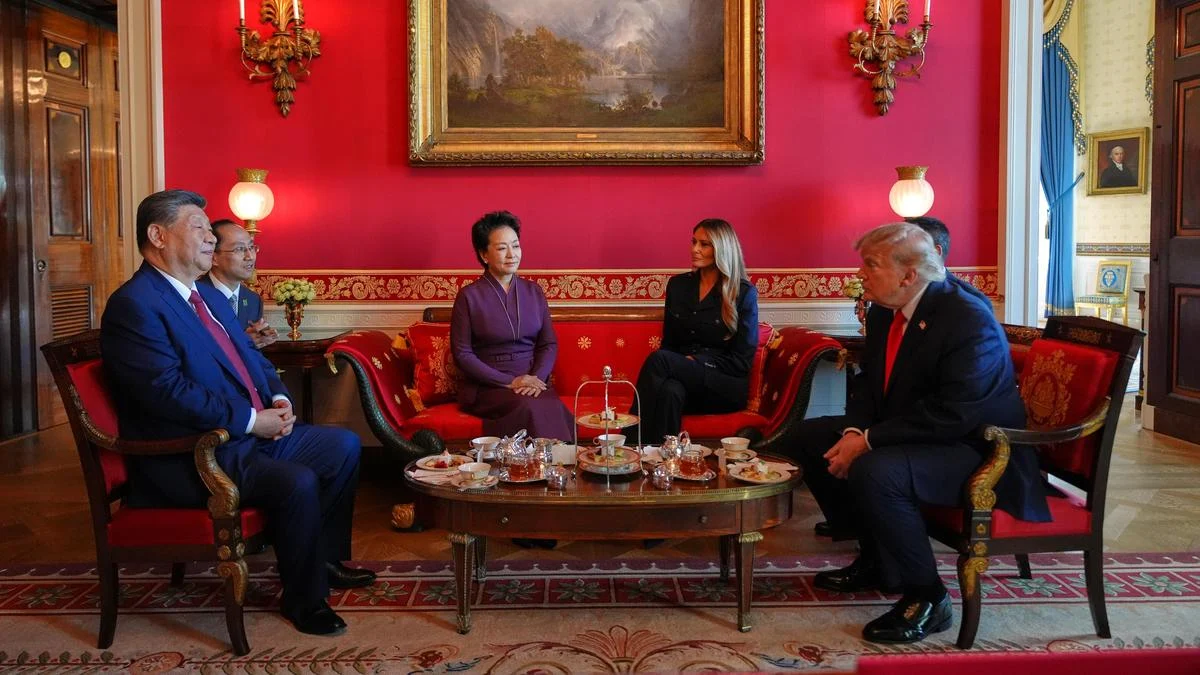
President Xi Jinping’s arrival in Washington on Wednesday, September 23, marked the official commencement of the three-day high-stakes summit. The schedule was reportedly packed with closed-door sessions, working lunches, and strategic dialogues designed to foster direct communication between the two leaders and their senior delegations. A notable moment of personal diplomacy captured by photographers was the tea held in the Red Room of the White House on September 25, featuring President Trump and First Lady Melania Trump alongside President Xi and his wife Peng Liyuan. Such intimate settings are often crucial for building rapport and trust, especially in relationships as complex as those between Washington and Beijing.
The summit concluded on Friday, September 25, with President Xi departing Washington for Beijing, as reported by Chinese state news agency Xinhua on Saturday, September 26. The relatively swift announcement of an "eight-point consensus" upon his return underscored the productive nature of the engagements, moving beyond mere photo opportunities to concrete agreements. The timing of the Chinese Foreign Ministry’s comprehensive statement on Saturday, detailing the outcomes, highlighted Beijing’s eagerness to publicize the positive results of what it clearly viewed as a successful diplomatic endeavor.
Supporting Data and Economic Context
The $30 billion reciprocal tariff reduction agreement, while a significant sum, needs to be understood within the broader context of the U.S.-China trade relationship, which has seen hundreds of billions of dollars in tariffs imposed over recent years. At its peak, the trade war saw tariffs on over $360 billion worth of Chinese goods by the U.S. and retaliatory tariffs on over $110 billion worth of U.S. goods by China. The $30 billion figure, therefore, represents a substantial, but still partial, rollback of these duties.
Economists suggest that even a partial reduction can have a ripple effect. Businesses, particularly those in sectors heavily impacted by tariffs such as agriculture, manufacturing, and technology components, could see reduced input costs and increased market access. For instance, American farmers previously hit by Chinese retaliatory tariffs on soybeans, pork, and other agricultural products might regain market share, while Chinese manufacturers could see lower costs for importing crucial American components. The reciprocal nature implies that the U.S. will also reduce tariffs on specific Chinese goods, potentially lowering consumer prices for imported electronics, apparel, and other consumer goods.

The establishment of a trade council is a critical piece of supporting infrastructure. Unlike ad-hoc negotiations, a permanent council can facilitate continuous monitoring of trade balances, intellectual property protection, market access issues, and state subsidies – all areas that have fueled past disputes. It aims to provide a more stable and predictable framework for managing trade relations, reducing the reliance on last-minute crisis negotiations. The extension of previous talks from Kuala Lumpur further indicates a commitment to building on existing, albeit limited, progress rather than starting from scratch.
In the realm of AI, the data points to an intensifying global race for technological supremacy. Both the U.S. and China are investing massive resources into AI research and development, with projections indicating that AI could contribute trillions of dollars to the global economy by the next decade. The urgency of a dialogue on "risks and benefits" is supported by growing concerns among policymakers and ethicists about autonomous weapons, surveillance technologies, data privacy, and the potential for AI-driven misinformation campaigns. The "super intelligence" versus "artificial intelligence" linguistic distinction, as noted by the Chinese Foreign Ministry, subtly highlights Beijing’s focus on the most advanced and potentially transformative forms of AI, underscoring the high stakes of this technological frontier. The proposed communication channel for "AI-related incidents" is a direct acknowledgment of the potential for unforeseen accidents or escalations in an increasingly automated and interconnected world.
Official Responses and Interpretations
The Chinese Foreign Ministry’s robust and detailed statement on Saturday provided the first comprehensive official account of the summit’s outcomes. Foreign Minister Wang Yi’s pronouncements were notably effusive, emphasizing the "historic" nature of the visit and its potential to usher in a "new chapter" for bilateral relations. This highly positive framing from Beijing suggests a strong desire to project an image of constructive engagement and diplomatic success. The emphasis on "constructive and stable" relations and "overall stability of bilateral ties" signals China’s preference for managing competition within a framework of cooperation, especially in light of ongoing global uncertainties.
The statement also underscored Beijing’s appreciation for Washington’s use of the term "super intelligence" in discussions, viewing it as a recognition of AI’s advanced state and the need for deeper, evolving dialogue. This subtle linguistic preference reflects China’s ambition in AI and its desire to shape the global discourse around advanced technological governance, rather than merely responding to existing frameworks. The call for "step[ping] up exchanges and work toward consensus in line with new developments" further articulates China’s vision for collaborative, yet forward-looking, AI governance.
In contrast, the U.S. Embassy in Beijing’s immediate lack of comment to a Reuters request reflects a more measured, or perhaps strategically calibrated, approach from Washington. While the White House typically releases its own statements following such high-level engagements, the initial silence could indicate ongoing internal discussions, a deliberate strategy to allow the Chinese narrative to set the initial tone, or simply a slower process for official U.S. communication. Nevertheless, the fact that such significant agreements were reached, including the trade truce extension announced by the Treasury Secretary, confirms U.S. participation and agreement on the consensus points. The personal diplomacy between Trump and Xi, highlighted by the Red Room tea, suggests a pragmatic desire from the U.S. side to leverage direct leader-to-leader engagement to navigate complex issues, rather than relying solely on bureaucratic channels.
Broader Implications and Future Trajectories
The Washington summit’s outcomes carry profound implications across economic, technological, and geopolitical landscapes.

Economically, the $30 billion tariff reduction could be a crucial step towards de-escalation, fostering greater predictability for global supply chains and encouraging cross-border investment. While not a complete reversal of the trade war, it signals a strategic retreat from the most confrontational aspects of economic policy, potentially easing inflationary pressures and boosting global trade volumes. The newly established trade council could evolve into a vital platform for addressing structural economic issues, such as market access, intellectual property rights, and state subsidies, which have long been sources of friction. This institutionalization could lead to a more stable long-term trade relationship, benefiting businesses and consumers worldwide.
Technologically, the AI dialogue and the incident communication channel are perhaps the most forward-looking elements of the consensus. They acknowledge that AI is not just an economic or military tool, but a transformative force requiring global governance. This collaboration, even if nascent, could lay the groundwork for international norms and standards for AI development and deployment, particularly in sensitive areas like autonomous systems and ethical AI. The shared recognition of "super intelligence" points to a mutual understanding of the exponential pace of AI advancement and the imperative to manage its profound implications, preventing a potential AI arms race from spiraling out of control. This dialogue could become a template for managing other emerging technologies with dual-use potential.
Geopolitically, the summit represents a significant effort to stabilize a relationship often characterized by strategic rivalry. Wang Yi’s "new chapter" rhetoric, while perhaps optimistic, reflects a genuine desire from Beijing to prevent a complete decoupling and to maintain channels of communication. For the U.S., engaging China on these terms indicates a pragmatic recognition of China’s undeniable global influence and the necessity of managing competition without resorting to outright hostility. The mutual support for APEC and G20, and the leaders’ commitment to attend each other’s hosted summits, underscore a shared belief in multilateralism as a means of addressing global challenges, even amidst bilateral tensions.
The foreign policy consensus on Iran’s nuclear commitments and the assertion on international waterways also carry weight. The joint stance on Iran reinforces global non-proliferation efforts and demonstrates a capacity for the two powers to align on specific regional security issues. The statement on international waterways, while not explicitly naming regions, implicitly addresses concerns in areas like the South China Sea or critical choke points such as the Strait of Hormuz, signaling a shared interest in upholding freedom of navigation and avoiding disruptive transit tolls, which are vital for global commerce.
However, challenges remain. The "personal diplomacy" approach, while effective in securing immediate agreements, can also be susceptible to changes in leadership or political will. Deep structural issues, including ideological differences, human rights concerns, and geopolitical competition in regions like the Indo-Pacific, were likely not resolved during this summit and will continue to test the "constructive and stable" relationship.
Ultimately, the Washington summit of September 2026 can be viewed as a cautious but significant step towards managing the complexities of the U.S.-China relationship. It signifies a mutual recognition that despite profound differences, the cost of unmanaged confrontation, especially in areas like trade and advanced technology, is too high for both nations and the world. The consensus reached provides a framework for continued engagement, but the success of this "new chapter" will depend on the consistent political will and diplomatic dexterity of both Washington and Beijing in the years to come.
