

The Indian automotive landscape is witnessing a paradigm shift as manufacturers pivot toward multi-powertrain strategies to cater to a diverse consumer base. At the forefront of this evolution is Tata Motors, a company that has successfully resurrected one of its most iconic nameplates: the Sierra. Following the successful re-introduction of the Sierra in Internal Combustion Engine (ICE) formats last year, the company is now aggressively expanding the SUV’s portfolio.
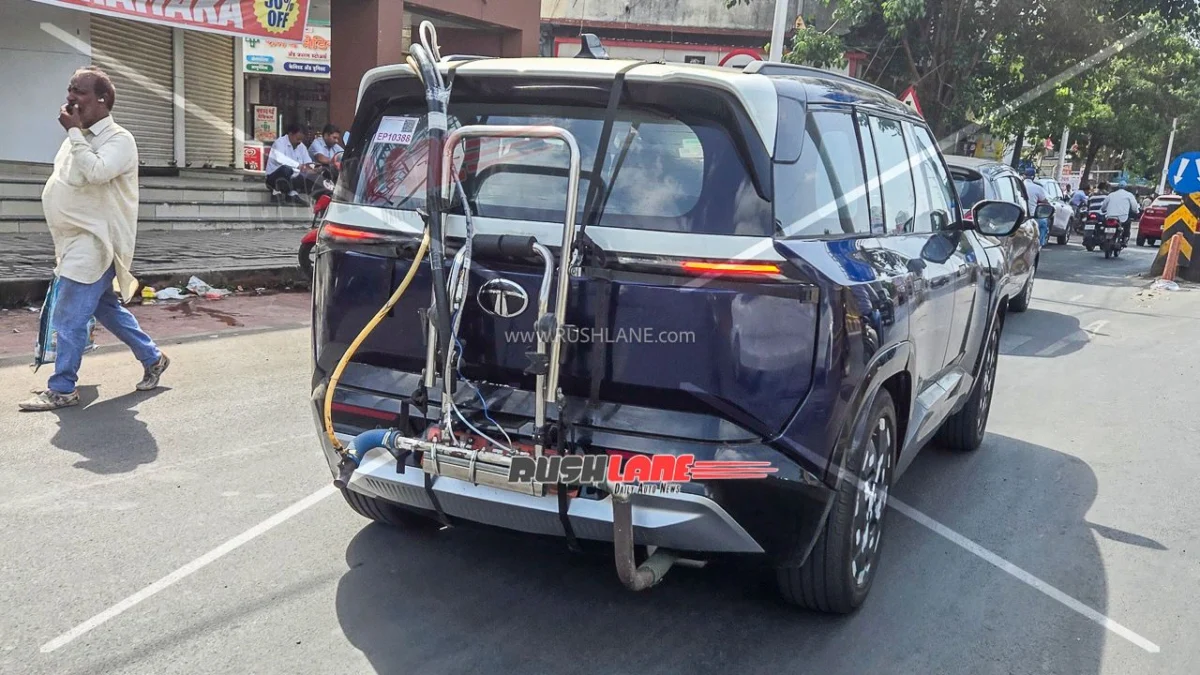
Recent sightings of a camouflaged test mule near the company’s Pimpri-Chinchwad facility in Pune have sent ripples through the industry. The vehicle, equipped with a Portable Emissions Measurement System (PEMS), strongly suggests that Tata is in the advanced stages of developing the Sierra i-CNG. This move aims to bridge the gap between traditional fossil fuels and full electrification, offering a high-utility, low-running-cost alternative in the premium mid-size SUV segment.
1. Main Facts: The Sierra i-CNG Emerges
The latest spy shots reveal a Tata Sierra test mule undergoing rigorous road testing. While the exterior design remains consistent with the current production model—characterized by its signature glasshouse and rugged stance—the presence of an external emission testing kit is a tell-tale sign of a new powertrain calibration.
Key Discoveries from the Spotted Mule:
- Emission Testing Kit: The vehicle was seen carrying a rear-mounted PEMS rig, used to measure real-world driving emissions (RDE). This is a standard procedure when a manufacturer adapts an existing engine to a new fuel source like Compressed Natural Gas (CNG).
- Strategic Location: The proximity to Tata’s Pune plant suggests that the R&D team is finalizing the engine mapping for the i-CNG variant.
- Divergent Engineering: Unlike the Tata Curvv, which utilizes a 1.2L three-cylinder engine, the Sierra i-CNG is expected to leverage a more robust 1.5L four-cylinder architecture to handle the SUV’s larger footprint and weight.
Tata Motors has already confirmed that the Sierra will eventually be available in Petrol (NA and Turbo), Diesel, Electric (EV), and now, seemingly, i-CNG. This makes the Sierra one of the few vehicles in the world to offer four distinct types of propulsion on a single platform.

2. Chronology: The Rebirth and Evolution of an Icon
To understand the significance of the Sierra i-CNG, one must look at the timeline of the "Sierra" brand’s revival, which has been a masterclass in heritage-based marketing.
- 1991 – 2003: The original Tata Sierra was India’s first indigenously designed and produced SUV, gaining cult status for its unique three-door design and alpine windows.
- Auto Expo 2020: Tata Motors shocked the industry by showcasing the Sierra EV Concept, signaling their intent to bring the nameplate back.
- Auto Expo 2023: A more production-ready version of the Sierra was displayed, featuring a five-door layout to ensure commercial viability while retaining the classic aesthetic.
- Early 2025: Tata Motors officially launched the Sierra ICE (Internal Combustion Engine) versions. The lineup debuted with a 1.5L Naturally Aspirated (NA) Petrol, a 1.5L Turbo Petrol, and a 1.5L Turbo Diesel engine.
- Early 2026: Deliveries of the ICE versions commenced, with the SUV quickly finding its footing in the competitive C-segment.
- June 30, 2026 (Scheduled): The official global debut of the Sierra EV, which is expected to offer a range of over 500 km and optional All-Wheel Drive (AWD).
- Late 2026 (Expected Diwali Launch): The anticipated market entry of the Sierra i-CNG, coinciding with the festive season to maximize sales volume.
3. Supporting Data: Technical Specifications and Market Performance
The Power of the 1.5L Engine
The Sierra i-CNG’s most significant advantage over its smaller sibling, the Nexon i-CNG, lies under the hood. While the Nexon uses a 1.2L Turbo CNG setup, the Sierra is poised to use the 1.5L four-cylinder engine.
| Feature | Estimated Specification (Sierra i-CNG) |
|---|---|
| Engine Type | 1.5L, 4-Cylinder, Naturally Aspirated / Turbo |
| CNG Technology | Twin-Cylinder (2 x 30L tanks) |
| Transmission | 6-Speed Manual / AMT (Optional) |
| Key Features | Direct Start in CNG, Single ECU, Seamless Switching |
| Boot Space | Optimized via under-floor tank placement |
Sales Analysis: A Steady Climber
Since its launch, the Sierra has maintained a healthy trajectory in the Indian market.
- Average Monthly Sales: ~7,406 units.
- Total Dispatches to Date: 37,319 units.
- Sales Range: Between 6,000 and 9,000 units per month.
The introduction of the i-CNG variant is expected to provide a 15-20% incremental boost to these figures. In a market where diesel is facing regulatory headwinds and EVs still face charging infrastructure hurdles, CNG has emerged as the "sensible middle ground" for high-mileage users.

4. Official Strategic Context: Tata’s Multi-Powertrain Philosophy
While Tata Motors has not released a formal "press release" regarding the specific spy shots, their corporate strategy—often articulated by MD Shailesh Chandra—provides a clear backdrop.
Tata Motors has moved away from the "one size fits all" approach. Their Acti.ev and Premium SUV platforms are designed to be "powertrain agnostic." This allows the company to react quickly to market shifts.
The Twin-Cylinder Innovation
One of the primary hurdles for CNG vehicles has historically been the loss of luggage space. Tata’s patented Twin-Cylinder technology—which places two smaller tanks beneath the luggage floor—has been a game-changer. By applying this to the Sierra, Tata ensures that the SUV retains its premium "lifestyle" appeal without the compromise of a bulky tank obstructing the boot.
Furthermore, Tata’s i-CNG system is the only one in India that allows the car to be started directly in CNG mode. In a premium vehicle like the Sierra, this "seamlessness" is critical to maintaining the brand’s upmarket positioning.

5. Implications: Market Impact and Competitive Landscape
The launch of a CNG-powered Sierra carries heavy implications for the mid-size SUV segment, currently dominated by the Hyundai Creta, Kia Seltos, and Maruti Suzuki Grand Vitara.
A. Pressure on Rivals
Currently, the Maruti Suzuki Grand Vitara and Toyota Urban Cruiser Hyryder are the only major players offering CNG in this segment. However, they use a 1.5L engine that is often criticized for being "underpowered" in heavy SUV shells. If Tata manages to pair their 1.5L Turbo Petrol engine with i-CNG, it would create the most powerful CNG SUV in India, effectively neutralizing the performance disadvantage usually associated with the fuel.
B. The Death of Diesel?
For years, the Sierra’s 1.5L Diesel was the go-to for long-distance travelers. However, with the narrowing price gap between diesel and CNG, and the increasing complexity of BS6 Phase II diesel engines (DPF issues, AdBlue requirements), the i-CNG variant offers a "cleaner" and less maintenance-heavy alternative.
C. Fleet vs. Private Mix
While the Sierra is primarily a private-buyer vehicle, the i-CNG variant could attract a new demographic: premium fleet operators and long-distance "nomads" who want the ruggedness of a Sierra with the fuel economy of a hatchback.

D. Environmental and Economic Synergy
By expanding the Sierra’s fuel options, Tata is future-proofing the model. As city administrations in India (like Delhi-NCR) continue to impose restrictions on older diesel engines, the Sierra i-CNG provides a 10-to-15-year registration security that diesel simply cannot match.
Conclusion: The Road Ahead
The sighting of the Tata Sierra i-CNG testing in Pune is more than just a routine update; it is a strategic move to democratize premium SUV ownership. By leveraging their 1.5L four-cylinder engine and the innovative twin-cylinder tank setup, Tata Motors is poised to offer a vehicle that balances nostalgia, modern luxury, and extreme frugality.
With the Sierra EV set to debut in late June 2026 and the Sierra i-CNG likely to follow by Diwali, Tata Motors is building a "Sierra for everyone." Whether the consumer is an eco-conscious urbanite, a long-distance cruiser, or a budget-conscious family man, the Sierra’s expanding portfolio ensures that the iconic nameplate will remain a dominant force on Indian roads for years to come.
