

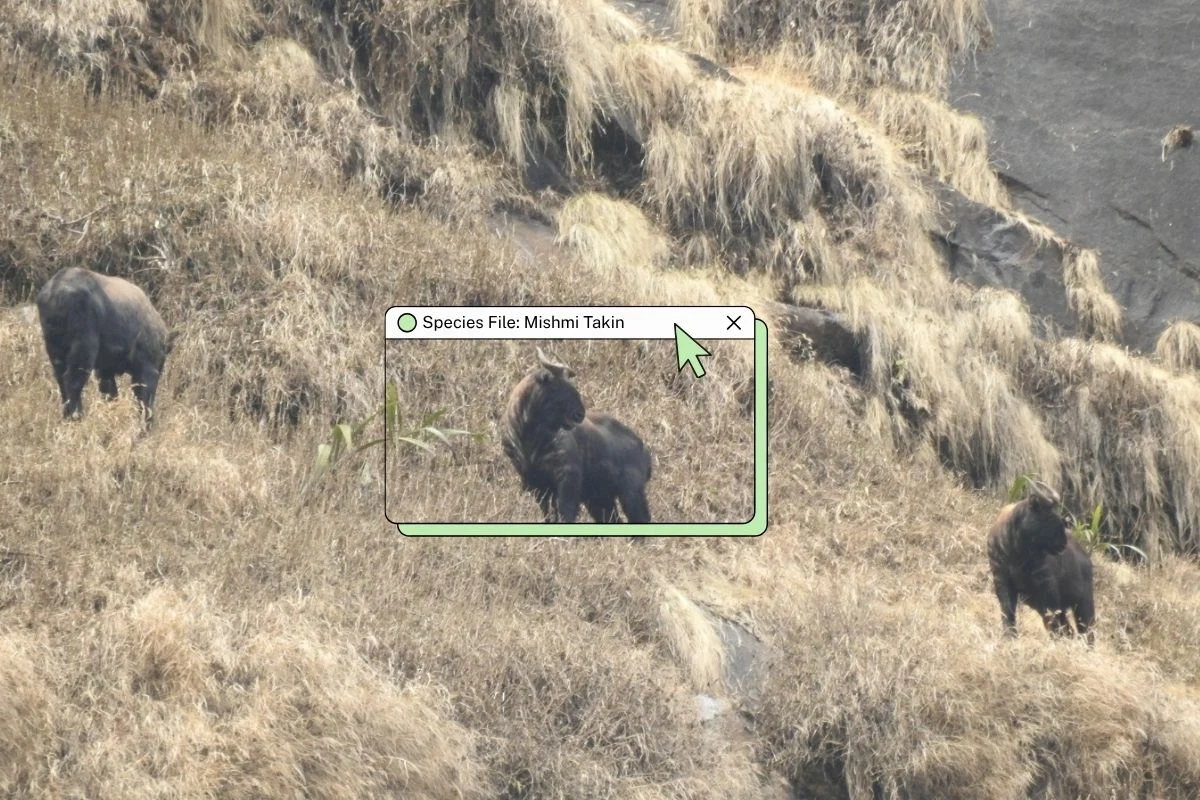
GANGTOK – In a significant milestone for Himalayan wildlife conservation, forest officials in Sikkim have captured rare high-definition footage of a Mishmi takin (Budorcas taxicolor) herd in the Tingda Reserve Forest. The sighting, which occurred during a routine patrolling exercise, has sent ripples of excitement through the scientific community, not only because of the species’ elusive nature but because the group comprised eight individuals—the largest herd ever recorded in this specific locality.
Often described by taxonomists as a biological curiosity that looks like a cross between a goat and an ox, the Mishmi takin is a flagship species of the Eastern Himalayas. This recent sighting provides a glimmer of hope for a species that is increasingly besieged by habitat loss and climate-induced shifts in its high-altitude home.
The Rare Sighting in Tingda: A Breakthrough for Sikkim’s Conservationists
The discovery took place in the rugged, vertical terrain of the Tingda Reserve Forest, a region known for its dense canopy and treacherous slopes. During a standard monitoring and patrolling operation aimed at curbing illegal activities and tracking biodiversity, officials from the Sikkim Forest and Environment Department encountered the herd moving through the undergrowth.
The recorded video, which has since been shared by the state government, shows the robust ungulates navigating the steep terrain with surprising agility. While individual takins are occasionally spotted by camera traps or local herders, the presence of eight individuals suggests a healthy, albeit small, breeding population within the reserve.
Forest officials noted that the sighting is particularly vital because it confirms that the Tingda Reserve Forest serves as a critical corridor or perhaps a permanent residence for the species. "To see eight individuals together is a rare privilege," one official remarked. "It indicates that despite the pressures of the modern world, these ancient corridors are still being utilized by the state’s most secretive residents."
Understanding the ‘Goat-Ox’: Taxonomy and Biological Marvels of the Takin
The Mishmi takin is one of four subspecies of the takin, alongside the Golden takin, the Sichuan takin, and the Bhutan takin. To the uninitiated, the animal appears as a chimeric wonder. It possesses the heavy, muscular body of a muskox, the agile hooves of a goat, and the distinctive convex nose of a moose.
Biologically, the Mishmi takin is a masterpiece of evolution, specifically adapted to the oxygen-thin, freezing environments of the Eastern Himalayas. Their thick, shaggy coats are saturated with an oily substance that acts as a natural raincoat, protecting them from the persistent mists and heavy monsoons of the region. Their large, bulbous noses are not just for show; they contain large sinus cavities that warm the frigid mountain air before it reaches their lungs, preventing internal heat loss.
As a large herbivorous ungulate, the takin plays a foundational role in its ecosystem. Their diet is diverse, ranging from grasses and bamboo shoots to the bark of deciduous trees. By feeding on rhododendrons, oaks, and willows, they act as "ecosystem engineers," thinning out dense vegetation to allow light to reach the forest floor and aiding in seed dispersal through their migratory movements.
Distribution and Habitat: A High-Altitude Resident
The Mishmi takin is a creature of extremes. It thrives in some of the most inaccessible terrains on Earth, moving between elevations of 1,800 and 4,500 meters. Their movement is dictated by the seasons: they ascend to alpine meadows in the summer to feast on nutrient-rich grasses and descend into deep, humid valleys during the harsh Himalayan winters.
In India, the primary stronghold of the Mishmi takin is the Dibang Valley of Arunachal Pradesh. However, the Sikkim population represents a vital western frontier for the subspecies. Beyond Indian borders, the takin’s range extends into southeastern Tibet, northwestern Yunnan in China, and the northern reaches of Myanmar.
The survival of the species is intrinsically linked to the "integrity of humid montane forests," as noted by Chi Ma, an associate professor of mammal behavior at Dali University. These forests provide not only food but also "mineral licks"—salt-rich deposits that takins visit religiously to supplement their diet. Without access to these specific geological features and uninterrupted migration corridors, the social and biological structures of takin herds begin to collapse.
The Numbers Game: Population Pressures and Conservation Status
Despite their physical bulk, Mishmi takins are ghosts of the mountains, making accurate population counts notoriously difficult. Current estimates, largely based on anecdotal reports and sporadic field surveys, suggest a dire situation in India. It is estimated that only 220 to 300 individuals remain within Indian territory.

In contrast, China hosts a significantly larger population, estimated at approximately 3,500 individuals. This disparity highlights the urgent need for transboundary conservation efforts. The International Union for Conservation of Nature (IUCN) currently lists the Mishmi takin as "Vulnerable," a status that reflects a declining population trend across its entire range.
In India, the legal framework for their protection is stringent. The Mishmi takin is listed under Schedule I of the Wildlife (Protection) Act, 1972, granting it the highest level of legal protection, equivalent to that of the tiger or the one-horned rhino. However, legal status on paper does not always translate to safety on the ground.
Cultural Intersections: The Idu Mishmi and the Sacred Ungulate
One cannot discuss the Mishmi takin without acknowledging the indigenous communities that share its habitat. In Arunachal Pradesh, the Idu Mishmi people have lived alongside the takin for centuries. Their relationship is one of deep spiritual and cultural significance.
The Idu Mishmi follow traditional belief systems that often include taboos against the over-hunting of certain species, including the takin. This indigenous stewardship has historically acted as a primary defense against the extinction of the species. However, as traditional lifestyles change and external economic pressures mount, these ancient conservation ethics are being tested. The sighting in Sikkim serves as a reminder that the takin’s survival depends as much on cultural preservation as it does on biological protection.
The Looming Threats: Habitat Fragmentation and Infrastructure
The greatest threat to the Mishmi takin is not necessarily the hunter’s rifle, but the surveyor’s transit. The Eastern Himalayas are currently witnessing an unprecedented boom in infrastructure development. Road construction, while vital for human connectivity and national security, acts as a double-edged sword for wildlife.
Research conducted by the Wildlife Institute of India (WII) paints a sobering picture: only about 11% of northern and eastern Arunachal Pradesh—the takin’s heartland—currently provides "optimal habitat" for the species. As roads slice through ancient migration paths, herds become isolated. Isolation leads to a restricted gene pool, making the species more susceptible to disease and environmental changes.
Furthermore, climate change is altering the phenology of the alpine plants the takin relies on. As the treeline shifts upward and weather patterns become more erratic, the delicate timing of the takin’s vertical migration is thrown out of sync. Human encroachment for agriculture and livestock grazing further squeezes the takin into smaller, less viable pockets of land.
Official Responses and the Road to Preservation
The Sikkim Forest Department’s decision to release the footage of the herd is a strategic move to garner public and political support for mountain conservation. Officials emphasize that the presence of the herd in Tingda is a call to action.
"The footage is a testament to the effectiveness of our patrolling, but it is also a warning," said a senior conservationist involved in the region. "If we do not protect these specific corridors now, we will lose the Mishmi takin within a generation. We need to move beyond ‘protected areas’ and start thinking about ‘connected landscapes’."
The implications of this sighting are clear:
- Enhanced Monitoring: There is an urgent need for more camera trap studies and satellite collaring to understand the exact migratory routes of the Sikkim population.
- Community Engagement: Conservation efforts must involve local communities as stakeholders, ensuring that the protection of the takin provides tangible benefits to those living on the fringes of the forest.
- Sustainable Development: Infrastructure projects in the high Himalayas must incorporate "wildlife underpasses" or "overpasses" to ensure that the takin’s path to mineral licks and seasonal pastures remains open.
As the sun sets over the jagged peaks of the Eastern Himalayas, the Mishmi takin remains a symbol of the wild, untamed spirit of the mountains. The sighting of the eight-strong herd in Tingda is more than just a news item; it is a rare window into a world that is fast disappearing—and a reminder of the heavy responsibility that comes with sharing a landscape with such a magnificent, elusive sentinel.
