

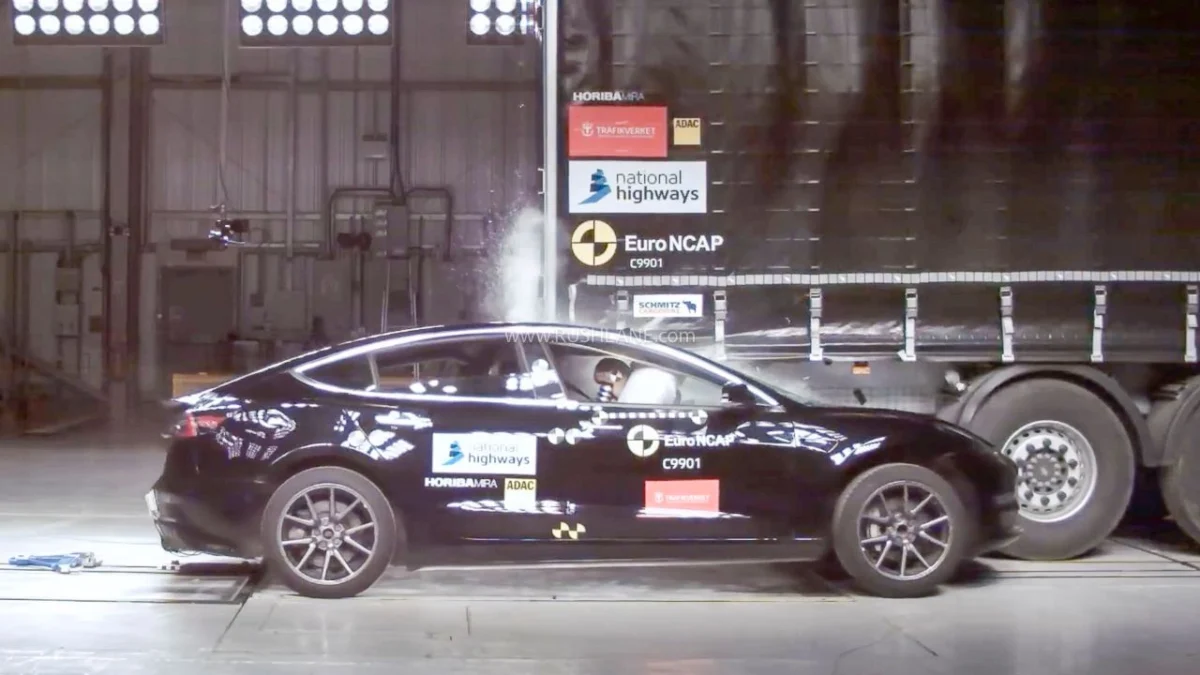
The safety organization warns that current European standards are failing to prevent "unsurvivable" accidents, leading to hundreds of preventable deaths each year.
In the realm of automotive safety, the "underrun" crash remains one of the most terrifying and lethal scenarios on modern roads. It occurs when a passenger vehicle strikes the rear of a heavy goods vehicle (HGV) or trailer and, instead of the car’s safety structures engaging, the vehicle slides beneath the truck’s chassis. The result is often "passenger compartment intrusion"—a clinical term for a catastrophic event where the truck’s rear structure enters the car at head-height, bypassing crumple zones and airbags.
Following a series of rigorous new evaluations, Euro NCAP, the continent’s leading authority on vehicle safety, has issued a stark warning: current mandatory underrun protection barriers are inadequate. The organization is now calling on European and UK regulators to urgently upgrade their standards, citing an estimated 400 fatalities annually linked to rear underrun crashes across the region.
Main Facts: A Crisis of Compatibility
The core of the issue lies in a fundamental mismatch between the height and structural rigidity of modern passenger cars and the rear-end design of heavy trailers. While passenger cars have become significantly safer over the last three decades, achieving 5-star ratings through advanced high-strength steels and sophisticated crumple zones, these features are rendered useless if they never make contact with the object they hit.
The Lethal Failure of Current Standards
The current European standard for underrun protection, known as UN Regulation R58.03, is intended to provide a "buffer" that prevents cars from sliding under trucks. However, Euro NCAP’s latest research demonstrates that these barriers often buckle, shear off, or allow the car to wedge underneath them during real-world collision speeds.
The Human Toll
Euro NCAP estimates that approximately 400 people lose their lives every year in the UK and Europe due to rear underrun collisions. Many of these accidents occur at speeds that should, in theory, be survivable if the car’s safety systems were allowed to function correctly.
The Call for Change
Euro NCAP is not merely pointing out a flaw; it is proposing a solution. The organization is urging the adoption of standards equivalent to the IIHS TOUGHGUARD program used in the United States, which has already proven to be significantly more effective in preventing underrun during offset crashes.

Chronology: The Evolution of the Underrun Study
The path to these findings involved years of data collection and international cooperation.
1996–2020: The Foundation of Safety
Since its inception in 1996, Euro NCAP has focused primarily on how cars protect their occupants during car-to-car or car-to-pole impacts. However, as car safety reached a plateau of excellence, investigators began looking at "compatibility" issues—how cars interact with larger vehicles.
2021–2023: The Investigative Phase
Initiated and supported by National Highways in the UK, a massive data-mining project began. Researchers analyzed real-world collision data to identify why occupants in 5-star rated cars were still dying in rear-end collisions with trucks. The data pointed overwhelmingly to the failure of the rear underrun protection system (RUPS).
2024: Global Testing Collaborative
To validate the data, Euro NCAP launched a comprehensive testing program. This was not a solitary effort; it involved a coalition of the world’s most respected safety bodies:
- ADAC (Germany): Conducted laboratory testing and high-speed impact simulations.
- Horiba Mira (UK): Provided advanced engineering and track facilities.
- Trafikverket (Sweden): Offered insights into Scandinavian road safety and heavy vehicle regulations.
- IIHS (USA): Shared data from their TOUGHGUARD testing, which has been operational since 2017.
July 2026: The Findings Released
The culmination of this research has led to the current demand for regulatory intervention. The tests revealed that even the most advanced electric vehicles (EVs) currently on the market cannot protect occupants if the truck’s barrier fails to hold.
Supporting Data: ADAS Limitations and Crash Test Realities
Euro NCAP’s research focused on two primary areas: the ability of technology to prevent the crash (ADAS) and the ability of the hardware to mitigate the crash (the barrier).
The ADAS Gap: A 15-Year Wait
Advanced Driver Assistance Systems (ADAS), such as Autonomous Emergency Braking (AEB), are often touted as the cure-all for road fatalities. However, Euro NCAP’s evaluation revealed a troubling reality:

- Stationary Object Detection: While brand-new ADAS systems are highly capable, many older or mid-tier systems struggle to identify stationary trucks and trailers, especially those with unusual shapes like skeletal trailers or those used in roadworks.
- Fleet Turnover: Euro NCAP estimates it will take at least 15 years before the majority of cars on European roads are equipped with ADAS sophisticated enough to reliably prevent these impacts. This makes physical barriers the "final line of defense" for the foreseeable future.
Physical Crash Test Results
Euro NCAP conducted physical tests using a 5-star rated electric car. The scenarios were designed to mimic common real-world accidents:
- 30% Frontal Offset Impact (56 km/h): This simulates a driver attempting a last-second evasive maneuver. In this test, the trailer’s rear structure bypassed the car’s crumple zones entirely. The result was massive intrusion into the passenger compartment, with sensors indicating likely fatal head and neck injuries for the driver.
- 75% Frontal Impact: Even with more of the car’s front end engaged, the barrier failed to prevent the car from sliding under. The "safety cage" of the 5-star car was compromised, leading to potentially fatal outcomes for both front-seat occupants.
The Tata Sierra EV Context
The industry recently saw a safety demonstration by Tata Motors for its Sierra EV, which showed the vehicle braking for a truck and then being hit from behind, pushing it partially under the trailer. While Tata demonstrated that the passenger compartment remained intact in that specific low-to-mid-speed scenario, Euro NCAP’s findings suggest that at higher regulated speeds (56 km/h and above), the outcome is far more precarious. The comparison highlights that a car’s structural integrity is only half the equation; the truck’s barrier must be rigid enough to meet the car’s frame.
Official Responses: A Mandate for Regulators and Manufacturers
The response from Euro NCAP has been one of urgent advocacy rather than mere observation.
Euro NCAP’s Stance
Dr. Michiel van Ratingen, Secretary General of Euro NCAP, emphasized that the current situation is unacceptable. "We have seen cars that achieve the highest safety ratings in our tests fail catastrophically when they hit the back of a truck. The barrier is the final line of defense. When it fails, the car’s safety features—no matter how advanced—are rendered useless."
Recommendations to Regulators
Euro NCAP has formally requested that European and UK regulators move beyond the R58.03 standard. They recommend adopting a standard modeled after the IIHS TOUGHGUARD benchmark.
- Why TOUGHGUARD? Introduced in 2017 in the US, this voluntary standard requires barriers to withstand impacts across the full width of the trailer, as well as 50% and 30% offsets.
- Proven Success: Approximately 70% of new trailers sold in the US now meet this standard, significantly reducing underrun fatalities in North America.
A Call to Industry
The organization is also calling on trailer manufacturers to act ahead of legislation. They are urging companies to:
- Voluntarily Adopt Stronger Guards: Implement reinforced steel beams and improved mounting brackets on all new units.
- Retrofit Solutions: Develop and sell kits to upgrade existing fleets, ensuring that older trailers on the road do not remain "rolling guillotines."
Implications: The Future of Road Safety Infrastructure
The findings of Euro NCAP have far-reaching implications for the automotive and logistics industries.

The Shift to "Total System" Safety
For decades, vehicle safety was viewed as the responsibility of the passenger car manufacturer. This study shifts the paradigm toward "Total System Safety," where the infrastructure (road design) and heavy vehicles must be compatible with the cars sharing the road. If an HGV is not designed to interact safely with a car, it is increasingly being viewed as a road hazard.
Economic Impact on Logistics
Upgrading underrun barriers involves adding weight and cost to trailers. A stronger barrier requires more steel and reinforced mounting points, which could slightly reduce the payload capacity of a trailer. However, Euro NCAP argues that the cost-to-benefit ratio is clear: the economic burden of 400 fatalities and thousands of life-altering injuries far outweighs the cost of reinforced steel.
Global Standardization
The push for IIHS TOUGHGUARD standards in Europe signals a move toward global safety standardization. As logistics companies operate across borders, having a unified, high-strength standard for underrun protection simplifies manufacturing and ensures a consistent level of safety regardless of where a trailer is registered.
Conclusion: The Final Line of Defense
Euro NCAP’s latest initiative serves as a sobering reminder that safety is a chain, and that chain is only as strong as its weakest link. For hundreds of motorists every year, the weak link is the rear of a truck. By demanding a transition to the TOUGHGUARD standard, Euro NCAP is seeking to ensure that a 5-star safety rating actually means protection in the real world—not just in the laboratory. As the 15-year wait for universal ADAS begins, the physical barrier remains the only thing standing between a survivable collision and a fatal one.
