

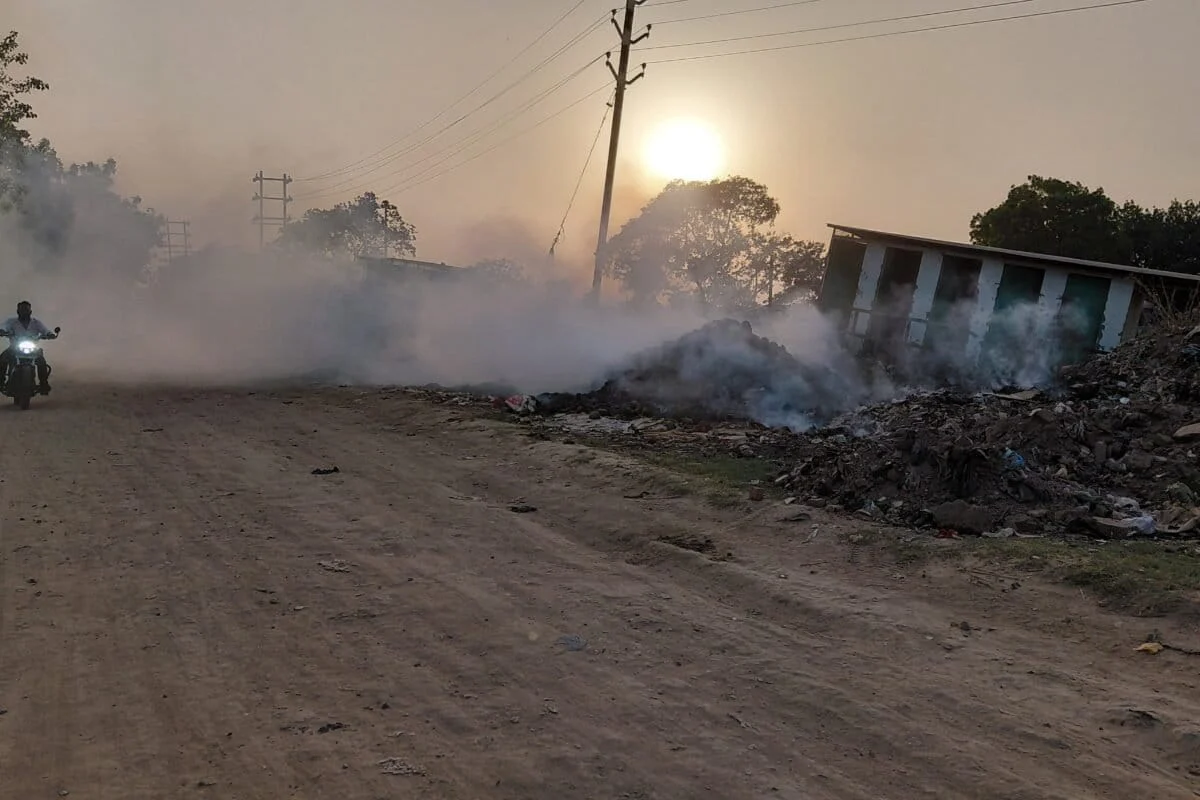
KOILWAR, BIHAR — In the popular imagination, the Indian countryside is often romanticized as a sanctuary of fresh air and open skies, a stark contrast to the smog-choked metropolises of Delhi or Mumbai. However, for the residents of the Bhojpur district in Bihar, this pastoral ideal is a fading memory. In the villages surrounding Koilwar and Arrah, the air has become a source of chronic illness, a seasonal predator that shifts from blinding dust in the summer to a suffocating, toxic shroud in the winter.
New empirical evidence suggests that the air breathed by millions in rural Bihar is not just poor; it is frequently lethal. A landmark study by the Indian Institute of Technology (IIT) Kanpur has revealed that rural Bihar violates national safety standards for air quality on nearly 90% of the days in a year. This revelation challenges the long-standing urban-centric focus of India’s pollution policies and highlights a burgeoning public health catastrophe in the heart of the Indo-Gangetic Plain.
The Seasonal Cycle: From Dust Storms to Winter Stagnation
The crisis in Bihar’s rural heartland follows a predictable, yet increasingly severe, chronological pattern. During the peak of summer, the landscape is dominated by mechanical forces. Strong, arid winds sweep across the agricultural plains of Bhojpur, whipping up fine topsoil into massive dust storms. By midday, a layer of grit coats everything from standing crops to the rooftops of ancestral homes.
"During the summer, we somehow manage," says Vishwanath Pratap Singh, a local social activist based in Bhojpur. "The heat and the dust storms are challenging, but there is a sense that the air is moving. You can see the enemy."
However, the true "disaster," as Singh describes it, unfolds once the monsoon recedes and the temperatures begin to plunge. As winter sets in, the atmospheric dynamics change. Ground-level wind speeds drop to near-stagnation, and a phenomenon known as thermal inversion takes hold. Instead of rising and dispersing, emissions from household cookstoves, local industries, and agricultural fires are trapped close to the earth.

"A strange heaviness grips the village air," Singh explains. "Persistent eye irritation and chronic throat infections have now become a daily reality for our children and the elderly. It is no longer about dust; it is about a weight in the chest."
For Aamod Kumar, a resident of Koilwar, the arrival of winter marks the beginning of a struggle for breath. "Once the brick kilns start operating, the whole area fills with smoke, especially in the mornings," Kumar says. "Ash settles on our crops, affecting the harvest. Stepping outside feels like breathing smoke instead of fresh air."
Project AMRIT: Quantifying the Invisible
The anecdotal suffering of residents like Kumar and Singh has now been validated by rigorous scientific data. Under the ambitious Project AMRIT (Ambient Air Quality Monitoring over Rural areas using Indigenous Technology), a team from IIT Kanpur deployed a massive network of 538 indigenous sensor nodes across every block in Bihar’s 38 districts.
The study, published in the journal Environmental Science & Technology in November 2025, represents one of the most comprehensive rural air quality assessments ever conducted in India. The findings are staggering. In northwest Bihar, including the districts of Muzaffarpur and Gopalganj, winter concentrations of PM2.5 (particulate matter less than 2.5 micrometers in diameter) routinely reached 210 µg/m³. This is more than three times the national safety standard of 60 µg/m³ and many times higher than the World Health Organization’s (WHO) recommended limits.
The study identified two distinct "pollution profiles" within the state:
- The Industrial Northwest: In Muzaffarpur and surrounding areas, the high PM2.5 levels are attributed to a cocktail of widespread brick kilns, sugar mills, and thermal power stations.
- The Uniformly Polluted Southwest: In districts like Bhojpur, Buxar, and rural Patna, the pollution is characterized by its consistency, driven largely by seasonal stubble burning and the pervasive use of biomass for cooking.
The Data Gap: Why Rural Bihar Was Ignored
One of the most significant revelations of Project AMRIT is the sheer lack of existing infrastructure to monitor rural air. Sachidanand Tripathi, the National Clean Air Program Chair Professor at IIT Kanpur and chief investigator of the project, points to a massive "empirical blindness" in traditional governance.

Bihar, a state spanning nearly 100,000 square kilometers and home to approximately 127 million people, has historically relied on just 35 traditional Continuous Ambient Air Quality Monitoring (CAAQM) stations.
"This implies there is roughly one regulatory monitor for every 3.5 to 4 million citizens," Tripathi emphasizes. "Furthermore, these stations are concentrated almost exclusively in urban hubs. For decades, the state effectively had zero visibility into the air breathed by its rural majority."
By using low-cost, indigenous sensors, Project AMRIT has "democratized" this data landscape. However, this shift toward low-cost technology has sparked a debate with state regulators.
Official Responses and the Accuracy Debate
The IIT Kanpur findings have met with skepticism from the Bihar State Pollution Control Board (BSPCB). D.P. Shukla, Chairman of the BSPCB, questioned the validity of the sensors used in the study, suggesting they are only about 60% accurate compared to multi-crore imported regulatory monitors.
Professor Tripathi has countered this skepticism by highlighting the realities of environmental science. "No instrument in the world operates at 100% absolute accuracy," he states. "Even the expensive imported monitors exhibit operational vulnerabilities depending on atmospheric fluxes. The essence of modern data science lies in how you mathematically calibrate that data against standard references."
Meenakshi Sundaram, a Project Consultant at the Centre of Excellence (ATMAN) at IIT Kanpur, adds that the indigenous sensors have proven their reliability through extensive "co-location trials," where their data trends mirrored official regulatory stations perfectly.

The debate highlights a tension between traditional regulatory frameworks, which favor high-cost but sparse data, and new-age monitoring, which favors hyper-local, high-density data.
The Anatomy of a Geographic Trap
To understand why villages often register higher pollution loads than cities, geographers point to the unique meteorology of the Indo-Gangetic Plain. Sanjay Kumar, Head of the Post Graduate Geography Department at Maharaja College, Ara, explains the "thermal dome" effect.
"During the day, urban centers become heat islands due to concrete density and vehicles. This creates a rising thermal dome that can actually push some pollutants upward," Kumar explains. "However, as night falls in the rural areas, the regional wind dynamics shift. The cooler, denser air over the fields, combined with high moisture, induces a severe localized inversion."
This creates a "geographical trap." Instead of dispersing, the moisture in the rural air collides with dust and industrial smoke, trapping a thick, low-lying blanket of heavy smog directly over households from midnight through the early morning hours. This is why residents report the air being most "unbearable" at dawn.
The Sources: Beyond the Brick Kilns
While industrial sources like brick kilns are often the first to be blamed, the reality is more complex. Manoj Singh, State Spokesperson for the Bihar Brick Kiln Owners’ Association, argues that the industry is being "scapegoated."
"Our industry is strictly seasonal," Singh says, noting that the vast majority of kilns in Bihar have already transitioned to "Zigzag Technology" and installed particulate filters in accordance with a 2022 government mandate. "Rural air quality is deeply tied to domestic biomass use. It requires collective solutions rather than industry-specific penalties."

Indeed, the IIT study points to a deeply entrenched socio-economic challenge: "fuel stacking." Despite the success of the Pradhan Mantri Ujjwala Yojana in providing LPG connections, many rural families continue to use traditional mud chulhas (stoves) alongside gas.
"In rural belts, the adoption of clean cooking energy is not merely an economic issue of cylinder pricing; it is rooted in cultural habits," says Meenakshi Sundaram. "When agricultural residues, firewood, and dung cakes are available for free, families avoid burning paid LPG for heavy daily cooking. Without shifting this baseline social behavior, cleaning rural air remains a structural impossibility."
Implications and the Path Forward
The findings from Project AMRIT suggest that Bihar’s air quality crisis cannot be solved within state borders or city limits. The state belongs to a shared, contiguous eastern Indo-Gangetic airshed. Transboundary northwesterly winds transport heavy pollution loads from Punjab, Haryana, Delhi, and western Uttar Pradesh into Bihar, where the local geography then traps them.
The study recommends several urgent interventions:
- Airshed Management: Moving beyond city-specific plans to a comprehensive framework that includes cooperation between districts and neighboring states.
- Economic Incentives for Clean Energy: Making LPG cylinder refills more economically viable for the rural poor to discourage the use of solid biomass.
- Strict Audits: Conducting field audits to ensure that the transition to "Zigzag Technology" in brick kilns is not just on paper but functional.
- Hyper-local Monitoring: Expanding the use of sensor networks to provide real-time health advisories to rural communities.
As the sun sets over the fields of Bhojpur, casting a golden hue through a persistent haze of smoke and dust, the residents are left to grapple with a silent emergency. For Aamod Kumar and millions like him, the "fresh air" of the countryside has become a myth, replaced by a toxic reality that requires urgent, science-backed intervention. The "heaviness" in the air is no longer just a seasonal nuisance; it is a call for a fundamental shift in how India monitors and manages the very air that sustains its rural heartland.
