SEO Keywords: KAIST HOUND, AI Robotics, Reinforcement Learning, Transformer Models, Quadruped Robot, Autonomous Locomotion, Disaster Response, Search and Rescue, Science Robotics, APT-RL.
Published: July 17, 2026, 03:52 PM IST
Read Time: 3 min (Original estimate, but this expanded article will be much longer)
Pioneering Autonomy: KAIST HOUND Redefines Robotic Navigation with Adaptive AI
SEO Subheading: Breakthrough in four-legged robot technology allows real-time gait adaptation for complex terrains, signaling a new frontier for autonomous systems.
In a significant leap forward for artificial intelligence and robotics, researchers have unveiled a revolutionary training method that empowers a four-legged robot, dubbed KAIST HOUND, to autonomously adapt its movement in real-time. This groundbreaking capability allows the 45-kilogram machine to seamlessly navigate a diverse array of challenging environments—from ascending staircases and traversing dense forests to gracefully leaping over formidable obstacles—all without the direct intervention or instruction of a human operator.
The innovation, detailed in a seminal paper published in the esteemed journal Science Robotics, introduces a novel training framework known as Action Pretrained Transformer-Based Reinforcement Learning (APT-RL). This sophisticated system represents a powerful fusion of transformer-based AI, renowned for its prowess in sequential data processing and pattern recognition, with the adaptive learning capabilities of reinforcement learning. The result is a robot that not only learns intricate movement patterns from a vast repository of pre-generated examples but also continuously refines its behaviour through iterative trial and error, much like a living creature honing its motor skills.
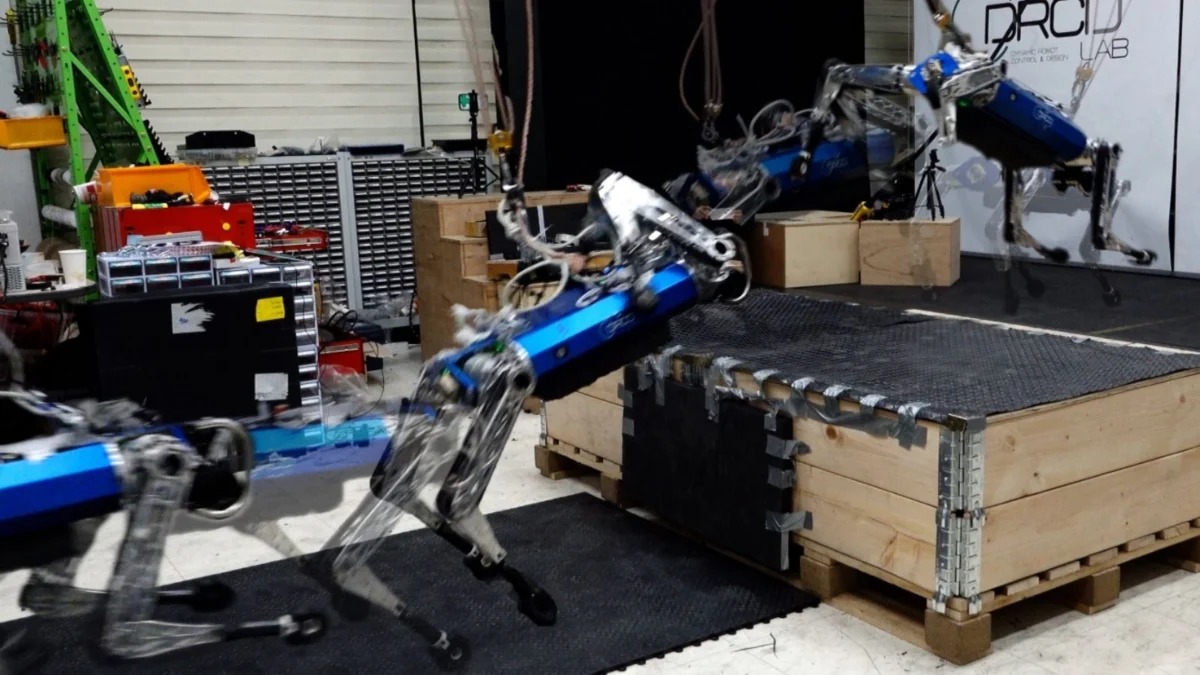
Equipped with an array of advanced onboard sensors, including high-resolution cameras and precise lidar technology, KAIST HOUND possesses an acute awareness of its surroundings. This sensory input is fed directly into its APT-RL brain, enabling it to instantaneously analyse the terrain ahead. Based on this real-time environmental assessment, the robot can dynamically switch between two primary gaits: a stable, energy-efficient trot ideal for maintaining balance on uneven ground, and a powerful, agile bound designed for conquering larger steps, gaps, or obstacles at impressive speeds. This dual-gait system is a cornerstone of its unprecedented adaptability and autonomy.
The implications of this research extend far beyond mere technological novelty. This level of self-directed locomotion promises to unlock new possibilities for robotic deployment in critical applications such as disaster response, where human access is perilous, and in search-and-rescue missions across complex, unpredictable terrains. The KAIST HOUND’s ability to operate autonomously in such environments could drastically reduce risks to human personnel and accelerate response times in life-or-death situations, marking a pivotal moment in the evolution of practical robotics.
The Genesis of Agility: A Chronological Journey of KAIST HOUND’s Development
SEO Subheading: Tracing the research milestones from conceptualization to real-world validation of KAIST HOUND’s advanced AI locomotion.
The journey to developing KAIST HOUND’s remarkable capabilities is a testament to years of dedicated research, blending theoretical advancements in AI with practical challenges in robotic engineering. The project originated from a fundamental problem plaguing conventional robotic systems: their inherent limitations in adapting to highly variable and unpredictable environments without explicit programming or constant human oversight. Traditional control systems often rely on predefined movement patterns for specific terrains, leading to a lack of versatility when faced with novel or rapidly changing conditions.
Conceptual Foundations:
The research team at KAIST (Korea Advanced Institute of Science and Technology) recognized the potential of combining two cutting-edge AI paradigms to overcome these limitations. Reinforcement Learning (RL) had already shown promise in teaching robots complex tasks through reward-based learning, allowing them to discover optimal strategies through interaction with their environment. However, pure RL often requires extensive training time and can struggle with generalization. Simultaneously, transformer models, which had revolutionized natural language processing, were beginning to demonstrate their power in processing sequential data and identifying intricate patterns, suggesting their applicability beyond linguistic domains.
The conceptual breakthrough was to integrate these two approaches, leveraging the pattern recognition and predictive power of transformers to "pre-train" a robust foundation of movement, which could then be dynamically refined and adapted through reinforcement learning. This hybrid model aimed to accelerate the learning process, enhance stability, and improve the robot’s ability to generalize across different scenarios.
Developing the APT-RL Framework:
The initial phase involved the meticulous development of the Action Pretrained Transformer-Based Reinforcement Learning (APT-RL) framework. This was not merely an incremental improvement but a fundamental rethinking of how robotic locomotion policies are learned and executed. The researchers focused on creating an architecture where the transformer component could effectively learn a vast library of motion primitives and transitions from simulated data, while the reinforcement learning component would act as an adaptive layer, fine-tuning these actions in real-time based on sensory feedback and environmental state.
The Simulation Crucible:
A critical phase of the project was the creation of an extensive and highly diverse simulated training environment. Rather than relying solely on real-world trial and error, which is time-consuming and can damage hardware, the team leveraged advanced trajectory optimisation techniques to generate an enormous dataset of ideal movement sequences. This involved crafting approximately 180,000 simulated trotting and bounding sequences. What is truly remarkable is the efficiency of this process: despite representing over 15 hours of continuous movement data, this massive dataset was generated in a mere eight minutes. This rapid data generation capability was crucial for iterating quickly and building a comprehensive knowledge base for the transformer model.
Within these simulated environments, KAIST HOUND was subjected to an exhaustive gauntlet of challenges designed to push its adaptive capabilities to the limit. These included traversing complex staircases, leaping over varying hurdles, meticulously stepping across irregular stepping stones, bridging precarious gaps, and maintaining balance on highly uneven ground. Each simulation provided valuable data, allowing the AI to learn the nuanced physics of its body interacting with diverse terrains.
Hardware Integration and Real-World Validation:
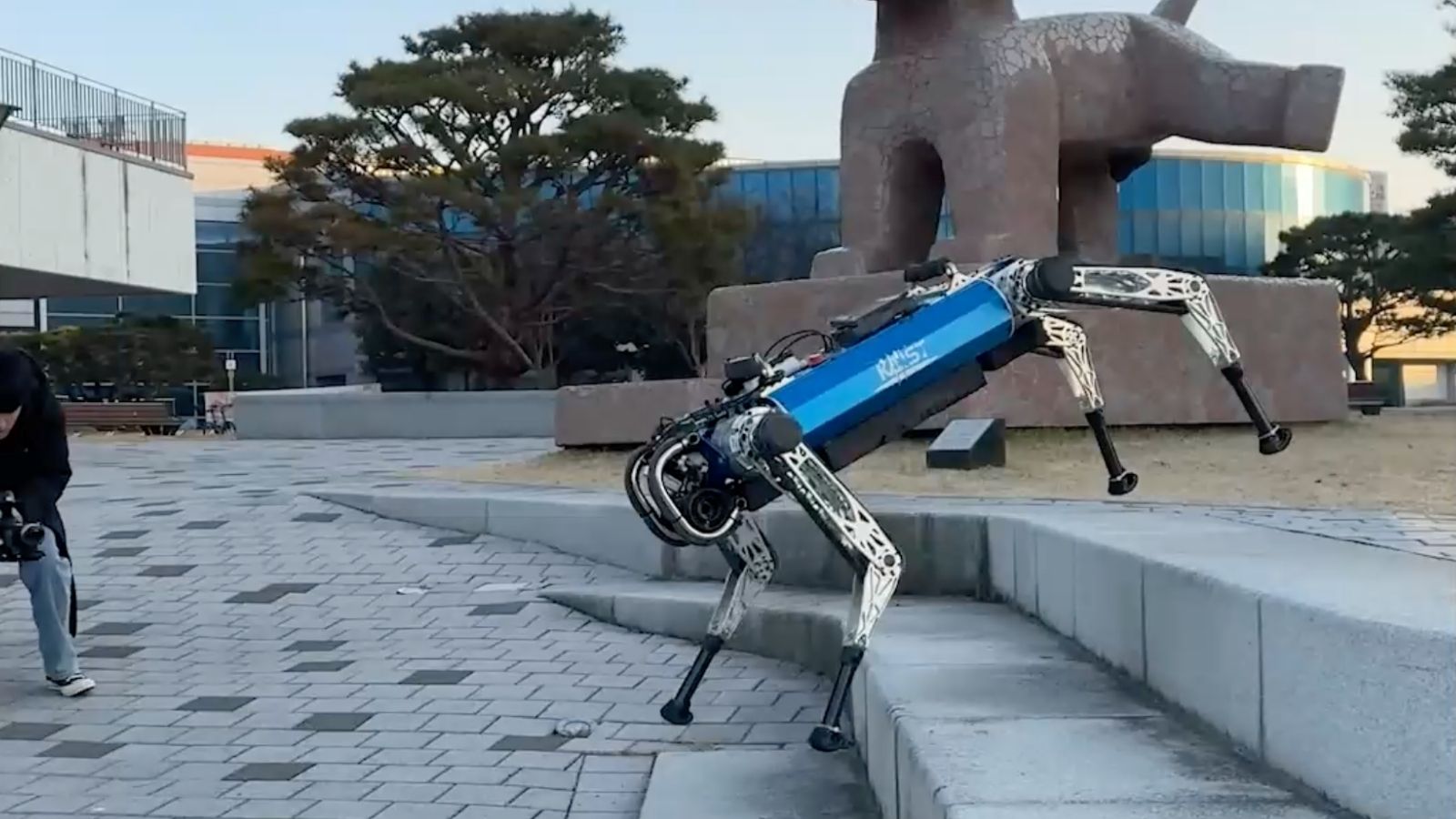
With the APT-RL framework sufficiently trained in simulation, the next step was to integrate it with the physical robot, KAIST HOUND. This involved calibrating the onboard cameras and lidar sensors to accurately perceive the real world and translate that data into inputs understandable by the AI. The 45-kilogram quadruped robot, designed for robustness and agility, served as the ideal platform for testing the theoretical advancements in a tangible form.
The real-world testing phase was rigorous and designed to validate the robot’s autonomy under actual, unpredictable conditions. KAIST HOUND was deployed on a demanding 1.1-kilometer route across the university campus, navigating various urban obstacles and surfaces. Following this, it was challenged with a more formidable 300-meter forest trail, a treacherous path replete with exposed roots, slippery fallen logs, and a carpet of wet leaves – conditions that would typically confound less adaptive robots.
Perhaps the most visually striking demonstration of its prowess involved bounding over a 60-centimeter obstacle, during which the robot briefly achieved impressive speeds of 15 kilometers per hour, showcasing its explosive power and dynamic stability. Another critical test involved safely descending a three-step staircase, a task requiring precise foot placement, weight distribution, and balance adjustment. In every real-world scenario, KAIST HOUND performed with a level of adaptability that surpassed previous robotic systems, proving the efficacy of the APT-RL framework in bridging the gap between simulated learning and real-world performance.
Unpacking the Innovation: Supporting Data and Technical Prowess
SEO Subheading: Deep dive into the APT-RL framework, sensor integration, and performance metrics showcasing KAIST HOUND’s superior locomotion capabilities.
The superior performance of KAIST HOUND is not merely anecdotal; it is underpinned by a meticulously engineered AI framework and robust hardware integration. The core of this innovation lies in the Action Pretrained Transformer-Based Reinforcement Learning (APT-RL) system, a sophisticated paradigm shift in robotic control.
The APT-RL Framework Explained:
At its heart, APT-RL combines the strengths of two powerful AI methodologies:
-
Transformer Models for Action Pretraining: Transformers excel at processing sequential data and identifying long-range dependencies, much like they do in understanding human language. In the context of robotics, this means the transformer component can learn from the vast simulated dataset of ideal trotting and bounding sequences. It effectively learns a "language of motion" – predicting optimal limb movements, body poses, and force applications given a specific terrain and desired gait. This pretraining provides the robot with a highly robust and versatile baseline of movement patterns, preventing the chaotic "flailing" often seen in robots learning from scratch with pure reinforcement learning. It acts as a sophisticated motion planner, capable of generating coherent and effective action sequences.
-
Reinforcement Learning for Real-time Adaptation: While the transformer provides a strong foundation, the real world is inherently unpredictable. This is where reinforcement learning (RL) comes into play. The robot continuously receives sensory feedback (from cameras, lidar, accelerometers, gyroscopes) about its current state and the environment. Based on this feedback, the RL component makes subtle, real-time adjustments to the pre-trained actions. It learns through a system of "rewards" and "penalties." Successfully navigating an obstacle, maintaining balance, or reaching a goal efficiently earns rewards, reinforcing the successful actions. Conversely, stumbling or failing to clear an obstacle incurs penalties, discouraging suboptimal movements. This iterative process allows the robot to adapt its pre-trained knowledge to the immediate, dynamic conditions of its surroundings, fine-tuning its gait and trajectory on the fly.
-
Seamless Integration: The true genius of APT-RL lies in the seamless integration of these two components. The transformer provides the broad strokes of motion, while RL provides the fine details and adaptive nuances, creating a dynamic and responsive control system that can transition smoothly between gaits and navigate complex environments with unprecedented fluidity.
Hardware Specifications and Sensory Input:
The physical embodiment of this intelligence is the KAIST HOUND robot itself. Weighing approximately 45 kilograms, it is a sturdy yet agile quadruped designed to withstand the rigors of challenging terrains. Its primary sensory apparatus includes:
- Onboard Cameras: Providing high-resolution visual data, allowing the AI to identify obstacles, assess ground texture, and understand the general layout of its immediate surroundings.
- Lidar Sensors: Generating precise 3D point clouds of the environment, crucial for accurate distance measurement, obstacle height detection, and detailed terrain mapping, even in low-light conditions.
These sensors continuously feed data to the robot’s powerful onboard processing unit, which runs the APT-RL algorithm. The raw sensory data is processed, analyzed, and used to inform the robot’s gait selection and precise limb movements in milliseconds.
Gait Mechanics and Dynamic Transition:
KAIST HOUND’s ability to automatically switch between a trot and a bound is central to its versatility:
- Trotting: This gait involves diagonal pairs of legs moving together, offering high stability and energy efficiency, particularly suitable for navigating uneven or slightly challenging terrain at lower to moderate speeds. The robot generally preferred trotting on uneven ground, demonstrating its inherent understanding of optimal stability.
- Bounding: This is a more dynamic gait where both front legs move together, followed by both hind legs, akin to a rabbit’s hop. It provides bursts of speed and the vertical clearance necessary to overcome larger obstacles, gaps, or steps. The robot autonomously switched to bounding when encountering obstacles exceeding a certain height or when needing to cover ground quickly.
The critical innovation is not just having two gaits, but the robot’s capacity to transition smoothly between them without losing balance or requiring a pause. Unlike traditional systems that might require separate, distinct controllers for different movements, the APT-RL allows for a continuous, fluid adaptation, making its locomotion appear remarkably natural and efficient.
Performance Metrics and Validation:
The real-world testing provided concrete evidence of KAIST HOUND’s superior performance:
- Speed and Obstacle Clearance: During demonstrations, the robot successfully bounded over a 60-centimeter obstacle, achieving peak speeds of 15 kilometers per hour. This showcases both its power and its ability to dynamically adjust its trajectory for significant vertical displacement.
- Endurance and Navigation: It completed a 1.1-kilometer campus route and a 300-meter forest trail without human intervention, navigating complex natural obstacles like roots, fallen logs, and slippery leaves, highlighting its robustness and navigational intelligence.
- Multi-level Navigation: The robot safely descended a three-step staircase, a task demanding precise perception, balance, and controlled deceleration.
- Comparative Advantage: Crucially, the researchers found that the dual-gait system consistently outperformed versions of the robot restricted to only one style of movement. This data validates the core hypothesis that dynamic gait switching, guided by intelligent AI, is paramount for true multi-terrain adaptability. Robots limited to a single gait were either too slow, less stable, or incapable of overcoming certain obstacles.
The efficiency of the data generation—15 hours of simulated movement in just eight minutes—is also a significant technical achievement, indicating a scalable and cost-effective approach to developing highly complex robotic behaviors. This rapid simulation capability is a powerful tool for future advancements in robotic learning.
Voices from the Frontier: Official Responses and Expert Commentary
SEO Subheading: Leading researchers and external experts weigh in on the transformative impact of KAIST HOUND’s AI framework on the future of autonomous robotics.
The successful development and demonstration of KAIST HOUND have elicited considerable excitement within the robotics and artificial intelligence communities. The researchers behind this breakthrough are optimistic about its potential to redefine the capabilities of autonomous systems.
Professor Jun-Gill Kang, the lead researcher from KAIST, whose team pioneered the APT-RL framework, emphasized the paradigm shift represented by their work. "For too long, quadrupedal robots have struggled with seamless adaptation across wildly different terrains," stated Professor Kang in a press release. "Our APT-RL framework addresses this fundamental challenge by integrating the powerful pattern recognition of transformer models with the adaptive learning of reinforcement learning. This allows KAIST HOUND to not just follow commands, but to truly understand and react to its environment in real-time, making autonomous decisions about the most efficient and safest way to move."
Professor Kang further elaborated on the long-term vision: "We believe this technology is a crucial step towards creating truly intelligent and resilient robots that can operate independently in highly complex and unstructured environments. The ability to dynamically switch gaits – from a stable trot to an agile bound – based on instantaneous environmental cues is a game-changer for versatility and efficiency."
External experts in the field have also lauded the achievement. Dr. Anya Sharma, a leading authority on robotic locomotion from the Massachusetts Institute of Technology, offered her perspective: "The KAIST team’s work is a significant leap forward. The marriage of transformer models and reinforcement learning, particularly with action pretraining, is a brilliant strategy. It tackles the challenge of robotic generalization head-on. Historically, training robots for such diverse locomotion has been incredibly data-intensive and computationally expensive. The efficiency with which they generated their simulated training data, and the subsequent real-world performance, is truly impressive."
She added, "This is not just about a robot being able to climb stairs or jump; it’s about the underlying AI framework that enables unprecedented adaptability. It sets a new benchmark for how we approach the design of intelligent control systems for highly dynamic robotic platforms."
From an industry perspective, this development could signal a new competitive frontier. While companies like Boston Dynamics have showcased incredible agility in their robots, KAIST HOUND’s autonomous decision-making for gait switching represents a crucial step towards less programmed, more truly intelligent machines. Robotics firms will undoubtedly be closely studying the APT-RL framework for potential integration into future product lines, particularly those aimed at rugged, unpredictable environments.
While the primary focus is on technological advancement, the researchers are also acutely aware of the broader societal implications. "As we advance towards more autonomous robots, it becomes increasingly important to ensure their development is guided by ethical considerations and a focus on beneficial applications," Professor Kang noted. "Our immediate focus is on applications that serve humanity, such as enhancing safety in disaster zones and assisting in critical search-and-rescue efforts, where the robot’s independence and adaptability can save lives." This forward-thinking approach underscores a commitment to responsible innovation as these advanced robotic capabilities move closer to widespread deployment.
Beyond the Horizon: Implications and Future Trajectories of Robotic Autonomy
SEO Subheading: Exploring the transformative potential of KAIST HOUND’s technology for disaster relief, exploration, and future advancements in multi-modal robotic locomotion.
The successful deployment of KAIST HOUND with its adaptive APT-RL framework heralds a new era for autonomous robotics, with profound implications across numerous sectors. The ability of a robot to independently assess, decide, and execute complex locomotion strategies in real-time fundamentally changes the landscape of what’s possible for machines operating in unstructured environments.
Transforming Disaster Response and Search & Rescue:
Perhaps the most immediate and impactful applications lie in disaster response and search-and-rescue missions. Imagine a catastrophic earthquake or a collapsed building:
- Navigating Rubble: KAIST HOUND’s capacity to climb over debris, leap across chasms, and maintain balance on unstable surfaces makes it an ideal scout for navigating treacherous ruins that are too dangerous or inaccessible for human responders.
- Remote Assessment: Equipped with cameras and other sensors, it can provide critical visual and thermal data from deep within disaster zones, locating survivors, identifying structural weaknesses, and mapping dangerous areas.
- Carrying Supplies: While currently focused on locomotion, future iterations could carry light payloads of medical supplies, communication devices, or even water to trapped individuals, significantly improving immediate aid capabilities.
- Reducing Human Risk: By sending autonomous robots into high-risk environments, the need to expose human rescuers to immediate danger is drastically reduced, thereby saving lives and optimizing the efficiency of rescue operations.
Expanding Exploration and Monitoring:
Beyond disaster zones, KAIST HOUND’s capabilities open doors for exploration and monitoring in environments traditionally hostile to human presence:
- Space Exploration: Future planetary rovers could incorporate similar adaptive locomotion, allowing them to traverse varied Martian or lunar terrains, from rocky outcrops to sandy dunes, with greater autonomy and less reliance on remote human control.
- Environmental Monitoring: Deploying such robots in remote wilderness areas, active volcanoes, or deep-sea environments (with appropriate modifications) could enable long-term data collection, wildlife tracking, and environmental hazard detection without disturbing delicate ecosystems or risking human safety.
Advancements in Logistics and Industrial Applications:
While the initial focus is on challenging environments, the underlying technology could also revolutionize logistics and industrial applications:
- Last-Mile Delivery: Navigating complex urban environments, including stairs, curbs, and varied pedestrian zones, for autonomous package delivery.
- Inspection and Maintenance: Performing autonomous inspections in large industrial facilities, construction sites, or hazardous environments, accessing areas that are difficult or dangerous for humans.
Pushing the Boundaries of Robotic Intelligence:
More broadly, the APT-RL framework contributes significantly to the field of AI, particularly in embodied intelligence. It demonstrates a pathway for robots to develop more sophisticated cognitive mapping and decision-making abilities, bridging the gap between perception and action in a dynamic world. This will undoubtedly inspire further research into self-supervised learning, multi-modal sensor fusion, and robust real-time control systems for complex robotic systems.
The Roadmap Ahead: Future Development and Enhancements:
The KAIST team acknowledges that while impressive, the current iteration of KAIST HOUND is just the beginning. Their future research roadmap is ambitious and aims to further expand the robot’s operational envelope:
- Additional Locomotion Modes: The current system supports two forward-moving gaits. Future work will focus on integrating a wider repertoire of movements, such as crawling through confined spaces, climbing vertical surfaces, or even swimming for aquatic environments. This would make the robot truly omni-capable across diverse physical challenges.
- Enhanced Maneuverability: Improving the robot’s ability to execute sharper turns, perform sideways movements, and navigate tight corners with precision is crucial for operating in cluttered or densely packed environments.
- Increased Payload Capacity: To be truly effective in many applications, KAIST HOUND will need to carry heavier payloads, such as advanced sensor arrays, communication equipment, or even rescue tools. This will require further optimization of its mechanical design and power systems.
- Improved Energy Efficiency: Extending the operational duration of the robot is a continuous goal. Research into more energy-efficient gaits, power management systems, and potentially even autonomous charging capabilities will be critical.
- Human-Robot Collaboration: While currently autonomous, future developments might focus on seamless human-robot interaction, allowing operators to set high-level goals or intervene when necessary, while the robot handles the micro-level navigation. This collaborative autonomy could unlock even more complex applications.
- Commercialization Pathways: As the technology matures, exploring pathways for commercialization and mass production will be a natural progression, bringing these advanced capabilities to a wider market.
The development of KAIST HOUND and its APT-RL framework represents a monumental stride towards creating truly autonomous, adaptable, and intelligent robots. It underscores a future where machines can operate with unprecedented independence in the most challenging environments, augmenting human capabilities and providing critical assistance in situations where human intervention is either impossible or too risky. The horizon for robotic autonomy has just significantly expanded, promising a future where robots are not just tools, but intelligent partners in navigating our complex world.