

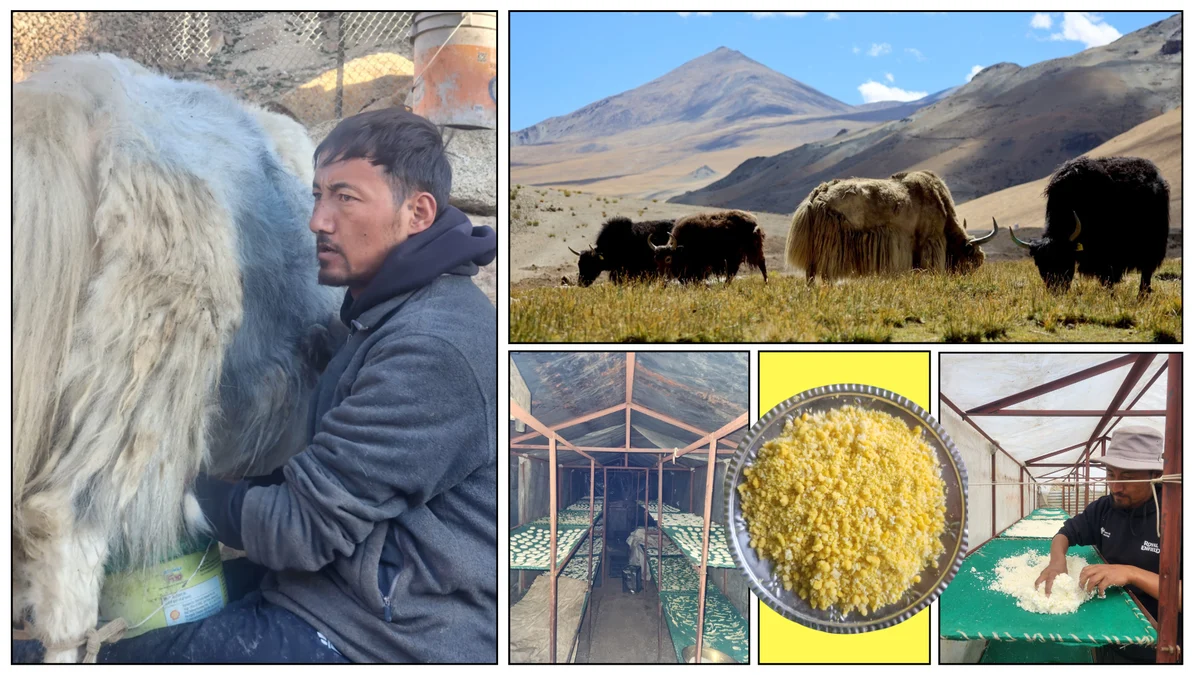
Leh, Ladakh – In the starkly beautiful, high-altitude expanse of Ladakh’s Changthang region, where the air is thin and temperatures plummet to sub-zero, a quiet revolution is unfolding. Thenlay Nurboo, a 36-year-old yak herder, has brought global acclaim to his family’s ancestral craft, transforming humble yak milk into a prize-winning delicacy. His soft yak chhurpe has earned a gold medal at the prestigious Mundial do Queijo do Brasil, an international competition celebrating dairy excellence. This triumph, however, is more than just an individual achievement; it is a potent symbol of the enduring resilience of Ladakh’s pastoral traditions, a beacon of hope against the encroaching challenges of climate change and economic pressures, and a testament to the untapped potential of indigenous food systems.
A Taste of the Himalayas: From Survival Staple to Global Gold
The story of Thenlay Nurboo’s award-winning chhurpe begins long before the glitz of international competitions. It starts at 5:30 AM, amidst the biting cold of the Changthang highlands, at an altitude of 16,600 feet. Here, Nurboo, bundled in a thick yak wool sweater, begins the slow, laborious, and entirely manual task of milking his family’s herd of shaggy-haired yaks. This daily ritual, taking four to five hours, yields approximately 60 liters of rich, creamy milk from 50 to 60 yaks. For generations, this milk, with its distinct earthy aroma and creamy notes, has been the cornerstone of survival in Ladakh’s unforgiving landscape, transformed into butter, buttermilk, and the quintessential chhurpe.
This traditional cheese, a staple for the nomadic Changpa people, typically possesses a dense yet chewy texture and a subtle smoky flavor, often derived from the use of yak dung as fuel during its preparation. It is a food born of necessity, designed to sustain life through harsh winters and remote journeys. Yet, this April, Nurboo’s chhurpe, a softer, artisanal variant of the regional specialty, transcended its utilitarian origins to capture the world’s attention.

The Unforeseen Journey to Brazil: A Testament to Dedication
Nurboo’s journey to the Mundial do Queijo do Brasil was not without its dramatic turns. He received the invitation a mere 12 days before the event, presenting a logistical hurdle compounded by the necessity of a yellow fever vaccination. A trip to Delhi for the inoculation proved unfruitful as he arrived minutes after the vaccination center closed. Undeterred, he collaborated with the National Dairy Development Board (NDDB) to ensure his cheese made the journey to Brazil.
"I did not want to waste government money," Nurboo explained, his voice laced with a quiet pride. "I had already briefed the officials [of the NDDB] about the process and told them to present the cheese." This pragmatic approach, coupled with his deep understanding of his product, laid the groundwork for an unexpected triumph. The news that his cheese, crafted using time-honored methods passed down through generations, had secured a gold medal arrived as a profound affirmation.
A Personal Renaissance: Redefining a Pastoral Career
The gold medal was more than just an accolade for a dairy product; it was a catalyst for profound personal reflection for Nurboo. For years, he had grappled with the question of whether yak herding was the right career path, especially in a region where tourism and other professions often appear to offer more lucrative opportunities. "Winning the award removed that doubt," he stated emphatically.

Having spent seven years herding yaks with his parents, and having previously experimented with European-style cheesemaking, Nurboo understood the allure of alternative careers. In many Changthang families, herding yaks is even considered a form of punishment for children who do not study diligently, a reflection of its perceived arduousness. "Winning made me certain that this is what I want to do; I don’t want to pursue anything else," he declared, his resolve palpable. This recognition has solidified his commitment to his ancestral livelihood, inspiring him to see it not as a chore, but as a viable and rewarding profession.
India’s Culinary Ascent: A Collective Triumph
Nurboo’s Yak Chhurpe-Soft was not the sole Indian representative to shine on the international stage. India made a remarkable debut at the Mundial do Queijo do Brasil, with four Indian cheeses clinching awards. Alongside Nurboo’s creation, cheeses from Mumbai-based Eleftheria Cheese, founded by Mausam Narang, also garnered significant recognition. Narang’s artisanal brand, which partners with family-run farms and utilizes both cow and goat milk, saw its Brie-style Gulmarg awarded a super gold, its Brunost a gold, and its Kaali Miri a silver. The judging process, a blind tasting, assessed the cheeses on their visual appeal, flavor, and texture, underscoring the quality and diversity of Indian dairy products.
The Art and Science of Yak Chhurpe: A Deeper Understanding
At Nurboo’s roadside artisanal enterprise, "Nomadic Farm," located in eastern Ladakh, the gold medal and a letter of appreciation from President Droupadi Murmu are proudly displayed. Here, his yak cheese commands a price of ₹2,000 per kilogram, a testament to its unique character and growing demand. This distinctiveness is deeply rooted in the traditional cheesemaking process and the natural diet of the yaks.

"A large proportion of what the animals eat are medicinal plants across the Himalayan region," Nurboo explained, highlighting the unique terroir that imbues his cheese with its exceptional qualities. He also elaborated on the appreciated smoky flavor, a direct result of using yak dung as fuel during the cheesemaking process. While he has not formally studied cheesemaking, his experimentation with cheeses like French Tomme and Spanish Manchego has informed his approach. However, he remains steadfast in his commitment to traditional practices, recognizing that direct competition with European cheeses, which often require vast quantities of milk, is not feasible.
The Craft Behind the Cheese: A Step-by-Step Revelation
The creation of chhurpe is a meticulously orchestrated process, deeply intertwined with the rhythms of nature and tradition. It begins with fresh yak milk, gently heated to a temperature between 32°C and 35°C, a range that fluctuates with the prevailing weather conditions. A small quantity of starter culture is then introduced, allowing the milk to ferment overnight.
The following morning, the fermented milk undergoes a crucial churning process, lasting approximately an hour. Historically, this was accomplished using a skyalpa, a traditional churn fashioned from goat or sheep skin. Today, Nurboo utilizes a more modern machine capable of churning up to 60 liters per hour.

Following the churning, the butter and lassi (a whey-based beverage) are separated. The butter is either sold directly or transformed into ghee. The lassi, a byproduct rich in nutrients, is then boiled to produce the cheese, which, in its fresh state, bears a resemblance to ricotta. "It is drained for three to four hours, dried, and made into a dough," Nurboo described. He further emphasized the critical role of weather: "In summer, when the yaks graze on fresh grass, the butter and cheese are richer, more yellow and flavorful. In winter, when grass is scarce, they are lighter in color and contain less fat." This seasonal variation is a direct reflection of the yaks’ natural diet and the impact of the environment on the milk’s composition.
The drying process, historically done on parachute cloth, has been significantly improved with the support of the Animal Husbandry Department. They have provided specialized cheese-drying shelves, which facilitate faster and more hygienic drying. This modernization, while respecting traditional methods, ensures that the cheese meets international hygiene and quality benchmarks. The final products include hard dried chhurpe, powdered cheese, and a recently introduced sweet cheese, sweetened with sugar before drying. These cheeses boast an impressive shelf life, capable of being stored for up to two years.
Nurboo’s dedication to understanding his product extends to exploring its nutritional potential. He has identified that yak cheese is particularly rich in protein. The residue left after cheese extraction, known as churku, is also highly proteinaceous. Nurboo is now exploring the possibility of creating protein drinks from this byproduct, further diversifying the utilization of yak milk and its derivatives.

Evolving Traditions: From Local Sustenance to Global Palates
The global recognition of Nurboo’s chhurpe has sparked a surge in demand for yak milk, lassi, cheese, and butter. Local residents and tourists alike are increasingly drawn to Nomadic Farm, eager to learn about the products and the stories behind them. "I tell them the story behind the cheese, about the yak herds and the altitudes at which they graze," Nurboo shared. He has even received inquiries from restaurants in major cities like Mumbai. However, Nurboo remains committed to maintaining an artisanal scale of production.
"Supplying to restaurants means I have to produce cheese in large quantities. For that, I’ll need a large herd of more than 300 yaks, and enough pasture land for them, which isn’t feasible. So, exports and large orders to hotels are not possible at the moment," he explained, highlighting the logistical and environmental constraints.
The Delicate Balance: Preserving Authenticity in a Global Market
The ascent of chhurpe from a survival staple to a celebrated delicacy raises crucial questions about authenticity and accessibility. Shalini Philip, co-founder of The Farm, an integrated dairy farm and restaurant in Chennai and a pioneer in India’s artisanal cheese movement, points out the inherent paradox. "Chhurpe has always been a part of Himalayan kitchens. But to attain a wider audience, cheesemakers may either have to adopt western techniques or evolve traditional methods into something that has international appeal," she observed.

Philip also voiced concerns about the potential for indigenous foods to become unaffordable for their original communities. "Once it is on tasting menus and fancy tables, sometimes it could mean that the indigenous people can no longer afford their own food." This highlights the delicate balance between global commercialization and the preservation of local heritage and affordability.
Conversely, this newfound appreciation offers a unique opportunity for cultural immersion. "Instead of taking a flight to Leh and driving up to Khardung La Pass to check it off a bucket list, people can get an insight into aspects of the culture they wouldn’t otherwise know," Philip added.
Chef Nilza Wangmo, proprietor of Alchi Kitchen, a renowned establishment serving classic Ladakhi cuisine, sees immense potential in chhurpe. She creatively incorporates dried chhurpe into soups, with her potato yak cheese soup being a particular favorite. Fresh chhurpe, she notes, offers a "distinct, slightly tangy flavor" and could serve as a compelling alternative to paneer in salads. Wangmo believes that the wider recognition of chhurpe "could help preserve Ladakh’s pastoral traditions while improving the livelihoods of yak herders."

The Identity of Chhurpe: A Plea for Individuality
Shalini Philip also underscored the importance of naming and branding. "Now, cheesemakers around the world choose to name their cheeses, to give it an identity. Chhurpe is a generic term that refers to many different types of cheeses made across the Himalayas. It can range from something soft and fresh to the super hard variety that is sold in the U.S. as dog treats. So, I hope he names his award-winning cheese and gives it its own identity," she urged. This sentiment reflects a growing understanding that distinct products require distinct identities to thrive in the global marketplace.
Challenges on the Horizon: The Uncertain Future of Yak Herding
Ironically, this moment of international triumph arrives at a critical juncture for yak herding in Ladakh. The very ecosystem that sustains these animals and their herders is under threat. Climate change is altering the high-altitude landscape, with retreating glaciers and declining snowfall. "Earlier, we used to receive a lot of snow, but now there is more rain," Nurboo observed. While increased rainfall might lead to greener slopes in the short term, a continued decline in snowfall poses a significant risk to freshwater springs, a vital resource for both yaks and human communities.
Furthermore, yak herding itself has seen a considerable decline across the Changthang region, reportedly by nearly 50%. The allure of better employment opportunities is drawing younger generations away from traditional livelihoods. In Nurboo’s village, his family is the sole purveyor of yak milk, a stark indicator of this demographic shift.

The Economic Equation: The Unvalued Potential of Yak Wool
Adding to these challenges are the economic realities of yak herding. The commercial value of yak wool, a crucial byproduct, remains significantly low. While pashmina, Ladakh’s prized export, can fetch between ₹6,000 to ₹8,000 per kilogram, yak wool garners only around ₹600 per kilogram, with limited buyers. This underestimation of yak wool’s potential is puzzling, given its versatility. It can be used to create blankets, shawls, sweaters, and traditional chali mats. The iconic rebo tent, a waterproof and durable dwelling for nomadic herders, is also crafted from woven yak wool and can last up to 15 years. "The quality and potential are there, the question is why are we not making better use of them," Nurboo questioned, highlighting a missed economic opportunity.
To address these multifaceted issues, Nurboo is actively involved in the 13-member Yak Herders Association, formed five years ago. The association advocates for the legalization of yak meat, which they believe could potentially double farmers’ incomes, and the establishment of a National Research Centre for Yak to foster research and development in yak husbandry and related products.
Konchok Norgay, a local entrepreneur, expressed optimism about the award’s impact. "Now, young people may see the potential in dairy farming," he stated. "Today, people are health conscious, and there is a huge demand for fresh, quality products. I see a lot of scope in the dairy sector, and I believe many more youngsters will take it up in the future." This sentiment underscores the potential for the award to catalyze a revival of interest in yak herding and dairy farming among the youth.

Securing Sustainable Livelihoods: The Enduring Value of Tradition
For Thenlay Nurboo, the gold medal transcends mere global recognition. It is a profound validation of the knowledge, food systems, and livelihoods that have enabled communities to thrive in one of the world’s most challenging landscapes. "If I had sold all my yaks and invested in tippers or JCBs like many others, it would not have been sustainable," he asserted. He pointed to the resilience of his family’s way of life during the COVID-19 pandemic, when tourism and other businesses ground to a halt, yet their traditional practices continued unabated.
"Tourism is seasonal, but this work goes on throughout the year. We need to help young people understand the importance of sustainable livelihoods in Ladakh," Nurboo emphasized. He firmly believes that the future of the yak, and indeed a way of life, is intrinsically linked to the preservation and evolution of these traditional practices, with cheese production playing a pivotal role.
The story of Thenlay Nurboo and his award-winning chhurpe is a compelling narrative of resilience, innovation, and the enduring power of tradition. It is a reminder that in the most remote corners of the world, ancient wisdom, when nurtured and adapted, can not only sustain communities but also captivate the global imagination, offering a taste of heritage that is both delicious and deeply meaningful. The challenge now lies in ensuring that this newfound success translates into sustainable livelihoods, preserves the delicate balance of the Himalayan ecosystem, and empowers future generations to embrace their rich pastoral heritage with pride and purpose.
