

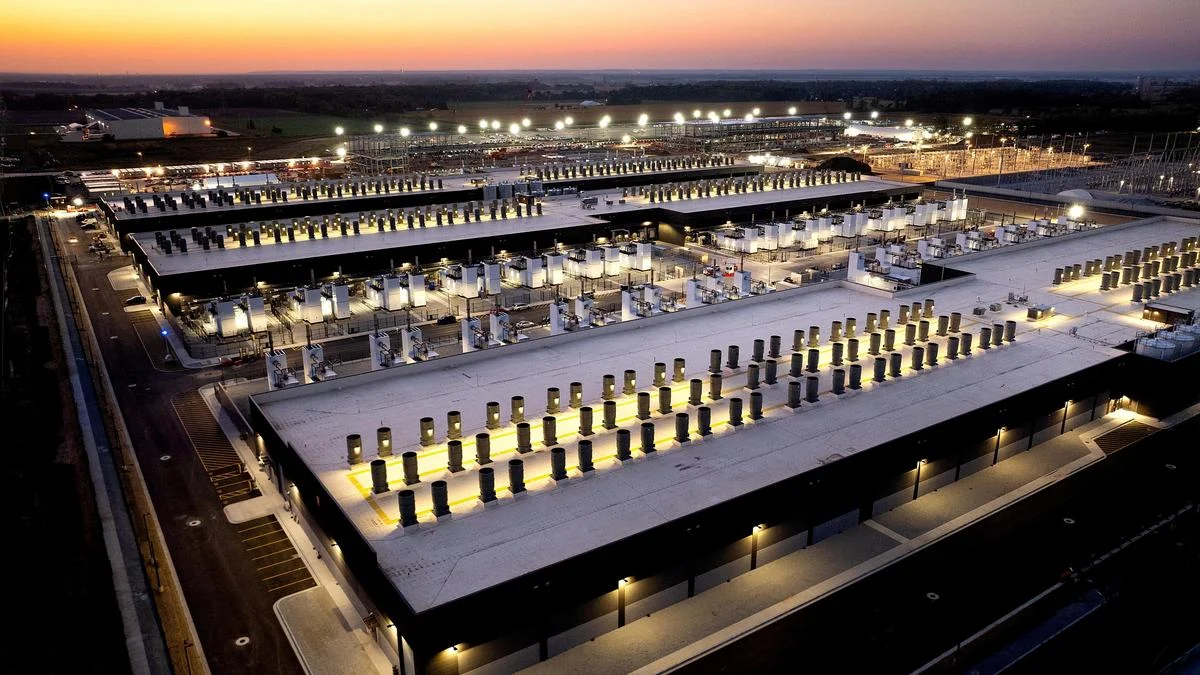
The relentless hum of server farms, once a quiet symbol of America’s burgeoning technological prowess and artificial intelligence ambitions, has morphed into a discordant political battle cry ahead of November’s midterm elections. What was once seen as an engine of economic growth, eagerly courted by states with generous tax incentives and promises of high-tech jobs, has unexpectedly become a lightning rod for public anger. This seismic shift is fueled by rapidly escalating electricity bills, persistent noise pollution, and a growing sense of local communities bearing the brunt of Big Tech’s insatiable energy demands.
The backlash is striking in its bipartisan nature. Democrats, long wary of corporate influence, are finding common ground with an increasing number of Republicans, many of whom previously championed such developments. This widespread discontent has permeated the political discourse, with candidates in at least 21 races across 18 states airing television advertisements specifically targeting data centers this election cycle. Marketing data cited by U.S. media indicates an almost even split between both parties in deploying this potent new wedge issue.
The sheer scale of demand from these facilities is staggering. An independent market monitor revealed that on the PJM Interconnection grid, which serves the crucial Senate battleground state of Ohio and 12 other states, demand from data centers drove capacity costs up by an astounding $9.3 billion in a single year—a monumental 174 percent increase. This financial burden is directly translating into higher household utility bills, igniting a populist distrust of Silicon Valley that transcends traditional political divides. Lawmakers who, until recently, were enthusiastic proponents of these sprawling server farms, showering them with tax breaks and promises of investment, are now facing intense scrutiny and a reckoning from their constituents. The data center issue, once a niche concern, has rapidly ascended to become a "sleeper issue" with the potential to significantly impact electoral outcomes nationwide.
A Shifting Landscape: The Chronology of Discontent
The journey of data centers from celebrated economic drivers to political liabilities is a compelling narrative of evolving public perception and the unintended consequences of rapid technological expansion.
From Welcome Mat to Warning Signs: Early Enthusiasm and Emerging Concerns
For years, state and local governments rolled out the red carpet for data center developers. The allure was undeniable: these facilities promised to anchor states in the digital economy, creating high-paying tech jobs and attracting further investment. Politicians vied to brand their regions as the next "epicenter of AI development," offering substantial tax breaks, expedited permitting processes, and access to robust infrastructure.
Texas Governor Greg Abbott, for instance, was a vocal advocate, proudly touting his state’s attractiveness for AI infrastructure. The narrative was simple and appealing: embrace the future, create jobs, and secure a competitive edge in the global tech race. This period saw a proliferation of data center projects across the country, with many communities eager to host them, often overlooking the long-term implications for local resources and infrastructure. The initial economic impact assessments often focused on construction jobs and the prestige of hosting tech giants, with less emphasis on the sustained operational costs and environmental footprint.
The Tipping Point: Escalating Costs and Community Outcry
However, the honeymoon period for data centers began to wane as their operational realities became undeniable. The sheer energy demands of these facilities, constantly processing vast amounts of data and requiring intensive cooling, started to strain existing power grids. This strain, as evidenced by the independent market monitor’s report on the PJM Interconnection grid, translated directly into soaring capacity costs, which were then passed on to consumers in the form of higher electricity bills. The $9.3 billion increase in capacity costs—a staggering 174 percent jump in just one year—became a stark, quantifiable measure of the economic burden.
Simultaneously, the promised "quiet" presence of these facilities proved to be a myth for many communities. Residents living near newly constructed data centers began reporting persistent, intrusive noise pollution. Melissa Burnett, a 44-year-old resident of Brazoria, Texas, situated between Houston and the Gulf Coast, vividly described her experience to AFP. The 17-megawatt center that opened near her quiet neighborhood last year shattered its serenity, producing a constant hum that she likened to "a freight train always coming at you." Burnett’s experience echoed a growing sentiment among communities: "We were not supposed to hear it, nor was it supposed to affect our quality of life, and it’s just done the opposite, you know?" This convergence of rising household bills and tangible impacts on daily life ignited a potent blend of frustration and a broader populist distrust of Silicon Valley, exposing the vulnerability of lawmakers who had championed these projects.
Political Realignment: Lawmakers Respond to Constituents
As public anger mounted, a discernible political realignment began to take shape. Lawmakers, once staunch proponents, found themselves compelled to respond to their constituents’ grievances. The issue transcended party lines, demonstrating its power to unite disparate groups.
In Texas, Governor Greg Abbott, who once declared his state the "epicenter of AI development," performed a noticeable pivot. He has since frozen new data center projects, allowing regulators to weigh their impact on critical resources like power and water supplies. His Democratic challenger has seized on the issue, demanding a moratorium until stronger safeguards are enacted, accusing Abbott of prioritizing wealthy interests over ordinary Texans.
Similarly, states like New York have imposed year-long moratoriums on new hyperscale facilities, indicating a cautious approach to future development. Pennsylvania has also moved to require developers to cover infrastructure costs and adhere to tougher standards regarding water use, local hiring, and community consultation. These actions signify a departure from the previous "anything goes" approach, reflecting a growing recognition that the costs of unchecked development outweigh the perceived benefits. Even candidates who initially supported data center expansion, such as Wisconsin Republican gubernatorial nominee Tom Tiffany, have shifted their positions, now advocating for scrapping tax incentives and imposing tighter regulations, though stopping short of an outright ban. This widespread political recalibration underscores the potency of the data center issue as a decisive factor in local and state elections.
The Tangible Impacts: Supporting Data and Real-World Consequences
The political backlash against data centers is not merely ideological; it is rooted in tangible, measurable impacts on energy grids, local environments, and community well-being. The data supports the grievances, painting a clear picture of the costs associated with the rapid expansion of AI infrastructure.
The Energy Drain: Straining Grids and Inflating Bills
At the heart of the controversy lies the astronomical energy consumption of data centers. These facilities are essentially massive computing factories, housing thousands of servers that run 24/7, generating immense heat and requiring constant, intensive cooling. This process demands colossal amounts of electricity, often equivalent to that of small cities.
The independent market monitor’s report on the PJM Interconnection grid provides a stark illustration of this burden. Serving a vast region encompassing Ohio, Pennsylvania, New Jersey, Maryland, Delaware, and parts of Illinois, Indiana, Kentucky, Michigan, North Carolina, Tennessee, Virginia, West Virginia, and the District of Columbia, the PJM grid saw its capacity costs surge by $9.3 billion in a single year due to data center demand. This 174 percent increase is not an abstract figure; it directly translates into higher wholesale electricity prices, which are then passed on to residential and commercial consumers. For the average household, this means an unwelcome increase in their monthly utility bills, compounding financial pressures in an era of general economic anxiety.
The issue extends beyond just the quantity of electricity. Data centers often require significant upgrades to existing grid infrastructure, including new power lines, substations, and even new power generation facilities. The question of who bears the cost for these upgrades—ratepayers or the tech companies themselves—is a central point of contention, forming the basis of many political campaigns and regulatory debates. The sheer scale of planned AI expansion suggests that without significant policy changes, this energy drain will only intensify, placing unprecedented strain on an already aging and vulnerable national grid.
Noise Pollution and Quality of Life: A Community Perspective
Beyond the economic strain, data centers impose a direct, often debilitating, burden on the quality of life for nearby residents. The constant whirring of cooling fans, backup generators, and other operational machinery creates a pervasive, low-frequency hum that can penetrate homes and disrupt daily life. Melissa Burnett’s description of a "freight train always coming at you" is a powerful testament to this often-underestimated form of pollution.
This incessant noise can lead to sleep disturbances, stress, and a general erosion of the peace and quiet that residents expect in their homes. For communities that were promised "clean industry" and minimal impact, the reality can be a rude awakening. The psychological toll of living next to a perpetually noisy industrial facility is significant, yet it often goes unquantified in economic impact statements.
Furthermore, the environmental footprint extends to water usage. Data centers require vast quantities of water for cooling systems, particularly in regions where water resources are already scarce. Texas Governor Abbott’s decision to freeze new projects explicitly cited concerns about both power and water supplies, highlighting the multifaceted environmental challenges posed by these facilities. The construction itself also involves significant land use, often transforming agricultural or natural landscapes into sprawling industrial complexes, further impacting local ecosystems and community aesthetics.
Economic Promises vs. Realities: Scrutinizing the Job Creation Narrative
One of the primary selling points for data centers has always been the promise of job creation and economic development. While construction phases do generate temporary employment, the long-term operational staffing of a data center is often far less than initially advertised, especially when compared to the enormous energy and land resources they consume. Modern data centers are highly automated, requiring a relatively small number of highly skilled technicians to manage thousands of servers.

This disparity raises critical questions about the true return on investment for communities. Are the substantial tax breaks and incentives offered to tech giants genuinely benefiting local economies, or are they primarily subsidizing the operations of highly profitable corporations with minimal local employment impact? The debate is shifting from simply "jobs created" to a more nuanced analysis of the type of jobs, their longevity, and whether they justify the significant public investment and environmental burden. The populist distrust of Silicon Valley is fueled, in part, by this perception that local communities are footing the bill for global tech expansion without reaping commensurate benefits.
The Political Response: Divergent Strategies and Emerging Policies
The political landscape is reacting dynamically to the burgeoning data center controversy, revealing both bipartisan alignment on the ground and a notable divergence at the federal level, particularly within the Republican party.
Bipartisan Backlash at the Local and State Level
The most striking aspect of this political phenomenon is its ability to unite politicians from across the ideological spectrum. This is not a partisan squabble but a shared response to localized grievances that cut across traditional voting blocs.
In Texas, Republican Governor Greg Abbott’s decision to freeze new data center projects signals a pragmatic shift, prioritizing concerns over power and water supplies in a state grappling with rapid growth and grid vulnerabilities. His Democratic challenger, meanwhile, is pushing for a full moratorium, highlighting the bipartisan nature of the opposition to unchecked development.
Ohio, a key Senate battleground, offers a vivid illustration. Sherrod Brown, a Democrat, has launched at least four ads attacking Republican Lieutenant Governor Jon Husted for actively courting data center investment. Brown’s campaign brands Husted as "the face of data centers" and pledges to make operators pay the full cost of the power they consume. This aggressive tactic underscores the political potency of the issue. Indeed, Senate Republicans have openly warned that the data center issue could cost Husted the race, labeling it a "sleeper issue" whose impact could "chill political support for the industry nationwide" if it leads to a defeat.
Similar arguments are emerging in disparate races across the country:
- A Republican running for governor in Florida is campaigning on shielding families from facilities that drive up utility bills.
- A Pennsylvania Democrat is demanding that tech companies bear their own infrastructure costs.
- A Wyoming Republican won a House primary largely on advertisements attacking Silicon Valley billionaires, tapping into a broader populist anti-tech sentiment.
- In Michigan, the issue proved decisive in a primary, where a leftist candidate defeated two better-connected Democrats by uniting "committed Republicans, Trump voters, independents and Democrats" against data center expansion.
- Wisconsin’s Republican gubernatorial nominee, Tom Tiffany, has taken to derisively calling his Democratic opponent "Data Center David Crowley." This is a significant pivot for Tiffany, who earlier this year was praising the technology and voting to fast-track AI infrastructure. Now, he advocates for scrapping state tax incentives and imposing tighter industry regulations, though he stops short of a complete ban.
Democratic governors are also taking proactive measures. New York has imposed a year-long moratorium on new hyperscale facilities, allowing the state to assess their full impact. Pennsylvania has enacted tougher standards, requiring developers to cover infrastructure costs and meet stringent criteria on water use, local hiring, and community engagement. These actions reflect a growing consensus that the era of unfettered, subsidized data center expansion is drawing to a close.
The Federal Divide: Trump’s Stance and the National AI Imperative
Amidst this groundswell of local and state opposition, former U.S. President Donald Trump stands in stark contrast. He has largely refrained from joining the chorus of criticism against data centers, instead framing the industry as "essential to beating China on AI." This position puts him at odds with a growing segment of his own party, particularly those running on populist platforms that rail against Big Tech and corporate interests.
Trump’s administration, recognizing the strategic importance of AI dominance, has pursued a different approach. His spokeswoman, Karoline Leavitt, reiterated his stance, stating, "America must remain dominant in the AI race that is the future. I think the American people understand that, and this president certainly does."
In an attempt to mitigate the financial burden on consumers, Trump’s administration has secured a voluntary "Ratepayer Protection Pledge." Under this pledge, major tech companies including Google, Microsoft, Meta, Oracle, xAI, OpenAI, and Amazon have committed not to leave consumers paying for the power plants and grid upgrades their facilities require. While a step towards accountability, this voluntary measure has not been sufficient to quell the barrage of political advertisements or the underlying public anger, highlighting the limitations of such pledges in the face of widespread community impact. Trump’s focus remains on the geopolitical race for AI supremacy, a perspective that sometimes clashes with the localized environmental and economic concerns dominating state and local elections.
Implications: What This Means for Big Tech, Policy, and Future Elections
The emergence of data centers as a potent political issue signals a significant turning point, with profound implications for the technology industry, energy policy, and the future trajectory of American politics.
A Chill for Big Tech’s Expansion Plans
The bipartisan backlash and the increasing regulatory scrutiny represent a substantial challenge to Big Tech’s previously unhindered expansion. The days of easily securing tax breaks and expedited permits for large-scale data center projects appear to be numbered. The warning from Senate Republicans that a defeat blamed on data centers could "chill political support for the industry nationwide" is not an overstatement; it reflects a growing political risk that developers can no longer ignore.
This shift will likely force tech companies to re-evaluate their site selection strategies, perhaps favoring locations with more robust existing infrastructure, lower population densities, or those that have already embraced renewable energy solutions. They will also need to engage more proactively and transparently with local communities, addressing concerns about noise, water usage, and energy demands before they escalate into political firestorms. The "Ratepayer Protection Pledge," while a start, clearly demonstrates that voluntary commitments are insufficient to assuage public discontent. The industry will need to demonstrate tangible, verifiable actions to mitigate their impact and contribute equitably to infrastructure costs.
Redefining the Tech-Economy Narrative
For decades, the tech industry has largely enjoyed a positive public image, synonymous with innovation, progress, and high-wage job creation. The data center controversy is chipping away at this narrative, forcing a re-evaluation of whether technological advancement, particularly in AI, always translates into unadulterated benefits for local communities. The debate is shifting from a simplistic "tech is good" mantra to a more nuanced discussion about the trade-offs involved.
The intense scrutiny on tax breaks and incentives will likely lead to their re-negotiation or outright elimination in many areas. States and municipalities will be pressured to demand more stringent community benefit agreements, environmental impact assessments, and guarantees of local hiring and infrastructure investment in exchange for hosting these facilities. This redefinition of the tech-economy narrative challenges the notion that any tech-related development is inherently beneficial, pushing for greater accountability and a more equitable distribution of costs and benefits.
The Future of Energy Policy and Local Autonomy
The data center issue is inextricably linked to broader discussions about energy policy and grid modernization. The massive energy demands highlight the urgent need for robust, resilient, and sustainable power infrastructure. This will likely accelerate investment in renewable energy sources and smart grid technologies, as communities and states seek to power these facilities without overburdening existing systems or increasing reliance on fossil fuels.
Furthermore, the controversy underscores the growing importance of local autonomy in decision-making regarding large-scale industrial projects. Communities are asserting their right to control their local environment, infrastructure, and quality of life, pushing back against decisions made at higher levels that do not adequately consider local impacts. This trend could lead to more localized control over zoning, permitting, and environmental regulations for industrial developments, including data centers. It also raises questions about whether a national strategy is needed to balance the imperatives of AI development with local environmental and economic concerns.
A Bellwether for Future Elections?
Perhaps the most significant implication is the potential for data centers to become a recurring and increasingly influential issue in future electoral cycles. The ability of this issue to unite diverse political groups—from committed Republicans and Trump voters to independents and Democrats—demonstrates its broad appeal and potential to sway elections. It taps into a powerful populist sentiment that is skeptical of large corporations, concerned about rising costs, and protective of local quality of life.
As AI continues its rapid expansion, the need for more data centers will only grow, making this conflict more acute. The "silent hum" of server farms has truly become a very loud political statement, forcing politicians, developers, and communities alike to confront the complex realities of powering America’s technological future. The resolution of this unforeseen political firestorm will shape not only the landscape of AI infrastructure but also the dynamics of American politics for years to come.
