

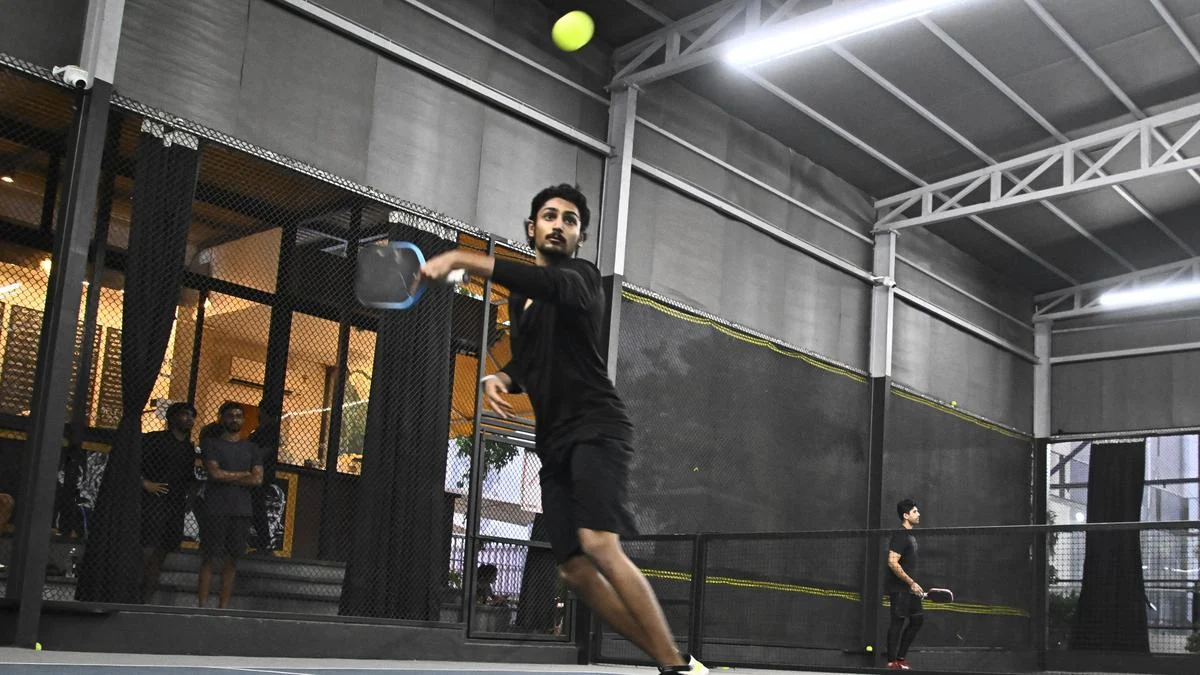
Hyderabad, India – The rhythmic thwack of a plastic ball against a paddle has become the unofficial soundtrack to weekday evenings and weekends across Hyderabad. Once a niche activity, pickleball has exploded in popularity, transforming quiet sports facilities into vibrant hubs of activity. What began as a casual, social game, often discovered through fleeting social media clips, is now drawing a diverse crowd, from IT professionals seeking an after-work escape to seasoned athletes looking for a new challenge, and even dedicated enthusiasts investing significant time and money into the sport.
The sheer proliferation of pickleball courts across the city is a testament to its burgeoning appeal. Just a few years ago, finding a dedicated space to play was a challenge, with only a handful of courts scattered across Hyderabad. Today, the landscape has dramatically shifted. "Earlier there were only 8 to 10 courts in the city. Now you can find courts in different localities," remarks Dorlodhu Pradeep, a part-time coach at Hyderabad Paddle Park. This rapid expansion has democratized access to the sport, making it more convenient and accessible for a wider segment of the population.
The Epicenter of the Pickleball Boom
Certain areas have emerged as prime destinations for pickleball enthusiasts. Jubilee Hills, long known for its upscale ambiance, now boasts Hyderabad Paddle Park and The Kitchen, which consistently draw substantial crowds during peak hours. These venues offer a refined experience, often featuring air-conditioned courts that provide respite from the city’s notorious heat and contribute to the sport’s premium appeal.
Meanwhile, Madhapur, the heart of Hyderabad’s bustling IT corridor, has found its own pickleball haven in Pickle Yard, located in Ayyappa Society. This venue has become a particular favorite among the city’s tech workforce, offering a convenient and engaging way to unwind after long hours at the desk. For those seeking a more expansive sporting environment, Gandipet’s Cross Court Sports provides a larger campus, catering to a broader range of athletic pursuits alongside pickleball. Other popular spots contributing to the city’s pickleball ecosystem include Dink N Dash and the prestigious Pullela Gopichand Academy, further solidifying the sport’s widespread presence.
Understanding the Appeal: What is Pickleball?
At its core, pickleball is an accessible yet strategically engaging paddle sport that ingeniously blends elements of tennis, badminton, and table tennis. The game is played on a court that mirrors the dimensions of a badminton doubles court, making it significantly more compact than a standard tennis court. Players wield solid paddles, rather than strung rackets, and engage with a perforated plastic ball. This unique ball, due to its construction, exhibits an unpredictable bounce, adding a layer of complexity and requiring players to develop keen anticipation and quick reflexes.

A fundamental rule in most pickleball formats dictates that the ball must bounce once before volleys are permitted. This rule, often referred to as the "two-bounce rule," distinguishes it from tennis and encourages strategic play rather than outright aggression. Points are typically scored only by the serving side, further emphasizing the importance of consistent serving and defensive play.
While various formats exist, doubles play is overwhelmingly the most popular in Hyderabad. This arrangement, where four players share a court, fosters a strong social dynamic and makes it an ideal activity for group outings and casual gatherings. The simplicity of the basic rules allows newcomers to grasp the game quickly, while the subtle nuances of strategy and shot-making provide ample depth for seasoned players to explore.
The origin of the name "pickleball" itself is shrouded in a bit of delightful ambiguity, with competing anecdotes adding to its charm. One widely circulated explanation attributes the name to a dog named Pickles, who was reportedly fond of retrieving stray balls. Another theory traces its etymology to the "pickle boat" in rowing, a term used for a crew formed from leftover members of other teams. Both stories are frequently shared in online discussions and within the pickleball community, adding a layer of folklore to the sport.
The Hyderabad Ignition: How the City Embraced Pickleball
The initial spark for Hyderabad’s pickleball fervor can largely be traced back to the pervasive influence of short-form video content on social media platforms. These visually engaging clips, often showcasing the sport’s fast-paced action and social appeal, captured the attention of many. Furthermore, corporate groups, perpetually on the lookout for innovative team-building activities and engaging employee wellness programs, found themselves drawn to pickleball’s unique blend of physical activity and social interaction.
Darla Jyotirmayi, a finance professional from Nanakramguda who makes the regular trek to Jubilee Hills to play, recalls the initial allure. "We kept seeing it online and finally decided to try it," she shares. "Though it seemed simple at first, we discovered it wasn’t." This sentiment is echoed by many newcomers. The apparent simplicity of the game, evident in those initial viral videos, often belies a deeper strategic and technical challenge that quickly becomes apparent upon stepping onto the court.
Garikapati Madhavi, an engineer from Kukatpally, experienced a similar disconnect between perception and reality during her first foray into the sport. "Online videos never show how hard it is to judge the bounce," she explains. "You think you know where it will go, and then you miss it completely." This initial struggle, far from deterring players, often serves as a powerful motivator. The challenge of mastering the unpredictable bounce and refining one’s technique becomes a compelling reason to return to the courts, fostering a cycle of persistent practice and gradual improvement. This gap between initial expectation and the actual gameplay experience has been a significant driver of the sport’s sustained growth in Hyderabad.

A Diverse Playing Field: Who is Picking Up the Paddle?
A casual observation across Hyderabad’s pickleball courts reveals a remarkably diverse demographic. The scene is a vibrant tapestry of individuals united by their shared enthusiasm for the game. Corporate teams, often participating for the first time as part of organized outings, mingle with IT professionals who transition seamlessly from their office attire to athletic wear, heading straight to the courts after work. Teenagers with backgrounds in competitive tennis are also increasingly present, bringing a focused, results-driven approach to their games.
Gaurav Jha, a digital marketer residing in Madhapur’s Ayyappa Society, discovered pickleball during a corporate event. "My boss explained the rules and I just joined," he recounts. Like many others, he initially found the sport challenging. "I struggled to connect with it," he admits, recalling the difficulty in accurately hitting the ball. It took him several matches, approximately five to six, before he started to feel comfortable and develop a rudimentary understanding of the game’s rhythm.
Chandravela Yash, a competitive tennis player who travels from KPHB to The Kitchen in Jubilee Hills – a commute of 30 to 50 minutes – adapted to pickleball more rapidly than most. However, he remains acutely aware of the sport’s subtleties. "Tennis helped me adjust," he states, "But the ‘dink’ is the hardest shot and consistency matters." The "dink" shot, a soft, arcing shot played into the opponent’s non-volley zone, requires immense finesse and control, often proving to be a significant hurdle for players accustomed to more forceful strokes.
At the more committed end of the spectrum is Kannur Gopi from Begumpet. A regular at The Kitchen, Gopi has transitioned from casual play to actively participating in competitive tournaments in under a year. His dedication comes with a significant financial investment. He estimates spending upwards of ₹40,000 annually on court bookings, equipment, and shared costs. His high-performance carbon fibre paddles, costing around ₹6,000 each, require replacement every three to four months due to the intensity of his play. "Most other sports are cheaper," he acknowledges, "But once you start, it is hard to stop." This sentiment encapsulates the addictive nature of pickleball for its dedicated adherents.
The Economic Equation: Understanding the Costs of Play
The financial outlay for engaging in pickleball in Hyderabad is a factor that varies significantly depending on the venue and the time of play. Smaller, more informal facilities often charge around ₹700 per hour for court rental. However, at premium indoor venues, particularly those equipped with air conditioning, the rates are considerably higher. Hyderabad Paddle Park, for instance, charges approximately ₹1,500 per hour for court time, while The Kitchen commands a rate of around ₹1,600 per hour.

Beyond court rental, the cost of equipment adds another layer to the financial commitment. Entry-level paddles can be purchased for ₹1,500 to ₹2,000, offering a reasonable starting point for newcomers. However, for those looking to enhance their performance, advanced carbon fibre paddles, which offer greater power and control, can cost substantially more. The standard practice of playing doubles means that the cost of court time is typically split among four players. While this arrangement democratizes access and reduces the individual financial burden, it necessitates coordination among players or a willingness to join rotating groups to secure court time.
Navigating the Learning Curve: Skills, Safety, and Injury Prevention
The learning curve for pickleball, while accessible, presents its own set of challenges and considerations, particularly concerning equipment and injury prevention. Experienced players often distinguish between indoor and outdoor balls, noting that indoor balls tend to be slower and lighter, while outdoor balls are faster and heavier, neither behaving entirely intuitively for beginners. Mastering wrist control is identified as a crucial initial hurdle, as small technical errors can have a disproportionately larger impact on shot consistency compared to sheer power.
To mitigate the risk of injury, particularly ankle strains, the use of court-specific shoes is strongly recommended. These shoes are designed to provide adequate lateral support for the constant side-to-side movements characteristic of pickleball. Standard running shoes, while comfortable for forward motion, lack the necessary stability for the game’s dynamic nature.
Dorlodhu Pradeep, the coach at Hyderabad Paddle Park, emphasizes a fundamental principle that transcends pickleball and applies to any physical activity: proper warm-up is paramount. "Most injuries happen when players skip warm-ups," he states. "People only take it seriously after they get hurt." He further highlights that even a seemingly small adjustment, such as correcting wrist movement, can dramatically transform a beginner’s game and significantly enhance their enjoyment and proficiency.
For individuals with prior racket sport experience, becoming comfortable with the basics of pickleball typically takes two to three sessions. Those without such a background may require a longer period to adapt. A deeper understanding of the game’s intricacies, strategic nuances, and shot-making techniques develops over weeks of consistent play.
For the moment, pickleball sessions in Hyderabad are evolving beyond mere sporting activity. They have transformed into vibrant community gatherings, with the court serving as the central point around which social interactions, friendly rivalries, and shared passions revolve. As the sport continues its upward trajectory, it promises to further enrich Hyderabad’s recreational landscape, offering a dynamic and engaging outlet for fitness and camaraderie.
