

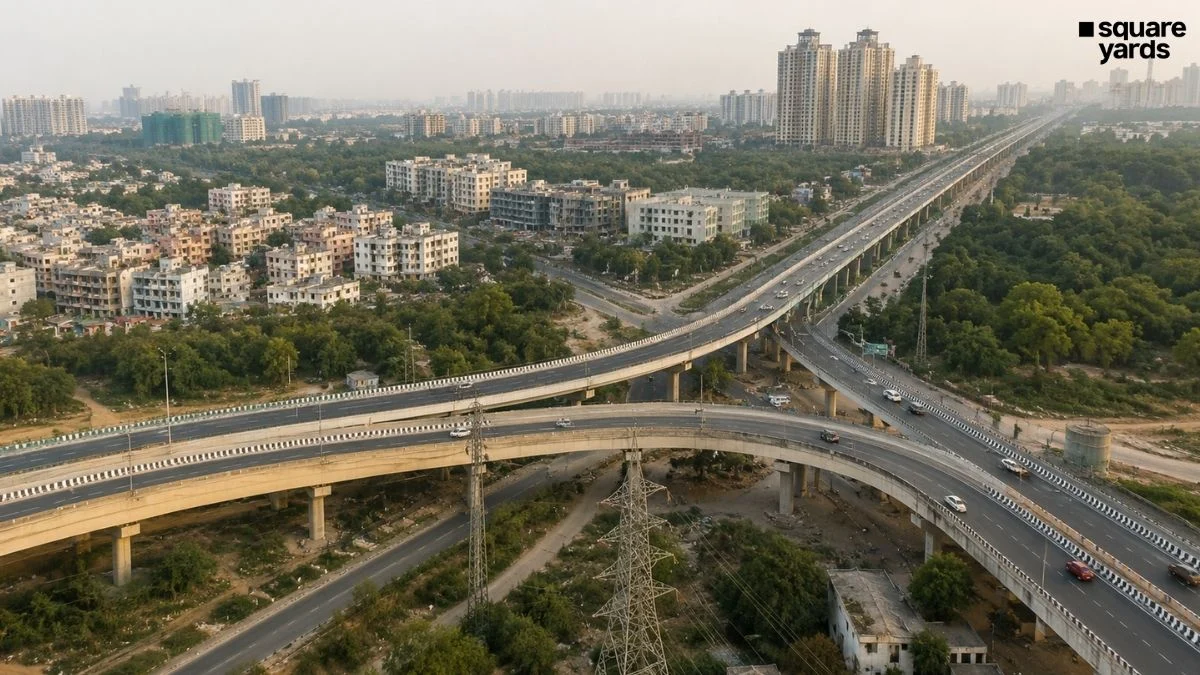
The landscape of Indian real estate is undergoing a fundamental transformation, driven not merely by housing demand, but by a massive, state-led infrastructure overhaul. As major metropolitan hubs face the limits of vertical and horizontal density, the focus has shifted toward the "periphery." New highways, twin tunnels, suburban rail corridors, and ring roads are no longer just civil engineering projects; they are the primary catalysts for a new era of suburban living. By drastically reducing "time-distance"—the time it takes to travel between two points—infrastructure is unlocking land value in areas that were previously considered too remote for primary residence.
1. Main Facts: The Connectivity Revolution Across Tier-1 Cities
The current infrastructure push is characterized by a shift toward multi-modal connectivity. In the Mumbai Metropolitan Region (MMR), the focus is on penetrating geographical barriers like the Sanjay Gandhi National Park (SGNP) and extending the suburban rail network. In Bengaluru and Hyderabad, the strategy revolves around bypasses and commuter rails to decongest the tech-heavy cores.
Key Highlights of the National Infrastructure Push:
- MMR’s Tunneling Feats: Two major tunnel projects (Thane-Borivali and Goregaon-Mulund) are set to bypass hours of traffic, slashing travel times by up to 80%.
- The Rail Expansion: The Panvel-Karjat suburban line is transitioning Karjat from a "second-home" destination to a viable commuter hub.
- The Ring Road Model: Hyderabad and Pune are utilizing massive regional and inner ring roads to create a "polycentric" city model, where multiple commercial hubs exist outside the main city center.
- Industrial-Residential Synergy: In Chennai, the Peripheral Ring Road is prioritizing the logistics-industrial corridor, which in turn fuels the demand for workforce housing.
- Gurugram’s Micro-Connectivity: The focus here is on "signal-free" corridors and cloverleaf interchanges to streamline movement between major expressways like the Dwarka Expressway and NH-48.
2. City-Specific Deep Dives and Supporting Data
Mumbai Metropolitan Region (MMR): Piercing the Geographical Barriers
The MMR is perhaps the most striking example of infrastructure-led appreciation. The Thane-Borivali Twin Tube Tunnel, an 11.84-km engineering marvel, includes a 10.25-km stretch under the SGNP. Currently, the commute between these two vital hubs takes 60 to 90 minutes via the Ghodbunder Road or Western Express Highway. Post-completion, this will drop to a mere 15 minutes.
Market Impact:
Ghodbunder Road, already a mature market with average property rates hovering around Rs 14,500 per sq. ft., stands to benefit the most. Rather than creating a new market, this project acts as a "value-sustainer," making the area more practical for high-income professionals working in the Western Suburbs but living in Thane.
Similarly, the Goregaon-Mulund Link Road (GMLR), a 12.2-km project, will bridge the gap between the Eastern and Western suburbs. The reduction in travel time from 80 minutes to 25 minutes is expected to trigger a wave of redevelopment in older eastern suburbs like Mulund, Bhandup, and Nahur.
Bengaluru: The Northward Surge and Rail Delays
Bengaluru’s growth has historically been hampered by bottlenecks. The Bengaluru Suburban Rail Project (BSRP), spanning 148 km with four corridors, is designed to be the city’s lifeline. The KSR Bengaluru City-Devanahalli corridor is particularly vital for North Bengaluru.
Data Points:
- Devanahalli Property Rates: Prices have surged to approximately Rs 9,250 per sq. ft.
- The Delay Factor: Originally slated for 2026, the project is now looking at a 2028 completion date.
- Analysis: While the airport has been the primary driver for Devanahalli, the suburban rail will provide the "last-mile" reliability needed to convert speculative land investments into high-density residential clusters.
Hyderabad: The Regional Ring Road (RRR) and Logistics
Unlike the urban-centric tunnels of Mumbai, Hyderabad’s Regional Ring Road (RRR) is a regional play. By expanding the Hyderabad Metropolitan Region (HMR) to include a 2-km buffer around the RRR, the government is effectively doubling the city’s planned footprint.
This project focuses on the "Industrial-Logistics" nexus. By connecting peripheral districts directly to national highways, the RRR encourages manufacturing hubs, which subsequently create a demand for affordable housing for the industrial workforce.
Chennai and Pune: The Industrial and Satellite Growth
In Chennai, the Peripheral Ring Road (133.64 km) is the backbone of the "Detroit of Asia." Connecting the northern ports to industrial hubs like Oragadam and Sriperumbudur, it reduces the cost of moving goods. Real estate here is driven by the blue-collar and mid-management workforce.
In Pune, the 173-km Ring Road and the 83.12-km PMRDA Inner Ring Road are essential because the city’s residential core has reached a saturation point. Areas like Wagholi and Charholi have seen massive supply, but price growth has slowed recently. The new infrastructure is expected to provide the necessary "second wind" by improving local access to the Hinjewadi tech parks and the airport.
3. Chronology of Development: A Timeline of Transformation
The realization of these projects follows a phased timeline that dictates investor behavior:
- 2018–2021 (The Planning & Approval Phase): Most projects, including the Bengaluru Suburban Rail and the Hyderabad RRR, received initial approvals. Land acquisition began, leading to a "speculative spike" in peripheral land prices.
- 2022–2024 (The Construction & Bottleneck Phase): Work commenced on the Thane-Borivali tunnels and the Panvel-Karjat rail line. This period saw "infrastructure fatigue" in some markets (like Wagholi) where construction dust and traffic diversions temporarily slowed transaction volumes.
- 2025–2026 (The Near-Term Completion Window): The Panvel-Karjat line and certain stretches of the Chennai Peripheral Ring Road are expected to reach finality. This is the "End-User Entry" phase, where actual residents begin moving to these suburbs.
- 2027–2028 (The Long-Term Horizon): The revised deadline for the Bengaluru Suburban Rail and the full operationalization of the Hyderabad RRR. This phase will likely see the stabilization of property prices at a higher baseline.
4. Official Responses and Government Framework
The surge in infrastructure is a result of coordinated efforts between the Center and State governments.
- The Funding Model: In the case of the Hyderabad RRR, the Telangana government has committed to sharing 50% of the land acquisition costs, a move that the Central Government cited as a prerequisite for its investment decision.
- The Planning Shift: Authorities like the MMRDA (Mumbai) and PMRDA (Pune) are moving toward Transit-Oriented Development (TOD). This policy allows for higher Floor Space Index (FSI) near transit hubs, encouraging developers to build high-rise apartments and commercial complexes within walking distance of new stations or tunnel exits.
- The Environmental Balance: Official responses regarding the SGNP tunnels emphasize "minimal surface footprint." By going underground, the government aims to balance the urgent need for connectivity with the conservation of urban forests, a move that has received cautious optimism from urban planners.
5. Implications: Economic, Social, and Market Trends
The long-term implications of this infrastructure boom extend beyond simple real estate appreciation.
The Rise of "Polycentric" Urbanism
India is moving away from the "Central Business District" (CBD) model. With the GMLR and the various Ring Roads, we are seeing the rise of multiple satellite centers. This decentralization reduces the pressure on city-center infrastructure and allows for a more equitable distribution of wealth across the metropolitan region.
Affordability vs. Connectivity
Infrastructure often acts as a double-edged sword for affordability. While it makes remote areas accessible, the announcement of a project often leads to immediate price hikes. As seen in Wagholi, if the local social infrastructure (schools, hospitals) does not keep pace with the highways, the "affordability advantage" is lost, and transaction volumes may dip.
The Shift in "Second-Home" Psychology
The Panvel-Karjat rail corridor is a prime example of how infrastructure changes the use case of a property. Karjat was once a weekend retreat. With a dedicated suburban link, it is being rebranded as a "first-home" destination for the middle-class workforce of Navi Mumbai and Panvel, potentially offering a better quality of life at a fraction of the cost of Mumbai’s inner suburbs.
Industrial and Logistics as Residential Drivers
In Chennai and Hyderabad, the residential market is becoming a "derivative" of the industrial market. As the Peripheral Ring Road improves port connectivity, the resulting job creation in the manufacturing sector will provide a steady, long-term demand for rental and affordable housing, making these areas attractive for "yield-focused" investors.
Conclusion: The Future of the Indian Suburb
The massive capital expenditure on tunnels, rails, and roads is fundamentally redrawing the map of India’s cities. The most successful real estate markets of the next decade will not necessarily be those in the heart of the city, but those located at the "nodes" of these new infrastructure projects.
For the homebuyer, the "suburban dream" is becoming more viable as travel times collapse. For the developer, the periphery offers the scale needed for township projects that were impossible in the congested cores. As these projects move from blueprints to reality between 2025 and 2028, the distinction between "city" and "suburb" will continue to blur, creating a more integrated and mobile urban India.
