


In a world saturated with information and curated experiences, the very foundations of our communication and identity are being subtly, yet profoundly, reshaped. Far from being purely internal constructs, these fundamental aspects of human existence are deeply intertwined with the external world, molded by what we repeatedly see, hear, and engage with. This age-old philosophical insight, rooted in ancient Indian thought, resonates with an amplified urgency in our hyper-connected era, where constant exposure acts as an unseen architect of our perceptions, reasoning, and ultimately, who we become.

The Genesis of Self: Ancient Wisdom in a Modern Crucible
The prevailing understanding often treats communication as a mere act of expression and identity as an immutable, self-generated core. However, a closer examination reveals a far more fluid and contingent reality. Both are in a perpetual state of formation, shaped by the constant, often unconscious, influx of our surroundings. The philosophical traditions of ancient India, particularly the Nyaya and Yoga Sutras, offer profound insights into this dynamic interplay between the external environment and internal development.
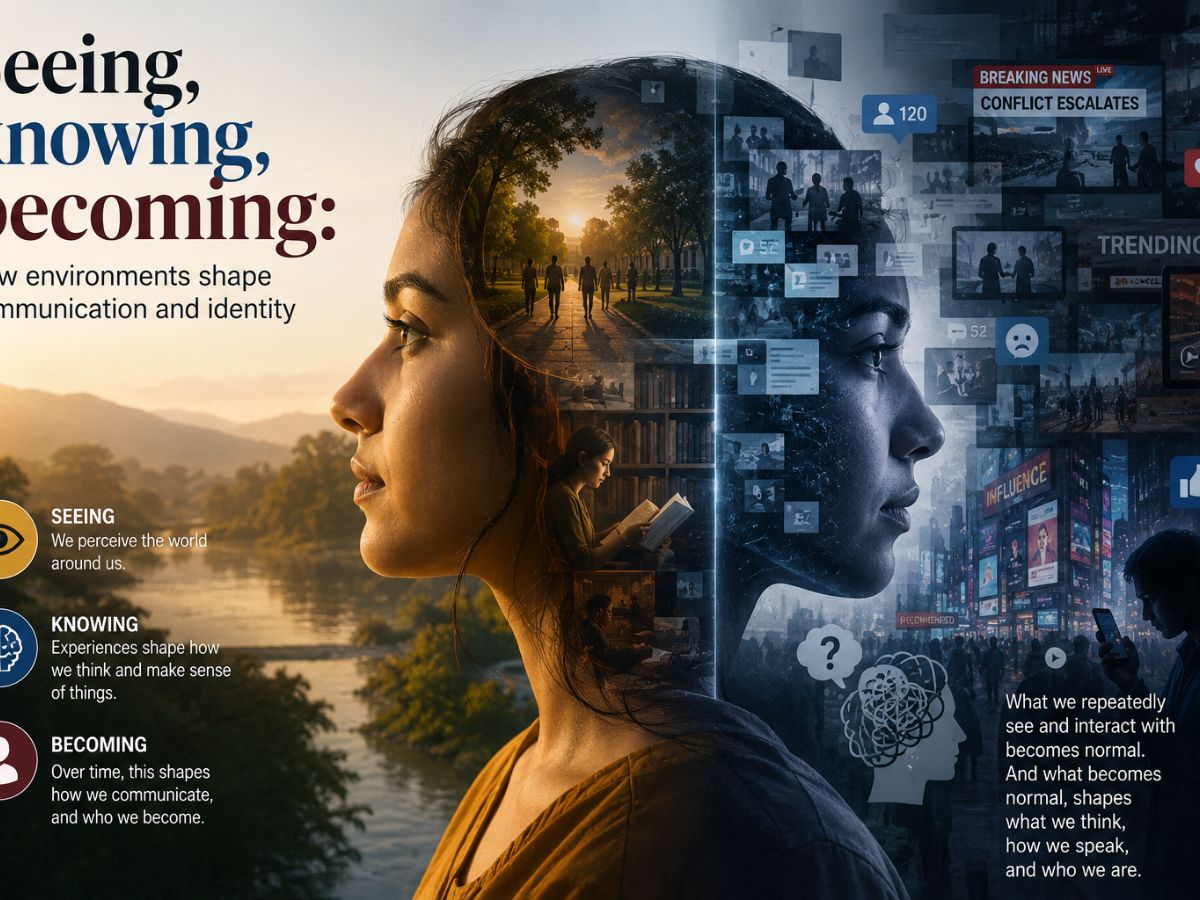)
The Nyaya Sutra, a cornerstone of Indian logic and epistemology, posits pratyaksha, or perception, as the primary conduit for acquiring valid knowledge. Our understanding of the world begins with the direct contact between our senses and the external environment. What we see, hear, and experience forms the bedrock upon which we build our inferences, judgments, and reasoning processes. This establishes a clear causal chain: stimulus precedes cognition, and cognition, in turn, informs articulation.

Extending this principle, the Yoga Sutra delves into the formation of the mind, defining it as a constellation of vrittis, or mental fluctuations. These fluctuations, as famously articulated in the aphorism "yogah chittavrittinirodhah" (Yoga Sutra 1.2), arise from the impressions forged through sensory engagement and lived experiences. Over time, the repetition of these exposures leaves deeper imprints, known as samskaras. These samskaras act as powerful shapers of our tendencies, preferences, and ingrained patterns of response. Consequently, identity, from this perspective, is not a fixed entity but an accumulated construct, continuously sculpted by our encounters.
)
The Pervasive Influence: How Environments Sculpt Thought and Expression
The core tenet these ancient frameworks impart is the profound impact of external environments on our internal states. They elucidate a crucial progression: what we repeatedly encounter becomes what we recognize; what we recognize gains validity in our minds; and what we deem valid ultimately dictates what we express. Communication, therefore, transcends being a simple outward projection of pre-formed thoughts. It emerges as the culmination of a layered process where the external world plays an indispensable formative role.
)
This dynamic holds immense relevance in the contemporary landscape. Individuals today are immersed in environments teeming with stimuli – the relentless scroll of social media feeds, the curated narratives of digital platforms, and the ceaseless torrent of information. These environments are far from neutral. They inherently favor certain forms of expression, amplify specific linguistic patterns, and normalize particular worldviews.
)
The consequence of this sustained exposure is a subtle yet pervasive alteration in both how individuals communicate and how they perceive themselves. Consider the striking standardization of language across various digital platforms. Words, phrases, and expressions proliferate with remarkable speed, acquiring shared meanings and serving as potent signals of belonging. What may have initially been a mere descriptive term can rapidly transform into a marker of identity. Language that once denoted a preference or an activity can now function as a definitive self-identifier.
)
This linguistic evolution is not accidental. It directly reflects the influence of repeated engagement with particular communication patterns, which, over time, become internalized as natural, expected, and even essential for social participation. The same phenomenon is observable in the formation of opinions and ideological stances. Exposure to a narrow spectrum of viewpoints can foster the illusion of widespread consensus, while continuous immersion in specific narratives can powerfully shape an individual’s perception of credibility and legitimacy.
)
The Nyaya emphasis on perception as the genesis of knowledge suggests that a constriction in the range of what is perceived inevitably leads to a contraction in the scope of what can be reasoned about. Thought processes, in essence, follow the pathways laid out by our exposure. The Yoga Sutra’s focus on impressions adds another critical dimension: repetition amplifies impact. A single exposure might offer information, but sustained engagement instills enduring patterns. Over time, these habitual interactions leave indelible cognitive and emotional residues that profoundly influence our behavior. Preferences begin to feel innate, even when they are the product of accumulated environmental conditioning. Identity, in turn, appears stable and self-contained, even when it is in a constant state of subtle reformulation.
)
The Curated Reality: Navigating the Media-Saturated World
The modern media environment presents a unique set of challenges and opportunities in this context. The sheer volume and pervasiveness of media mean that individuals are exposed to an unprecedented array of messages, images, and narratives. This constant barrage, often algorithmically curated to maximize engagement, can create echo chambers and filter bubbles, reinforcing existing beliefs and limiting exposure to diverse perspectives.
)
Supporting Data: Studies on social media algorithms consistently demonstrate their tendency to prioritize content that aligns with a user’s existing preferences, leading to a reduction in exposure to dissenting or novel viewpoints. This phenomenon can contribute to increased polarization and a diminished capacity for critical engagement with information. For instance, research by Pew Research Center has highlighted how differing news consumption habits on social media correlate with significant divergences in political attitudes.
)
The implication is that our understanding of the world, and our place within it, is increasingly shaped by the digital environments we inhabit. The language we use, the values we hold, and the opinions we form are all susceptible to the subtle, yet persistent, influence of these mediated experiences.
)
Institutional Responsibilities: Shaping Environments for Enriched Cognition
This understanding of how environments shape thought and expression places a significant responsibility on institutions, particularly those involved in education and communication. The design of the environments in which learning and discourse take place becomes paramount. What is made visible, what is amplified, and what is reiterated will inevitably influence not only what individuals know but also how they think and articulate their thoughts.
)
Higher education institutions, for example, often prioritize content delivery and skill development. However, less attention is frequently paid to the communicative environment that underpins the learning process. If exposure demonstrably shapes cognition, then the quality of discourse, the richness of diverse perspectives, and the nature of intellectual engagement should be considered central to the educational endeavor.
)
The same principle applies to the broader media and public communication landscape. The ongoing trend towards compressing complex information into short, easily digestible formats, while potentially enhancing accessibility, carries the inherent risk of reducing nuance and oversimplification. When exposure is confined to these simplified representations, the capacity for sophisticated and critical thinking can be eroded. Communication might become more efficient, but it may also lose its substantive depth.
)
Official Responses: While there are no singular "official responses" to the philosophical concept of environmental influence, educational institutions are increasingly recognizing the importance of fostering inclusive and diverse learning environments. Initiatives aimed at promoting critical media literacy, encouraging interdisciplinary dialogue, and providing platforms for a wide range of student voices are indicative of this growing awareness. In the media industry, there is an ongoing debate about the ethical implications of algorithmic curation and the responsibility of platforms to promote a more balanced and informative information ecosystem.
)
Implications for the Future: Cultivating Deliberate Influence
The challenge ahead is not to eliminate external influence altogether, an impossible task in a social species, but rather to cultivate a profound awareness of its operation. We must recognize that what we repeatedly witness will shape our thoughts, and our thoughts, in turn, will shape our expressions. In an era where environments are increasingly mediated and intentionally curated, this awareness is not merely beneficial; it is essential for intellectual autonomy and meaningful communication.
)
The formation of communication and identity is not an isolated internal event. It is a continuous process occurring at the intricate intersection of exposure, interpretation, and repetition. The fundamental question is not if we are influenced by our surroundings, but rather how we engage with that influence. Are we attentive to its mechanisms? Are we deliberate in shaping the environments that, in turn, shape us? By fostering this critical self-awareness, we can move towards a future where our communication and identities are not simply products of passive absorption but are consciously and constructively forged.
