

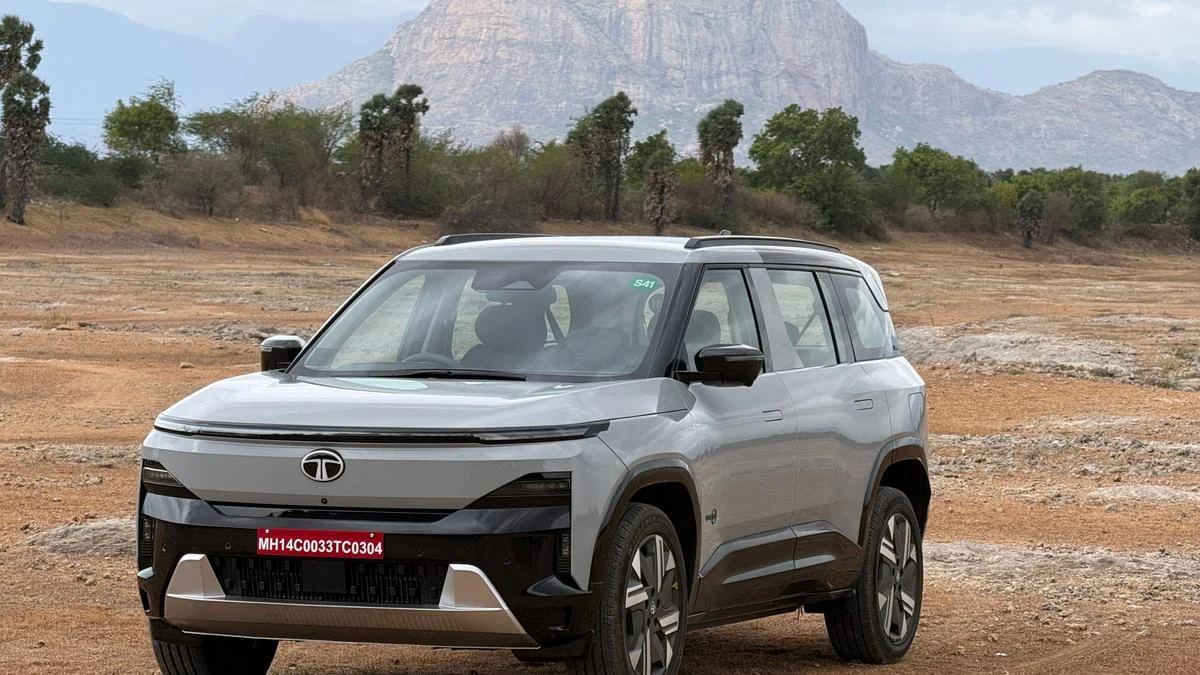
The automotive industry is often a theater of compromise. Some vehicles offer blistering performance at the cost of skeletal comfort; others provide plush interiors while sacrificing driving dynamics. However, every few years, a vehicle emerges that defies these binary choices, harmonizing disparate qualities into a singular, cohesive package. After an exhaustive day of testing the Tata Sierra.ev across the diverse terrains of Coimbatore—ranging from congested urban arteries and high-speed highways to a technical test track and a punishing off-road course—it is evident that Tata Motors has not merely built a new electric SUV; they have crafted what is arguably their most complete and sophisticated vehicle to date.
Main Facts: A New Benchmark for Indian Electric Mobility
The Tata Sierra.ev is more than a nostalgic nod to the iconic 1990s nameplate; it is a technological showcase built on the company’s dedicated Acti.ev (Advanced Connected Tech-Intelligent Electric Vehicle) architecture. This platform allows for a "born-electric" design that maximizes interior space and optimizes weight distribution.
The vehicle is offered in two distinct battery configurations to cater to different consumer needs. Our test unit was the flagship variant, featuring a 75 kWh battery pack and a sophisticated dual-motor Quad Wheel Drive (QWD) system. This setup employs a 234 bhp motor on the rear axle and a 138 bhp motor on the front, delivering a combined, earth-shaking torque of 504 Nm. For those prioritizing efficiency and urban utility over raw power, Tata also offers a 63 kWh version equipped with a single rear-mounted motor.
On the specification sheet, the 75 kWh variant boasts a claimed MIDC (Modified Indian Driving Cycle) range of 665 kilometers. While laboratory figures often differ from real-world usage, the Sierra.ev’s engineering suggests a level of efficiency that positions it at the forefront of the long-range EV conversation in India.

Chronology of the Drive: From Urban Crawl to Off-Road Grit
Morning: The Urban Litmus Test
The day began in the heart of Coimbatore. In the stop-and-go traffic of the city, the Sierra.ev immediately displayed its refined road manners. Despite its commanding road presence, the steering is tuned for effortless maneuverability. It is light and communicative, allowing the driver to thread through narrow lanes with the ease of a much smaller hatchback. The regenerative braking system, adjustable via paddle shifters, proved to be an invaluable tool in city traffic. Even at its highest setting, the transition between motor-based deceleration and traditional friction braking is seamless, allowing for "one-pedal" driving that significantly reduces driver fatigue.
Midday: Highway Stability and Refinement
As the city skyline faded in the rearview mirror, we transitioned onto the open highway. This is where the Sierra.ev’s "Frequency Dependent Damping" (FDD) suspension truly shone. Indian highways are notorious for sudden expansion joints and unexpected undulations. The Sierra.ev’s suspension has been calibrated with surgical precision; it rounds off sharp edges and settles the chassis almost instantly after hitting a dip.
At cruising speeds, the SUV remains "arrow straight." The steering, which felt light in the city, gains a reassuring weightiness as the speedometer climbs. There is a sense of "hewn-from-granite" solidity here, aided by the low center of gravity inherent in an EV with a floor-mounted battery pack.
Afternoon: Track Dynamics and Performance
On the closed test track, we pushed the Sierra.ev to its limits. Tata claims a 0 to 100 km/h sprint time of just 5.8 seconds for the dual-motor version. In practice, the acceleration is startling but never violent. Unlike many EVs that deliver an abrupt, neck-snapping jolt, the Sierra.ev builds momentum with a sophisticated, linear surge.

In the corners, the rigid chassis and the QWD system work in tandem to minimize body roll. During repeated hard braking exercises, the SUV maintained its composure, scrubbing off high speeds without any hint of tail-wagging or brake fade. It is a predictable, confidence-inspiring machine that masks its weight remarkably well.
Evening: The Demanding Off-Road Course
The final leg of the journey took us to a rugged off-road trail. While most owners may never take their Sierra.ev beyond a gravel driveway, the vehicle’s "Quad Wheel Drive" system is more than just a marketing buzzword. The instant torque delivery and the precise electronic control of the front and rear motors allowed the SUV to crawl up steep, rocky inclines that would challenge many traditional internal combustion engine (ICE) 4x4s. The 190mm+ ground clearance and the protected battery casing provided the necessary peace of mind to navigate through deep ruts and uneven terrain.
Supporting Data: Engineering Excellence by the Numbers
To understand the Sierra.ev’s performance, one must look at the underlying data that supports its premium positioning:
- Powertrain Architecture: The dual-motor setup provides a total system output that rivals luxury European EVs. The 504 Nm of torque is available from 0 RPM, ensuring effortless overtaking maneuvers.
- Charging Capabilities: Range anxiety is addressed not just through battery size, but through charging speed. On a compatible DC fast charger, the Sierra.ev can replenish 263 kilometers of range in a mere 15 minutes. This makes the "snack-and-charge" philosophy a viable reality for long-distance touring.
- Thermal Management: Tata has employed an advanced liquid-cooling system for the battery pack, ensuring consistent performance even during Coimbatore’s sweltering afternoon temperatures—a critical factor for battery longevity in the Indian climate.
- Real-World Range Projection: Based on our mixed driving cycle—which included aggressive track laps and low-speed off-roading—a realistic real-world range of 450 to 500 kilometers seems well within reach for the average driver.
Interior and Technology: A Digital Sanctuary
The cabin of the Sierra.ev represents a significant leap forward for Tata Motors in terms of perceived quality. The dashboard follows a minimalist, horizontal theme, utilizing high-grade materials that are "rich to the touch."

The Triple-Screen Experience
The cockpit is dominated by three high-resolution displays. While they offer a futuristic aesthetic, their integration is functional rather than overwhelming. The primary infotainment system is intuitive, featuring crisp graphics and lag-free operation. A unique inclusion is the "AirConsole" feature, which allows passengers to use their smartphones as controllers for multiplayer games on the central screen. This transforms the cabin into a mobile lounge, particularly useful during charging stops.
Acoustic Excellence
Perhaps the most impressive interior feature is the Dolby Atmos-enabled JBL Black audio system. In the near-silent environment of an EV, audio quality becomes paramount. The JBL system delivers an expansive soundstage with deep, controlled bass and crystalline highs. It is, without hyperbole, one of the finest factory-fitted audio systems available in the Indian market today.
Comfort and Utility
The panoramic sunroof floods the cabin with light, enhancing the sense of airiness. The air conditioning system deserves a special mention for its "chilling" efficiency, a staple requirement for the Indian market. Additionally, the suite of driver aids—including Auto Park Assist, Summon Mode, and an Augmented Reality Head-Up Display—integrates seamlessly into the driving experience rather than feeling like intrusive gimmicks.
Official Positioning and Manufacturer Response
Tata Motors has positioned the Sierra.ev as their "halo" product in the mass-premium segment. According to company insiders, the focus during development was on "Refinement and Resolution." The goal was to eliminate the "rough edges" often associated with indigenous manufacturing.

The use of the "Sierra" name is a strategic move to capture the hearts of Gen X and Millennial buyers who grew up admiring the original three-door SUV. However, Tata is clear that this is not a "retro" car; it is a forward-looking vehicle that uses its heritage as a foundation for modern innovation. By pricing the vehicle between INR 18.79 and 24.79 Lakh (ex-showroom), Tata is directly challenging the established mid-size SUV segment, offering an EV alternative that matches or exceeds the luxury of ICE competitors.
Implications for the Indian EV Market
The arrival of the Sierra.ev carries significant implications for the Indian automotive landscape:
- Normalization of Long-Distance EVs: With a real-world range approaching 500 km, the Sierra.ev effectively kills the "city-only" stigma of electric vehicles. It proves that a single-car household can successfully transition to electric.
- Pressure on Global Rivals: The Sierra.ev enters a segment populated by the Hyundai Creta Electric, MG ZS EV, and the upcoming Mahindra BE 6. Its high level of fit and finish sets a new benchmark that will force competitors to elevate their game.
- The Death of Compromise: Previously, buying an Indian EV often meant accepting minor ergonomic flaws or inconsistent panel gaps. The Sierra.ev largely eliminates these issues, signaling that Tata is ready to compete on a global stage of quality.
Conclusion: The Verdict
No vehicle is entirely without fault. In the Sierra.ev, the primary grievance is a noticeable amount of wind noise around the A-pillars at speeds exceeding 100 km/h. Furthermore, the one-touch window function on the driver’s side exhibited some inconsistency during our test. However, in the context of the overall package, these are minor blemishes.
The Tata Sierra.ev is a triumph of engineering and design. It manages to be many things at once: a serene urban commuter, a high-speed highway cruiser, a capable off-roader, and a high-tech family lounge. It does not ask the buyer to compromise on performance for the sake of the environment, nor on comfort for the sake of technology.

In a market saturated with "me-too" SUVs, the Sierra.ev stands out as a thoroughly resolved, mature, and deeply desirable vehicle. If this represents the future of Tata Motors’ electric journey, then the future is not just green—it is exceptionally bright. For the discerning buyer with a budget in the 20-lakh range, the Sierra.ev isn’t just an alternative; it is quite possibly the best choice on the market.
