

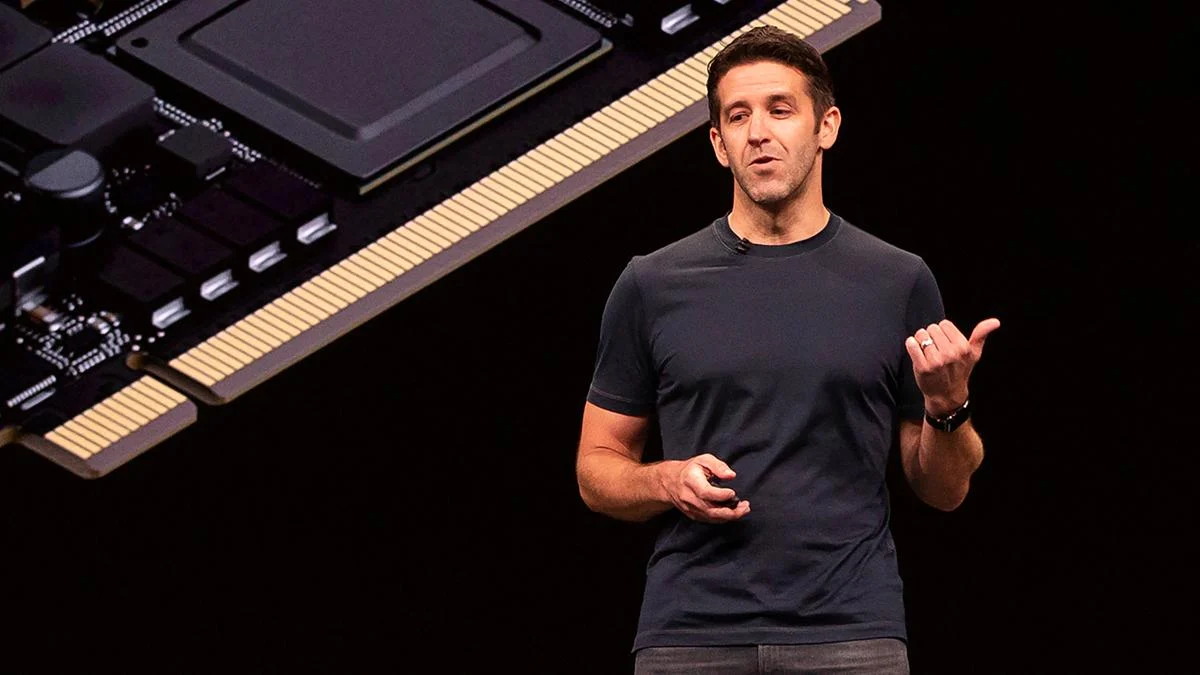
CUPERTINO, CA – In a pivotal transition that signals a new era for the world’s most valuable technology company, John Ternus has ascended to a leading role in shaping Apple’s product destiny. Under the stewardship of Tim Cook, Apple achieved an unprecedented $4.6 trillion market capitalization, meticulously constructed an efficient global supply chain, and successfully sold over three billion iPhones, all while safeguarding the visionary legacy of Steve Jobs. Cook’s tenure will be etched in history for its monumental scale and operational prowess, yet these towering achievements would have been impossible without a bedrock of innovative, market-defining products. This fundamental reliance on exceptional hardware engineering—the very domain championed and now overseen by John Ternus—underscores the profound significance of his expanded influence.
As Apple navigates a rapidly evolving technological landscape, particularly one increasingly dominated by artificial intelligence, Ternus’s vision for deeply integrated hardware, coupled with a renewed focus on pioneering new product categories, will be instrumental. His journey from an early career in virtual reality to becoming the global head of hardware engineering reflects a deep-seated understanding of product development, an unwavering commitment to design excellence, and a strategic mind capable of orchestrating complex engineering feats.
A Legacy Forged in Silicon and Steel: Tim Cook’s Era of Unprecedented Scale
Tim Cook’s 13-year reign as CEO of Apple was characterized by a relentless pursuit of operational excellence and strategic expansion. Taking the helm in the shadow of the legendary Steve Jobs, Cook deftly navigated the immense pressure to not only maintain Apple’s innovative edge but also to scale it to unforeseen heights. His era saw the company transform from a technology leader into a global economic titan.
Cook’s genius lay in optimizing every facet of Apple’s business. He refined and expanded Apple’s intricate global supply chain into a model of efficiency, ensuring that billions of devices could be manufactured and delivered with unparalleled precision and speed. This operational mastery allowed Apple to achieve astonishing profit margins and a market capitalization that dwarfed most national economies. Beyond the sheer numbers, Cook expanded Apple’s services division, creating new revenue streams that diversified the company’s portfolio and deepened its ecosystem lock-in. He also championed initiatives in environmental sustainability and privacy, cementing Apple’s brand as a responsible global citizen.
However, the foundation for this colossal success was always the product. From the iPhone’s continued evolution to the introduction of new categories like the Apple Watch and AirPods, Cook understood that even the most efficient operations needed extraordinary products to sell. It is within this crucible of product innovation and strategic execution that John Ternus distinguished himself, proving to be a critical architect of Apple’s hardware future.
The Genesis of a Hardware Visionary: John Ternus’s Early Chapters
John Ternus’s journey within Apple began in 2001, a pivotal year for the company. He joined the Cinema Display team, contributing to Apple’s high-end monitor lineup. This role followed a formative stint at a smaller firm named Virtual Research Systems, where he immersed himself in the nascent field of VR headset design. This early exposure to cutting-edge display technology and immersive experiences would prove foundational to his later work.
When Ternus arrived at Apple, the company was basking in the glow of the iPod’s revolutionary success, which had redefined portable music. Yet, the technological currents were already shifting dramatically. The world was rapidly coming online, and consumers were increasingly gravitating towards cellular devices. The market was dominated by robust, albeit functionally limited, feature phones like Nokia’s ubiquitous 3310, which, with its small, green-lit screen, was selling in the tens of millions. These devices, while solid and reliable, primarily offered basic communication and limited storage, which was beginning to encroach upon the standalone music player market that the iPod had so brilliantly carved out.
Apple recognized the imperative to capture this burgeoning trend. The challenge was immense: how to innovate beyond the physical keypads and rudimentary screens that defined the mobile landscape? The answer would come in the form of a device that truly redefined mobile telephony. With the instrumental contributions of French computer scientist Jean-Marie Hullot, who had previously developed programs for the original Macintosh and an operating system for a smartphone, Apple embarked on a secret project that would culminate in the iPhone.

The iPhone, unveiled in 2007, was a radical departure. By daring to ditch the physical keypad in favor of a multi-touch display, Apple not only revolutionized user interaction but also showcased an unparalleled mastery of display hardware and software integration. This bold design choice effectively sidelined established players like BlackBerry, whose physical keyboards, once a hallmark of productivity, suddenly appeared archaic. Ternus, while not directly involved in the original iPhone’s conception, was part of the hardware engineering culture that made such a leap possible, witnessing firsthand the profound impact of revolutionary product design.
A Seat at the Table: The Ascent Through Apple’s Ranks
The years following the iPhone’s launch saw Apple solidify its position as an unrivaled leader in consumer hardware. In 2010, the company unveiled the iPad, a device that further demonstrated Apple’s prowess in creating entirely new product categories and setting industry benchmarks. The iPad, a post-PC device, bridged the gap between smartphones and laptops, proving that a tablet could be a powerful tool for creation and consumption.
It was against this backdrop of continuous innovation that John Ternus’s contributions gained increasing recognition. In 2013, the same year Apple launched the remarkably thin and light iPad Air, Ternus was elevated to Vice President of Hardware Engineering. This promotion was a clear acknowledgment of his significant contributions, expanding his purview and control over crucial product lines. He demonstrated a keen ability to merge aesthetic design with cutting-edge engineering, a hallmark of Apple’s most successful products.
His ascent continued steadily, reflecting his growing influence and expertise. By 2021, John Ternus was appointed the Global Head of Hardware Engineering, a role that placed him directly under Tim Cook and gave him operational oversight of engineering for every major product line Apple sold. This was more than just a title; it was a clear signal that Ternus was central to Apple’s future product strategy.
Apple’s internal succession language explicitly credits Ternus with being instrumental in introducing multiple new product lines that have since become household names and significant revenue drivers, specifically the AirPods and the iPad. The AirPods, launched in 2016, revolutionized wireless audio, offering seamless connectivity and a minimalist design that quickly became a cultural phenomenon. Their success was not just in their form factor, but in the sophisticated internal engineering that allowed for such a compact and reliable wireless experience. Ternus’s role in guiding the hardware development of these products cemented his reputation as a leader capable of delivering groundbreaking innovation.
Beyond new product categories, Ternus also played a crucial role in refining existing ones. He is notably recognized for pushing for the creation of iPadOS in 2019 as a distinct operating system, rather than leaving the iPad to run a stripped-down version of iOS. This strategic decision was pivotal, allowing the iPad to fully leverage its powerful hardware capabilities, offering a more desktop-like experience and enabling more professional use cases. It was a clear demonstration of Ternus’s understanding that software and hardware must evolve in concert to unlock a product’s true potential.
A Glimpse into the Ternus Era: The iPhone Air and Integrated Design
The clearest preview of the "Ternus era" philosophy manifested with the launch of the iPhone Air in 2025. Heralded as Apple’s thinnest iPhone ever, it offered a compelling glimpse into Ternus’s approach to product development: an unwavering commitment to pushing the boundaries of physical design without compromising performance.
The iPhone Air was not merely a smaller version of an existing iPhone; it was a testament to radical re-engineering. Ternus’s team worked in unprecedented lockstep with the hardware technologies team, led by Johny Srouji, to integrate pro-level performance into a dramatically thinner chassis. This required a holistic approach, where every component was rethought and optimized for space and efficiency.

Key innovations included the introduction of the new A19 Pro chip, Apple’s next-generation custom silicon designed for unparalleled processing power within strict thermal and spatial constraints. The device also featured Apple’s N1 wireless chip, responsible for managing Wi-Fi, Bluetooth, and Thread connectivity with enhanced efficiency. Most notably, the iPhone Air debuted the C1X modem, Apple’s second-generation in-house cellular modem. The development of an internal modem is a massive undertaking, and its successful integration into a device with a thinner, smaller battery underscored the precision and coordination required from Ternus’s and Srouji’s teams. A proprietary modem allows for deep optimization of power consumption, crucial for maintaining battery life in a slimmed-down device, while also offering greater control over cellular performance and future-proofing.
The iPhone Air exemplifies how Ternus’s hardware engineering teams and Srouji’s chip teams operate in a deeply integrated fashion from the earliest stages of a product’s design. The cellular modem, the main processor, and the physical chassis were engineered concurrently, rather than in a sequential, siloed manner. This "co-design" approach allows for mutual optimization, ensuring that the silicon perfectly complements the physical form factor and vice versa, leading to a more harmonious and efficient product.
The Silicon Factor: Johny Srouji and Apple’s Vertical Integration
Central to understanding how Apple builds devices today, and indeed, how it will continue to innovate under Ternus, is the work of Johny Srouji. Srouji joined Apple in 2008 and quickly became instrumental in developing the A4, the company’s first custom chip, which powered the original iPad and iPhone 4. Since then, he has spearheaded the build-out of an entire in-house silicon operation, a strategic move that has given Apple an unparalleled competitive advantage.
Today, Srouji’s domain encompasses a comprehensive suite of custom chips:
- A-series chips: The powerhouse behind every iPhone and iPad, delivering industry-leading performance and power efficiency.
- M-series chips: These have redefined the performance and battery life of every Mac, iPad Pro, and the groundbreaking Vision Pro, marking a significant departure from third-party processors.
- C-series chips: Dedicated to powering Apple’s in-house cellular modems, a crucial component for connectivity and battery life.
- N1 networking chip: Handles critical wireless functions like Wi-Fi, Bluetooth, and Thread, ensuring seamless and robust connectivity.
The effort to develop an in-house cellular modem, in particular, has been a multi-year undertaking of monumental scale and strategic importance. Apple acquired Intel’s smartphone modem business in 2019, following a protracted legal battle with Qualcomm over licensing fees and proprietary technology. This acquisition was a clear declaration of Apple’s intent to achieve full vertical integration, giving it complete control over the entire device stack, from the lowest-level hardware to the highest-level software. The company dedicated roughly six years to building an internal baseband engineering team before the C1 modem finally shipped, a testament to the complexity and investment involved.
While the C1 modem is now a reality, Apple’s transition to custom modems across its entire lineup is still ongoing. The flagship iPhone 17 Pro models, for instance, are rumored to still ship with Qualcomm’s Snapdragon X80 modems, suggesting that the full integration across all product tiers and geographies is a phased approach, reflecting the immense technical challenges and the need to ensure robust global cellular compatibility.
An Integrated Hardware Vision: Srouji’s Expanded Role
In a significant leadership reshuffle coinciding with John Ternus’s promotion, Johny Srouji’s role has also been expanded. He now holds the title of Apple’s Chief Hardware Officer, overseeing both the Hardware Technologies and Hardware Engineering teams. This new structure places Srouji in direct command of the groups run by himself (Hardware Technologies, i.e., silicon) and John Ternus (Hardware Engineering, i.e., physical products).
This organizational change is profoundly strategic. The chip design and physical product engineering functions, while long closely coupled, were previously organizationally separate. Now, they sit under a single executive, reporting directly to the CEO. This deep integration is poised to unlock even greater synergies, fostering a truly holistic approach to product development. It means that silicon architects and hardware engineers can collaborate from conception, allowing for unprecedented optimization of performance, power, and form factor. Such a deeply integrated hardware division is not just an organizational tweak; it is a fundamental shift designed to deliver an even more solid lineup of premium products, where every component is designed to work in perfect harmony.

The Road Ahead: New Products and the AI Imperative
Under Ternus’s leadership, Apple is expected to continue its tradition of pushing boundaries and exploring new product categories. The rumor mill is currently churning with considerable chatter about Apple potentially unveiling its first foldable phone at an event in Cupertino, perhaps as early as September 9th. While official confirmation remains elusive, the persistent rumors suggest Apple is keenly aware of market trends and the need to innovate within the smartphone form factor. A foldable iPhone would present immense engineering challenges, from display durability to software optimization for dynamic screen sizes, areas where Ternus’s hardware expertise would be critical.
Beyond foldables, the company is also likely to build a new product lineup in the smart-glasses segment. Apple’s cautious entry into spatial computing with the Vision Pro in 2024 has laid the groundwork for future AR/VR devices. Under Ternus, the company would likely expand the capabilities of the Vision Pro, making it more accessible and integrated into daily life, while also exploring more lightweight and consumer-friendly smart glasses that could eventually replace or augment the iPhone. This long-term vision requires a mastery of miniaturization, advanced display technology, and seamless integration with Apple’s ecosystem—all hallmarks of Ternus’s domain.
The Software Alignment: Tackling the AI Challenge
However, beyond the tangible realm of hardware, John Ternus faces an equally, if not more, critical task: the profound integration of Apple’s software developments, particularly in artificial intelligence, with the cutting-edge products built by his and Srouji’s teams. This challenge comes on the heels of what has been perceived as a "botched AI launch" for Apple, which notably culminated in a $250 million class-action settlement in May related to past Siri performance.
Apple Intelligence, the company’s answer to the burgeoning AI landscape, arrived later than many competing offerings. A long-promised overhaul of Siri, Apple’s virtual assistant, has faced delays, and the company has ultimately turned to Google to help power some of its more advanced AI features rather than relying solely on its in-house models. Tim Cook’s tenure, while defined by operational excellence and disciplined expansion into new hardware categories, did not produce a signature AI product or strategy to rival the revolutionary impact of the iPhone or Mac.
This is the formidable problem now squarely on John Ternus’s desk. He inherits a company with an enormously profitable and innovative hardware business, one that includes product lines he personally helped build and shape. Yet, it is also a company that, in the rapidly accelerating age of AI agents and intelligent systems, lacks a clear, singular, and market-leading AI strategy of its own.
The success of the "Ternus era" will therefore be measured not just by the sleekness of future iPhones or the immersiveness of new spatial computing devices, but by how seamlessly and intelligently Apple’s software capabilities are integrated into the devices it makes. In an era where AI is becoming the defining feature of user experience, Ternus, a hardware veteran, must now oversee a profound alignment between silicon, physical design, and an intelligent software layer. How he orchestrates this critical integration, transforming Apple’s powerful hardware into intelligent, intuitive agents, will be tracked closely by industry observers and consumers alike, determining Apple’s trajectory in the next decade of technological evolution.
