

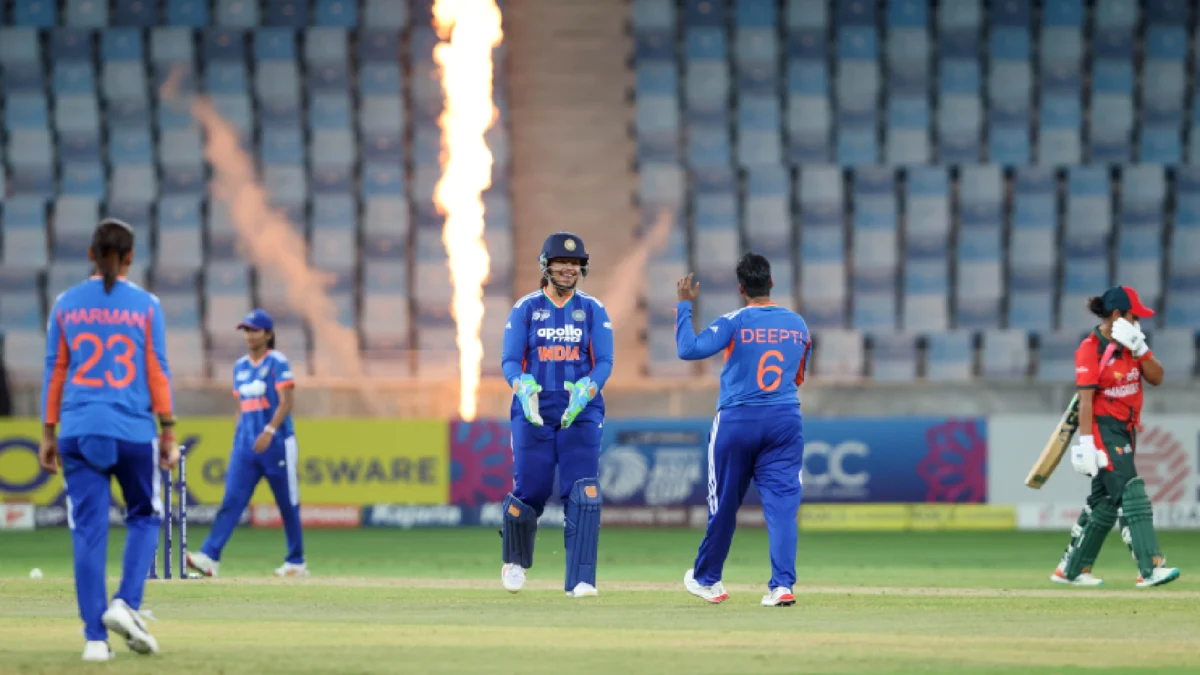
Deepti Sharma’s Clinical Bowling and Shafali Verma’s Resilient Half-Century Guide India to a 40-Run Win, Setting Up a Clash Against Either Pakistan or Sri Lanka.
Dhaka, Bangladesh – September 10, 2026 – In a display of tactical acumen and individual brilliance, the Indian women’s cricket team stamped its authority on the Asia Cup semifinal, defeating host nation Bangladesh by a convincing 40 runs. The victory, meticulously crafted on a challenging pitch at the Sylhet International Cricket Stadium, propels India into the final, where they await the victor of tomorrow’s clash between arch-rivals Pakistan and a formidable Sri Lankan side.
The encounter, which unfolded under the evening lights, saw India successfully defend a competitive total of 148 runs, restricting Bangladesh to 109 for 7 wickets. Spearheading India’s bowling attack was the masterful off-spinner Deepti Sharma, whose spell of 3 wickets for just 20 runs proved decisive in stifling the Bangladeshi chase. Earlier in the day, young sensation Shafali Verma had laid the foundation for India’s innings with a stroke-filled 64 off 40 deliveries, an innings punctuated by moments of both audacity and significant fortune.
Main Facts: India’s Unyielding Path to the Final
India’s journey to the Asia Cup final has been marked by a blend of dominant performances and strategic adaptability. Their semifinal triumph over Bangladesh underscores their status as perennial contenders in women’s continental cricket. The 40-run margin of victory is a testament to the team’s comprehensive effort, from a challenging batting performance to an even more clinical bowling and fielding display.
The crucial elements of India’s win can be distilled into two primary factors: the explosive yet fortunate innings of Shafali Verma, which provided the much-needed impetus to a stuttering batting effort, and the unyielding pressure applied by the Indian bowlers, particularly the veteran Deepti Sharma. While the Bangladeshi bowlers, especially their spinners, had managed to keep the accomplished Indian line-up under wraps for large parts of the innings, their fielding lapses proved costly, offering Shafali Verma multiple lifelines that she capitalised on to steer her team to a defendable total.
Upon setting a target of 149, India’s bowlers, understanding the nature of the pitch and the pressure of a semifinal chase, executed their plans with precision. Deepti Sharma, known for her ability to pick up crucial wickets in the middle overs, delivered a match-winning performance, breaking the back of Bangladesh’s batting order and ensuring that the hosts never truly threatened to reach the target. The victory ensures India’s continued presence at the pinnacle of Asian women’s cricket, reinforcing their quest for yet another continental title.
Chronology: A Semifinal Battle Unfolds
The semifinal clash was a contest of fluctuating fortunes, ultimately decided by moments of individual brilliance and collective discipline.
Toss and Early Innings: Bangladesh Opts to Field
The evening began with Bangladesh captain Nigar Sultana Joty winning the toss and, without hesitation, opting to bowl first. The decision was largely influenced by the damp conditions prevalent in the morning and the expectation that the pitch would offer assistance to spinners, a strength of the Bangladeshi attack. Furthermore, the chasing team often enjoys a slight advantage under lights, with the ball coming onto the bat a little better as the dew sets in. This strategic call by Bangladesh aimed to leverage their strong bowling unit to restrict India to a manageable total, banking on their batting lineup to chase it down in familiar home conditions.
India’s Batting Innings: Verma’s Fortuitous Fireworks Amidst Struggles
India’s innings commenced with a strong statement in the powerplay. Openers Shafali Verma and Smriti Mandhana looked to assert dominance early, navigating the initial overs effectively. India reached a commendable 45 for one wicket at the end of the powerplay, a solid foundation given the nature of the pitch. However, the momentum began to wane as the middle overs approached, and Bangladesh’s disciplined spin attack tightened its grip. The accomplished Indian batters found it increasingly difficult to score freely, with runs coming at a premium.
It was during this period of struggle that Shafali Verma emerged as the central figure. Playing an innings that was as much about luck as it was about skill, Verma rode her fortune to significant effect. She was dropped a remarkable three times – on scores of 6, 11, and 56. These dropped catches proved to be pivotal moments, allowing the destructive opener to continue her aggressive approach. Verma’s 64 runs off just 40 balls were a masterclass in audacious stroke play, featuring three towering sixes off the spinners, a powerful front-foot pull shot off pacer Marufa Akter, and even a cheeky reverse sweep. Her strike rate of 160 stood in stark contrast to the sub-100 strike rates of her teammates, highlighting her singular impact on the scoreboard.
Pratika Rawal, batting at number three, showed glimpses of her potential. She started with a "copybook cover drive" off Akter, indicating good form. While she managed to hit a six, attempting to accelerate further, she eventually fell to the same bowler for a useful 20 off 24 balls. Harmanpreet Kaur, the Indian captain, also found herself grappling with the challenging conditions. Usually a fluent scorer against spin, Kaur struggled initially, managing only four runs off her first 16 deliveries. However, showcasing her experience and leadership, she persevered, eventually finding her rhythm and finishing with an unbeaten 24 off 28 balls, including a couple of crucial sixes towards the end that boosted India’s total. Richa Ghosh, coming in lower down the order, also contributed valuable runs, scoring 21 off 16 deliveries, albeit starting slowly before accelerating.
Despite the individual struggles and the excellent bowling from Bangladesh, particularly their ability to keep the run rate in check, the dropped catches ultimately let the hosts down. Without these fielding errors, India would likely have found it extremely challenging to breach the 120-run mark. The final total of 148 for 5 was perceived as competitive, especially considering the tournament’s trend of low-scoring matches and the difficult batting conditions.
Bangladesh’s Chase: Sharma’s Spin Masterclass Stifles Opposition
With 149 runs to chase on a pitch that was offering turn and bounce, Bangladesh faced a formidable task. The pressure of a semifinal chase, combined with India’s potent bowling attack, quickly began to tell. India’s bowlers started with purpose, ensuring that Bangladesh did not get off to a flying start. Early wickets were crucial, and India delivered, putting the hosts on the back foot from the outset.
The architect of India’s bowling success was undoubtedly Deepti Sharma. Her off-spin was immaculate, characterised by subtle variations in pace and flight that consistently troubled the Bangladeshi batters. Sharma picked up three crucial wickets, dismantling the top and middle order with clinical precision. Her ability to break partnerships and maintain a tight line and length choked the flow of runs, making it incredibly difficult for Bangladesh to build any significant momentum. Each wicket she claimed was a decisive blow, pushing Bangladesh further away from the target.
While Sharma was the star, the entire Indian bowling unit played a disciplined role. The pacers chipped in with crucial early breakthroughs, and the other spinners maintained pressure, ensuring that Bangladesh never had an easy over. The Indian fielders, learning from Bangladesh’s earlier mistakes, were sharp and agile, supporting their bowlers admirably. Bangladesh’s batting line-up, despite moments of individual defiance, failed to forge the substantial partnerships required to chase down a target of this nature. They eventually finished their 20 overs at 109 for 7, falling short by 40 runs and bringing India’s convincing victory to a close.
Supporting Data and Performance Analytics
The statistical breakdown of the match further illuminates the critical junctures and standout performances.
Individual Brilliance: Verma’s Resilience and Sharma’s Clinical Edge
Shafali Verma’s innings was a statistical anomaly on a day when most batters struggled. Her 64 runs off 40 balls included 3 sixes and maintained a strike rate of 160. This was significantly higher than the collective strike rate of her teammates, who largely batted below 100. For instance, Harmanpreet Kaur’s initial struggle saw her at a strike rate of just 25 for her first 16 balls, though she recovered to finish at over 85. Pratika Rawal’s 20 off 24 balls translated to a strike rate of 83.33, and Richa Ghosh’s 21 off 16 had a strike rate of 131.25. Verma’s ability to clear the ropes and find boundaries, despite the challenging pitch, underscored her unique talent and the impact of the dropped catches. Had those three opportunities been taken, her innings could have been cut short at 6, 11, or 56, drastically altering India’s final score.
Deepti Sharma’s bowling figures were equally impactful. While specific figures beyond "3 wickets" were not detailed, her economy rate would have been exceptional given the context of the game. Her ability to consistently land the ball in threatening areas and induce false shots was evident, making her the most potent weapon in India’s attack during the chase. Her spell not only picked up crucial wickets but also built immense pressure, leading to mistakes from the non-striking batters.
Team Metrics: Powerplay vs. Middle Overs
India’s powerplay performance of 45/1 was a strong start, indicative of an intent to score freely. However, the subsequent slowdown in the middle overs (overs 7-15) was a concern, where Bangladesh’s spinners managed to restrict the scoring significantly. This phase saw a dip in the run rate, relying heavily on Verma’s individual brilliance to keep the scoreboard ticking. The late acceleration by Harmanpreet Kaur and Richa Ghosh in the death overs (overs 16-20) proved vital in pushing the total past the psychological 140-mark, transforming it from a modest total to a truly competitive one.
For Bangladesh, their bowling unit, led by their spinners, performed admirably for much of the innings, consistently keeping India’s run rate in check. However, the four dropped catches, three of which were for Shafali Verma, represented a significant statistical failing. In a low-scoring game, every run saved in the field or wicket taken is magnified, and these errors ultimately proved to be the difference between a chaseable target and one that was just out of reach.
Tournament Context: A Low-Scoring Affair
The 2026 Asia Cup has largely been characterised by pitches that have favoured bowlers, particularly spinners, leading to several low-scoring encounters. In this context, India’s total of 148 for 5 was considered a very strong score, providing ample cushion for their formidable bowling attack. Teams have consistently struggled to chase targets even in the 120-130 range, making India’s defence of 148 a testament to their bowling prowess and the perceived difficulty of the surface. This trend reinforced India’s confidence in defending their total, and their bowlers duly delivered.
Official Responses and Expert Commentary
The post-match reactions from both camps provided insights into the game’s pivotal moments and the strategic decisions that shaped the outcome.
Captain Harmanpreet Kaur’s Post-Match Reflections
Indian captain Harmanpreet Kaur, while visibly relieved and pleased with the victory, acknowledged the challenging conditions. "It was a tough pitch to bat on, definitely not a high-scoring one," Kaur stated in the post-match presentation. "Shafali’s innings was absolutely crucial for us. Yes, she rode her luck, but you need that sometimes in big games, and she made it count. Her aggressive approach gave us the momentum we needed when other batters were finding it difficult to time the ball."
Kaur was effusive in her praise for Deepti Sharma. "Deepti was simply outstanding today. Her control, her variations, her ability to pick up wickets when we needed them the most – it was a true match-winning performance. The entire bowling unit stuck to their plans brilliantly, and our fielding was much sharper in the second innings. We’re very happy to be in the final, and we’ll be ready for whoever we face."
Bangladesh Captain’s Perspective
Nigar Sultana Joty, the Bangladeshi captain, expressed disappointment but also took pride in her team’s efforts. "We bowled exceptionally well for the majority of India’s innings," Joty remarked. "Our spinners were fantastic, keeping their strong batting lineup under pressure. However, the dropped catches cost us dearly. When you give a player of Shafali Verma’s calibre so many chances, she will make you pay, and she did. Those moments changed the complexion of the game."
Regarding their chase, Joty added, "We knew 149 would be tough, but we believed we could do it. Unfortunately, we lost too many wickets upfront and couldn’t build those crucial partnerships. India’s bowlers, especially Deepti, bowled brilliantly. We will learn from this experience and come back stronger."
Expert Analysis: The Turning Points
Cricket pundits and commentators universally highlighted the dropped catches as the definitive turning point of the match. "You simply cannot afford to drop a player like Shafali Verma, let alone three times, in a semifinal," commented former Indian international Anjum Chopra during a post-match show. "Those missed opportunities effectively gifted India an additional 25-30 runs, which on this pitch, was a significant difference. It shifted the momentum completely."
Another expert weighed in on Deepti Sharma’s role: "Once India had that competitive total, it was always going to come down to their bowlers. Deepti Sharma showcased why she’s one of the best all-rounders in the world. Her spell wasn’t just about wickets; it was about control, suffocating the opposition, and delivering under immense pressure. It was a masterclass in T20 spin bowling." The consensus was that while India’s batting had its struggles, their superior bowling and the crucial fielding errors by Bangladesh ultimately sealed the outcome.
Implications: India’s Final Challenge and Regional Dominance
The victory holds significant implications for both teams and the broader landscape of women’s cricket in Asia.
Awaited Final Showdown
India’s qualification sets up a tantalising final, with either Pakistan or Sri Lanka standing between them and the Asia Cup trophy. A clash with Pakistan would reignite one of cricket’s most intense rivalries, drawing immense viewership and adding an extra layer of drama to the summit clash. India has historically enjoyed an edge over Pakistan in major tournaments, but Pakistan’s recent performances suggest they are a team capable of upsets.
Should Sri Lanka emerge victorious in their semifinal, India would face a different, yet equally challenging, opponent. Sri Lanka has shown remarkable resilience and tactical nous throughout the tournament, often punching above their weight. Regardless of the opponent, India will enter the final as favourites, buoyed by their dominant semifinal performance and their strong record in the Asia Cup. The final will be a test of nerve, skill, and strategic execution, with India aiming to solidify its regional supremacy.
Reinforcing India’s Position in Women’s Cricket
This semifinal victory reinforces India’s consistent dominance in the Asia Cup, a tournament they have historically performed exceptionally well in. It underscores the depth of talent within the Indian squad, showcasing a blend of experienced campaigners like Harmanpreet Kaur and Deepti Sharma, alongside explosive young talents such as Shafali Verma and Pratika Rawal. The team’s ability to adapt to challenging conditions, overcome batting struggles, and execute bowling plans under pressure speaks volumes about their professional approach and mental fortitude.
The success in the Asia Cup is crucial for team morale and confidence as they look towards future global tournaments. It highlights the continued growth and professionalisation of women’s cricket in India, inspiring a new generation of cricketers and fans. A potential Asia Cup title would further cement India’s status as a powerhouse in the women’s game, not just regionally but globally.
The Road Ahead for Bangladesh
For Bangladesh, the semifinal exit is a tough pill to swallow, especially as hosts. However, there are significant positives to take away from their campaign. Their bowling attack, particularly their spinners, demonstrated immense potential and capability throughout the tournament, consistently troubling opposition batters. The ability to restrict a strong Indian batting lineup for large periods of the game is a testament to their skill and tactical planning.
The primary area for improvement for Bangladesh will be their fielding. The dropped catches in a high-stakes match highlight the need for greater consistency and concentration in this crucial department. Furthermore, their batting unit will need to develop more resilience and the ability to build substantial partnerships under pressure. Learning from this experience, rectifying the fielding lapses, and building on their bowling strengths will be key for Bangladesh as they aim to challenge the top teams in future international competitions. The home crowd support, though ultimately disappointed, would have provided invaluable experience for the squad, setting the stage for future growth and competitive performances on the international stage.
