


The Union Territory of Jammu and Kashmir is currently undergoing a seismic shift in its administrative landscape, particularly in how land governance is managed. Historically, the region’s land records were characterized by a complex, manual system maintained by local revenue officials, often leading to delays, lack of transparency, and disputes. However, the introduction of the Jammu and Kashmir Land Records Management System (LRMS) and the flagship initiative "Aapki Zameen Aapki Nigrani" (Your Land, Your Watch) has ushered in a new era of digital accountability.
This article provides an in-depth examination of the J&K Land Records portal, detailing its technical features, operational procedures, and the broader socio-economic implications of land digitalization in the region.
1. Main Facts: The Digital Infrastructure of J&K Land Records
The primary vehicle for this transformation is the official J&K Land Records portal, managed by the Jammu and Kashmir Land Records Management Agency (JaKLaRMA). The portal serves as a centralized repository for crucial documents such as Jamabandi (Records of Rights), Khasra Girdawari (Harvest Inspection), and Mutation records.
Key Objectives of the Portal:
- Transparency: To eliminate the monopoly of middlemen and provide citizens with direct access to their property data.
- Accountability: To ensure that every change in land ownership or status is recorded with a digital audit trail.
- Efficiency: To reduce the time required to obtain land-related certificates, which previously took weeks or months of physical visits to Tehsil offices.
- Modernization: To align J&K’s land governance with the National Digital India Land Records Modernization Programme (DILRMP).
The portal allows residents to view Jamabandi online, search for specific land parcels, access digitized maps, and link their Aadhaar for secure verification.

2. Chronology: The Journey Towards Digitalization
The evolution of land records in J&K has moved through several critical phases:
- Pre-2015: The Manual Era: Records were kept in physical registers (Bastas) by Patwaris. Information was often difficult to access and prone to physical damage or manipulation.
- 2016-2020: The Digitization Push: Under the DILRMP, the government began the massive task of scanning millions of revenue documents and maps.
- October 2021: Launch of "Aapki Zameen Aapki Nigrani": The UT administration launched this public-centric portal, making scanned records available to the public for the first time.
- 2022-2023: Multilingual Digital Passbooks: The government introduced digital land passbooks in Urdu, Hindi, and English to bridge the linguistic gap.
- 2024-2026: The Virasat Campaign: A focused initiative to update succession records (Virasat) and ensure that the names of current legal heirs are reflected in the Jamabandi.
3. Supporting Data: Operational Guides and Procedures
To effectively utilize the portal, citizens must navigate several technical processes. Below are the structured guides for the most common tasks.
How to Register and Log In
Before accessing detailed reports, users are encouraged to create an account.
- Visit the Website: Navigate to landrecords.jk.gov.in.
- Sign Up: Click on the "Login" button and select "Public User." If you are a new user, click "Sign Up."
- Enter Details: Provide your name, mobile number, email, and address.
- Verification: Complete the OTP (One-Time Password) verification sent to your mobile.
- Access: Once registered, log in using your credentials to access personalized land data.
Searching for Jamabandi and Land Records
The search functionality is designed to be granular, allowing users to find data even with minimal information.
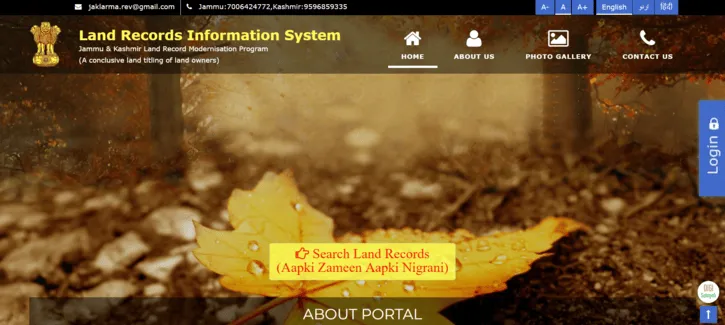
- Step 1: Select the "Search Land Records" option on the homepage.
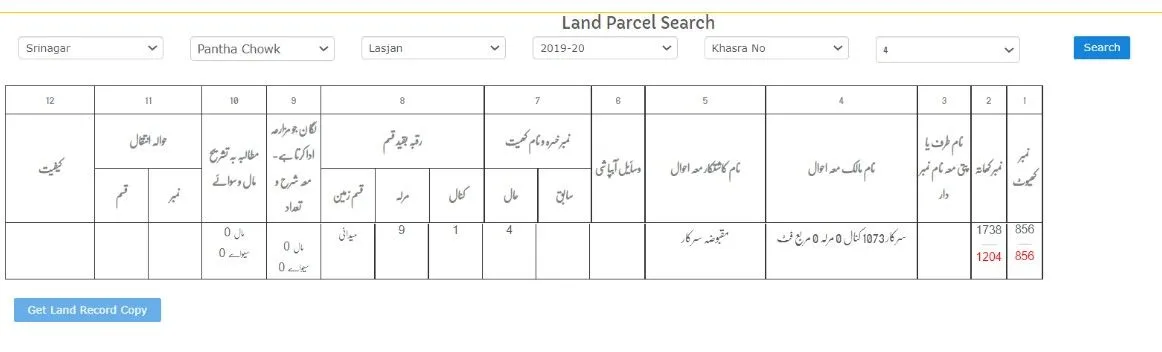
- Step 2: Choose your District, Tehsil, and Village from the dropdown menus.
- Step 3: You can search by Khasra Number (Plot number), Khewat Number (Owner’s holding number), or Owner Name.
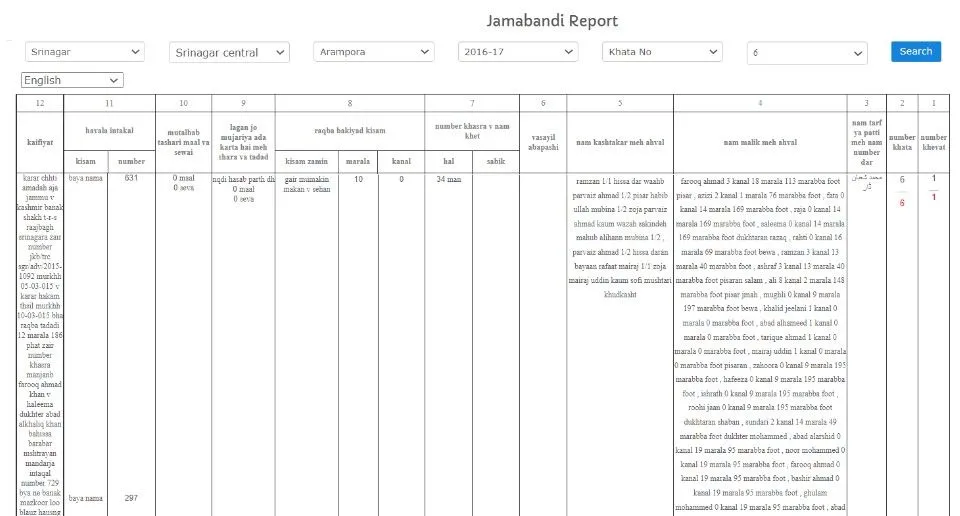
- Step 4: View the document on the screen. The system allows you to view the historical "Scanned Records" as well as the "Digitized Jamabandi."
Viewing Land Parcel Maps (GIS)
One of the most advanced features is the Geographic Information System (GIS) integration.
- Click on the "View Map" option.
- You will be redirected to the GIS portal.
- Use the "Universal Search" to enter your Khasra or Khewat number.
- The system will zoom into the specific land parcel on a satellite or cadastral map, showing the exact boundaries and neighboring plots.
Checking Mutation Status
Mutation is the process of updating ownership records after a sale, gift, or inheritance.
- Log in to the portal and look for the "Mutation Status" or "Application Tracking" section.
- Enter your application ID or the Khasra number.
- The system will show whether the mutation is "Pending," "Rejected," or "Approved" by the Tehsildar.
4. Financials and Documentation: What You Need to Know
While viewing records is largely free, certain official services and certified copies incur nominal charges.
Charges for Services
| Service Type | Estimated Fee (INR) |
|---|---|
| Viewing Scanned Records | Free |
| Digital Land Passbook | Free (Initial) / Nominal for reprints |
| Certified Copy of Jamabandi | Rs. 15 – Rs. 30 per page |
| Mutation Processing | Varies by property value and area |
Mandatory Documents for Record Updates
To update or claim land records (especially under the Virasat campaign), the following are required:

- Identity Proof: Aadhaar Card or Voter ID.
- Death Certificate: In case of succession (Virasat) claims.
- Legal Heir Certificate: Issued by the competent revenue authority.
- Sale Deed: If the property was recently purchased.
5. Official Responses and Grievance Redressal
The J&K administration has acknowledged that the transition to a digital system is not without hurdles. To address this, a robust feedback and grievance mechanism has been established.
Reporting Discrepancies
If a landowner finds that the online record does not match their physical documents, they can:
- Use the "Feedback/Grievance" link on the portal.
- Upload a scanned copy of the correct document.
- Track the status of the grievance using a unique ID.
Official Contact Information
- Jammu Division Helpline: 7006424772
- Kashmir Division Helpline: 9596859335
- Email: [email protected]
- Head Office: JaKLaRMA, Revenue Complex, Rail Head Campus, Jammu.
6. Implications: The Impact of Land Digitalization
The shift to the LRMS has profound implications for the socio-economic fabric of Jammu and Kashmir.
Economic Empowerment
By providing clear, undisputed titles, the digital system makes it significantly easier for farmers and property owners to secure bank loans. Previously, banks required a "Fard" (record copy) signed by a Patwari, a process often fraught with delays. Now, QR-code-verified digital passbooks are increasingly accepted as valid proof of ownership.
Reduction in Litigation
A significant portion of the J&K judiciary’s caseload involves land disputes. Digitized maps and clear ownership trails reduce the scope for "double-selling" of land and boundary encroachments. The portal’s ability to track court cases related to specific Khasra numbers ensures that potential buyers are aware of any legal encumbrances before proceeding with a transaction.
Multilingual Accessibility
By offering records in Urdu (the traditional revenue language), Hindi, and English, the government has democratized information. This ensures that both the elderly generation (comfortable with Urdu) and the younger, English-speaking generation can navigate the system with equal ease.
Challenges and the Road Ahead
Despite the success, challenges remain:
- Internet Connectivity: In remote hilly terrains, accessing the portal remains difficult.
- Data Accuracy: Some scanned historical records are blurred or contain clerical errors from the manual era that now need digital correction.
- Digital Literacy: A large segment of the rural population still requires assistance from "Khidmat Centres" or Common Service Centres (CSCs) to access their records.
7. The 2026 Virasat Campaign: Ensuring Future Accuracy
Looking forward, the 2026 Virasat Campaign is perhaps the most critical step in the digitalization journey. Many land records in J&K have not been updated for decades, still showing the names of deceased ancestors. By proactively identifying these cases and facilitating the transfer of titles to legal heirs, the government aims to create a "clean" database. This will prevent future legal battles and ensure that government subsidies and compensation (for road or infrastructure projects) reach the rightful owners.
Conclusion
The Jammu and Kashmir Land Records portal is more than just a website; it is a tool for empowerment and a shield against administrative corruption. While the system continues to evolve, the progress made under the "Aapki Zameen Aapki Nigrani" initiative has already brought a level of transparency to the region that was once thought impossible. For the residents of J&K, their land—their most valuable asset—is finally under their own watch.
Disclaimer: Land laws and portal features are subject to change by the UT administration. Users are advised to verify critical data with the local Tehsildar’s office for legal purposes.
