

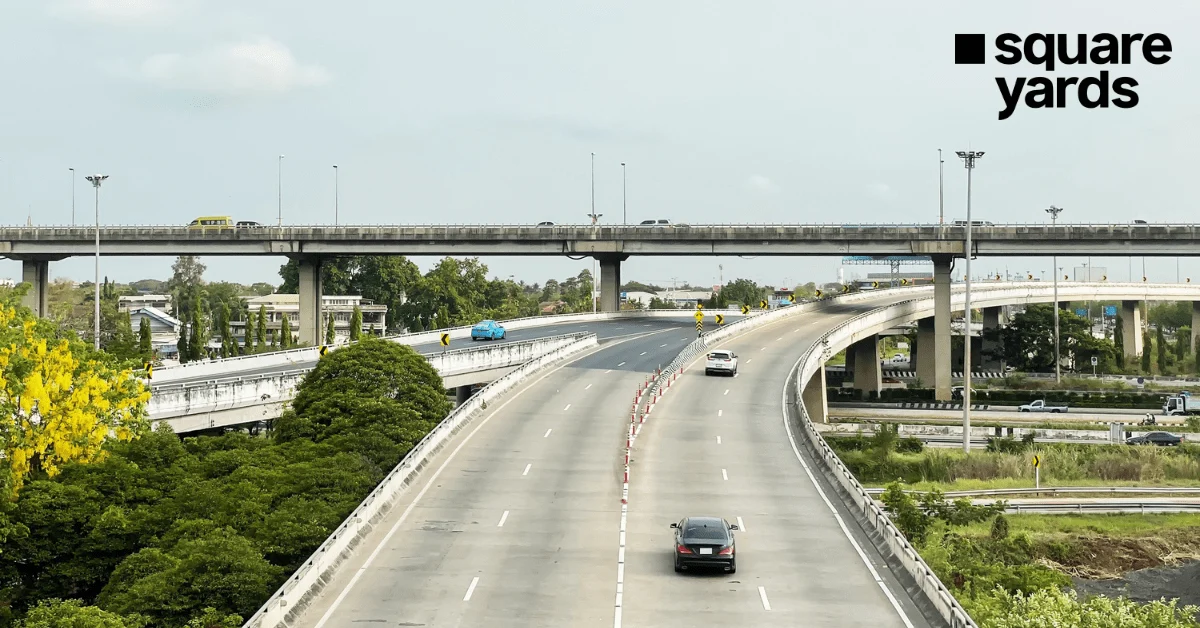
NOIDA – In a significant boost to the National Capital Region’s (NCR) infrastructure landscape, the long-awaited Chilla Elevated Road project has entered a phase of rapid acceleration. Recent progress reports indicate that construction is now nearly 47% complete, signaling a turning point for a project that has faced over a decade of administrative and financial hurdles. Designed to bridge the gap between East Delhi and the burgeoning economic hubs of Noida and Greater Noida, the corridor is now poised to become a central pillar in the region’s "multi-modal" connectivity strategy, particularly in light of the upcoming Noida International Airport at Jewar.
The Core Update: Engineering a Faster Future
The Chilla Elevated Road is a 5.5-kilometer, six-lane corridor designed to provide a seamless, signal-free transition for commuters traveling between the Chilla Regulator near Mayur Vihar in Delhi and the Mahamaya Flyover on the Noida Expressway. For years, this stretch has been a notorious bottleneck, where thousands of commuters spend hours trapped in gridlock during peak office hours.
While the project was initially set for a December 2027 completion, Noida Authority officials have recently expressed optimism that the project could be operational by mid-2027. This acceleration comes as the Uttar Pradesh government prioritizes infrastructure projects that feed into the "Jewar Airport Ecosystem." The total project cost, which has seen several revisions due to delays and inflation, now stands at approximately ₹893 crore, up from the original estimate of ₹605 crore.
A Chronology of Delays: From Conception to Resurgence
The journey of the Chilla Elevated Road has been a saga of bureaucratic red tape and financial negotiations. To understand the significance of the current 47% completion mark, one must look at the timeline of its evolution:
- 2012–2013: The project was first conceived as a solution to the mounting traffic on the Delhi-Noida Link Road. Initial surveys were conducted, but the project remained on paper due to lack of environmental clearances.
- 2019: Construction finally commenced after the foundation stone was laid. However, the project hit a major roadblock regarding the funding pattern. The initial agreement proposed a 50-50 cost-sharing model between the Noida Authority and the Uttar Pradesh Public Works Department (PWD).
- 2020–2021: The COVID-19 pandemic brought work to a standstill. Simultaneously, a dispute arose over funding, as the PWD expressed inability to meet its share of the rising costs, leading to a total halt in construction for nearly two years.
- 2023: Following high-level intervention by the state government, a revised funding structure was approved. The Noida Authority took a more proactive role in financing to ensure the project did not turn into a "stranded asset."
- 2024–2026: Work resumed in full swing with modern construction techniques. The focus shifted to completing the heavy-duty pillars and the pre-cast segments required for the elevated structure.
Decongesting the Arteries: Mobility and Regional Connectivity
The primary objective of the Chilla Elevated Road is the total transformation of the daily commute between Delhi and Noida. Currently, the Delhi-Noida Link Road serves as the primary artery for residents of Mayur Vihar, Vasundhara Enclave, and parts of East Delhi entering Noida. This road merges with the DND Flyway and the Noida Expressway at the Mahamaya Flyover, creating a "perfect storm" of traffic congestion.
The Signal-Free Advantage
Once the elevated road is operational, commuters will be able to bypass at least four major traffic signals. This is expected to reduce travel time from Mayur Vihar to the Noida Expressway from the current 30–45 minutes (during peak hours) to a mere 5–7 minutes.
The Jewar Airport Link
The project is no longer being viewed in isolation. It is being integrated into a massive high-speed spine. The corridor will link directly to the Noida-Greater Noida Expressway, which in turn feeds into the Yamuna Expressway. This creates a direct, high-speed route from the heart of Delhi to the Noida International Airport at Jewar.
To further enhance this, authorities are integrating the project with:
- The 10-lane Delhi-Jewar Corridor: A massive expansion project aimed at creating a dedicated expressway for airport-bound traffic.
- Yamuna Pushta Road Expansion: Strengthening the peripheral roads to ensure that local traffic does not spill over into the high-speed corridors.
- The Okhla Bird Sanctuary Link: Plans are underway for an elevated spur from the Mahamaya Flyover to the Okhla Bird Sanctuary Metro station. This will allow for a seamless transition between road and rail, facilitating a "Park and Ride" culture for commuters heading into the deeper pockets of Noida and Delhi.
Official Responses: A Commitment to Deadlines
Government officials have emphasized that the Chilla project is a "priority one" infrastructure task. A senior official from the Noida Authority stated, "We have cleared all the utility shifting hurdles, including major electricity lines and water pipelines that were previously obstructing the pillar locations. The contractor has been instructed to increase the labor force and utilize pre-fabricated segments to ensure we beat the December 2027 deadline. Our goal is to hand over this road to the public by the summer of 2027."
Engineers on-site have noted that the 47% completion mark is a "tipping point." With the foundation and majority of the pillars in place, the placement of the superstructure (the actual road deck) can proceed at a much faster pace.
Supporting Data: Real Estate Impact and Market Trends
The infrastructure push is already reflecting in the real estate metrics of the region. As connectivity improves, property values along the corridor and its extensions have seen a marked upward trajectory.
Micro-Market Price Analysis
The following table illustrates the current average property prices in the key areas expected to benefit most from the Chilla Elevated Road:
| Micromarket | Average Price (per sq. ft.) | Impact Drivers |
|---|---|---|
| Sector 94 | ₹13,600 | Proximity to Delhi; Luxury high-rises |
| Sector 44 | ₹14,150 | Established premium residential hub |
| Sector 150 | ₹12,200 | "Greenest Sector"; Direct Expressway access |
| Pari Chowk | ₹14,450 – ₹19,850 | Entry point to Greater Noida; Commercial hub |
| Greater Noida (West) | ₹8,300 | High-density residential; Affordable luxury |
| Yamuna Expressway | ₹9,600 (Plots) | Proximity to Jewar Airport |
The Yamuna Expressway Surge
Data from Square Yards highlights a staggering trend: apartment prices along the Yamuna Expressway have nearly tripled over the last five years. Plot prices in the Jewar region, which stood at roughly ₹3,000–₹3,500 per sq. ft. in 2020, have now surged to nearly ₹9,600 per sq. ft. The Chilla Elevated Road is seen as the "missing link" that makes these distant sectors viable for daily commuters who work in Delhi but live in Greater Noida.
Broader Implications: Socio-Economic Transformation
The completion of the Chilla Elevated Road will trigger a domino effect across several sectors:
1. Commercial and Retail Expansion
Improved connectivity often leads to the development of "Transit-Oriented Development" (TOD). Sectors like 94 and 150 are already seeing an influx of commercial office spaces and high-end retail malls. Businesses that were previously hesitant to move further down the expressway due to the "Chilla Bottleneck" are now reconsidering Noida as a primary headquarters location.
2. Rental Market Dynamics
There is a projected 15–20% increase in rental demand in sectors along the Noida Expressway. As travel time to Delhi decreases, working professionals in the IT/ITES sectors will find it more feasible to live in the spacious, modern townships of Noida and Greater Noida while maintaining their offices in South or East Delhi.
3. Environmental Impact
While construction causes temporary disruptions, the long-term environmental impact of the elevated road is expected to be positive. By eliminating idling traffic at signals, the project will significantly reduce vehicular emissions along the Link Road, contributing to better air quality in the Mayur Vihar-Noida border zone.
4. Integration with Global Aviation
The road is a crucial component of the "Airport City" concept. For the Noida International Airport to be successful, it requires a catchment area that includes the affluent neighborhoods of South and East Delhi. The Chilla Elevated Road, combined with the DND Flyway, provides that essential high-speed conduit.
Conclusion: A New Era for NCR Mobility
The Chilla Elevated Road is more than just a 5.5-kilometer stretch of bitumen and concrete; it is a symbol of the NCR’s evolution into a modern, interconnected metropolis. By overcoming a decade of stagnation, the project demonstrates a renewed political will to modernize urban transit.
As construction crosses the halfway mark, the anticipation among residents and investors is palpable. By mid-2027, the "Chilla crawl" may finally become a thing of the past, replaced by a swift, signal-free journey that links the historical heart of Delhi to the futuristic aviation hubs of the Yamuna Expressway. For Noida and Greater Noida, this is the final piece of the puzzle in becoming India’s premier residential and commercial destination.
