

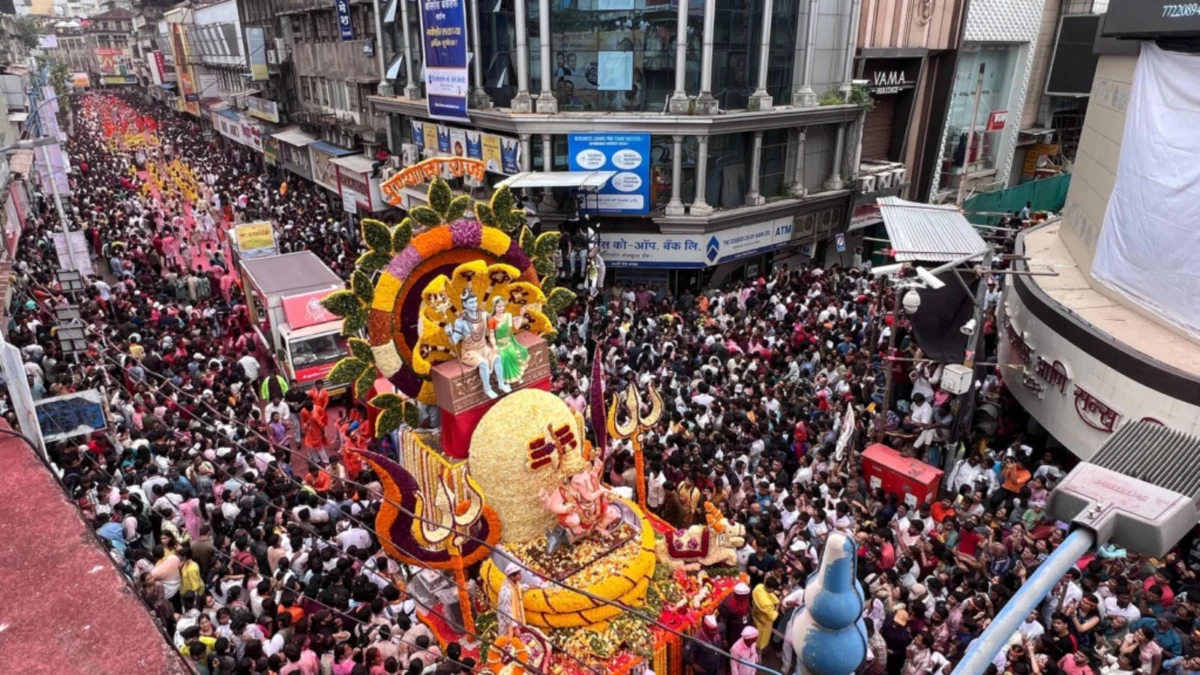
Pune, Maharashtra – As the auspicious 11-day Ganesh festival, commencing on September 14, draws near, a contentious debate over the use of high-decibel sound systems, particularly DJs, has escalated into a significant political flashpoint across Maharashtra. What began as a local civic concern in Pune has now reverberated through the state’s political corridors, exposing deep divisions within the ruling Mahayuti alliance and galvanizing the Opposition. The controversy pits traditional festive exuberance against growing public demand for noise pollution control, placing Chief Minister Devendra Fadnavis in a precarious position.
Main Facts: A Cultural Conundrum Meets Political Crossroads
At the heart of the dispute is the omnipresent presence of DJs and other powerful sound amplification equipment during the Ganesh festival, a celebration of immense cultural and spiritual significance in Maharashtra. Ganesh mandals, community groups responsible for organizing the festivities, often employ these systems to create a vibrant, celebratory atmosphere. However, the accompanying high noise levels have become a persistent source of public grievance, raising concerns about health impacts, disturbance to daily life, and violation of noise pollution norms.
The Opposition, primarily comprising the Maha Vikas Aghadi (MVA) constituents – Shiv Sena (Uddhav Balasaheb Thackeray), Nationalist Congress Party (Sharadchandra Pawar), and Congress – has seized upon the issue, demanding decisive state action against noise pollution. They advocate for strict adherence to existing legal guidelines and court orders. Conversely, the ruling Mahayuti alliance, formed by the Bharatiya Janata Party (BJP) and the Shiv Sena (Eknath Shinde faction), finds itself internally fragmented. While some leaders acknowledge the need for regulation, others staunchly defend the mandals’ right to use such sound systems, often citing cultural tradition and the potential for a backlash from a significant voter base.
Chief Minister Devendra Fadnavis, a senior BJP leader, has notably refrained from taking a firm stance, opting instead for a conciliatory approach. His cautious disposition stems from a palpable apprehension of alienating the vast network of Ganesh mandal workers, particularly in Pune, who represent a crucial support base for the BJP. Pune alone boasts over 10,000 registered and unregistered Ganesh mandals, mobilizing lakhs of predominantly young workers. Their collective influence, both social and electoral, is undeniable, making any decision that could be perceived as curbing their festive spirit a politically risky move. The unfolding drama thus encapsulates a classic dilemma: balancing cultural expression and public welfare with political expediency.
Chronology of Discord: From Local Meeting to State-Wide Debate
The current political storm over DJs did not erupt overnight but brewed from a series of local incidents that gradually gained statewide prominence. The timeline of events reveals how a seemingly localized grievance transformed into a major policy debate.
August 24: The Spark in Narayan Peth
The controversy formally ignited on August 24 during a preparatory meeting organized by the local civic body in Pune. It was here that Vidyanand Bapat, a resident of the historic Narayan Peth area, courageously stepped forward to demand a comprehensive ban on DJs during the upcoming Ganesh festival. Bapat articulated concerns shared by many residents regarding the excessive noise, its disruptive impact, and its potential health hazards.
However, his plea was met with immediate and vocal opposition from a significant contingent of Ganesh mandal workers present at the meeting. Bapat was reportedly shouted down and his demands dismissed, a clear indication of the entrenched views and passions surrounding the issue. Despite the hostile reception, Bapat remained resolute, publicly vowing to persist with his campaign against high-decibel sound systems, thereby laying the groundwork for a broader public discourse. His defiance, in the face of strong community pushback, marked the beginning of a sustained citizen-led movement.
September 3: The Attack that Ignited a Firestorm
The simmering tensions escalated dramatically on September 3, when Vidyanand Bapat became the victim of an alleged physical assault. While Bapat was engaged in an interview, reportedly discussing his anti-DJ campaign, a youth, identified by onlookers as a Ganesh mandal worker, allegedly attacked him. The incident sent shockwaves through the city and quickly became a national headline, drawing widespread condemnation.
This act of violence not only underscored the intensity of emotions surrounding the DJ debate but also injected a new, more volatile dimension into the political discourse. The attack transformed the issue from a mere policy discussion into a question of civil liberty, freedom of expression, and law and order. It served as a potent symbol for both sides: for proponents of the ban, it highlighted the aggressive and intolerant nature of some mandal elements; for opponents, it may have been seen as a reaction to what they perceived as an attack on their traditions.
Unfazed by the assault, Bapat reiterated his unwavering commitment to the cause. He expanded his demand beyond just DJs, calling for a ban on all noise-polluting sound systems, including traditional loudspeakers and ‘dhol-tasha’ (traditional percussion ensembles), in open or public spaces. His argument was simple: while celebrations could incorporate sound systems, these should be confined to closed environments to mitigate public disturbance. This principled stand, despite personal risk, further solidified his position as a key figure in the controversy and amplified the call for noise regulation across Maharashtra.
Supporting Data: The Science of Silence and the Economics of Sound
The debate over DJ usage transcends mere cultural preference; it is deeply intertwined with scientific data on noise pollution, established legal frameworks, and the significant socio-economic role of Ganesh mandals. Understanding these facets is crucial to grasping the complexity of the ongoing conflict.
The Unseen Threat: Noise Pollution and Public Health
Noise pollution, often an overlooked environmental hazard, poses serious health risks. The Central Pollution Control Board (CPCB) guidelines, based on scientific research, specify permissible noise levels for different zones: 55 dB (day) and 45 dB (night) for residential areas, and even lower for silent zones like hospitals and educational institutions. During festivals, however, sound levels frequently soar past 100-120 dB, comparable to a jackhammer or a jet engine taking off.
Prolonged exposure to such high decibels can lead to permanent hearing loss, tinnitus, and an increased risk of cardiovascular diseases. Beyond physical ailments, excessive noise contributes to stress, anxiety, sleep disturbances, and impaired cognitive function, particularly in children. Vulnerable populations, including infants, the elderly, and those with pre-existing health conditions, are disproportionately affected. Doctors and public health experts have consistently highlighted the detrimental impact of festival noise on community well-being, providing a scientific bedrock for calls to regulate sound systems. The "earthquake-like tremors" described by Shiv Sena (UBT) spokesperson Sanjay Raut, while metaphorical, vividly illustrate the perceived intensity of the noise.
Legal Precedents: The Courts’ Stance on Decibel Limits
The judiciary in India, particularly the Supreme Court and various High Courts, has repeatedly intervened to address noise pollution, recognizing it as a violation of citizens’ fundamental right to a peaceful environment under Article 21 (Right to Life). The Noise Pollution (Regulation and Control) Rules, 2000, provide the statutory framework for regulating noise levels, empowering authorities to take action against violations.
Crucially, the Bombay High Court has issued several directives over the years, specifically targeting noise levels during festivals in Maharashtra. In Mumbai, for instance, a ban on high-powered sound systems was enforced last year following a High Court order, a precedent the civic administration has confirmed will continue this year. These legal pronouncements emphasize that while cultural and religious freedoms are protected, they cannot infringe upon the fundamental rights of others, particularly concerning public health and peace. The courts have consistently stressed the need for a balanced approach, where celebrations are conducted within permissible decibel limits, making the current debate not just a political one, but also a matter of legal compliance and enforcement.
The Mandals: A Force in Maharashtra’s Cultural and Political Landscape
Ganesh mandals are more than just organizers of religious festivities; they are deeply woven into the social, cultural, and political fabric of Maharashtra. Originating in the late 19th century under Lokmanya Tilak’s leadership to unite people against British rule, they have evolved into powerful community organizations. Beyond religious observances, many mandals engage in social work, cultural programs, and youth development initiatives throughout the year.
The sheer scale of their operation is immense. With over 10,000 registered and unregistered mandals in Pune alone, mobilizing lakhs of predominantly young workers, they represent a significant grassroots network. These workers, often passionate and dedicated, view the festival as a central part of their identity and community pride. The use of DJs and elaborate sound systems, for many, has become an integral part of modern celebrations, symbolizing vibrancy and grandiosity.
Politically, mandals are formidable entities. Their ability to mobilize large numbers of people, especially youth, makes them indispensable vote banks and campaign resources for political parties. Parties, particularly the BJP, have historically cultivated strong ties with mandal leaders and workers. Any perceived affront to their traditions or festive practices can translate into significant electoral losses, explaining the cautious approach adopted by ruling party leaders. This intricate web of cultural significance, social influence, and political power makes the DJ ban issue exceptionally sensitive and challenging to resolve.
Official Responses: A Symphony of Dissent and Deliberation
The controversy has elicited a wide spectrum of responses from political leaders, revealing the complex calculations and divergent ideologies at play within both the ruling coalition and the Opposition.
Chief Minister Fadnavis: The Tightrope Walk
Chief Minister Devendra Fadnavis finds himself walking a political tightrope. His reluctance to take a firm stand on the DJ ban is widely interpreted as a strategic maneuver to avoid alienating the powerful Ganesh mandal constituency, a bedrock of BJP support, particularly among the youth in urban centers like Pune. Fadnavis has spoken on the issue twice, but on both occasions, he has carefully sidestepped a definitive declaration, instead deferring the decision to the "citizens of Pune."
His public statements emphasize the need for consensus and confidence-building over strict legal enforcement. "All decisions must be made by taking people into confidence… Traditions or customs in festivals cannot be stopped suddenly through laws. Discontinuing such practices requires taking people into confidence to find a middle ground rather than relying solely on the threat of laws," Fadnavis stated. This approach, while appearing democratic, has been lambasted by the Opposition as "indecisive" and a dereliction of duty, especially given the growing public demand for action against noise pollution and the existence of clear legal guidelines. Fadnavis’s hesitation underscores the electoral sensitivity of the issue, highlighting the deep political investment parties have in maintaining cordial relations with mandal organizers.
The Mahayuti’s Discordant Notes: BJP and Shiv Sena Divided
The ruling Mahayuti alliance, comprising the BJP and the Eknath Shinde-led Shiv Sena, presents a picture of internal discord on the DJ ban, reflecting localized pressures and differing ideological interpretations.
BJP’s Internal Divisions
Within the BJP, the division is stark. Pune city president Dheeraj Ghate has emerged as a staunch supporter of DJs and traditional dhol-tasha, aligning himself with the festive exuberance of the mandals. His stance is likely influenced by the strong local sentiment among mandal workers. In contrast, Rajya Sabha MP Medha Kulkarni has vociferously opposed the use of loud sound systems. Kulkarni advocates for a disciplined and decent celebration, stating, "Festivals should be celebrated in a disciplined and decent manner. I strongly oppose loud music on DJs and loudspeakers during festivals. Celebrations should not be vulgar. Hindutva should not be polluted by celebrating festivals in an ugly way." Her remarks introduce an ideological dimension, linking noise pollution to the purity of religious observance and cultural values. Higher and Technical Education Minister Chandrakant Patil, another prominent BJP leader, has adopted a more moderate tone, appealing to citizens to "avoid excessive use of DJs and laser beams" while celebrating with joy. These varied positions within the same party illustrate the internal struggle to balance tradition, public health, and political optics.
Shiv Sena’s Contrasting Stances
The Shiv Sena (Eknath Shinde faction) also displays a similar internal divergence. Minister Sanjay Shirsat has supported restrictions on DJs, primarily citing the adverse impact of excessive noise on vulnerable groups. "If some people feel bad about the DJ ban, let them feel that way. Young children, senior citizens and patients suffer immensely because of it," Shirsat asserted, highlighting the humanitarian aspect of the issue. He further added that residents along procession routes should not be expected to endure such distress.
However, another Sena Minister, Yogesh Kadam, holds a contrasting view. Kadam has unequivocally stated that sound limits would not be imposed and that DJs and traditional brass bands would not be silenced. "Celebrating festivals without sound is not possible," he declared, echoing the sentiment of many mandal workers who believe loud music is integral to the festive spirit. This internal conflict within the Shiv Sena reflects the party’s historical connection to cultural celebrations and the pressure to cater to both traditionalist and modern sensibilities.
Adding a further layer of controversy, former Independent MP Navneet Rana, now aligned with the BJP, has taken a particularly strident position. She not only supported DJs but also made a provocative statement, suggesting that those troubled by DJs during Hindu festivals should "go to Pakistan." She further demanded that loudspeakers used for prayers at mosques be restricted first, injecting a communal angle into the debate and drawing sharp criticism.
The Opposition’s United Front: Demanding Decisive Action
In stark contrast to the Mahayuti’s internal divisions, the Opposition, under the banner of the Maha Vikas Aghadi (MVA), has largely maintained a united front, consistently demanding decisive government action against high-decibel sound systems. Their collective stance emphasizes legal compliance, public health, and accountability.
Congress’s Measured Approach
The Congress was among the first to condemn the attack on Vidyanand Bapat and the inflammatory language used by some BJP leaders. Pune city Congress chief Prashant Jagtap affirmed the party’s opposition to high-decibel DJs, while simultaneously expressing support for traditional musical instruments, provided they are used within permissible limits. This position reflects a nuanced approach, aiming to address noise pollution without completely stifling cultural expressions.
MVA Allies Press for Accountability
The Shiv Sena (UBT), NCP (SP), and Maharashtra Navnirman Sena (MNS) have been particularly vocal in their criticism of Chief Minister Fadnavis’s perceived indecisiveness. Shiv Sena (UBT) spokesperson Sanjay Raut forcefully argued that the "central issue is the severe noise pollution generated by DJs." He lambasted the government for its delay, stating, "The government should take immediate action and not remain indecisive. Political decisions are often executed within hours. A decision regarding DJs is being unnecessarily delayed." Raut graphically described the sound generated by DJs as "earthquake-like tremors," underscoring the severity of the disturbance.
NCP (SP) working president Supriya Sule accused the government of "dithering" and emphasized the need for strict legal enforcement. "The government has been indecisive in banning DJs. It should strictly implement Supreme Court guidelines regarding sound limits and decibel levels during public festivals. The guidelines must be legally enforced rather than left ambiguous," Sule asserted, pushing for a clear and legally binding resolution.
MNS chief Raj Thackeray also joined the chorus, questioning the government’s inconsistent application of rules. He pointed out the disparity, asking why action was not being taken in Pune when similar restrictions had been imposed in major cities like Mumbai and Nagpur, implying political favoritism or a lack of political will. The collective Opposition narrative frames the government’s stance as weak, inconsistent, and detrimental to public welfare, demanding adherence to rule of law.
The BJP, however, has maintained its ambiguous stance, with state spokesperson Navnath Ban stating, "We will go by the public sentiment. Whatever public sentiment there is about DJs, we will follow it." The party has also sought to deflect criticism by accusing the Opposition of selectively targeting Hindu festivals, questioning why parties like the Sena (UBT) remained silent over the use of loudspeakers and DJs during Muharram and festivals of other communities, thereby attempting to broaden the scope of the debate and introduce communal undertones.
Implications: Echoes Beyond the Festival
The DJ ban controversy is more than just a fleeting pre-festival squabble; it carries profound implications for Maharashtra’s social fabric, political landscape, legal framework, and cultural evolution. Its resolution, or lack thereof, will resonate far beyond the 11 days of Ganesh Chaturthi.
Social Fabric: Tradition, Modernity, and Community Harmony
At a societal level, the debate highlights a growing tension between traditional festive practices and modern urban living concerns. While Ganesh mandals champion the use of DJs as an essential component of contemporary celebrations, embodying community spirit and youthful energy, a significant section of the populace, particularly the elderly, students, and those with health conditions, views it as an egregious intrusion on their peace and well-being. This creates a generational and ideological divide within communities. The controversy threatens to fray the social fabric, pitting neighbor against neighbor and potentially undermining the very spirit of unity that festivals are meant to foster. Finding a middle ground that respects both cultural expression and public welfare is crucial for maintaining community harmony. The attack on Vidyanand Bapat serves as a stark reminder of how deeply polarizing such issues can become, eroding civil discourse and fostering intolerance.
Political Landscape: Electoral Stakes and Shifting Alliances
Politically, the issue is a high-stakes game. Ganesh mandals, with their extensive networks and ability to mobilize voters, represent significant electoral capital for all parties. For the BJP, alienating this base, especially the youth, could have repercussions in upcoming local body elections and the crucial state assembly elections. Chief Minister Fadnavis’s cautious approach is a testament to this political calculus. The internal divisions within the Mahayuti alliance, with leaders taking conflicting stances, expose the fragility of the coalition and the diverse pressures they face from different constituencies.
Conversely, the Opposition’s united front on noise pollution allows them to project an image of being responsible and responsive to public grievances, while simultaneously attacking the government’s perceived indecisiveness. The MNS, by highlighting the inconsistency in enforcement across cities, also positions itself as a champion of fairness. The controversy could well become a litmus test for political leadership, demonstrating which parties are willing to prioritize public health and legal compliance over short-term electoral gains. The BJP’s counter-accusation of selective targeting of Hindu festivals also indicates an attempt to shift the narrative and potentially consolidate its core vote bank by appealing to cultural identity.
Legal Framework: Enforcement Challenges and Future Precedents
Legally, the controversy underscores the persistent challenges in enforcing noise pollution regulations, despite clear guidelines from the Supreme Court and High Courts. The differing approaches of various district administrations – with some like Nagpur, Solapur, Latur, and Nanded imposing bans, while Pune remains ambiguous – highlight a lack of consistent statewide policy and enforcement. Mumbai’s continued ban, based on a High Court order, sets a precedent, but its application across the state remains uneven.
The government’s deferral of the decision to "citizens" or its emphasis on "taking people into confidence" rather than strict legal enforcement raises questions about the rule of law. Should fundamental rights, such as the right to a peaceful environment, be subject to public sentiment or be upheld through consistent legal application? The resolution of this particular dispute in Pune will likely set an important precedent for future festival regulations across Maharashtra, influencing how noise pollution laws are interpreted and enforced in culturally sensitive contexts. It also opens the door for further legal challenges and petitions if the situation remains unresolved.
Cultural Evolution: Redefining Celebrations
Finally, the debate prompts a broader reflection on the evolving nature of cultural and religious festivals in modern India. As urban spaces become denser and awareness of public health and environmental concerns grows, there is an increasing demand to balance traditional practices with contemporary sensibilities. The question arises: can festivals retain their vibrancy and spiritual significance without resorting to excessive noise and environmental disruption?
The call for "disciplined and decent" celebrations, as articulated by BJP MP Medha Kulkarni, suggests a desire to redefine how festivals are celebrated, moving towards more inclusive and less disruptive forms. The support for traditional instruments within permissible limits, as advocated by the Congress, also points towards a cultural re-evaluation. This controversy, therefore, is part of a larger ongoing dialogue about how ancient traditions adapt to the realities of the 21st century, ensuring that celebrations remain joyous and meaningful for all, without compromising the well-being of the community. The outcome in Pune could serve as a model, or a cautionary tale, for how other culturally rich states navigate similar challenges in the future.
