

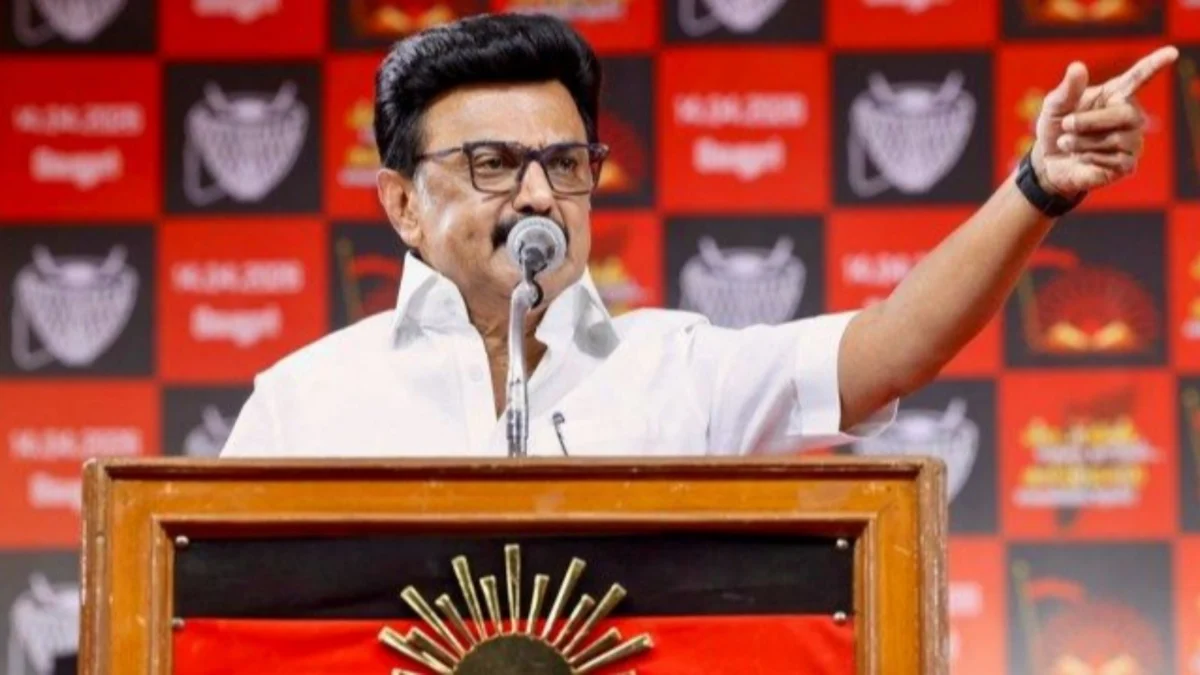
Chennai, India – In the vibrant and often theatrical political landscape of Tamil Nadu, where gestures can carry as much weight as policy pronouncements, a seemingly innocuous movement of the hand has ignited a fierce political firestorm. For generations, cinematic luminaries like C. Joseph Vijay have trained audiences to decipher the subtle language of the body – a raised eyebrow signaling defiance, a pregnant pause preceding a punchline. Last Wednesday, this deep-seated cultural understanding collided with raw political history when Chief Minister Vijay, during an Assembly speech, touched and slightly lifted his jaw with his right hand. The gesture, fleeting as it was, immediately drew the ire of the opposition Dravida Munnetra Kazhagam (DMK), with its president, M.K. Stalin, delivering a powerful and deeply personal rebuttal that stretched back half a century into the state’s tumultuous past, accusing the Chief Minister of trivializing a painful chapter in his party’s and his family’s history.
The incident has swiftly escalated beyond a mere legislative spat, becoming a battle over historical narrative, personal suffering, and the very nature of governance in a state accustomed to the blurring lines between cinema and statecraft. It underscores the unique challenges faced by a superstar Chief Minister attempting to navigate the complexities of administration while grappling with the enduring power of political symbolism.
The Inciting Gesture: A Spark in the Assembly
The core of the controversy lies in Chief Minister Vijay’s specific action. During his address to the Assembly, a moment captured on camera showed him placing a palm against his jaw and moving it subtly upwards – a gesture that could be interpreted in various ways, from thoughtful contemplation to a dismissive shrug, or even, as the DMK alleged, a mocking reference. In any other political arena, it might have gone unnoticed. But in Tamil Nadu, where political discourse is often imbued with cinematic flair and every public figure is a performer, the seconds-long gesture instantly acquired a profound political afterlife.
The DMK and its allies, including the CPI(M) and VCK, were quick to interpret the gesture as a direct and insensitive mockery of M.K. Stalin’s past suffering during the Emergency era, specifically alluding to a severe injury he sustained to his jaw during his incarceration under the draconian Maintenance of Internal Security Act (MISA). This interpretation transformed a simple physical action into a loaded political statement, sparking outrage and immediate demands for its expunction from the Assembly records.
The Assembly Confrontation and Vijay’s Clarification
The legislative session immediately following the gesture was tumultuous. DMK legislators vehemently protested, demanding that Vijay’s references to Enforcement Directorate documents, the Sarkaria Commission, and particularly his alleged mockery of the MISA period, be removed from the official record. Speaker J.C.D. Prabhakar, however, rejected the demand, leading to further uproar and the eventual eviction of protesting DMK members by marshals, highlighting the deep partisan divide the incident had exacerbated.
Amidst the escalating criticism, Chief Minister Vijay issued a clarification on Tuesday, attempting to douse the flames. He stated, "My body language was an involuntary expression. I would like to make it known that it was not in any way intentional." He further requested that "it should not be interpreted as an act intended to hurt anyone’s feelings on a personal level." This explanation, however, did little to quell the indignation of the DMK, which viewed it as an insufficient and belated apology for an act perceived as deliberately provocative.
Echoes of Emergency: MISA and DMK’s Foundational Memory
The controversy’s combustibility stems from its direct connection to one of the DMK’s most sacred and painful foundational memories: the period of persecution during the Emergency. The Emergency, imposed by Prime Minister Indira Gandhi in June 1975, saw widespread arrests of political opponents and suppression of civil liberties. In Tamil Nadu, the then-governing Karunanidhi government, a vocal critic of the Emergency, was dismissed in January 1976, ostensibly for corruption, amid an increasingly hostile relationship with New Delhi. This era also marked a significant political churn, with the rise of cinematic icon M.G. Ramachandran (MGR) as a powerful political force, further intertwining cinema, charisma, and state power.
It was during this dark chapter that M.K. Stalin, then a young and newly married DMK activist, was detained under the MISA. On Wednesday, Stalin meticulously reconstructed his arrest and incarceration, painting a vivid and harrowing picture of his personal ordeal. He recounted how, when police first arrived at the Gopalapuram residence to arrest him, his father, the late M. Karunanidhi, told them, "The boy has gone out for campaigning. He will return tomorrow. Once he comes back, I myself will call you. Come and arrest him," and sent them away. The next day, true to his word, Karunanidhi himself asked the police to return and oversaw his son’s arrest.
Stalin’s description of his time in prison was even more brutal. He detailed how ten detainees were packed into a small room, forced to share a single pot as a toilet. "At night, the police would not allow us to sleep. They would beat us with lathis and stamp on us with their boots," he recounted, his voice heavy with emotion. The physical and psychological torment had devastating consequences. "Because of those beatings, my dear elder brother and Member of Parliament Chitti Babu, who was with me, died in jail. Because of their beatings, the bones in my jaw were broken." This specific injury, a broken jaw, is what the DMK believes Chief Minister Vijay’s gesture directly mocked, transforming an impersonal historical reference into a deeply personal affront.
Stalin’s Resounding Rebuttal: A Scathing Critique
M.K. Stalin’s response transcended a mere defense of his past; it became a comprehensive and scathing critique of Chief Minister Vijay, his understanding of history, and his administration. "Brother Vijay, what you said about the history of MISA is true. There is nothing false about it," Stalin began, acknowledging the factual basis of Vijay’s initial references. Then came the devastating pivot: "You even placed your hand like this and pointed to the jaw, didn’t you? That is correct." This direct confrontation validated the gesture’s interpretation while simultaneously condemning its intent.
Stalin, who often portrays the BJP-led Union government as his ideological adversary, challenged Vijay’s political acumen. "How did you, who portray the Union government as your ideological enemy, not know all this?" he questioned, implying a fundamental lack of historical awareness or empathy. He further dismissed Vijay’s reliance on the Sarkaria Commission and Enforcement Directorate materials, arguing that repeated changes in government since the 1970s meant that any genuine allegations of wrongdoing would have resulted in action.
However, Stalin’s most expansive attack targeted Vijay’s three-month-old government, accusing him of prioritizing image over substance. "Turning the Legislative Assembly itself into a place for shooting reels, standing on the bridge that we built and doing photoshoots – you are running the government and administration itself like a cinema shoot," he declared, hitting at the perception that Vijay’s administration is more focused on optics than governance. "To conceal your incompetent administration, you are putting out all kinds of reels and deceiving an entire generation."
The Paradox of the Superstar Chief Minister
This incident lays bare the inherent paradox confronting a superstar who ascended to power with a historic mandate. C. Joseph Vijay’s political asset has always been his unparalleled ability to compress complex emotions and meanings into a single, compelling image – a skill honed over decades in cinema. Yet, the realities of governance are resistant to cinematic time. Files move slowly, electoral promises acquire eligibility clauses, crime statistics refuse to be choreographed, and real-world problems rarely disappear after a dramatic "interval fight."
Tamil Nadu has a long and storied history of actor-to-Chief-Minister transitions, with M.G. Ramachandran (MGR) being the preeminent example of converting screen charisma into durable political authority. However, even MGR’s illustrious career demonstrated that sustained political power eventually required the image to coexist with robust party organization, comprehensive welfare schemes, efficient administration, and the capacity for compromise. Vijay now faces a digital-age version of this challenge, where every public gesture, every casual remark, every official appearance can instantly become "content" for viral consumption, often before the Assembly session has even concluded.
Stalin meticulously listed various areas where, he argued, Vijay’s government had fallen short, highlighting a perceived gap between campaign promises and administrative reality. He cited concerns over law and order, crimes against women, the contentious Parandur airport project, unfulfilled farm-loan waivers, and unkept promises regarding cooking-gas cylinder subsidies and women’s assistance schemes. "What you said then is one thing; what you are doing now is another," Stalin asserted, directly challenging Vijay’s credibility.
A Battle of Narratives and the Road Ahead
The DMK president also recalled a personal encounter with Vijay shortly after the latter became Chief Minister. "During the election campaign, I criticised you a lot. I am sorry, sir," Stalin quoted Vijay as having said. Stalin claimed he replied, "It’s all right, brother. I haven’t kept any of that in my mind. You are now the Chief Minister of a State. Whenever you speak about anyone, speak with the dignity that comes with that position." The current controversy, Stalin concluded, indicated that Vijay had "forgotten all that."
Stalin ended his impassioned speech with a declaration of his party’s enduring legacy and commitment: "We fought for their grandfather. We fought for their father. Now, we will fight for them themselves. This is the history of our DMK. That history will never change." This statement not only reinforced the DMK’s intergenerational political identity but also served as a warning shot to Vijay, signaling that the DMK is prepared for a prolonged and aggressive political battle.
The "jaw gesture" controversy, therefore, is far more than an isolated incident. It is a microcosm of the intense political rivalry brewing in Tamil Nadu, a clash of historical narratives, governing philosophies, and leadership styles. It highlights the inherent tension between the ephemeral world of cinematic image-making and the enduring, often brutal, realities of political history and state administration. For Chief Minister Vijay, the challenge remains to translate his immense popularity and charismatic appeal into effective governance that can withstand the rigorous scrutiny and historical memory of a politically conscious state. For the DMK, it is an opportunity to reassert its foundational narrative of struggle and sacrifice, cementing its identity as the custodian of Tamil Nadu’s political conscience against what it perceives as superficial showmanship. The stage is set for a protracted political drama, where every gesture, every word, and every historical reference will be weighed, debated, and weaponized.
