The Master of Business Administration (MBA) degree, long considered a golden ticket to career advancement and lucrative opportunities, is at a critical juncture. While still a powerful tool for many, its value proposition has undeniably evolved. The traditional narrative of a guaranteed swift return on investment, particularly at newer institutions, is being challenged by rising fees, stagnating salary growth, and the disruptive influence of artificial intelligence on entry-level positions. This comprehensive analysis delves into the current state of the MBA, examining its financial viability, the performance of newer Indian Institutes of Management (IIMs), the impact of AI, the global trends, and offering a forward-looking perspective on the degree’s future.
The Shifting Sands of Financial Viability: A Tale of Two Tiers
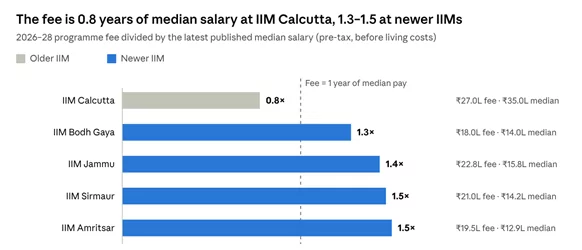
The financial justification for pursuing an MBA hinges dramatically on the institution. For graduates of the premier IIMs, the return on investment remains compelling. IIM Calcutta, for instance, commands a fee of approximately ₹27 lakh for its 2026-2028 batch. The reward? A median graduate salary of ₹35 lakh, suggesting a payback period of less than a year, even before accounting for opportunity costs. This rapid recoupment of investment underscores the enduring value of an MBA from elite institutions, bolstered by strong alumni networks and access to top-tier recruitment.
However, the picture darkens considerably for many newer IIMs. In stark contrast to their established counterparts, several of these institutions are experiencing a troubling divergence: median salaries are stagnating or even declining, while tuition fees continue their upward trajectory. For students at these newer IIMs, the payback period can extend to a year and a half, or even three years or more, when factoring in forgone salary, living expenses, and interest on loans. This extended financial commitment necessitates a more cautious and data-driven decision-making process, moving beyond headline-grabbing highest salary figures to a realistic assessment of median outcomes.
The Newer IIMs: Unpacking the Unseen Data
The "is it worth it?" question becomes particularly acute when examining the newer IIMs. An analysis of National Institutional Ranking Framework (NIRF) data by Careers360 reveals a disquieting trend: six out of nine "baby" IIMs reported lower median salaries for their 2025 graduating batch compared to earlier cohorts. The decline is not insignificant. IIM Bodh Gaya witnessed a substantial drop of approximately 22%, from ₹15.5 lakh to ₹12.12 lakh over two batches. Similarly, IIM Amritsar saw its median salary slide by about 19% to ₹12.9 lakh.
While not a universal decline, with some institutions like IIM Sirmaur showing a commendable 12.6% increase to ₹14.2 lakh and IIM Jammu edging up to ₹15.8 lakh, the overall trend warrants careful scrutiny. Crucially, placement reports often omit critical data points that paint a more complete picture. For instance, IIM Amritsar’s 2024-26 batch placement report highlights a highest CTC of ₹43 lakh but conspicuously lacks median or average figures. IIM Sirmaur’s latest summary provides an average but omits the median. IIM Bodh Gaya, while adhering to good practice by reporting on an audited "MEP" (Management Education Program) basis, presents data not always directly comparable with schools that do not follow the same rigorous auditing standards.
Prospective students must therefore scrutinize placement reports with a critical eye, asking pointed questions about audited median salaries, the inclusion of all graduates, and the methodology used for reporting compensation. The availability of such transparent and standardized data is paramount for informed decision-making.
AI’s Unseen Hand: Reshaping the Entry-Level Landscape
The burgeoning influence of Artificial Intelligence (AI) is a significant factor reshaping the MBA landscape, particularly at the entry-level. Evidence suggests that AI is not causing wholesale job destruction but is instead thinning out the junior ranks – precisely where many fresh MBA graduates traditionally find their footing.
A seminal study by Stanford’s Digital Economy Lab, analyzing payroll data from millions of US workers, revealed that individuals aged 22-25 in occupations most exposed to AI experienced a 13% relative decline in employment since late 2022. This trend has widened to 19% in subsequent updates, while overall economy-wide displacement remains minimal. This research offers crucial insights for MBA aspirants: jobs where AI augments human capabilities, rather than fully replacing tasks, show stable or increasing employment. Furthermore, the impact of AI diminishes with higher levels of education, suggesting that skills beyond codified, repeatable tasks—such as judgment, client interaction, and the ability to direct AI—are more resilient.
This sentiment is echoed by employers. A 2026 GMAC survey of 621 recruiters across 39 countries indicated that approximately one in three planned to replace some entry-level roles with AI. Concurrently, 53% identified proficiency in using AI tools as the most critical skill for the next five years.
In India, the Naukri JobSpeak index for September 2026 illustrates this phenomenon. While overall white-collar hiring saw a modest 2% increase and fresher hiring rose by a mere 1%, AI/ML roles surged by 20%. Within the IT sector, demand for AI talent was most pronounced among professionals with 8-16 years of experience. This highlights a clear employer preference for specialized skills and experience, leading to increased caution around generalist freshers.
The consulting sector, a major recruiter at top IIMs, exemplifies this shift. McKinsey, after a period of contraction, signaled a 12% hiring increase for 2026 and has integrated AI components into its final-round interviews in the US. BCG is increasingly prioritizing AI and tech specialists over generalist MBAs. While firms are hiring, the profile of the ideal candidate has evolved. The implication for MBA aspirants is clear: a generic MBA, without a focus on specialized, AI-resistant skills, faces a shorter shelf life than it did even a few years ago. The future MBA graduate must be equipped to not just manage but also leverage AI effectively.
The Global Arena: Demand Persists, but the Playing Field Shifts
Globally, the demand for MBA graduates remains robust, albeit with a discernible shift in institutional preference and geographic focus. GMAC’s latest survey indicates a 2% rise in MBA applications for the 2025-26 cycle, building on a significant 13% surge the previous year, with full-time, two-year programs experiencing a 4% growth.
This growth, however, is concentrated at the apex of academic institutions. The most selective quarter of MBA programs saw a 52% increase in applications, while the least selective experienced only a 28% rise. This trend has led to the closure or pause of full-time MBA programs at several US business schools, including Houston’s Bauer College, and earlier shifts by institutions in Illinois and Iowa towards online, part-time, or one-year formats.
Even elite institutions faced headwinds. Harvard Business School reported that 23% of its Class of 2024, seeking employment, remained without an offer three months post-graduation—more than double the historical norm. While the Class of 2025 showed a stronger recovery, with 90% securing offers by the three-month mark and nearly 94% by November (Stanford GSB also reporting 90%), the experience served as a stark reminder of the evolving job market. Notably, compensation remained largely unaffected.
Despite these shifts, the MBA premium endures. GMAC’s 2026 recruiter survey projects a median starting salary of US$120,000 for new MBA hires in the United States, compared to US$107,500 for experienced hires recruited directly from industry. Employers continue to value the MBA, but their selection criteria are becoming more discerning, with a strong emphasis on a graduate’s ability to navigate and utilize AI.
Five Predictions for the MBA’s Future (2026-2031)
Based on the prevailing trends, here are five predictions for the MBA landscape between 2026 and 2031:
- Hyper-specialization within MBA Programs: Business schools will increasingly offer specialized tracks or concentrations, allowing students to develop deep expertise in areas like AI ethics, sustainable finance, digital transformation, or advanced data analytics, making them more attractive to employers.
- Rise of Hybrid and Shorter MBA Formats: The traditional two-year full-time MBA will face increased competition from one-year programs and flexible hybrid models that cater to experienced professionals seeking to upskill without significant career disruption.
- Increased Emphasis on Experiential Learning and AI Integration: Curricula will evolve to incorporate more hands-on projects, simulations, and case studies that directly address the application of AI in business decision-making and problem-solving.
- Geographic Diversification of Top-Tier MBA Programs: While North America will remain a significant hub, expect to see increased growth and recognition for top MBA programs in Asia and Europe, driven by global economic shifts and a desire for diverse perspectives.
- The "AI-Ready" MBA as the New Standard: Graduates will be expected to possess not only business acumen but also a demonstrable understanding and practical ability to leverage AI tools and technologies across various business functions. Those who fail to adapt will find their career progression significantly hampered.
The Crucial Question: Should You Pursue an MBA?
The MBA is no longer a monolithic product; its value is nuanced and dependent on individual circumstances. The decision to pursue an MBA in the current climate requires a personalized assessment, aligning your aspirations with the evolving realities of the market.
| Your Situation | Our Honest Take | What to Check First |
|---|---|---|
| 99+ percentile range, aiming for IIM A/B/C/L/K or equivalent | Still one of the best-value degrees in India. Payback is fast, and the network compounds significantly. | Which specific roles you aspire to, ensuring the two years are strategically utilized. |
| Two-plus years of work experience and a clear career switch in mind (e.g., engineering to product, or ops to strategy) | A strong case. The MBA is fundamentally designed for career transitions, and AI poses the least threat to experienced professionals. | Whether a one-year program can achieve your objectives more efficiently and cost-effectively. |
| Fresher with converts mainly from newer IIMs or tier-2 schools | Think critically. Fees approaching ₹18-23 lakh against median salaries of around ₹12-16 lakh represent a long payback period, and fresher roles are highly exposed to AI. | The school’s audited median salary figures and its historical record of fresher placements. |
| Pursuing an MBA because "everyone in my batch is doing it" or to escape a disliked job | It’s likely better to wait. A year of focused skill development, acquiring AI-centric expertise, or seeking internal role transitions might yield better results. | What specific, indispensable outcomes you cannot achieve without the degree. |
| Planning to take a substantial loan for a non-IIM, non-top-20 program | Exercise extreme caution. This is where the Return on Investment (ROI) narrative most frequently falters. | Your loan EMI against realistic, not aspirational, post-MBA salary projections. |
Ultimately, the decision to invest in an MBA is a strategic one. For those who can leverage the degree to accelerate career progression, pivot into desired fields, and acquire specialized, AI-resistant skills from reputable institutions, the MBA remains a potent force. However, for others, particularly those facing the dual challenges of rising fees and an AI-influenced entry-level job market at less established schools, a more pragmatic and data-driven approach is essential. Connecting with current students and alumni from target institutions for candid insights will be invaluable in navigating this complex decision. The MBA’s future is not in question, but its application and value are undeniably being redefined.