
New Delhi, India – October 26, 2026 – The allure of an MBA, once a near-guaranteed ticket to rapid career advancement and lucrative salaries, is undergoing a profound recalibration. While the degree remains valuable, its worth is increasingly contingent on the institution, the individual’s career stage, and the evolving landscape shaped by artificial intelligence and global economic shifts. For aspiring MBA candidates, particularly those eyeing the Indian market, a stark reality check is in order: the MBA is still worth it, but for fewer people, at fewer schools, and for reasons that have diverged significantly from those that dominated just five years ago.
At the pinnacle of India’s Indian Institutes of Management (IIMs), the financial returns for graduates can still be exceptional, with median salaries allowing for a full fee recovery in under a year. However, this rosy picture is not uniform. A growing number of newer IIMs are witnessing a concerning trend: stagnating or declining median salaries juxtaposed with consistently rising tuition fees. Compounding this challenge is the quiet but persistent influence of Artificial Intelligence (AI), which is beginning to erode the entry-level corporate positions that traditionally served as the first rung on the career ladder for MBA freshers.
For students diligently preparing for the Common Admission Test (CAT), the critical question often surfaces in the quiet hours of the night, after a disappointing mock exam performance: "Is this investment of ₹20-27 lakh and two years of my life truly justified?" While parents may refrain from voicing this concern aloud, and coaching institutes are incentivized to present an optimistic outlook, the constant stream of aspirational LinkedIn posts rarely offers a candid assessment. This report aims to provide that honest evaluation, dissecting the financial realities, the performance of newer IIMs, the tangible impact of AI on entry-level jobs, the global standing of the MBA, and projecting its trajectory towards 2031. Without any sales pitch, this analysis relies on data and insightful interpretation.
The Financial Equation: Payback Period Hinges Critically on IIM Prestige
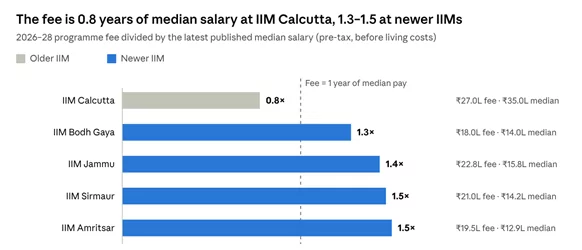
The financial viability of an MBA in India remains strongly correlated with the reputation and placement success of the institution. For graduates of the premier IIMs, the return on investment (ROI) narrative is compelling. For instance, the Indian Institute of Management Calcutta (IIMC), with a fee of approximately ₹27 lakh for the 2026-28 batch, reported a median salary of ₹35 lakh for its 2026 graduating cohort. This implies a payback period of less than a year, a remarkably swift recovery of the educational investment.
However, this optimistic outlook rapidly deteriorates when examining newer IIMs. For several of these institutions, the tuition fees now exceed the typical graduate’s annual salary, stretching the payback period to well over a year. The provided data, while illustrative, presents a "flattering" version of the financial reality. It often omits crucial factors such as income tax, the significant living expenses incurred over two years of study, and, crucially, the salary forgone by the individual during their MBA tenure. For someone earning ₹10 lakh per annum prior to commencing their MBA, the lost income alone can amount to approximately ₹20 lakh, in addition to the tuition fees. When these costs are factored in, the payback period at a newer IIM can extend to 1.5 to 3 years, or even longer, depending on the individual’s pre-MBA salary and the extent of their financial borrowing.
This does not inherently render a degree from a newer IIM a poor choice. A median salary in the range of ₹14-16 lakh still represents a substantial career upgrade for a fresh graduate or a career switcher transitioning from a ₹5-7 lakh job. Nevertheless, it underscores the necessity of making the MBA decision based on a realistic assessment of median outcomes and personal financial projections, rather than solely on headline-grabbing highest salary packages.
Navigating the Newer IIMs: Unpacking the Unspoken in Placement Reports
The question of an MBA’s worth becomes particularly acute when considering the newer IIMs. An analysis of National Institutional Ranking Framework (NIRF) data by Careers360 reveals a disquieting trend: six out of nine newer IIMs reported a decline in median salaries for their 2025 graduating batch compared to previous cohorts.
These salary drops are not negligible. For example, IIM Bodh Gaya witnessed a decline in its median salary from ₹15.5 lakh to ₹12.12 lakh over two graduating batches, a substantial decrease of approximately 22%. Similarly, IIM Amritsar’s median salary slipped by about 19% to ₹12.9 lakh. While the trend is not uniformly negative – IIM Sirmaur’s median salary saw an increase of about 12.6% to ₹14.2 lakh, and IIM Jammu edged up to ₹15.8 lakh – the overall picture for these newer institutions warrants careful scrutiny.

Crucially, the information omitted from placement reports often carries more weight than what is explicitly stated. For the 2024-26 batch, IIM Amritsar reported a highest Cost to Company (CTC) of ₹43 lakh but conspicuously omitted average or median salary figures. IIM Sirmaur’s latest summary provides an average salary but lacks a median. IIM Bodh Gaya reports its placements on an audited "MEP" (Management Education Program) basis, a commendable practice, but this data is not directly comparable to schools that do not adhere to the same auditing standards. Prospective students are strongly advised to scrutinize any placement brochure by asking four critical questions:
- What is the audited median salary? This provides a more representative measure of graduate earnings than the highest package.
- What is the average salary for the batch? While the median is often preferred, the average can offer additional context.
- What is the placement rate for the entire batch? Some reports might highlight placement for a subset, not the whole cohort.
- Are there separate figures for freshers versus experienced candidates? This is crucial for understanding the entry-level job market.
A comprehensive tracker of IIM placement reports, which juxtaposes median salaries, batch sizes, and audit status for every IIM that publishes such data, is an invaluable tool for prospective applicants.
AI and the Entry-Level Job Market: Evidence-Based Impact
The pervasive narrative surrounding AI’s impact on employment often paints a picture of wholesale job destruction. However, current evidence suggests a more nuanced reality: AI is not decimating jobs across the board, but it is undeniably thinning the ranks of junior-level positions – precisely the entry point for most Indian MBA graduates.
The most influential research in this domain originates from Stanford’s Digital Economy Lab. Their analysis of payroll data from millions of U.S. workers revealed that individuals aged 22-25 in occupations most exposed to AI experienced a relative employment decline of 13% since late 2022. In stark contrast, older workers in the same roles saw their employment levels remain stable or even increase. An update in August 2026 further widened this gap to 19%, while still finding no evidence of widespread job displacement across the entire economy.
Two key findings from this research hold particular significance for MBA aspirants. Firstly, jobs where AI serves as an augmentation tool, rather than a direct replacement for human tasks, demonstrated flat or rising employment figures. Secondly, the employment gap between younger and older workers narrows considerably when educational attainment is taken into account. In simpler terms, the routine, codified, and repeatable tasks of a junior analyst are susceptible to AI automation, whereas roles requiring judgment, client interaction, and the ability to strategically direct AI remain more resilient.
Employer sentiment aligns with these findings. A 2026 GMAC survey of 621 recruiters across 39 countries indicated that approximately one in three planned to replace some entry-level roles with AI. Concurrently, a significant 53% of respondents identified proficiency in using AI tools as the most critical capability for the next five years.
The Indian Context: Data from India mirrors these global trends. Naukri’s JobSpeak index for September 2026 reported a modest 2% increase in overall white-collar hiring, with fresher hiring up by a mere 1%. In contrast, roles related to AI/ML witnessed a substantial 20% surge. Within the IT sector, demand for AI talent was most pronounced among professionals with 8-16 years of experience. This indicates that companies are prioritizing specialized expertise and experience, while exercising caution regarding generalist freshers.
The consulting sector, a major recruiter at top IIMs, exemplifies this shift. McKinsey, following a period of contraction, signaled a 12% increase in hiring for 2026 and has integrated AI components into its final-round interviews in the U.S. Boston Consulting Group (BCG) has been progressively tilting its hiring strategy towards AI and technology specialists, rather than generalist MBAs. While hiring is resuming, the profile of the ideal candidate has evolved.
The Unvarnished Truth for Aspirants: AI is unequivocally diminishing the value of a generic MBA while amplifying the importance of a differentiated one. If an individual’s post-MBA plan involves securing a generic analyst role that can be partially automated by a sophisticated AI model, that career path has a significantly shorter shelf life than it did even in 2022.
The Global MBA Landscape: Sustained Demand, Shifting Preferences
Globally, the demand for MBA degrees remains robust, albeit with a discernible shift towards fewer, more prestigious institutions and a growing interest in programs located outside North America. GMAC’s latest survey indicates a 2% rise in MBA applications for the 2025-26 cycle, building on a record 13% increase the previous year. Full-time, two-year programs, in particular, saw a 4% growth.
This surge in applications is not evenly distributed. Among the most selective quarter of MBA programs, 52% reported an increase in applications, whereas only 28% of the least selective programs saw similar growth. Conversely, several U.S. business schools have recently paused or discontinued their full-time MBA programs, including Houston’s Bauer College in 2025, and earlier, institutions in Illinois and Iowa. These schools are often pivoting towards online, part-time, or one-year formats.
Even elite institutions have faced headwinds. Harvard Business School reported that 23% of its job-seeking Class of 2024 remained without an offer three months post-graduation, more than double the historical norm. While the Class of 2025 showed a recovery, with 90% securing offers at the three-month mark and close to 94% by November, and Stanford GSB also reporting 90%, compensation levels have largely held steady throughout.
The salary premium associated with an MBA continues to be a significant factor. GMAC’s 2026 recruiter survey projects a median starting salary of US$120,000 for new MBA hires in the United States, compared to US$107,500 for experienced professionals recruited directly from industry. Employers continue to value the degree, but their selectivity regarding the institution and the graduate’s aptitude for AI integration has intensified.
Projections for the MBA: A Five-Year Outlook (2026-2031)
Based on the discernible trends within the data, the following five predictions offer a glimpse into the future of the MBA by 2031:
- Increased Specialization and Skill Integration: MBA programs will increasingly incorporate specialized tracks and mandatory modules in areas like data analytics, AI ethics, and digital transformation, moving beyond traditional business functions.
- Rise of Hybrid and Modular Formats: To cater to evolving learner needs and the continuous learning imperative, a greater emphasis will be placed on flexible learning options, including hybrid models, executive MBAs, and shorter, specialized certificate programs.
- Divergence in Program Value: The gap between the value proposition of top-tier MBA programs and those from less reputable institutions will widen further, leading to a more polarized market.
- Emphasis on "Human" Skills: As AI automates technical tasks, MBA programs will increasingly focus on developing uniquely human skills such as leadership, strategic thinking, complex problem-solving, emotional intelligence, and ethical decision-making.
- Global Rebalancing of MBA Hubs: While North America will remain a significant player, Europe and Asia (particularly India and Southeast Asia) will see a sustained rise in the prominence and application numbers for their leading MBA programs.
The Crucial Question: Is an MBA Right for You?
The MBA is no longer a monolithic product; its value proposition is highly individualized. Therefore, a one-size-fits-all answer is impossible. Prospective candidates must identify the scenario that most closely reflects their personal circumstances:
| Your Situation | Our Honest Take | What to Check First |
|---|---|---|
| 99+ percentile range, aiming for IIM A/B/C/L/K or equivalent | Still one of the best-value degrees in India. Payback is fast and the network compounds significantly. | Which specific roles you genuinely aspire to, to ensure you utilize the two years of study effectively. |
| Two-plus years of work experience and a clear career switch in mind (e.g., engineering to product management, or operations to strategy) | A strong case. The MBA is inherently designed for such transitions, and AI poses the least threat to experienced professionals. | Whether a one-year program could achieve your career goals more swiftly and cost-effectively. |
| Fresher with converts mainly from newer IIMs or tier-2 schools | Proceed with extreme caution. Fees approaching ₹18-23 lakh against median salaries of ₹12-16 lakh translate to a prolonged payback period. Fresher roles are also the most exposed to AI automation. | The school’s audited median salary figures and its track record for fresher placements. |
| Pursuing an MBA because "everyone in my batch is doing it" or to escape a disliked job | It is likely advisable to wait. A year of focused skill development, acquiring AI-specific expertise, or seeking an internal role switch within your current company might yield more impactful results. | What specific career outcomes or skill development are unattainable without an MBA. |
| Planning to take a substantial loan for a non-IIM, non-top-20 program | Exercise extreme prudence. This is the segment where the ROI narrative most frequently falters. | Calculate your projected loan EMIs against realistic, not aspirational, post-MBA salary figures. |
In conclusion, the MBA landscape is undeniably shifting. While the degree retains its prestige and earning potential at the highest echelons, a more discerning and data-driven approach is now paramount for aspiring candidates. Understanding the nuances of institutional performance, the evolving demands of the job market influenced by AI, and one’s own career aspirations will be critical in determining whether the significant investment in an MBA will indeed yield the desired returns in the years to come. Connecting with current students and alumni from target institutions for candid insights remains an indispensable step in this decision-making process.