
The question of whether an MBA is still a worthwhile investment is no longer a simple yes or no. In the current educational and economic climate, the value proposition of a Master of Business Administration degree is increasingly nuanced, depending heavily on the institution, the individual’s career stage, and the evolving technological landscape. While top-tier Indian Institutes of Management (IIMs) continue to offer a swift return on investment, many newer institutions face challenges as rising fees outpace stagnant or declining median salaries, and the advent of Artificial Intelligence (AI) begins to reshape the entry-level job market. This analysis delves into the financial realities, the performance of newer IIMs, the impact of AI, the global MBA scene, and forecasts the future trajectory of this once-ubiquitous degree.
The Financial Calculus: An IIM-Dependent ROI
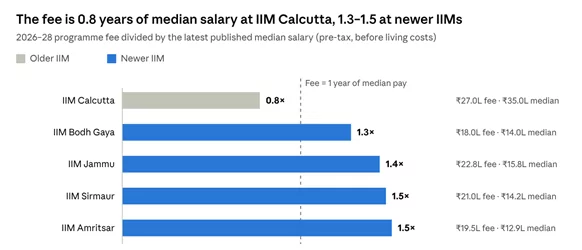
The financial viability of an MBA in India is starkly divided along institutional lines. For candidates aiming for the premier IIMs – such as IIM Ahmedabad, Bangalore, Calcutta, Lucknow, and Kozhikode – the investment remains compelling. For instance, IIM Calcutta’s fee for the 2026-28 batch stands at approximately ₹27 lakh. Crucially, its 2026 graduates reported a median salary of ₹35 lakh, indicating a payback period of less than a year for a significant portion of its alumni. This swift financial recovery, coupled with the formidable alumni network and brand prestige, solidifies the MBA’s value at these elite institutions.
However, the narrative shifts dramatically when examining the newer IIMs. In several of these institutions, a disquieting trend has emerged: median salaries have been experiencing a downward slide, even as tuition fees continue their upward trajectory. For a substantial number of these newer IIMs, the cost of the MBA program now exceeds the typical graduate’s annual salary, extending the payback period to a year and a half, or even longer. This calculation, however, often paints a deceptively rosy picture. It typically excludes crucial factors such as income tax, the considerable living expenses incurred over two years of study, and, most significantly, the opportunity cost of forgone salary. An individual earning ₹10 lakh annually before commencing their MBA program sacrifices approximately ₹20 lakh in potential earnings over two years, in addition to the program fees. When these elements are factored in, the payback period at a newer IIM can realistically stretch to three years or more, contingent on an individual’s pre-MBA salary and their reliance on educational loans.
It is important to emphasize that this financial disparity does not inherently render a newer IIM a poor choice. For individuals transitioning from entry-level positions earning ₹5-7 lakh per annum, a median salary of ₹14-16 lakh still represents a significant career advancement. Nevertheless, the decision to pursue an MBA at these institutions necessitates a pragmatic assessment based on projected median earnings and individual financial circumstances, rather than being swayed by headline-grabbing highest salary packages.
Newer IIMs: Decoding the Unspoken Realities
The question of "is it worth it?" becomes particularly pertinent and challenging when scrutinizing the newer IIMs. An analysis by Careers360, drawing upon the National Institutional Ranking Framework (NIRF) data, revealed a concerning trend: six out of nine "baby IIMs" reported a lower median salary for their 2025 graduating cohort compared to previous batches.
The decline in median salaries at some of these institutions is not negligible. IIM Bodh Gaya, for instance, witnessed a substantial drop from ₹15.5 lakh to ₹12.12 lakh over two graduating batches, representing a 22% decrease. Similarly, IIM Amritsar’s median salary saw a dip of approximately 19%, settling at ₹12.9 lakh. While this downward trend is not universal, with IIM Sirmaur’s median salary climbing by about 12.6% to ₹14.2 lakh and IIM Jammu edging up to ₹15.8 lakh, it underscores the variability in performance.
Beyond the published figures, what placement reports omit often carries more weight than what they disclose. For the 2024-26 batch, IIM Amritsar, for example, reported a highest Cost to Company (CTC) of ₹43 lakh but conspicuously omitted any data on average or median salaries. IIM Sirmaur’s latest summary provides an average salary but lacks a median figure. IIM Bodh Gaya, commendably, reports its placements on an audited "MEP" (Most Employed Professional) basis, a robust practice, but this makes direct comparisons with institutions that do not follow the same auditing standards challenging. Prospective students are strongly advised to scrutinize placement brochures with a critical eye, posing four key questions to gauge the true value proposition:
- What is the audited median salary? This provides a more realistic picture than the highest package.
- What percentage of the batch was placed? A high placement rate is crucial.
- What is the average salary for freshers versus experienced candidates? Understanding the differentiation is key.
- Are the placement figures audited by a credible third party? This ensures transparency and reliability.
A comprehensive tracker of IIM placement reports, which juxtaposes median salaries, batch statistics, and audit status for every IIM that publishes such data, can be an invaluable resource for prospective candidates navigating these complexities.

AI’s Inroads: Reshaping the Entry-Level Job Market
The discourse surrounding Artificial Intelligence (AI) and its impact on employment often evokes fears of widespread job destruction. However, current evidence suggests a more nuanced reality: AI is not decimating jobs wholesale, but it is significantly thinning the junior ranks of the corporate ladder – precisely the segment where most fresh MBA graduates traditionally find their initial footing.
A seminal study from Stanford’s Digital Economy Lab, which analyzed payroll data from millions of US workers, provided compelling insights. It found that 22-to-25-year-olds in occupations most exposed to AI experienced a 13% relative decline in employment since late 2022. In contrast, older workers in the same roles saw their employment figures remain stable or even increase. A subsequent update in August 2026 indicated that this employment gap had widened to 19%, while still finding no evidence of a broad-based, economy-wide wave of job displacement.
Two critical observations from this research hold particular significance for MBA aspirants. Firstly, roles where AI serves to augment human capabilities, rather than directly replacing tasks, have demonstrated flat or increasing employment. Secondly, the employment gap between younger and older workers in AI-exposed roles narrows when educational attainment is considered. In simpler terms, the highly codified and repetitive tasks performed by junior analysts are vulnerable to AI automation, whereas roles demanding judgment, client interaction, and the strategic direction of AI tools remain more resilient.
Employer sentiment corroborates these findings. A 2026 survey by GMAC, encompassing 621 recruiters across 39 countries, revealed that approximately one in three recruiters anticipate replacing some entry-level roles with AI. Crucially, the same survey highlighted that 53% of recruiters identified proficiency in using AI tools as the most critical skill expected in the next five years.
In India, the impact is palpable. Naukri’s JobSpeak index for September 2026 indicated a modest 2% increase in overall white-collar hiring and a mere 1% rise in fresher hiring. Concurrently, roles in AI/ML saw a significant surge of 20%. Within the IT sector, the demand for AI talent was particularly pronounced among professionals with 8-16 years of experience. This trend signifies a clear market preference for specialized expertise and experience, with companies exhibiting caution towards generalist freshers.
The consulting sector, a primary recruiter for most top IIMs, exemplifies this shift. McKinsey, after a period of contraction, has signaled a 12% increase in hiring for 2026 and has integrated AI components into its final-round interviews in the US. Boston Consulting Group (BCG) has also been strategically tilting its hiring towards AI and tech specialists over generalist MBAs. While these firms are actively recruiting again, the profile of the ideal candidate has evolved.
The candid assessment for MBA aspirants is clear: AI renders a generic MBA less potent, while simultaneously amplifying the value of a differentiated one. A career plan centered on obtaining an MBA to secure a generic analyst role, which a proficient AI model could partially perform, now has a significantly shorter shelf life than it did just a few years ago.
The Global MBA Landscape: Shifting Demographics and Evolving Demand
Globally, the demand for MBA degrees remains robust, albeit with a discernible shift in the landscape. Prospective students are increasingly gravitating towards fewer, more highly-ranked institutions, with a growing interest in programs located outside North America. GMAC’s latest survey indicates a 2% increase in MBA applications for the 2025-26 cycle, building upon a remarkable 13% surge in the preceding year, with full-time, two-year programs experiencing a 4% growth.
This growth is not uniformly distributed. Among the most selective MBA programs, 52% reported an increase in applications, whereas only 28% of the least selective programs saw a similar trend. This bifurcation underscores a growing concentration of demand at the apex of the MBA market. Conversely, several business schools in the United States have recently paused or discontinued their full-time MBA programs. Examples include the Bauer College at the University of Houston, which ceased its program in 2025, and earlier decisions by institutions in Illinois and Iowa to transition to online, part-time, or one-year formats.
Even elite institutions have encountered challenges. Harvard Business School reported that 23% of its graduating Class of 2024, actively seeking employment, had not secured job offers three months post-graduation – more than double the historical average. The Class of 2025 demonstrated a stronger recovery, with 90% of graduates holding offers three months after graduation, and close to 94% by November. Stanford’s Graduate School of Business (GSB) also reported a 90% placement rate. Throughout these fluctuations, salary levels for MBA graduates have largely remained stable.
Despite these shifts, the salary premium associated with an MBA degree remains significant. GMAC’s 2026 recruiter survey projects a median starting salary of US$120,000 for new MBA hires in the United States, compared to US$107,500 for experienced professionals recruited directly from industry. Employers continue to value the MBA, but their selection criteria are becoming more discerning, with a greater emphasis on a graduate’s ability to leverage AI and possess specific, in-demand skills.
Forecast: The MBA’s Trajectory to 2031
Based on the observable trends, the following five predictions offer a glimpse into the future of the MBA degree between 2026 and 2031:
- Increased Specialization and AI Integration: MBA programs will increasingly incorporate specialized tracks focused on AI, data analytics, and emerging technologies. Curricula will evolve to equip students with the skills to manage and leverage AI effectively.
- Diversification of Program Formats: Beyond the traditional two-year full-time MBA, there will be a continued rise in demand for specialized one-year programs, executive MBAs, and flexible online or hybrid formats catering to experienced professionals seeking career transitions.
- Stratification of Value: The gap between top-tier MBA programs and others will widen. Highly selective schools will continue to attract strong applicant pools and command premium salaries, while less prestigious programs may struggle to justify their cost and relevance.
- Emphasis on Experiential Learning and Soft Skills: As AI handles more routine analytical tasks, MBA programs will place a greater emphasis on developing critical thinking, leadership, emotional intelligence, ethical decision-making, and complex problem-solving abilities – skills that are inherently human and less susceptible to automation.
- Global Shifts in Demand: While North America will remain a significant market, the growth in MBA applications and the emergence of strong programs in Asia, Europe, and other regions will continue to reshape the global landscape, offering more diverse and competitive options.
Navigating Your MBA Decision: A Personalized Approach
The MBA is no longer a monolithic product; its value proposition is highly individualized. Therefore, a singular answer to the question of whether to pursue an MBA is impossible. Prospective candidates must carefully consider their unique circumstances and align them with the evolving realities of the business world.
| Your Situation | Our Honest Take | What to Check First |
|---|---|---|
| 99+ percentile range, aiming for IIM A/B/C/L/K or equivalent | Still one of the best-value degrees in India. The payback period is swift, and the alumni network’s compounding benefits are significant. | Which roles you actually want, so you can leverage the two years effectively for targeted skill development and networking. |
| Two-plus years of work experience and a clear career switch in mind | A strong case. The MBA is designed for career transitions, and AI poses the least threat to experienced professionals. | Whether a one-year program can achieve your goals faster and more cost-effectively. |
| Fresher with aspirations primarily towards newer IIMs or tier-2 schools | Think critically. Fees in the range of ₹18-23 lakh against median salaries of approximately ₹12-16 lakh translate to a prolonged payback period. Furthermore, fresher roles are the most vulnerable to AI displacement. | The school’s audited median salary and its placement record for freshers. |
| Pursuing an MBA because "everyone in my batch is" or to escape a disliked job | Consider alternatives. A year of focused professional development, acquiring an AI-centric skill, or pursuing an internal role change within your current company might offer a more direct and cost-effective path to career advancement. | What specific outcomes you cannot achieve without an MBA. |
| Planning a substantial loan for a non-IIM, non-top-20 program | Exercise extreme caution. This is the scenario where the Return on Investment (ROI) narrative most frequently falters. | Your projected loan Equated Monthly Installments (EMIs) against realistic, not highest, salary projections. |
In conclusion, the MBA remains a powerful tool for career advancement, but its efficacy is increasingly contingent on strategic choices. Prospective students must conduct thorough due diligence, focusing on institutional reputation, financial viability, and the evolving demands of the job market, particularly in the face of rapid technological advancements. Engaging with alumni and current students for firsthand insights can provide invaluable perspectives to inform this crucial decision.