In the rapidly evolving landscape of real estate and home improvement, the integration of Artificial Intelligence (AI) has transcended the status of a mere "trend" to become a fundamental pillar of the industry. As homeowners increasingly seek personalized, efficient, and cost-effective ways to curate their living spaces, AI-powered tools are stepping in to fill the void between imagination and execution.
A recent analysis by industry leaders, including insights from Kanika Gupta Shori, COO and Co-Founder of Square Yards, suggests that we are witnessing a paradigm shift. Interior design is moving away from the traditional, labor-intensive cycles of mood boards and manual revisions toward a streamlined, data-driven ecosystem. This transformation is not just about aesthetics; it is about making informed decisions that save time, reduce waste, and enhance the functional quality of modern living.
1. Main Facts: The Current State of AI in Interior Design
The application of Artificial Intelligence in the interior design sector is primarily focused on democratizing high-end design services. Historically, hiring an interior designer was a luxury reserved for a specific demographic. Today, AI-driven platforms allow any homeowner with a smartphone to visualize professional-grade layouts.
Key Pillars of the AI Design Revolution:
- Generative Design: Using algorithms to create multiple layout possibilities based on specific parameters such as room dimensions, budget, and preferred style (e.g., Mid-Century Modern, Industrial, or Minimalism).
- Predictive Analytics: AI systems can now predict how certain materials will age or how natural light will interact with specific wall colors at different times of the year.
- Virtual Staging and Visualization: Sophisticated rendering engines allow users to see a 360-degree photorealistic view of their renovated space before a single brick is moved.
- Resource Optimization: AI helps in calculating the exact amount of materials needed—be it tiles, paint, or timber—thereby minimizing environmental waste and overhead costs.
According to Kanika Gupta Shori, the core value of AI lies in its ability to facilitate "smarter, more practical decision-making." By moving the experimentation phase to a digital sandbox, homeowners avoid the costly "trial and error" approach that has long plagued the home renovation industry.
2. Chronology: The Evolution of the Design Workflow
To understand the magnitude of the current AI shift, one must look at the historical progression of interior design tools.
The Era of Manual Craftsmanship (Pre-1990s)
Design was a tactile and time-consuming process. Architects and designers relied on hand-drawn blueprints, physical mood boards with fabric swatches, and hand-painted renderings. Revisions meant starting from scratch, and the gap between a client’s vision and the designer’s interpretation was often wide.
The Digital Blueprint Phase (1990s – 2010s)
The introduction of Computer-Aided Design (CAD) and 3D modeling software like 3ds Max and SketchUp revolutionized the industry. While these tools allowed for greater precision, they required specialized technical skills. The design process remained siloed; the designer held the tools, and the homeowner remained a passive observer of the results.
The Inspiration Explosion (2010s – 2020)
The rise of Pinterest and Instagram created a "visual boom." Homeowners had access to millions of reference images, but this often led to "choice paralysis." People knew what they liked in a photo, but they had no way of knowing if those elements would work in their specific, real-world floor plans.
The AI-Integrated Era (2021 – Present)
We have entered a "Phygital" (Physical + Digital) era. AI tools now allow for real-time interaction. A user can take a photo of their empty living room, and within seconds, an AI can populate it with furniture that is actually available for purchase, scaled to the room’s exact dimensions. This marks the transition from "inspiration" to "implementation."
3. Supporting Data: The Economic and Functional Impact
The shift toward AI is backed by significant market growth and shifting consumer behavior. The global PropTech (Property Technology) market, of which AI-driven interior design is a significant part, is projected to reach unprecedented heights by 2030.
Industry Statistics:
- Market Growth: The global AI in construction and design market is expected to grow at a CAGR (Compound Annual Growth Rate) of over 25% through 2028.
- Efficiency Gains: Industry reports suggest that AI-powered visualization can reduce the "design-to-approval" timeline by as much as 60%. What used to take weeks of meetings can now be accomplished in a few interactive digital sessions.
- Cost Reduction: By identifying structural constraints and material requirements early through AI simulations, homeowners can save between 10% and 15% on total renovation costs by avoiding mid-project changes.
- Consumer Preference: A survey of modern homebuyers indicates that over 75% of Gen Z and Millennial buyers prioritize "smart design" and digital visualization tools when selecting a real estate or design partner.
These data points underscore why firms like Square Yards are heavily investing in integrated tech stacks. The goal is to provide a seamless "one-stop-shop" experience where a user buys a property and immediately enters a digital design suite to customize it.
4. Official Responses: Insights from Square Yards Leadership
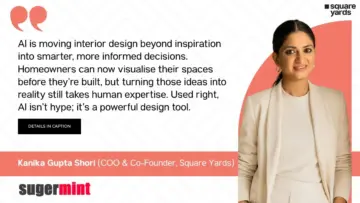
In her feature with Sugermint, Kanika Gupta Shori, COO and Co-Founder of Square Yards, emphasized that the true power of AI is its role as a "decision-support tool."
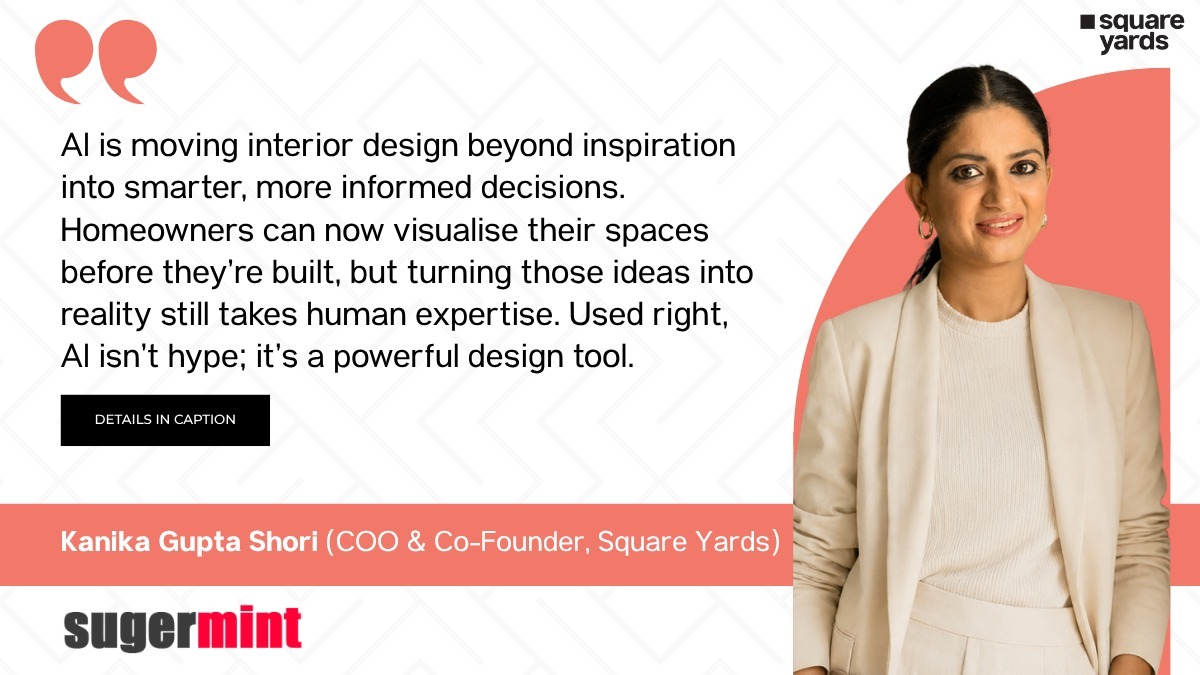
Shori notes that while the technology is impressive, its primary function should be to bridge the communication gap. "AI is moving interior design beyond inspiration towards smarter, more practical decision-making," she explained. This perspective shifts the focus from the technology itself to the outcome it produces for the consumer.
The Square Yards Perspective on Human-AI Collaboration:
Shori is a vocal advocate for the "Human-in-the-loop" model. Her insights highlight several critical areas where human expertise remains irreplaceable:
- Ergonomics and Flow: While an AI can place a chair in a corner, a human designer understands how a person moves through a room, the height requirements for a comfortable kitchen counter, and the subtle "feel" of a home.
- Technical Feasibility: AI might suggest removing a wall for an "open concept" look, but a professional engineer or designer must verify if that wall is load-bearing.
- Material Nuance: AI can simulate the look of marble, but it cannot convey the texture, the way it feels underfoot, or how it reacts to local humidity levels.
- Emotional Intelligence: A home is an emotional sanctuary. Designers act as therapists and stylists, interpreting the unsaid needs of a family—something an algorithm cannot yet replicate.
The official stance from leadership is clear: AI is the engine that speeds up the journey, but the human designer is the driver who knows the destination.
5. Implications: The Future of Living Spaces
The long-term implications of AI in interior design extend far beyond pretty pictures. This technological evolution will redefine the real estate economy and the concept of "home."
Sustainability and the Circular Economy
One of the most profound implications of AI is its potential for sustainability. AI can optimize cutting patterns for materials like wood and stone to ensure zero waste. Furthermore, by visualizing a space accurately, homeowners are less likely to buy furniture that doesn’t fit, reducing the carbon footprint associated with shipping and returns.
The Democratization of Professional Design
As AI tools become more affordable, "high-design" will no longer be a gatekept secret of the elite. This could lead to an overall improvement in the quality of urban living, as even small apartments can be optimized for maximum light, air, and space efficiency using algorithmic layouts.
Impact on the Job Market
There is a common fear that AI will replace interior designers. However, the more likely implication is a shift in the job description. The "Designer of the Future" will need to be part-technologist, using AI to handle the "grunt work" (like 3D rendering and quantity surveying) so they can focus on high-level creative strategy and client relationships.
The Rise of "Interactive Real Estate"
We are moving toward a future where "buying a home" and "designing a home" happen simultaneously. Real estate platforms will likely offer "AI-ready" listings where buyers can toggle through different interior finishes in real-time as they browse properties online.
Conclusion: A Balanced Synthesis
As we look toward 2027 and beyond, the message from industry experts like Kanika Gupta Shori is one of optimistic caution. Artificial Intelligence is undeniably the most powerful tool ever introduced to the world of interior design. It offers a level of clarity and efficiency that was previously unimaginable, transforming the way we conceptualize our personal environments.
However, the "soul" of a home remains a human construct. The future of the industry lies in a hybrid model: the speed and analytical power of AI combined with the empathy, technical knowledge, and creative intuition of human professionals. For the homeowner, this means a journey that is less stressful, more transparent, and ultimately results in a space that is not just a digital render, but a functional, beautiful reality.
Key Takeaway: AI makes design accessible and smart, but human expertise makes it livable. The synergy of the two is the new gold standard for the modern home.