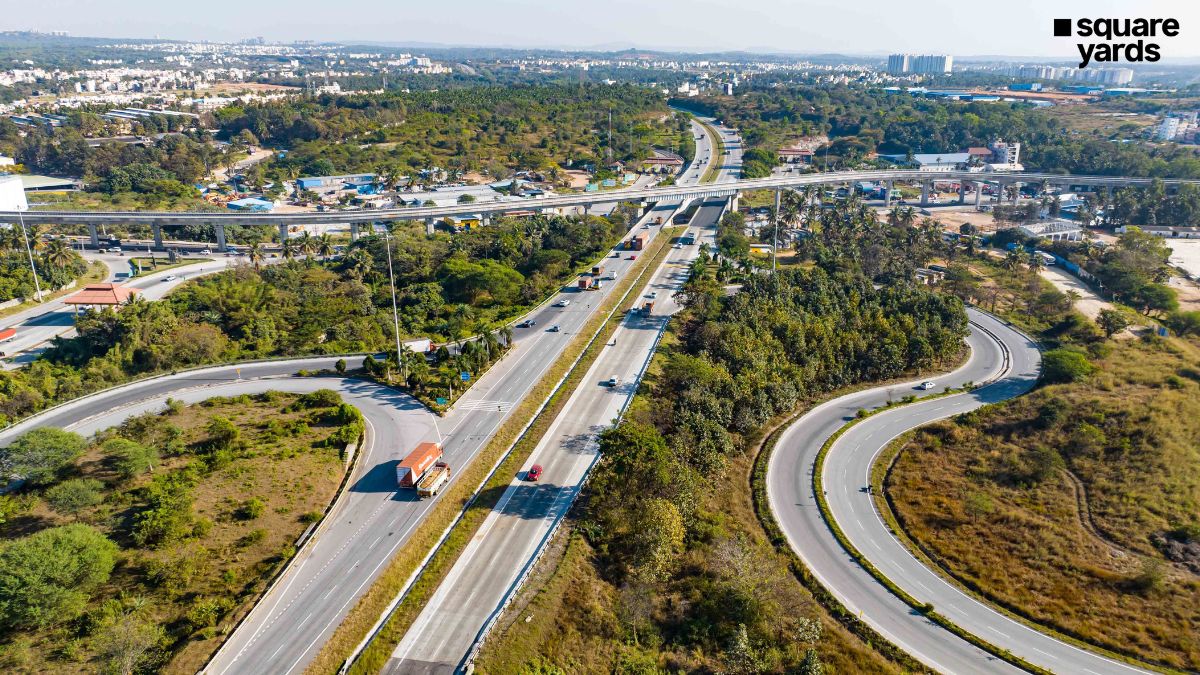
New Delhi / Faridabad / Sohna — The completion of the final stretch of the DND-Jaitpur-Faridabad-Palwal-Sohna expressway corridor marks a watershed moment for the National Capital Region’s (NCR) infrastructure. Once a conceptual blueprint aimed at decongesting the choking arteries of South Delhi, the now-operational 59-km access-controlled highway (NH-148A) is fundamentally altering the geography of the region.
By slashing travel times from nearly three hours during peak congestion to a mere 45 minutes, the corridor is doing more than just moving vehicles; it is shifting the gravitational center of the NCR’s real estate market. From the established high-rises of Faridabad to the nascent residential clusters of Sohna and the affordable frontiers of Palwal, a new era of urban expansion is underway.
I. Main Facts: A Multi-Modal Lifeline for the NCR
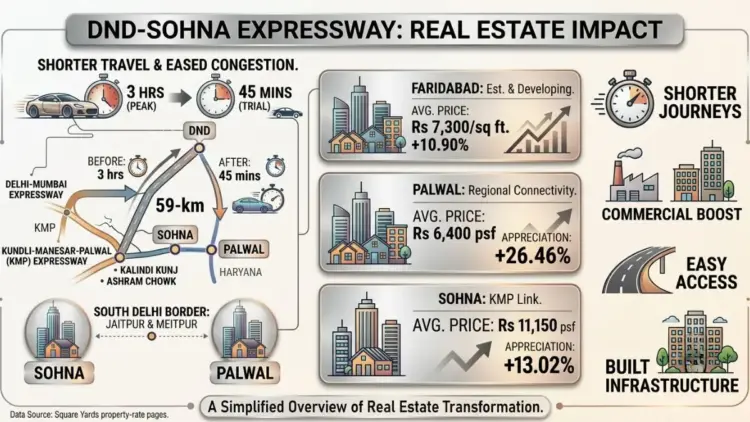
The DND-Faridabad-Sohna Access Controlled Highway is a critical component of the larger Bharatmala Pariyojana. Spanning 59 kilometers, this six-lane (expandable) corridor serves as a vital link between Delhi’s Ring Road and the massive Delhi-Mumbai Expressway (DME) network.
Key Technical and Strategic Highlights:
- Route Connectivity: The highway originates at the Delhi-Noida Direct (DND) Flyway near Maharani Bagh, passes through Jaitpur and Meethapur, traverses the length of Faridabad and Palwal, and culminates at the Kundli-Manesar-Palwal (KMP) Expressway interchange near Sohna.
- Decongestion of Urban Knots: One of the primary objectives of the project is to provide an alternative to the saturated Mathura Road (NH-19). By diverting long-distance traffic heading toward Agra or Mumbai, the corridor is expected to significantly ease bottlenecks at Ashram Chowk, Sarita Vihar, and Kalindi Kunj.
- The "45-Minute Revolution": Trial runs conducted recently have confirmed that the journey from Sarai Kale Khan in South Delhi to Sohna and Palwal—a trip that previously necessitated a grueling three-hour crawl through local traffic—can now be completed in approximately 40 to 45 minutes.
- Strategic Interlinking: The highway acts as a "feeder" to the Delhi-Mumbai Expressway, effectively connecting the national capital to the country’s industrial and financial hubs with unprecedented efficiency.
II. Chronology: From Bottlenecks to High-Speed Transit
The journey of the DND-Sohna Expressway has been one of engineering persistence and strategic planning. The project was conceived to address the "missing link" between Delhi’s inner-city roads and the high-speed regional expressways.
- Conceptualization (2018-2019): Recognizing that the Delhi-Mumbai Expressway would require seamless access from the heart of Delhi, the Ministry of Road Transport and Highways (MoRTH) approved the NH-148A project.
- Phased Development (2020-2023): Construction was divided into three major packages. Package 1 involved the elevated stretch from DND to Jaitpur; Package 2 covered the Jaitpur to Sector 62 (Faridabad) stretch; and Package 3 linked Faridabad to the KMP interchange at Sohna.
- Overcoming Urban Hurdles (2023-2024): The project faced significant challenges, including land acquisition in densely populated areas like Jaitpur and the requirement for complex elevated structures to bypass existing local traffic.
- The Final Stretch (Late 2024): With the completion of the final segments, the highway entered its trial phase. The successful integration of the Sohna-Palwal section with the DND-Jaitpur stretch signaled the readiness of the corridor for full-scale commercial and residential utility.
III. Supporting Data: The Real Estate Ripple Effect
As connectivity improves, the real estate markets along the corridor are witnessing a surge in both interest and capital value. Data from Square Yards indicates that the three primary Haryana markets linked by this corridor—Faridabad, Palwal, and Sohna—are moving at different speeds but with a shared upward trajectory.
1. Faridabad: The Resurgent Residential Hub
Faridabad, long overshadowed by Gurugram and Noida, is experiencing a renaissance. The city’s average apartment price has climbed to Rs 7,300 per sq. ft., marking a 10.9% year-on-year growth.
- Faridabad South: This micromarket has emerged as a star performer, with an average price of Rs 6,450 per sq. ft. and a staggering 27.48% annual appreciation. Its proximity to the expressway entry points makes it a prime target for middle-income professionals.
- Neharpar (Greater Faridabad) Phase 1: Averaging Rs 7,400 per sq. ft. with an 11.68% growth, this area is transitioning from a "future potential" zone to a fully realized residential destination.
2. Palwal: The New Frontier of Affordability
Palwal is no longer just a peripheral town. The corridor has placed it within commuting distance of Delhi, leading to a 26.46% appreciation in property rates.
- Average Prices: Currently standing at Rs 6,400 per sq. ft., Palwal offers a lower entry point for first-time homebuyers.
- Localities to Watch: Sector 143 (Rs 6,650 psf) and Sector 65 (Rs 6,700 psf) are seeing increased traction as investors bet on long-term capital gains driven by logistics and warehousing demand near the expressway.
3. Sohna: The "South of Gurugram" Premium
Sohna has benefited the most from the "luxury" spillover of Gurugram. With an average price of Rs 11,150 per sq. ft. and 13.02% appreciation, it is the most expensive market on this corridor.
- Sohna Sector 33: Prices here have reached Rs 12,550 per sq. ft. (+14.43%), driven by gated communities and integrated townships that cater to those working in Gurugram’s Cyber City but seeking more space and better air quality.
IV. Official Responses and Expert Perspectives
Urban planners and government officials view the completion of the DND-Sohna corridor as a "pressure valve" for the NCR.
National Highways Authority of India (NHAI) Perspective:
Officials from the NHAI have noted that the highway is designed not just for speed, but for "smart transit." The inclusion of advanced traffic management systems and the integration with the KMP Expressway creates a "loop" around the NCR, allowing heavy vehicles to bypass the city entirely, thereby reducing the carbon footprint within Delhi’s urban core.
Real Estate Analysts’ View:
"The DND-Sohna Expressway is a game-changer because it solves the ‘last-mile’ problem for Faridabad and Sohna," says a senior market analyst at Square Yards. "Historically, these areas were attractive on paper but difficult in practice due to the commute. Now, the time-distance ratio has been recalibrated. We expect to see a shift from ‘investor-led’ buying to ‘end-user-led’ occupancy over the next 24 months."
Local Governance:
Municipal authorities in Faridabad and Palwal have expressed optimism that the increased connectivity will attract private sector investment in schools, hospitals, and retail hubs, creating a self-sustaining ecosystem along the highway.
V. Implications: Beyond the Asphalt
The long-term implications of the DND-Sohna Expressway extend far beyond reduced travel times. The corridor is set to redefine the socio-economic fabric of Southern Haryana.
1. The Commercial and Logistics Boom
The proximity to the Delhi-Mumbai Expressway makes the Faridabad-Palwal belt a goldmine for the logistics and warehousing sector. As e-commerce continues to grow, the ability to move goods from Delhi to the KMP Expressway in under an hour will attract major distribution centers, subsequently creating local employment.
2. De-densification of South Delhi
With South Delhi reaching a saturation point in terms of both space and air quality, the DND-Sohna corridor offers a viable "escape." Established residential areas in Jaitpur and Meethapur, along with the border belts of Delhi and Faridabad, are likely to see redevelopment as builders capitalize on the improved access to the capital’s central business districts.
3. The "Uniform Growth" Fallacy
While the outlook is positive, experts warn against the assumption of uniform price hikes. Real estate appreciation will be highly localized. Properties situated within a 2-3 km radius of expressway interchanges will see the most significant gains. Conversely, areas lacking last-mile connectivity or basic civic infrastructure (sewage, water, electricity) may see slower growth despite their proximity to the highway.
4. Environmental and Infrastructure Challenges
The rapid pace of development along the corridor puts immense pressure on local ecology. The Haryana government will need to ensure that the "urban sprawl" triggered by the expressway is managed through sustainable zoning laws. Failure to provide adequate internal road networks to feed into the expressway could lead to new bottlenecks at the entry and exit ramps.
5. Investment Outlook
For investors, the Palwal-Sohna stretch represents a "buy and hold" opportunity. For end-users, Faridabad’s established sectors offer an immediate quality-of-life upgrade. As the corridor becomes fully operational and integrated with the Delhi-Mumbai Expressway, the distinction between "Delhi" and "Haryana" will continue to blur, creating a seamless, high-speed megalopolis.
Conclusion:
The DND-Jaitpur-Faridabad-Palwal-Sohna expressway is more than a feat of civil engineering; it is a catalyst for regional equilibrium. By bringing Palwal and Sohna within an hour’s reach of Delhi, the project is democratizing access to the capital’s economy while providing the NCR with the breathing room it desperately needs. For the property markets of Southern Haryana, the road to growth has finally been paved.