The rivers of the Indian Himalayan Region (IHR) are often described as the "water towers of Asia," but beneath their turbulent surfaces, a silent extinction is unfolding. A landmark report published by the United Nations Convention on the Conservation of Migratory Species of Wild Animals (CMS) has confirmed a devastating trend: migratory freshwater fish populations have plummeted by 81% globally since 1970. In the Ganges-Brahmaputra-Meghna (GBM) river system—a region identified as a global conservation priority—the crisis has reached a breaking point.
As habitat fragmentation, aggressive hydropower expansion, and climate-induced disasters converge, the biological connectivity of these ancient waterways is being severed. For the millions of people who depend on these rivers for food security and livelihoods, the message is clear: a river without its fish is no longer a living ecosystem, but merely a drainage channel.
Main Facts: A Basin at the Brink
The Global Assessment of Migratory Freshwater Fishes, drafted in collaboration with the UN Environment Programme-World Conservation Monitoring Centre (UNEP-WCMC), highlights a grim reality for aquatic biodiversity. Of the 58 fish species currently listed under the convention, a staggering 97% are facing the threat of extinction.
The GBM basin is perhaps the most critical "migration landscape" in South Asia. Spanning from the high Himalayan headwaters to the Bay of Bengal, it represents a single, interconnected pathway for megafish like the Golden Mahseer and the Snow Trout. However, this connectivity is being systematically dismantled.

The Drivers of Decline
The collapse is not the result of a single factor but a "perfect storm" of anthropogenic and natural pressures:
- Hydropower Proliferation: Massive dam projects in Uttarakhand, Sikkim, and Nepal act as impassable walls, trapping fish in isolated pockets.
- Habitat Fragmentation: The loss of "longitudinal connectivity"—the ability of fish to move upstream and downstream—prevents spawning and genetic exchange.
- Climate Instability: Glacial retreats and extreme weather events are creating "sediment bombs" that physically reshape riverbeds, burying the gravel beds and deep pools essential for survival.
- Altered Flow Regimes: Hydropeaking (the practice of releasing water based on electricity demand) creates artificial tides that confuse and kill aquatic life.
Chronology: A Timeline of Cascading Disasters
The physical transformation of Himalayan rivers has accelerated over the last three years, marked by catastrophic events that have displaced both human and aquatic populations.
October 2023: The Teesta GLOF
In October 2023, a Glacial Lake Outburst Flood (GLOF) struck the Teesta River in Sikkim. The flood didn’t just destroy infrastructure; it fundamentally altered the river’s geomorphology. According to a 2025 assessment by the ICAR-National Bureau of Fish Genetic Resources (NBFGR), the Teesta’s floodplain expanded by 138% in its upper reaches. This "simplification" of the river scoured out complex habitats, burying the deep-water refuges used by the Snow Trout (Schizothorax richardsonii) under millions of tonnes of sediment.
August 2026: The Lende Khola Avalanche
The most recent warning sign occurred in late August 2026. A massive ice and rock avalanche on the Nepal-Tibet border triggered a surge down the Bhote Koshi and Trishuli rivers. Monitoring stations at Galchchi recorded a terrifying nine-metre rise in water levels in just 30 minutes.

The aftermath was surreal. As the floodwaters reached the Gandak (Narayani) river system in Bihar, India, local villagers found their nets filled with "alien" species. These were high-altitude fish, physically washed down from the mountains and deposited in the tropical plains. The Bihar government was forced to issue public health advisories, as communities were catching and selling fish they had never seen before—species that were literally out of their element and dying in the silt-choked waters.
Supporting Data: The Biological Mechanics of Loss
To understand why these fish are disappearing, one must look at the specific biological requirements of the region’s "megafish."
The Golden Mahseer and the "Genetic Island" Effect
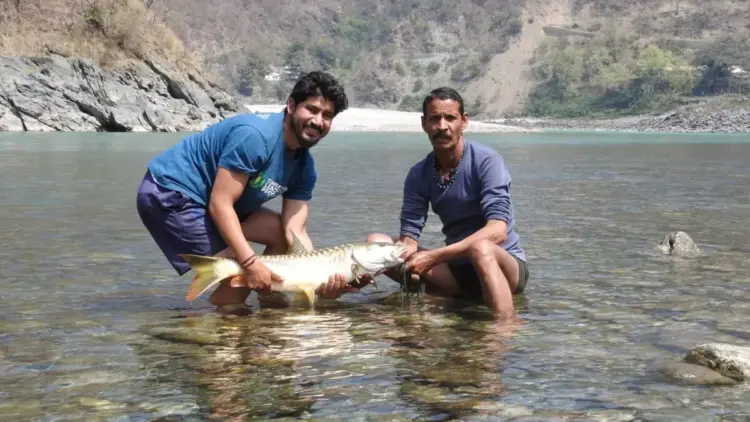
The Golden Mahseer (Tor putitora), often called the "Tiger of the Indian Rivers," is a migratory giant that can weigh over 50 kilograms. Its life cycle is a masterpiece of evolutionary timing: it migrates upstream into the Himalayan tributaries to spawn just before the monsoon.
However, radio telemetry research conducted by the Wildlife Institute of India (WII) has shown that dams like the Tehri (on the Bhagirathi) and the Srinagar (on the Alaknanda) have turned these migratory routes into dead ends. The Srinagar dam, in particular, has created "genetic islands." Upstream populations of Mahseer are now entirely cut off from the rest of the river system. These small, isolated clusters are forced into inbreeding, reducing their resilience to disease and environmental changes.

The Failure of Engineering Fixes
For decades, dam proponents have pointed to "fish ladders" and "pool-type passes" as solutions. However, in the Indian Himalayan context, these structures have proven largely ineffective.
- Design Flaws: Most fish ladders in India are designed for smaller species and cannot accommodate the burst-swimming speeds or the sheer size of a 50kg Mahseer.
- Hydropeaking Interference: Even where ladders exist, the rapid fluctuation of water levels due to hydropower operations makes the entrance to these passes impossible for fish to find.
The "Sediment Bomb" Phenomenon
Geo-scientists, including C.P. Rajendran of the National Institute of Advanced Studies (NIAS), warn that the mountains are currently "unstable." As glaciers retreat, they leave behind loose rock and silt. When triggered by heavy rain or GLOFs, this material becomes a "sediment bomb." Once a river is choked with this much debris, the gravel beds required for fish to lay eggs are smothered, effectively sterilizing the river for years.
Official Responses and the Community Alternative
While government agencies have largely focused on technical and "top-down" management, their success has been limited. The ICAR-Directorate of Coldwater Fisheries Research (DCFR) in Bhimtal has attempted to supplement wild populations through hatchery breeding, but captive breeding cannot keep pace with the scale of habitat destruction. The Mahseer matures late and produces few eggs, making it a poor candidate for rapid "restocking."
The Success of Grassroots Conservation
In contrast to failing engineering projects, indigenous and local community models are showing remarkable results. These "bottom-up" approaches rely on traditional knowledge rather than concrete.

- Meghalaya’s Wachi Wari Sanctuary: In the Garo Hills, the Simsang River remains a stronghold for the Chocolate Mahseer. The local community manages "waris"—deep river pools where fishing is strictly prohibited. By guarding these pools against dynamite and poison fishing, the community ensures a natural "overflow" of fish into other parts of the river, sustaining both the ecosystem and the local economy.
- Nagaland’s Tepuiki River: In Poilwa village, residents took it upon themselves to map and protect eight spawning grounds along a seven-kilometre stretch. Without any state funding, they barred extraction during breeding seasons, leading to a visible recovery of native fish stocks and an increase in household incomes within just a few seasons.
- Bhutan’s Seasonal Bans: In Bhutan, hunter-gatherer communities like the Oleps have long practiced seasonal fishing bans, ensuring that Snow Trout can spawn undisturbed.
Implications: A New Mandate for Transboundary Policy
The collapse of migratory fish is not merely an environmental footnote; it is a crisis of regional security and heritage. The current approach to managing Himalayan rivers—viewing them primarily as sources of kilowatt-hours—is fundamentally broken.
The Need for Transboundary Cooperation
The CMS report emphasizes that fish do not recognize national borders. For the GBM basin to survive, transboundary cooperation between India, Nepal, Bhutan, and Bangladesh must move beyond water-sharing quotas and electricity trade. It must evolve into a "biological flow" agreement. If one country builds a dam that cuts off a spawning ground, the entire downstream ecosystem suffers.
Policy Recommendations
- Protection of Free-Flowing Stretches: Policymakers must identify and legally protect the remaining undammed stretches of Himalayan rivers as "Fish Conservation Zones."
- Mandatory Environmental Flows: "E-flows" must be more than just a minimum volume of water; they must mimic natural seasonal variations to signal fish when to migrate and spawn.
- Community-Led Management: Formal recognition and legal backing should be given to community-managed fish sanctuaries like those in Meghalaya and Nagaland.
Conclusion: More Than Geography
The warnings are everywhere: from the inbreeding Mahseer trapped behind the Srinagar dam to the high-altitude fish washing up in the heat of the Bihar plains. The global frameworks provided by the UN are essential, but the most urgent lessons are being taught by the grassroots communities who have long understood that a river’s health is measured by the life within it, not just the power it generates.
As Zeb Hogan and other leading biologists suggest, the GBM basin is at a crossroads. We can continue to wall off our rivers until they are silent, or we can embrace a management model that respects the "single connected pathway" of the Himalayas. In the end, a river without fish is just geography—and a very poor geography at that.