The vast, interconnected arteries of the Ganges-Brahmaputra-Meghna (GBM) river system, stretching from the icy heights of the Himalayas to the tropical mangroves of the Bay of Bengal, are witnessing a biological collapse of unprecedented proportions. While public attention often focuses on the melting of glaciers or the politics of water sharing, a silent catastrophe is unfolding beneath the surface of these waters.
Main Facts: A Global Priority Region in Peril
Earlier this year, the United Nations Convention on the Conservation of Migratory Species of Wild Animals (CMS) released its Global Assessment of Migratory Freshwater Fishes. The findings were staggering: migratory freshwater fish populations have plummeted by 81% globally since 1970. Even more alarming is the fact that 97% of the 58 fish species currently listed under the convention are now facing the threat of extinction.
Among the various global watersheds, the report singled out the GBM river system as a "global priority region." Zeb Hogan, a renowned fish biologist and a lead author of the report, describes the GBM basin as one of South Asia’s most critical migration landscapes—a single, fluid pathway that allows life to move between drastically different altitudes and ecosystems. However, this pathway is being systematically dismantled.
The crisis is driven by a "triple threat":

- Aggressive Hydropower Expansion: The proliferation of dams that act as impassable concrete walls.
- Climate-Induced Disasters: Catastrophic floods and "sediment bombs" that physically reshape river ecologies.
- Habitat Fragmentation: The breaking of longitudinal connectivity, turning vast river networks into isolated "genetic islands."
Despite supporting an immense biomass that feeds millions of people, the basin’s ecological integrity is nearing a tipping point. As the CMS report suggests, the loss of these species is not just an environmental tragedy; it is a direct threat to the food security and livelihoods of riverine communities across India, Nepal, Bhutan, and Bangladesh.
Chronology: A Timeline of Cascading Disasters
The degradation of the Himalayan aquatic landscape is not a slow, linear process; it is punctuated by sudden, violent events that accelerate ecological decay.
October 2023: The Teesta GLOF
In October 2023, a Glacial Lake Outburst Flood (GLOF) was triggered on the Teesta River in Sikkim. This event sent a wall of water and debris downstream, obliterating infrastructure and permanently altering the river’s morphology. According to a 2025 assessment by the ICAR-National Bureau of Fish Genetic Resources (NBFGR), the flood expanded the Teesta’s floodplain by 138% in its upper reaches. For the snow trout (Schizothorax richardsonii), a species adapted to cold, fast currents, the disaster was a "simplification" of their habitat. Millions of tonnes of sediment buried the deep pools and gravel beds essential for spawning, leaving the river a shallow, choked version of its former self.
August 2026: The Nepal-Tibet Avalanche
In late August 2026, the fragility of the region was again laid bare. A massive ice and rock avalanche struck the Nepal-Tibet border, surging into the Lende Khola before roaring down the Bhote Koshi and Trishuli rivers. Monitoring stations run by the International Centre for Integrated Mountain Development (ICIMOD) recorded a terrifying nine-metre rise in water levels in just 30 minutes.

The flood did more than destroy 281 megawatts of hydropower capacity; it caused a biological dislocation. As the debris-choked water crossed the border into India’s Gandak (Narayani) river system, it carried high-altitude species into the floodplains of Bihar. In districts like West Champaran and Gopalganj, villagers found their nets filled with "alien" fish they had never seen before—species that belonged in the cold mountain headwaters, not the muddy plains. The Bihar government was forced to issue public health advisories, cautioning against the consumption of these displaced populations.
Supporting Data: The Mechanics of Habitat Fragmentation
The crisis is rooted in the physical and genetic isolation of species that have evolved over millennia to move freely.
The "Sediment Bomb" Phenomenon
C.P. Rajendran, a geo-scientist at the National Institute of Advanced Studies (NIAS), warns that the Himalayan ecological framework is buckling under infrastructure expansion that ignores environmental limits. As glaciers retreat, they leave behind "sediment bombs"—unstable deposits of rock and silt. When triggered by a GLOF or extreme rainfall, these deposits scour river channels, burying the "refuge pools" where fish survive the winter.
Genetic Islands and Inbreeding
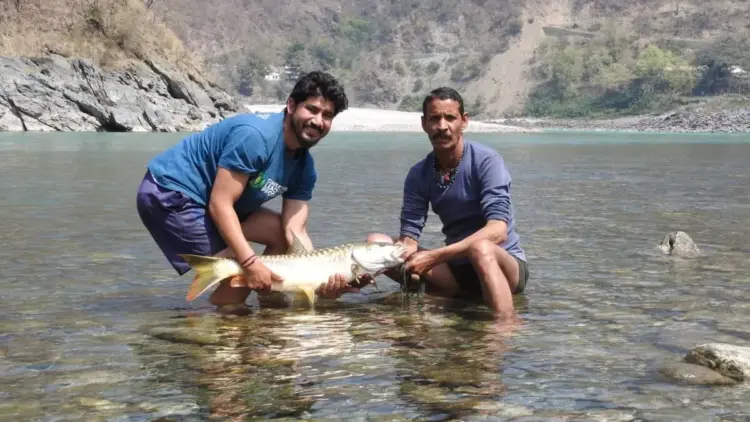
The structural walling of rivers has created a genetic crisis. The Golden Mahseer (Tor putitora), a "megafish" that can grow to 50 kilograms, is the primary victim. Research by the Wildlife Institute of India (WII) using radio telemetry has shown that the Tehri dam on the Bhagirathi and the Srinagar dam on the Alaknanda are absolute barriers.

Data indicates that the Srinagar dam has entirely cut off upstream Alaknanda stocks. These fish are now trapped in "genetic islands," where small, isolated populations are forced to inbreed. Over time, this reduces their resilience to disease and environmental changes, effectively sentencing the population to a "slow-motion extinction."
The Failure of Engineering Fixes
For decades, dam proponents have pointed to "fish ladders" and "pool-type passes" as solutions. However, the data suggests these are largely performative in the Indian context. Large, heavy-bodied migrants like the mahseer cannot navigate these structures, which are often poorly designed or rendered useless by "hydropeaking"—the practice of suddenly releasing water to meet peak electricity demand, which creates turbulent, unnavigable flows.
Official Responses: Institutional Gaps and Policy Failures
The response from regional governments has largely remained focused on top-down, engineering-heavy solutions that fail to address the biological reality of the rivers.
- Hatchery Management: The ICAR-Directorate of Coldwater Fisheries Research (DCFR) in Bhimtal has attempted to offset wild population losses through captive breeding. However, experts argue this is an "uphill fight." The Golden Mahseer matures late and produces few eggs, meaning hatchery releases cannot keep pace with the massive habitat loss caused by new dams.
- The CMS Mandate: The UN’s CMS report has called for freshwater fish conservation to be moved into the mainstream of policy. It advocates for "transboundary cooperation" that goes beyond water-sharing quotas. Currently, treaties between India, Nepal, and Bhutan focus almost exclusively on hydroelectricity and irrigation, with virtually no legal framework for the "biological flow" of the rivers.
- Public Health Advisories: In the wake of the 2026 floods, the Bihar government’s response was reactive rather than proactive, focusing on the immediate health risks of displaced fish rather than the long-term ecological collapse that caused the displacement.
The consensus among biologists is that the current policy of "build first, mitigate later" is fundamentally broken. Without a legal mandate for seasonally appropriate "environmental flows" (E-flows), the remaining biodiversity in the GBM basin is unlikely to survive the next decade.

Implications: The Community Alternative and the Path Forward
If top-down management and engineering fixes are failing, where does the solution lie? The answer may be found in grassroots models that eschew concrete in favor of community stewardship.
The Meghalaya Model: Wachi Wari
In the Garo Hills of Meghalaya, the Simsang River remains a rare stronghold for the Chocolate Mahseer. This is due to the Wachi Wari Community Fish Sanctuary. A wari is a deep river pool where fish congregate during the dry season. The local community, without government funding or formal paperwork, guards these pools with fierce dedication. They have banned dynamite and poison fishing, creating a "natural overflow" effect where thriving populations in protected pools replenish the rest of the river.
The Nagaland Success: Poilwa Village
Similarly, in Nagaland, residents along the Tepuiki River took action after noticing a sharp decline in fish stocks. They mapped eight spawning grounds along a seven-kilometre stretch and declared them off-limits. Within a few seasons, the native fish populations recovered, and household incomes from sustainable fishing in non-protected zones rose accordingly.
The Transboundary Necessity
The survival of the Himalayan rivers depends on a paradigm shift. Policymakers must accept that a river is not merely a "resource" for power and irrigation, but a living, continuous biological flow.

Key recommendations for the future include:
- Protecting Free-Flowing Stretches: Identifying and legally protecting the remaining undammed stretches of Himalayan rivers as "fish conservation zones."
- Mandatory E-Flows: Legally enforcing environmental flows that mimic natural seasonal cycles, allowing fish to reach spawning grounds.
- Transboundary Biological Corridors: Establishing international agreements between India, Nepal, and Bhutan that prioritize the movement of migratory species.
As Saurabh Dewan, founder of the Himalayan Conservancy Foundation, aptly summarizes: "A mahseer population quietly inbreeding above a dam or high-altitude fish washing into the plains of Bihar are warning signs we cannot afford to ignore. We must heed the global frameworks, but the more urgent lesson is being lived out by communities in Meghalaya and Nagaland who never needed a UN report to tell them how to keep a river alive."
Ultimately, the collapse of migratory fish is a harbinger of a wider systemic failure. If the "lifelines" of the Himalayas are cut, the entire GBM basin—and the millions who depend on it—will face a future of ecological silence. A river without fish is not a river; it is just geography.