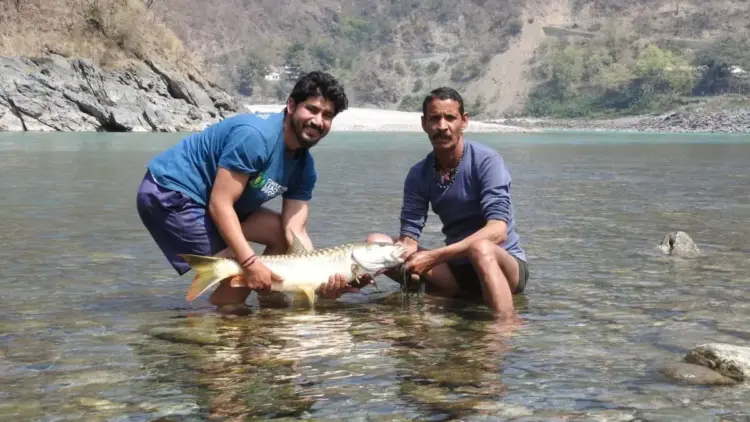
The rivers of the Hindu Kush Himalayas are often described as the "water towers of Asia," providing life-sustaining resources to nearly two billion people. However, beneath the churning white-water rapids and within the deep, silt-laden pools of the Ganges-Brahmaputra-Meghna (GBM) basin, a biological catastrophe is unfolding. While public attention often focuses on melting glaciers and downstream flooding, a more silent, aquatic collapse is occurring: the rapid disappearance of migratory freshwater fish.
Main Facts: A Basin in Crisis
The scale of the decline is staggering. According to the Global Assessment of Migratory Freshwater Fishes report published earlier this year by the United Nations Convention on the Conservation of Migratory Species of Wild Animals (CMS), migratory freshwater fish populations have plummeted by 81% globally since 1970. Even more alarming is the status of species specifically protected under the convention; nearly 97% of the 58 fish species listed now face the very real threat of extinction.
The report, developed in partnership with the UN Environment Programme-World Conservation Monitoring Centre (UNEP-WCMC), singles out the GBM river system as a "global priority region." This basin is not merely a collection of waterways but a singular, connected migratory pathway stretching from the high-altitude Himalayan headwaters down to the mangrove-fringed Bay of Bengal.
Zeb Hogan, a renowned fish biologist and lead author of the report, characterizes the GBM basin as one of South Asia’s most vital "migration landscapes." Despite its historical ability to support an immense biomass of diverse species, the basin is currently undergoing a structural collapse. The primary drivers are twofold: aggressive hydropower expansion, which physically severs river connectivity, and altered flow regimes exacerbated by climate change-induced disasters.

Chronology: A Timeline of Cascading Hazards
To understand the current state of the GBM basin, one must look at the recent sequence of catastrophic events that have reshaped the Himalayan aquatic landscape.
October 2023: The Teesta GLOF
In October 2023, a Glacial Lake Outburst Flood (GLOF) struck the Teesta River in Sikkim. This region is a critical stronghold for the snow trout (Schizothorax richardsonii), a primitive species adapted to the cold, oxygen-rich currents of the high Himalayas. A 2025 assessment by the ICAR-National Bureau of Fish Genetic Resources (NBFGR) revealed that the flood expanded the Teesta’s floodplain by 138% in its upper reaches. The sheer volume of water and debris "simplified" the river’s complex ecology, burying deep pools and gravel beds—essential for spawning and winter refuge—under millions of tonnes of sediment.
August 2026: The Nepal-Tibet Avalanche
The crisis reached a new peak in late August 2026. A massive ice and rock avalanche occurred on the Nepal-Tibet border, sending a wall of debris into the Lende Khola. The surge moved with terrifying speed down the Bhote Koshi and Trishuli rivers. Monitoring stations operated by the International Centre for Integrated Mountain Development (ICIMOD) at Galchchi recorded a water level rise of nine meters in just 30 minutes.
The disaster was not only a human tragedy, claiming hundreds of lives and wiping out 281 megawatts of hydropower capacity (including the historic 42-year-old Devighat plant), but it also acted as a biological displacer. As the debris-choked waters reached India’s Gandak (Narayani) river system in Bihar, villagers in West Champaran and Gopalganj found their nets filled with high-altitude species they had never seen before. The displacement was so severe that the Bihar government issued public health alerts, cautioning citizens against consuming these "unfamiliar" fish.

Supporting Data: Fragmentation and Genetic Isolation
The physical reshaping of rivers by disasters is compounded by the permanent, man-made barriers of hydroelectric dams. The Indian Himalayan Region (IHR) is currently the site of some of the world’s most intensive infrastructure development, often built without sufficient regard for the "longitudinal connectivity" required by migratory megafish.
The Case of the Golden Mahseer
The Golden Mahseer (Tor putitora), often called the "Tiger of the Indian Rivers," is the most iconic victim of this fragmentation. Growing up to 50 kilograms, this megafish requires an uninterrupted network of deep pools, shallow riffles, and lateral side-channels to complete its life cycle.
Data from radio telemetry research conducted by the Wildlife Institute of India (WII) shows that:
- Physical Barriers: The Tehri dam on the Bhagirathi and the Srinagar dam on the Alaknanda are completely impassable for the Mahseer.
- Genetic Erosion: Genetic analysis of fish stocks above the Srinagar dam shows that these populations have been entirely cut off from downstream stocks. They now exist as "genetic islands"—small, inbred clusters trapped above concrete walls, vulnerable to disease and environmental shifts.
- Biological Limits: Unlike some smaller species, Mahseer mature late and produce fewer eggs. This means captive breeding programs, such as those run by the ICAR-Directorate of Coldwater Fisheries Research (DCFR) in Bhimtal, struggle to keep pace with the rate of wild population loss.
The "Sediment Bomb" Phenomenon
C.P. Rajendran, a geo-scientist at the National Institute of Advanced Studies (NIAS), warns that the Himalayan ecological framework is nearing a tipping point. As glaciers retreat, they leave behind "sediment bombs"—vast, unstable deposits of rock and silt. When triggered by extreme rainfall or GLOFs, these deposits scour river channels, permanently disfiguring the aquatic landscape and removing the "complexity" (the variety of depths and flows) that fish need to survive.

Official Responses and Engineering Failures
The response from regional governments has largely focused on "engineering fixes" that many experts argue are inadequate for the scale of the crisis.
The Failure of Fish Ladders
In many parts of the world, fish ladders and pool-type passes are used to help migratory species bypass dams. However, in the Indian Himalayan context, these structures are either non-existent or poorly designed. Surveys of existing ladders indicate they are largely non-functional for large, heavy-bodied migrants like the Mahseer, which cannot navigate the turbulent, "hydropeaking" flows (sudden releases of water to meet peak electricity demand) characteristic of modern Himalayan dams.
Hatchery Management
The ICAR-DCFR has attempted to offset losses through hatchery management and artificial propagation. While successful in a controlled environment, these programs cannot replicate the genetic diversity or the sheer scale of natural riverine reproduction. Furthermore, stocking a fragmented, polluted river with hatchery-raised fish does little to address the underlying cause of the decline: the lack of a free-flowing habitat.
Policy Gaps
Current transboundary water agreements between India, Nepal, Bhutan, and Bangladesh focus almost exclusively on water-sharing quotas and hydroelectricity trade. There is currently no robust legal framework that treats the GBM basin as a singular biological entity, leaving migratory species without "legal standing" in international water diplomacy.

Implications: The Community Alternative and the Path Forward
If top-down engineering and policy have failed, a growing body of evidence suggests that the answer may lie in community-based conservation. These models, which rely on indigenous knowledge rather than concrete, have shown remarkable resilience.
Success in the Garo Hills and Nagaland
In Meghalaya, the Wachi Wari Community Fish Sanctuary on the Simsang River has successfully protected the rare chocolate mahseer (Neolissochilus hexagonolepis). By guarding "waris" (deep river pools) and enforcing strict village bans on dynamite and poison fishing, the community has created a natural "overflow" effect, where thriving populations move into open waters, supporting both the ecosystem and the local economy.
Similarly, in Nagaland’s Poilwa village, residents mapped eight spawning grounds along the Tepuiki River. By barring extraction in these zones during breeding seasons, they saw a recovery of native fish stocks and an increase in household incomes within just a few seasons.
The Need for a Paradigm Shift
The lessons from these communities, combined with the warnings in the CMS report, suggest three urgent shifts in Himalayan river management:

- Protecting Free-Flowing Stretches: Policy-makers must identify and legally protect the remaining undammed stretches of Himalayan rivers as "Fish Conservation Zones," where hydropower development is strictly prohibited.
- Mandatory Environmental Flows (E-Flows): For existing dams, "E-flows" must be more than just a minimum volume of water. They must be seasonally appropriate, mimicking natural flow patterns to allow for spawning and migration.
- Transboundary Biological Cooperation: Transboundary talks must expand to include "biological connectivity." This means shared tracking of fish populations and the creation of protected migration corridors that cross national borders.
Conclusion
The recent disasters in Nepal and Sikkim are not just "natural" events; they are warnings of a system in collapse. As Saurabh Dewan, founder of the Himalayan Conservancy Foundation, notes: "A river without fish is just geography."
The CMS global assessment provides the data, and the grassroots communities in Meghalaya and Nagaland provide the method. The question remains whether regional governments can move past a hydropower-first strategy to protect the living, breathing flow of the Himalayas before the Golden Mahseer and its kin vanish into the archives of natural history. The "sediment bombs" are ticking, and for the migratory fish of the GBM basin, time and water are both running out.