Introduction: A Basin on the Brink
The rivers of the Himalayas are often described in spiritual or geopolitical terms—as sacred lifelines or as sources of immense hydroelectric potential. However, beneath the churning white waters and the silt-heavy currents, a biological catastrophe is unfolding. For decades, the communities living along the Ganges-Brahmaputra-Meghna (GBM) river system have observed a steady thinning of the once-teeming schools of migratory fish. This anecdotal evidence has now been substantiated by harrowing scientific data.
According to the Global Assessment of Migratory Freshwater Fishes report, published earlier this year by the United Nations Convention on the Conservation of Migratory Species of Wild Animals (CMS), migratory freshwater fish populations have plummeted by a staggering 81% globally since the 1970s. Even more alarming is the status of the species specifically listed under the convention: 97% of them now face the imminent threat of extinction. The report, a collaborative effort with the UN Environment Programme-World Conservation Monitoring Centre (UNEP-WCMC), identifies the GBM basin as a global priority region—a "red zone" where the intersection of climate change, infrastructure expansion, and habitat fragmentation is creating a perfect storm for ecological collapse.

Main Facts: The Fragmentation of a Great Migration Landscape
The GBM basin is one of the world’s most significant aquatic corridors, representing a continuous biological pathway from the icy headwaters of the Himalayas down to the mangrove-rich delta of the Bay of Bengal. Zeb Hogan, a renowned fish biologist and a lead author of the CMS report, categorizes the GBM as one of South Asia’s "greatest migration landscapes." Yet, this landscape is being severed.
The primary driver of this decline is habitat fragmentation. The aggressive expansion of hydropower—intended to fuel the energy needs of a developing region—has resulted in a series of impassable concrete barriers. These dams and barrages do more than just block the path of fish; they alter the very "pulse" of the river. The natural flow regimes, which fish use as biological cues for spawning and migration, are being replaced by "hydropeaking," where water levels fluctuate wildly based on electricity demand rather than seasonal cycles.
The crisis is most acute in the high-altitude headwaters of the Indian Himalayan Region (IHR). While public discourse often focuses on large downstream barrages like Farakka, the most devastating damage is occurring upstream, where the lifelines of flow-dependent species are being cut apart piece by piece.
Chronology of a Crisis: Disasters and Displacements (2023–2026)
The timeline of the last few years illustrates how rapidly environmental shifts can disfigure an ecosystem.

October 2023: The Teesta GLOF
The Teesta River in Sikkim, a vital habitat for the snow trout (Schizothorax richardsonii), was struck by a Glacial Lake Outburst Flood (GLOF). This event was a catalyst for ecological "simplification." A 2025 study by the ICAR-National Bureau of Fish Genetic Resources (NBFGR) revealed that the flood expanded the Teesta’s floodplain by 138% in its upper reaches. While a wider river might sound beneficial, the reality was the opposite. Millions of tonnes of sediment buried deep pools and gravel beds—the essential winter refuges and spawning grounds for snow trout. The hydrologic connectivity between the main channel and its side-channels was severed, leaving the river a shadow of its former biological self.
August 2026: The Nepal-Tibet Avalanche
In late August 2026, a massive ice and rock avalanche occurred on the Nepal-Tibet border. Debris surged through the Lende Khola, the Bhote Koshi, and the Trishuli rivers. Monitoring stations run by the International Centre for Integrated Mountain Development (ICIMOD) recorded a terrifying rise in water levels—nine metres in just 30 minutes.
The immediate human and infrastructure toll was heavy: hundreds of lives lost and 281 megawatts of hydropower wiped out. However, the biological aftermath was equally surreal. As the debris-choked waters rolled into Bihar’s Gandak (Narayani) river system, high-altitude fish species were washed hundreds of kilometres downstream into the floodplains. Villagers in West Champaran and Gopalganj found their nets filled with "alien" species they had never seen before—fish adapted for freezing, fast-moving mountain currents, now gasping in the muddy heat of the plains. The Bihar government was forced to issue public health alerts, as the safety of consuming these displaced, stressed populations was unknown.
Supporting Data: The Biology of Isolation and "Sediment Bombs"
The collapse is not merely a result of sudden disasters but a consequence of long-term structural changes. Geo-scientist C.P. Rajendran of the National Institute of Advanced Studies (NIAS) warns that the Himalayan ecological framework is nearing a tipping point.

The "Sediment Bomb" Phenomenon
As glaciers retreat due to global warming, they leave behind "sediment bombs"—unstable deposits of rock and silt. Any trigger, such as an extreme rainfall event, can set these off, scouring out river channels and permanently disfiguring the aquatic landscape. For species like the snow trout, which are rheophilic (flow-loving) and primitive, these changes are often terminal.
Genetic Islands and the Mahseer’s Struggle
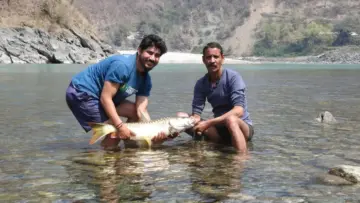
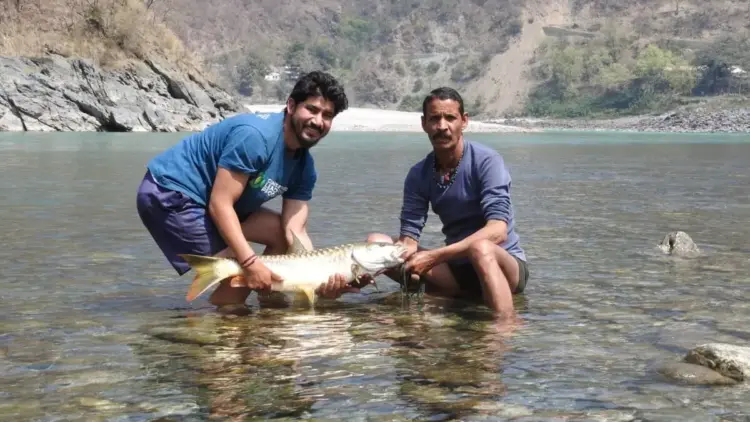
The Golden Mahseer (Tor putitora), often called the "Tiger of the River," serves as a grim case study in fragmentation. This megafish, which can exceed 50 kilograms, requires a diverse and uninterrupted network of deep pools and shallow riffles to complete its life cycle.
Research by the Wildlife Institute of India (WII) using radio telemetry has shown that the Tehri dam on the Bhagirathi and the Srinagar dam on the Alaknanda have become absolute barriers. These dams have created "genetic islands." Upstream populations of Mahseer are now trapped in small, inbred clusters, unable to reach their traditional spawning grounds or mix with other stocks. Over time, this lack of genetic variability makes the species less resilient to disease and environmental changes, effectively sentencing them to a "slow-motion extinction."
Official Responses and the Failure of Engineering Fixes
Government and institutional responses have largely relied on two strategies: hatchery management and engineering fixes like fish ladders. Both have proven insufficient.

The Hatchery Limitation
The ICAR-Directorate of Coldwater Fisheries Research (DCFR) in Bhimtal has spent years on captive breeding and stocking programmes for the Mahseer. However, the fish’s own biology is a hurdle. Mahseer mature late and produce relatively few eggs compared to other species. Captive breeding simply cannot scale up fast enough to offset the massive loss of wild habitat.
The "Fish Ladder" Myth
In many Western countries, fish ladders are standard requirements for dams. In India, they are rare. Where they do exist, they are often poorly designed for local species. Large, heavy-bodied migrants like the Mahseer find it nearly impossible to navigate these structures, especially when faced with the turbulent "hydropeaking" flows common in Himalayan power projects. Experts argue that these engineering solutions are often "cosmetic" additions that fail to address the fundamental loss of longitudinal connectivity.
Implications: Moving Toward a Community-Led Future
The failures of top-down, engineering-heavy management have led conservationists to look toward successful community models that prioritize the river’s health over infrastructure.
The Meghalaya and Nagaland Models
In the Garo Hills of Meghalaya, the Wachi Wari Community Fish Sanctuary offers a blueprint for success. By protecting "waris" (deep river pools), the community ensures that fish have a refuge during dry seasons. Village-enforced bans on dynamite and poison fishing have allowed the rare Chocolate Mahseer (Neolissochilus hexagonolepis) to thrive.

Similarly, in Nagaland, the residents of Poilwa village on the Tepuiki river took it upon themselves to map and protect eight spawning grounds. Without any state enforcement or UN funding, the community saw a recovery of native fish stocks within a few seasons, which in turn boosted local household incomes through sustainable fishing.
The Policy Mandate
The CMS global assessment provides a clear directive for policymakers. Freshwater conservation can no longer be a secondary concern. For the GBM basin, this requires:
- Transboundary Cooperation: Moving beyond water-sharing quotas to focus on the "biological flow" that spans nations.
- Protected Free-Flowing Stretches: Legally mandating that remaining undammed stretches of Himalayan rivers be designated as "no-go zones" for infrastructure.
- Mandatory Environmental Flows: Ensuring that existing dams release enough water at the right times to support the life cycles of migratory species.
Conclusion: A River is More Than Geography
The sight of high-altitude fish washing into the plains of Bihar and the quiet inbreeding of Mahseer above the Srinagar dam are warning signs of an ecosystem in its death throes. While global frameworks like the CMS provide the necessary data, the practical solutions are being demonstrated by grassroots communities in Meghalaya, Bhutan, and Nagaland.
As Saurabh Dewan, founder of the Himalayan Conservancy Foundation, aptly notes: "A river without fish is just geography." If the current trajectory of hydropower-first development continues, the Great Himalayan Migration—a process millions of years in the making—may vanish within a single human generation. The survival of these "Tigers of the River" depends on our ability to see the river not as a series of power-generating segments, but as a single, living, and continuous entity.