

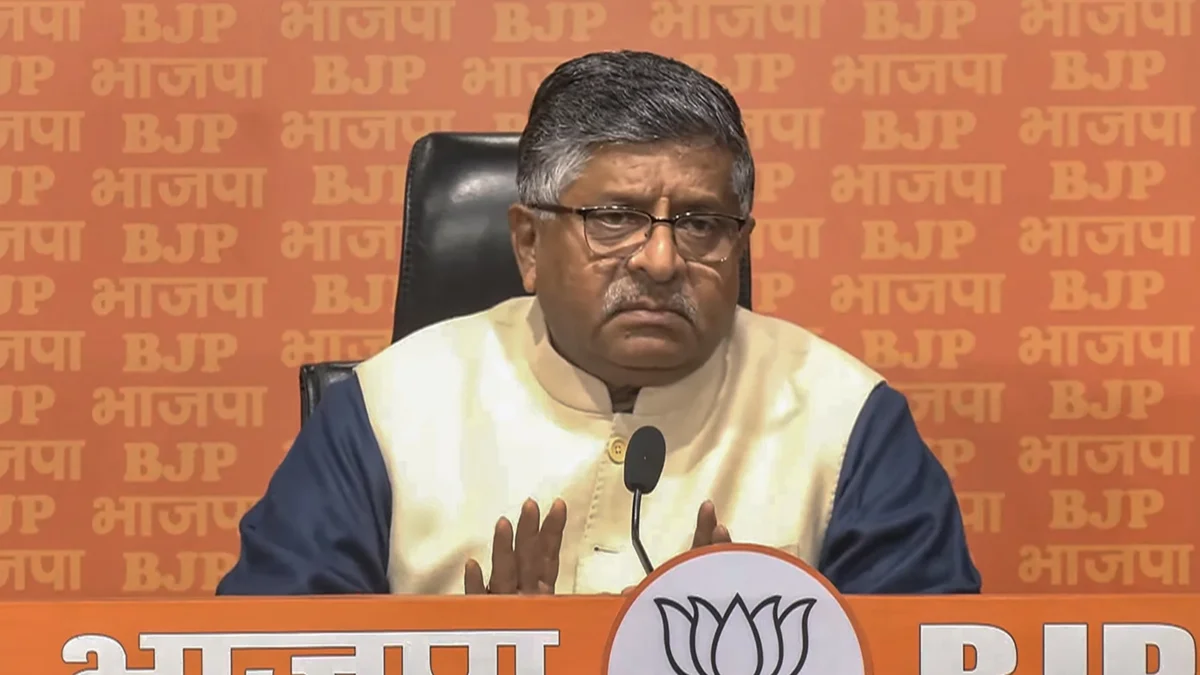
Patna, Bihar – September 9, 2026 – In a candid and expansive interview with The Indian Express, former Union Minister, senior BJP leader, and Member of Parliament for Patna Sahib, Ravi Shankar Prasad, offered a trenchant analysis of the contemporary Indian political landscape. Prasad delved into a spectrum of pressing issues, from the contentious "purification" row in Haldwani and the evolving campaigns of Congress leader Rahul Gandhi, to the emergence of new political entities like the "Cockroach Janata Party" (CJP), internal alliance dynamics within the BJP-led NDA, the recent electoral outcome in Bankipur, and the ongoing debate surrounding India’s GDP growth figures. His insights underscore the Bharatiya Janata Party’s (BJP) strategic positioning and its sharp critique of the opposition, setting a clear narrative amidst an increasingly complex political environment.
Prasad, known for his articulate defense of the BJP’s policies and his sharp ripostes to critics, meticulously addressed each query, providing a window into the ruling party’s perspective on national and regional challenges. His commentary painted a picture of a confident BJP, keenly aware of the political battles ahead, while simultaneously highlighting perceived inconsistencies and lack of seriousness within the opposition ranks.
The Haldwani "Purification" Controversy: A Clash of Narratives
The interview commenced with a deep dive into the politically charged incident in Haldwani, Uttarakhand, where a "purification" ritual was performed at a venue shortly after Congress president Mallikarjun Kharge had addressed a rally. This event triggered a strong backlash from the Congress, which accused the BJP of discriminatory practices, and subsequently led to an FIR being registered against Leader of Opposition Rahul Gandhi.
The Incident and Rahul Gandhi’s Stance
The Haldwani incident quickly escalated into a national debate, drawing accusations of casteism and communal polarization. Following Kharge’s rally, members of the BJP’s youth wing reportedly sprayed Ganga jal (holy water) at the venue, claiming to "purify" it. The Congress vehemently condemned this act, interpreting it as a deliberate insult to their party president and a symbolic gesture of exclusion. Rahul Gandhi, a prominent voice against what he perceives as the BJP’s divisive politics, strongly denounced the act, framing it within a broader critique of the ruling party’s ideology. His outspoken criticism, however, led to an FIR being filed against him, a move the Congress decried as an attempt to silence dissent and deflect from the core issue of discrimination. The filing of the FIR added another layer of complexity, transforming the incident from a local controversy into a legal and political flashpoint, with both parties doubling down on their respective positions.
Prasad’s Counter-Narrative: Dismissing Seriousness and Caste Angle
Ravi Shankar Prasad, in his characteristic style, wasted no time in dissecting the Congress’s reaction and Rahul Gandhi’s involvement. He articulated a fundamental critique of Rahul Gandhi’s political approach, stating, "One must understand one basic problem of Rahul Gandhi, which is the source of all the problems. He thinks that ‘I have to govern’ determines all his political moves. It keeps erupting from time to time." Prasad elaborated that this underlying ambition, coupled with a perceived lack of thorough preparation, leads to inconsistent and ultimately "non-serious" political interventions. He lamented, "Rahul Gandhi does not do his homework. Someone gives him a chit of paper and he throws the issue. But he doesn’t stick to the issue, be it caste census or SIR (special intensive revision of electoral rolls). I am sorry to say that as LoP, he is beginning to come off as a non-serious politician. People expect seriousness (from a person who holds such a post)."
Regarding the FIR against Rahul Gandhi, Prasad swiftly dismissed the Congress’s narrative of caste-based discrimination. He clarified, "One person from the Valmiki community has got the FIR registered. There was no caste angle to it." This assertion aimed to decouple the incident from any broader allegations of casteism, framing it instead as an individual complaint and a response to what the BJP views as inflammatory rhetoric. Prasad’s argument suggests that the Congress, and particularly Rahul Gandhi, often misinterpret or sensationalize incidents for political mileage, without a genuine understanding of the underlying facts. This stance is consistent with the BJP’s broader strategy of countering opposition accusations by questioning their motives and factual basis, often portraying them as politically opportunistic rather than genuinely concerned with social issues.
Broader Implications for Political Discourse
The Haldwani controversy and Prasad’s response highlight a deepening chasm in India’s political discourse. Such incidents are not merely isolated events but become symbols in the larger ideological battle between the BJP and the Congress. The "purification" act, whether intended as a religious ritual or a political statement, was immediately interpreted through the lens of identity politics, fueling accusations of caste discrimination and religious intolerance from one side, and being dismissed as political opportunism from the other. This dynamic exacerbates political polarization, where every action and reaction is viewed with suspicion and framed to fit pre-existing narratives. The registration of an FIR against a prominent opposition leader further underscores the increasingly litigious nature of Indian politics, where legal avenues are often used to counter political statements, raising concerns about freedom of speech and the robustness of democratic debate. The incident, therefore, serves as a microcosm of the challenges faced by India’s pluralistic society in navigating sensitive issues amidst heightened political tensions.
Rahul Gandhi’s Evolving Political Persona and Campaigns
The conversation then shifted to Rahul Gandhi’s recent political activities, particularly his "Chhatron ki Goonj" campaign, and the perception of his evolving political style.
"Chhatron ki Goonj" and Other Initiatives
In recent times, Rahul Gandhi has adopted a more visible and assertive campaigning style, characterized by direct engagement with various segments of society. His "Chhatron ki Goonj" (Echo of Students) campaign is a notable example, aiming to connect with India’s youth on issues such as unemployment, education, and competitive examination reforms. This campaign follows a series of other high-profile initiatives, including the "Bharat Jodo Yatra" (Unite India March), which sought to foster national unity and address social divisions, and his consistent push for a nationwide caste census. These efforts signal a concerted attempt by Rahul Gandhi to carve out a distinct political identity and position the Congress as a party attuned to the concerns of ordinary citizens, particularly those marginalized or disenfranchised. His interactions often involve candid discussions, aiming to project an image of approachability and genuine concern, contrasting with what he frequently criticizes as the BJP’s top-down governance model.
Prasad’s Critique: Substance vs. Seriousness
While acknowledging a degree of "earnestness" in Rahul Gandhi’s political campaigns, Ravi Shankar Prasad was quick to temper this observation with a critical assessment of their perceived lack of consistency and substance. Prasad reiterated his concern about Gandhi’s tendency to "keep moving on (from issues)," likening his political trajectory to someone "with a trolley suitcase in his hand," constantly shifting focus without sustained commitment. He suggested that for a campaign like "Goonj" to have a lasting impact, it "must be contrasted with what Congress governments in Telangana, Karnataka, and Himachal Pradesh are doing. ‘Goonj’ cannot be raised in isolation." This criticism implies that Rahul Gandhi’s rhetoric often lacks a grounding in the practical governance of Congress-ruled states, creating a disconnect between his national pronouncements and the party’s performance at the regional level. Prasad’s remarks underscore the BJP’s strategy of holding the opposition accountable not just for their words, but also for their actions and governance records wherever they hold power, thereby challenging the credibility of their national campaigns. The BJP consistently attempts to portray Rahul Gandhi as a dilettante, who raises issues without sufficient depth or follow-through, thereby undermining his claims of seriousness.
Congress’s Perspective and Political Analysis
From the Congress’s vantage point, Rahul Gandhi’s campaigns, including "Chhatron ki Goonj," are essential instruments for reinvigorating the party and challenging the BJP’s dominance. The party views these initiatives as crucial for connecting with diverse demographics, particularly the youth and marginalized communities, whose concerns they believe are often overlooked by the current government. His direct engagement style is seen as an attempt to foster a more participatory form of politics and to provide a platform for voices that feel unheard. The Congress argues that by raising issues like unemployment, economic inequality, and social justice, Rahul Gandhi is not merely campaigning but articulating the fundamental challenges facing India. They counter the BJP’s criticism of inconsistency by highlighting the vast and complex nature of India’s problems, necessitating a multi-faceted approach. Furthermore, the Congress would argue that the performance of state governments is distinct from the national narrative being built by Rahul Gandhi, and that regional challenges often differ from national policy debates. The BJP’s sustained efforts to undermine Rahul Gandhi’s credibility reflect their recognition of his growing visibility and the potential threat he poses, even if they publicly dismiss him as "non-serious." This ongoing battle over his public image and the efficacy of his campaigns remains a central feature of India’s political discourse.
The Rise of the Cockroach Janata Party (CJP): A New Political Force?
The interview also touched upon the "Cockroach Janata Party (CJP)," a term Prasad used to describe a nascent or perceived nuisance political entity, highlighting his skepticism about its potential impact.
Genesis and Agenda of CJP
While the "Cockroach Janata Party" (CJP) is not a formally recognized national political party in the traditional sense, Prasad’s use of the term likely refers to emerging, often unorganized, political groups or movements that gain some traction, particularly among disillusioned segments of the population. Given the context of the interview, such entities often capitalize on specific grievances, such as those related to youth unemployment, examination irregularities (like NEET, mentioned later by Prasad), or perceived government apathy. These groups typically coalesce around a specific set of demands or a charismatic, albeit sometimes untested, leader. Their appeal often lies in their perceived ‘outsider’ status, promising a break from traditional politics and established parties. They aim to leverage social media and grassroots discontent to challenge the established order, often without the deep organizational structure or ideological coherence of mainstream parties. Prasad’s coinage of "Cockroach Janata Party" itself suggests a view from the establishment that these groups are bothersome, perhaps numerous but lacking in gravitas, yet capable of creating localized disturbances.
Prasad’s Skepticism and Activist Roots
Drawing from his deep experience in political activism, particularly his involvement in the historic JP Movement, Ravi Shankar Prasad offered a discerning critique of such nascent political forces. He emphasized the fundamental requirements for any movement to achieve sustained success, stating, "I come from an activism background (JP Movement). There must be a proper agenda and there must be a leader." Prasad’s reference to the JP Movement, a powerful, ideologically driven, and well-led grassroots movement, serves as a benchmark against which he measures contemporary, less defined political entities. He expressed skepticism about the CJP’s ability to offer a "panacea for all problems," implying that their solutions might be superficial or narrowly focused.
Furthermore, Prasad leveled a pointed accusation against the CJP, highlighting what he perceived as a fundamental flaw in their objectivity: "The CJP is conspicuously silent about problems in Punjab and Congress-ruled states. They need to be objective." This criticism suggests that such emerging groups often exhibit a selective focus, targeting only the ruling party at the Centre while overlooking similar issues in non-BJP governed states. This selective advocacy, according to Prasad, undermines their claim to be objective or to represent a genuine, holistic concern for the nation’s problems, instead painting them as politically motivated or aligned. For Prasad, genuine activism demands a consistent moral and political stance, irrespective of which party is in power.
The Challenge of New Political Entrants
Prasad’s remarks on the CJP highlight the inherent challenges faced by new political entrants and movements in India’s complex multi-party democracy. While there is always space for new voices and issues, translating grassroots discontent into a sustainable political force requires more than just public anger. It demands a clear ideological framework, a robust organizational structure, visionary leadership, and the ability to articulate a consistent agenda that resonates across diverse regions and communities. The accusation of "conspicuous silence" points to the difficulty new groups face in maintaining impartiality, as they often find themselves pressured to align with or against existing political blocs. Without a pan-India presence and a commitment to addressing issues universally, their impact tends to remain localized or ephemeral. Historically, many such movements have either fizzled out, been absorbed by larger parties, or struggled to expand beyond their initial niche. The CJP, as described by Prasad, appears to embody these struggles, reminding us that while "engagement should not be a problem," mere agitation without substance and consistency is unlikely to alter the broader political landscape significantly. The ability to articulate and act upon a broad, objective national agenda, rather than a selective one, remains the litmus test for any aspiring political force in India.
Internal Dynamics: BJP Allies and Quota Sub-categorisation
The interview also touched upon the delicate balancing act within the BJP-led National Democratic Alliance (NDA), specifically addressing the public spat between two key allies in Bihar: Jitan Ram Manjhi and Chirag Paswan, over the contentious issue of quota sub-categorisation.
The Inter-Alliance Spat
The issue of quota sub-categorisation has long been a sensitive and divisive topic in Indian politics, particularly in states like Bihar where caste equations heavily influence electoral outcomes. It involves the further division of existing reservations for Scheduled Castes (SC) or Other Backward Classes (OBC) into sub-quotas, aiming to provide more equitable access to benefits for the "most backward" among these categories. The debate often pits various sub-castes against each other, as groups that have historically benefited less from reservations demand a separate share within the larger quota, while those who have been more successful resist any such re-calibration.
In Bihar, this complex issue led to a public disagreement between Jitan Ram Manjhi, leader of the Hindustani Awam Morcha (HAM) and a prominent Dalit leader, and Chirag Paswan, who heads the Lok Janshakti Party (Ram Vilas) and represents another significant Dalit constituency. Both leaders represent crucial vote banks for the NDA in Bihar, and their public sparring over such a sensitive issue could potentially create fissures within the alliance, especially with crucial elections on the horizon. The disagreement highlights the intricate caste dynamics that allies must navigate, even when part of a larger coalition, as each leader strives to protect and advance the interests of their specific community.
BJP’s Balancing Act
As the dominant partner in the NDA, the BJP often finds itself in the delicate position of mediating disputes among its allies. Ravi Shankar Prasad expressed confidence in the alliance’s ability to resolve the matter, stating succinctly, "I am sure they will settle it. It will be settled properly." This statement reflects the BJP’s established approach to managing coalition politics: projecting an image of internal harmony and robust leadership while working behind the scenes to iron out differences.
The BJP’s stake in Bihar is substantial, and maintaining a cohesive alliance is paramount to its electoral success. The state’s political landscape is heavily influenced by caste arithmetic, and any perceived instability or internal strife within the NDA could be exploited by the opposition. Therefore, the BJP’s central leadership is expected to engage both Manjhi and Paswan, employing a mix of persuasion, negotiation, and strategic reassurances to ensure that the issue does not escalate into a full-blown crisis that could jeopardize alliance unity. The challenge for the BJP lies in finding a solution that respects the demands of both leaders without alienating either their respective communities or other allied partners, demonstrating its capacity for inclusive governance within the coalition framework.
The Larger Caste Politics of Bihar
The Manjhi-Paswan disagreement over quota sub-categorisation underscores the enduring and pivotal role of caste politics in Bihar. Unlike many other states, where issues of development or identity might occasionally overshadow caste, in Bihar, caste remains an omnipresent factor influencing everything from local elections to state-level alliances. The demand for sub-categorisation itself is a testament to the internal stratification within traditionally marginalized communities, reflecting a desire for more targeted affirmative action. Different Dalit and OBC sub-groups often have distinct socio-economic realities and political aspirations, leading to internal competition for resources and representation.
For the NDA, managing these internal caste dynamics is critical. Bihar’s electoral battles are often won or lost on the strength of carefully constructed caste coalitions. Any misstep in addressing the demands of allied leaders, or any perceived favoritism, could lead to a fragmentation of crucial vote banks, potentially tilting the scales in favor of the opposition. The BJP’s ability to successfully navigate this sensitive issue, ensuring that both Manjhi and Paswan feel their concerns are adequately addressed, will be a significant test of its alliance management skills and its understanding of Bihar’s nuanced political landscape. The outcome of this internal debate will not only impact the stability of the current alliance but also set a precedent for how the NDA tackles similar issues of social justice and representation in the run-up to future electoral contests.
Bankipur’s Verdict: Prashant Kishor’s Triumph and BJP’s Reflection
A significant portion of the interview was dedicated to the recent Bankipur by-election, where political strategist-turned-activist Prashant Kishor secured a victory, and its implications for Bihar politics.
The Bankipur Election Outcome
The Bankipur Assembly constituency, located in the heart of Patna, witnessed a keenly contested by-election that resulted in a surprising victory for Prashant Kishor. Kishor, who had previously gained renown as an electoral strategist for various political parties, including the BJP itself, made a high-profile entry into direct electoral politics, campaigning on a platform of local development and anti-incumbency. His win against the BJP candidate, in what was considered a traditional stronghold for the ruling party, sent ripples across Bihar’s political establishment. The outcome was particularly noteworthy because it marked a shift from Kishor’s role as a backroom strategist to a frontline politician, demonstrating his direct appeal to voters. For the BJP, the loss in Bankipur, an urban seat, prompted questions about its connect with the electorate and the efficacy of its local campaigning machinery, despite its dominant position in state and national politics.
Prasad’s Defense and Analysis
Ravi Shankar Prasad addressed the Bankipur outcome with a blend of personal defense and strategic analysis. He first emphatically refuted a remark attributed to him by Prashant Kishor during the campaign, where Kishor alleged Prasad had said that "even a cat or dog (kutta-billi) could win the seat." Prasad vehemently denied this, stating, "I want to reiterate that I did not make the remark attributed to me… That is not my sanskar (values). A conscious and deliberate misreporting was done." This denial was crucial for Prasad, a seasoned politician with a reputation for decorum, to protect his public image and distance himself from any perceived arrogance or disrespect towards the electorate.
While acknowledging Kishor’s victory by stating, "I don’t minimise his (Kishor’s) victory," Prasad also offered a nuanced explanation for the BJP’s loss, linking it to broader factors. He suggested, "There could be NEET and some other factors." The reference to NEET (National Eligibility cum Entrance Test) indicates an awareness of public discontent over issues like examination irregularities, unemployment, or other governance challenges that might have influenced voter sentiment, even in a by-election. This approach allows the BJP to attribute the loss to specific, perhaps temporary, grievances rather than a fundamental rejection of its ideology or governance.
Crucially, Prasad downplayed the long-term significance of the Bankipur result for Bihar politics, cautioning against over-interpreting a single by-election outcome. He drew a historical parallel, recalling that "In 2008, the NDA did very poorly in Assembly bypolls, but we bounced back (in the 2010 Assembly polls, winning 206 of 243 seats)." This historical anecdote serves to underscore the BJP’s belief that political fortunes can fluctuate, and a single setback does not necessarily signal a permanent "re-orientation" of the political landscape. He concluded this point by emphasizing the enduring nature of political trust: "Having seen Bihar politics for a long time, I can say that it takes years of hard work to win people’s trust." This statement reinforces the idea that true political shifts are a result of sustained engagement and performance, rather than the isolated success of an individual candidate, however prominent.
Prashant Kishor’s Rise and Bihar’s Political Future
Prashant Kishor’s victory in Bankipur marks a significant turning point in his career, transitioning from a celebrated political strategist to an elected public representative. His success suggests a growing appetite among a segment of the electorate for new faces and alternative political narratives, particularly those focused on local issues and governance efficiency. Kishor’s campaign likely resonated with urban voters seeking pragmatic solutions and a break from traditional party politics.
However, the question remains whether this victory signals a broader "shift" in Bihar politics or if it is an anomaly driven by specific local factors, Kishor’s personal brand, and immediate issues like the NEET controversy. While his win undoubtedly boosts his political stature and provides a platform for his future ambitions, transforming this individual success into a statewide movement or a credible challenge to established parties like the BJP and RJD will require immense effort and organizational prowess. Bihar’s political landscape is deeply entrenched in caste and community loyalties, and while Kishor’s appeal might cut across these lines in an urban constituency, replicating this across the state’s diverse rural fabric presents a formidable challenge. For the BJP, the Bankipur loss, while downplayed by Prasad, will necessitate introspection, particularly regarding urban voter sentiment and the impact of national issues on local elections. It highlights the constant need for adaptation and responsiveness, even for a dominant political force, to maintain its hold on public trust in a dynamic political environment.
India’s Economic Trajectory: A Battle of Narratives on GDP Growth
The interview concluded with a discussion on India’s economic performance, specifically addressing the recent GDP growth figures and the differing interpretations presented by the ruling party and the opposition.
The 7.8% GDP Growth Figure
India’s economy has been a subject of intense scrutiny and debate, particularly in the context of global economic headwinds. The reported 7.8% GDP growth figure stands as a testament to the country’s economic resilience and its position as one of the fastest-growing major economies in the world. This figure, often highlighted by the government, is presented as evidence of effective economic management and robust foundational policies. International financial institutions like the International Monetary Fund (IMF) and the World Bank, along with India’s own Reserve Bank of India (RBI), have consistently projected strong growth for India, often citing its demographic dividend, increasing domestic demand, and government-led infrastructure push as key drivers. The 7.8% figure, therefore, becomes a crucial data point in the government’s narrative of economic success and a cornerstone of its claims of steering the nation towards prosperity.
Congress’s Scrutiny and BJP’s Counter
Despite these positive figures and international endorsements, the Congress party has consistently raised questions about the veracity and sustainability of India’s GDP growth. Their skepticism often stems from concerns about unemployment, inflation, and income inequality, which they argue are not adequately reflected in the headline growth numbers. Prasad alluded to this critique, noting that "If the Congress is relying on a disgruntled former finance secretary," it indicates their narrative is "bereft of ideas." This suggests that the Congress might be selectively using dissenting voices or specific data points to construct a counter-narrative that challenges the government’s economic claims.
Ravi Shankar Prasad, however, launched a robust defense of the government’s economic record, dismissing the Congress’s narrative as "completely misconceived and factually incorrect." He underscored the credibility of the growth figures by citing authoritative institutions: "The IMF, World Bank, and Reserve Bank of India have confirmed the country’s growth
