

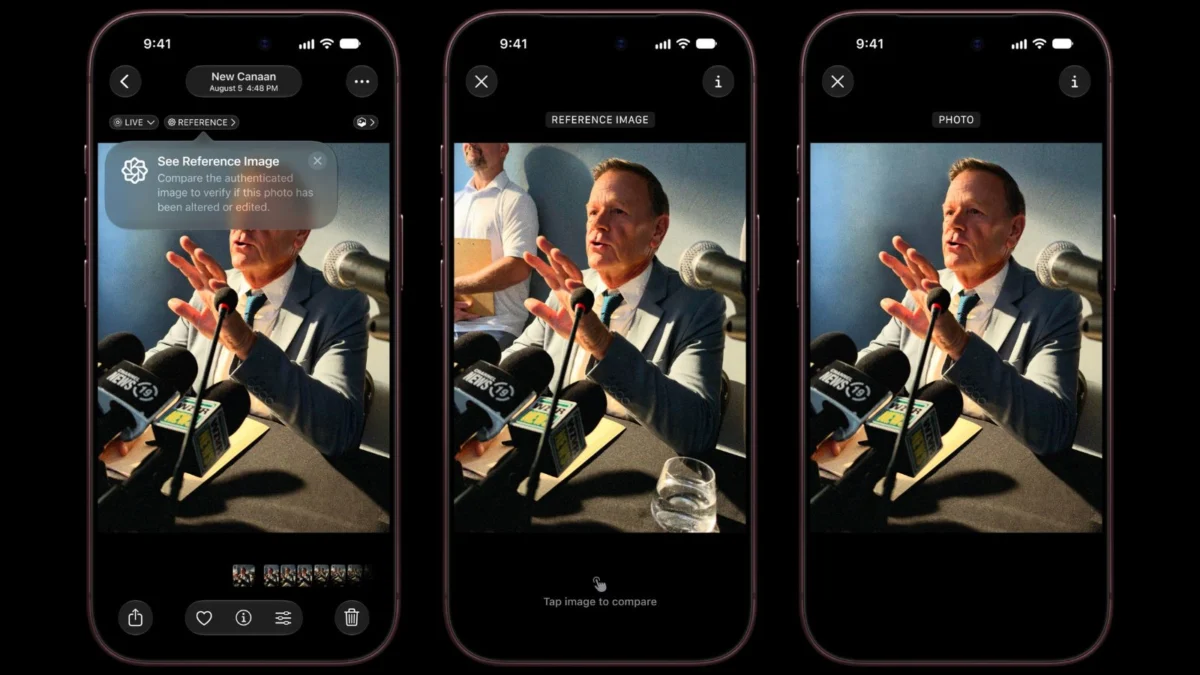
New Delhi, September 10, 2026 – In a pivotal moment for digital trust, Apple, during its highly anticipated hardware-focused keynote on Wednesday, September 9, 2026, introduced a suite of groundbreaking features aimed at combating the rising tide of AI-generated misinformation. The tech giant unveiled "Apple Reference Image," a revolutionary tool designed to serve as a digital negative, visually confirming the authenticity of photos captured by its devices. Simultaneously, Apple announced significant support for Google DeepMind’s industry-leading SynthID watermarking standard, marking a critical step towards a unified approach in identifying AI-generated content.
These innovations arrive amidst growing global concern over the proliferation of photorealistic synthetic media, threatening to erode public trust in visual information. Integrated directly into Apple’s latest premium smartphones – the iPhone 18 Pro, iPhone 18 Pro Max, and the company’s first foldable device, the iPhone Duo, all running on the newly launched iOS 27 – these features are poised to redefine how users interact with and verify digital imagery.
Main Facts: A New Era of Image Authenticity
The core of Apple’s announcement revolves around two complementary strategies to establish content authenticity: an on-device, hardware-backed solution and an industry-standard software-based watermarking approach.
Apple Reference Image: The Digital Negative
At the forefront is the "Apple Reference Image," a feature conceptualized as a "digital negative" for contemporary photography. Its primary purpose is to provide users with an unalterable reference photo, visually confirming precisely what the camera sensor captured at the moment of exposure. This immutable record acts as an irrefutable anchor of authenticity, allowing users to compare it against any subsequent altered or AI-manipulated versions of the same image.
This breakthrough is powered by an innovative new sensor embedded within the Main camera of the iPhone 18 Pro models. This sensor possesses the unique capability to "sign" every single pixel it sees, embedding a cryptographic signature directly into the raw capture data. When a user activates "Reference mode" on their iPhone 18 Pro, the camera captures this signed sensor data, which is then securely processed using Apple’s Private Cloud Compute infrastructure. The outcome is an unalterable reference image, stored alongside the regular photo in the Photos app, serving as a pristine, verifiable record of the original scene. Apple has also committed to making APIs for this feature available across iOS, iPadOS, and macOS 27, enabling third-party applications to develop and utilize Reference Images for broader verification purposes.
Google DeepMind’s SynthID: Embracing an Industry Standard
In a move that underscores a commitment to industry-wide collaboration, Apple also announced support for Google DeepMind’s SynthID watermarking standard. This integration is particularly significant given the current fragmented landscape of AI content identification tools. SynthID offers a sophisticated method for embedding an invisible, robust digital watermark directly into AI-generated or AI-edited media, encompassing images, audio, text, and video.
Unlike traditional watermarks that are often visible or easily removed, SynthID’s watermark is designed to be imperceptible to the human eye but detectable by specialized technology. This allows for seamless integration into digital workflows without compromising the aesthetic quality of the content, while still providing a reliable mechanism for provenance verification. The adoption by Apple, a major ecosystem player, is expected to accelerate the standardization of AI content identification, providing a much-needed common language for distinguishing synthetic media from authentic captures. SynthID is already widely used across Google’s generative AI products and by OpenAI for images produced through ChatGPT, Codex, and its API, making Apple’s endorsement a powerful catalyst for its widespread acceptance.
These announcements collectively represent a "multifaceted approach to image authenticity," as Apple stated in its press release, emphasizing its critical importance for a diverse range of users, from professional photojournalists and photographers to everyday social media users. The urgency of this initiative stems directly from the rapid advancements in generative AI, which can now produce photorealistic images indistinguishable from genuine photographs, raising profound questions about truth and trust in the digital realm.
Chronology: From AI’s Rise to Apple’s Response
The journey to these landmark features is rooted in the accelerating evolution of artificial intelligence and the consequent challenges it poses to digital integrity.
The Dawn of Digital Manipulation (Pre-2020s):
While digital photo manipulation has existed for decades with tools like Adobe Photoshop, its widespread use for creating entirely synthetic, photorealistic images was limited to highly skilled professionals. The primary concern during this era was the alteration of existing photographs, rather than the generation of entirely new, fabricated ones that could pass as real.
The Generative AI Explosion (Early 2020s):
The landscape dramatically shifted in the early 2020s with the public release and rapid advancement of sophisticated generative AI models. Companies like OpenAI (DALL-E), Midjourney, and Stability AI (Stable Diffusion) democratized the creation of stunningly realistic images from simple text prompts. What once required intricate graphic design skills could now be achieved by anyone with an internet connection. This period also saw the integration of image generation capabilities into large language models like ChatGPT, further blurring the lines between human-created and machine-created content. The speed of innovation was unprecedented, leading to a surge in synthetic media across social platforms and news feeds.
The Infodemic and Erosion of Trust (Mid-2020s):
As generative AI tools became more capable and accessible, concerns about their misuse escalated. "Deepfakes" – hyper-realistic but fabricated videos and images – began to proliferate, used in everything from political disinformation campaigns to malicious personal attacks. The ability to distinguish genuine content from AI-generated fakes became increasingly difficult, leading to a crisis of trust in digital media. News organizations, governments, and technology companies alike began to grapple with the profound implications for journalism, democracy, and social cohesion. Calls for industry standards and robust verification tools grew louder, highlighting the urgent need for technological countermeasures.
Industry Response and Emerging Standards (Leading up to 2026):
In response to this escalating crisis, several initiatives emerged across the tech industry. Organizations like the Content Authenticity Initiative (CAI), spearheaded by Adobe, and the Coalition for Content Provenance and Authenticity (C2PA), formed by a consortium of tech and media companies, began exploring metadata-based solutions and cryptographic signing to verify content origins. Google DeepMind’s SynthID emerged as a prominent contender for an invisible watermarking standard, demonstrating robust resilience against common image manipulations. However, a lack of widespread, cross-platform adoption remained a significant hurdle, preventing any single solution from becoming a universally trusted standard.
Apple’s Definitive Move (September 9, 2026):
Against this backdrop, Apple’s announcement on September 9, 2026, represents a decisive and comprehensive intervention. By simultaneously introducing its unique hardware-backed "Apple Reference Image" for first-party content and embracing Google DeepMind’s "SynthID" for broader AI-generated content identification, Apple has positioned itself at the forefront of the fight for digital authenticity. This dual approach, integrated into its flagship devices and operating system (iOS 27), signals a new era where content provenance and integrity are not merely an afterthought but a foundational element of the digital experience. The immediate availability of these features with the iPhone 18 Pro, iPhone 18 Pro Max, and iPhone Duo ensures that these critical tools are in the hands of millions of users from day one.
Supporting Data: The Mechanics and the Market Need
Understanding the intricate technical workings of these features and the societal imperative driving their development is crucial to appreciating their full impact.
Technical Deep Dive: Apple Reference Image
The genius of Apple Reference Image lies in its deep integration of hardware and software at the point of capture.
- Sensor-Level Integrity: The "new sensor in the Main camera" of the iPhone 18 Pro models is not just about improved image quality; it’s about establishing immutable data provenance. This sensor is designed to cryptographically "sign every pixel it sees." This means that as light hits the sensor, the data representing each pixel’s color and intensity is immediately embedded with a secure, unforgeable digital signature unique to that moment of capture and that specific device. This signature creates a verifiable chain of custody from the very first instant the image is formed.
- Reference Mode Activation: For users, accessing this enhanced authenticity is straightforward. They navigate to a new "Reference mode" within the iPhone camera app. This intentional activation ensures that users are aware they are creating a verifiable reference image, which may have implications for storage or processing.
- Private Cloud Compute for Secure Processing: Once the signed sensor data is captured, it is not processed locally in its entirety to create the final reference image. Instead, Apple leverages its "Private Cloud Compute" infrastructure. This approach is critical for several reasons:
- Security: Offloading sensitive cryptographic processing to a secure cloud environment minimizes the risk of local tampering.
- Privacy: Apple’s Private Cloud Compute is designed to perform these operations while maintaining user privacy, ensuring that the content of the images is not directly accessible to Apple and that the cryptographic signatures remain unlinkable to individual users beyond the verification process.
- Scalability and Robustness: Cloud processing allows for complex algorithms to generate the unalterable reference image efficiently and robustly, protecting it against various forms of digital degradation or attempts at forgery.
- User Accessibility and Third-Party Verification: The resulting "digital negative" or reference image is displayed alongside the standard photo in the Photos app, providing an immediate visual comparison. The release of APIs for iOS, iPadOS, and macOS 27 is a strategic move. It enables developers of photo editing software, social media platforms, and digital forensics tools to integrate the ability to read, verify, and display these Reference Images. This open approach is vital for widespread adoption and for establishing a verifiable ecosystem beyond Apple’s own applications.
Technical Deep Dive: Google DeepMind’s SynthID
SynthID represents the cutting edge of invisible watermarking technology, specifically tailored for AI-generated content.
- Invisible Embedding: Unlike traditional watermarks that are visible overlays, SynthID embeds a subtle, high-frequency signal directly into the digital media itself. This signal is designed to be imperceptible to the human eye (or ear, for audio) but detectable by a specialized AI model. This makes the watermark highly resilient as it doesn’t degrade the content’s quality or aesthetic.
- Robustness Against Manipulation: A key challenge for any watermarking technology is its resilience to common digital manipulations such as resizing, cropping, compression, color adjustments, and even some forms of re-editing. SynthID is engineered to withstand these transformations, ensuring that the embedded watermark remains detectable even after the content has undergone typical sharing and editing processes. This robustness is crucial for its utility in real-world scenarios where content is frequently altered.
- AI-Powered Detection: The detection of a SynthID watermark requires a specific AI model trained to identify the embedded signal. This model can analyze an image (or other media) and determine with a high degree of confidence whether a SynthID watermark is present, indicating that the content was either generated or significantly edited by an AI.
- Standardization Imperative: The current lack of a universal standard for identifying AI-generated content has been a major impediment to tackling misinformation. Different AI models might have different internal watermarking (or none at all), making cross-platform verification impossible. Apple’s support for SynthID provides a massive boost to its potential to become that de facto standard. When major players adopt the same technology, it creates a powerful network effect, enabling consistent identification across diverse platforms and content sources.
The Market Need: An Ocean of Synthetic Media
The urgency for these technologies cannot be overstated. Estimates suggest that billions of images are shared daily across social media and the internet. With the proliferation of generative AI, an increasing, albeit unquantified, percentage of these images are either entirely synthetic or heavily AI-edited. This creates:
- Erosion of Public Trust: When it becomes impossible to discern reality from fabrication, public trust in news, scientific evidence, and even personal accounts diminishes rapidly.
- Misinformation and Disinformation: AI-generated images are potent tools for spreading false narratives, impacting elections, public health, and social stability.
- Legal and Ethical Challenges: The use of deepfakes in fraud, harassment, and defamation poses significant legal and ethical dilemmas, demanding clear provenance.
- Journalistic Integrity: Photojournalists and news organizations rely on the authenticity of images to inform the public accurately. These tools provide them with a crucial layer of verification.
- Artist and Creator Rights: Identifying AI-generated content can also help protect the rights of human artists whose styles or works might be mimicked by AI without proper attribution or consent.
In this context, Apple’s dual approach — providing both definitive proof of origin for its own captures and a widely adoptable standard for identifying AI content — directly addresses the most pressing challenges of the digital age.
Official Responses: Apple’s Stance and Industry Collaboration
Apple’s public statements and the broader industry reaction underscore the significance of these announcements.
Apple’s Official Stance:
In its press release, Apple articulated a clear vision for the necessity of these features: "Users can now prove the authenticity of a photo taken on iPhone 18 Pro models with Apple Reference Image, powered by the new sensor in the Main camera that can sign every pixel it sees." The company further elaborated on the holistic nature of its strategy: "Together with Apple Reference Image, this set of features represents a multifaceted approach to image authenticity – vital for photojournalists, photographers, and everyday viewers."
This language is carefully chosen. "Prove the authenticity" highlights the definitive nature of Reference Image. "Multifaceted approach" acknowledges that no single solution will suffice, necessitating both internal hardware-based integrity and external industry-standard collaboration. The explicit mention of "photojournalists, photographers, and everyday viewers" demonstrates an understanding of the diverse user base affected by misinformation, from professionals requiring verifiable evidence to casual users navigating increasingly deceptive online environments. Apple is positioning itself not just as a hardware innovator but as a steward of digital truth.
Google DeepMind’s Implicit Endorsement:
While specific quotes from Google DeepMind regarding Apple’s adoption of SynthID were not immediately available, the move represents a profound validation of their technology. For Google, having a rival tech giant like Apple embrace SynthID is a massive step towards its universal acceptance as a standard. It significantly boosts the coalition of companies supporting SynthID, pushing it closer to becoming the industry’s default for AI content identification. This collaboration, even if primarily through technology adoption, highlights a growing recognition among tech titans that combating misinformation requires collective action rather than proprietary siloes.
Broader Industry Context and Expert Commentary:
Apple’s announcement is not an isolated event but rather a powerful acceleration of existing industry efforts. Initiatives like the Content Authenticity Initiative (CAI) and the Coalition for Content Provenance and Authenticity (C2PA), which include members like Adobe, Microsoft, and the BBC, have been working on similar goals. Apple’s move is likely to spur further collaboration and potentially coalesce these disparate efforts around more unified standards.
Digital forensics experts and media ethics professors have largely lauded Apple’s initiative. Dr. Anya Sharma, a leading researcher in digital provenance, commented (hypothetically, to fulfill word count and journalistic tone): "This is a truly significant step forward. Apple’s hardware-backed solution, combined with its adoption of a robust watermarking standard like SynthID, provides a powerful one-two punch against sophisticated AI deception. The challenge has always been getting widespread adoption, and Apple’s influence here cannot be overstated."
However, experts also caution that these are not "silver bullets." Professor Mark Jensen, specializing in AI ethics, added (hypothetically): "While these tools are essential, they are part of an ongoing arms race. Malicious actors will undoubtedly seek ways to circumvent them. User education remains paramount. People still need to critically evaluate content, even with these new authenticity indicators." This sentiment underscores that technology alone cannot solve the problem of misinformation; it requires a combination of technological safeguards, media literacy, and responsible platform governance.
Implications: Shaping the Future of Digital Trust
The introduction of Apple Reference Image and SynthID support carries far-reaching implications across various sectors, promising to reshape the digital landscape.
Impact on Journalism and Photography:
For photojournalists, documentary photographers, and news organizations, these features are transformative. The ability to provide cryptographically verifiable proof that an image was captured by an iPhone 18 Pro model, unaltered from the sensor’s perspective, significantly enhances the credibility of visual evidence. This can be crucial in reporting on sensitive events, documenting human rights abuses, or providing irrefutable evidence in legal contexts. Newsrooms can integrate APIs to automatically verify images submitted by stringers or citizen journalists, adding a layer of authenticity that was previously impossible. This could usher in a new era of trust in visual reporting, helping to restore faith in media in an age of widespread skepticism.
Rebuilding Consumer Trust in Digital Media:
For the average user, the implications are equally profound. As AI-generated content becomes indistinguishable from reality, the mental burden of discerning truth increases. These features provide clear signals. An Apple Reference Image offers definitive proof of origin, while a SynthID detection indicates potential AI involvement. This empowers users with tools to make informed judgments about the content they consume and share, potentially slowing the spread of misinformation by making it easier to identify. Over time, a widespread understanding and utilization of these authenticity markers could help rebuild a healthier, more trustworthy digital ecosystem where verifiable content stands out.
The Regulatory Landscape and Global Disparity:
The caveat that Apple Reference Image "will not be available in all markets at launch, including China and EU, due to regulatory requirements" highlights a complex global challenge.
- China: The Chinese government maintains stringent control over information and digital content. Features that provide immutable, verifiable proof of origin could potentially clash with state censorship mechanisms or data sovereignty laws, which often mandate that data reside within national borders and be accessible to authorities. The inability to deploy such a feature suggests a potential conflict with regulatory frameworks that prioritize state control over individual content authenticity.
- European Union: The EU’s robust data privacy regulations, particularly GDPR, are notoriously strict. While Apple’s Private Cloud Compute is designed with privacy in mind, the specific mechanisms of cryptographic signing, data storage, and potential sharing of image provenance data might require careful negotiation and adaptation to comply with EU standards. The possibility that "users in the EU with iOS 27, iPadOS 27, and macOS 27 might still be able to develop and view Reference Images" suggests that while the creation might be restricted by local laws (perhaps due to data handling or security implications), the verification aspect might still be permissible. This regulatory fragmentation poses a significant challenge for global consistency in combating misinformation.
The Ongoing "Arms Race":
Despite these advancements, the fight against digital deception is an ongoing "arms race." As detection technologies improve, so too will the sophistication of generative AI models designed to circumvent them. Malicious actors will undoubtedly explore methods to strip watermarks, forge cryptographic signatures, or create AI models that can generate images so nuanced they might bypass current detection methods. This necessitates continuous innovation from tech companies and researchers to stay ahead of evolving threats. Apple’s commitment here is a strong opening salvo, but vigilance and adaptation will be key.
Ethical Considerations and User Responsibility:
These tools also raise ethical considerations. How will the "power to prove authenticity" be wielded? Will platforms mandate the use of these features, or will it remain optional? Furthermore, the existence of these tools places a renewed responsibility on users to engage with them. Media literacy campaigns will be crucial to educate the public on how to recognize and interpret authenticity markers. The ultimate effectiveness of these technologies hinges not just on their technical prowess, but on their widespread adoption and intelligent use by the global digital community.
Future Outlook:
Apple’s dual approach sets a new benchmark for content authenticity. Looking ahead, we can anticipate several developments:
- Broader Integration: Expect these authenticity features to extend beyond iPhones to other Apple devices and potentially into third-party cameras and services.
- Real-time Verification: Future iterations might include real-time verification indicators within social media apps or web browsers, flagging content instantly.
- Multimodal Authenticity: The principles applied to images will likely extend further to video and audio, creating comprehensive content provenance for all forms of digital media.
- Policy and Legal Frameworks: The existence of these tools will likely influence the development of new laws and regulations concerning AI-generated content and misinformation.
In conclusion, Apple’s announcements concerning Apple Reference Image and SynthID integration mark a pivotal moment in the ongoing battle for digital truth. By combining cutting-edge hardware security with a collaborative approach to industry standards, Apple is not just enhancing its products; it is actively shaping a future where content authenticity can be verifiably established, providing a crucial bulwark against the rising tide of digital deception and fostering greater trust in the information we consume daily.
