

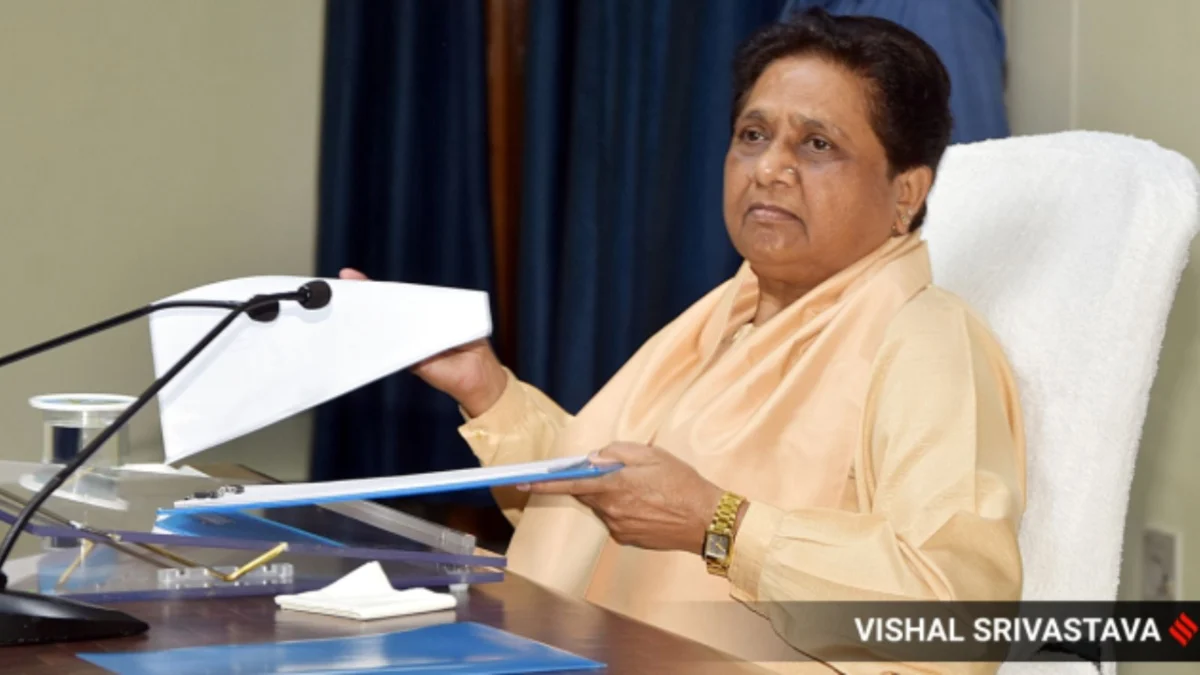
Lucknow, Uttar Pradesh – The Bahujan Samaj Party (BSP), once a formidable force in Indian politics, finds itself embroiled in yet another internal leadership crisis, as party supremo Mayawati decisively moves to consolidate her absolute authority. In a significant shake-up that underscores the enduring uncertainty surrounding the party’s future, Mayawati has announced that her nephew, Akash Anand, has been "completely freed" of all party responsibilities. This decision is accompanied by stern action against senior functionaries, including Akash’s father-in-law, Ashok Siddharth, ostensibly taken "in the interests of the party."
This latest purge, revealed on September 10, 2026, has sent ripples through the BSP cadre, raising fundamental questions about the party’s succession plan as it approaches the crucial 2027 Uttar Pradesh Assembly elections without a single MLA or MP in the state legislature. As Akash Anand, who was once prominently projected as Mayawati’s political heir, finds himself on the outs once more, attention has swiftly shifted to his younger brother, Ishan Anand, who appears to be groomed as the party’s next-generation face. The move reaffirms Mayawati’s singular position as the BSP’s undisputed power center, tolerating no challenge to her command, even from within her own family.
A Tumultuous Chronology: Akash and Siddharth’s Political Seesaw
The narrative of Akash Anand and Ashok Siddharth’s engagement with the BSP under Mayawati’s leadership has been one of repeated expulsions and reinstatements, illustrating the unpredictable nature of internal party dynamics. This pattern highlights Mayawati’s firm grip and her willingness to sideline even close relatives if she perceives a challenge to her supreme authority or the party’s disciplined image.
Early 2023: Akash’s Ascent and Matrimonial Ties
Akash Anand, who pursued an MBA in London, was initially projected as Mayawati’s political successor ahead of the 2024 Lok Sabha elections. His formal entry into party politics was marked by his marriage in March 2023 to Pragya Siddharth, daughter of former Rajya Sabha MP Ashok Siddharth. Pragya, like Akash, also studied in London, pursuing medicine. This matrimonial alliance seemingly cemented Akash’s position within the party’s inner circle, linking him to a veteran leader known for his ties to Mayawati’s family.
Mid-2024: The First Major Setback – "Aatankwadiyo ki Sarkar" Remark
Akash Anand’s political trajectory faced its first major hurdle during the campaigning for the 2024 Lok Sabha elections. In a fiery speech delivered in Sitapur, Uttar Pradesh, Akash referred to the BJP government as "aatankwadiyo ki sarkar" (government of terrorists). This controversial statement led to a police case being filed against him for promoting enmity. Mayawati swiftly reacted, removing him as the national coordinator in the middle of the election campaign, stripping him of his status as political heir, and barring him from campaigning. Her public statement at the time indicated that the directive would remain in force until her nephew attained "maturity." This incident underscored Mayawati’s intolerance for any deviation from the party line or statements that could invite legal trouble or political backlash.
Late 2024: Brief Reinstatement
Despite the stern action, Mayawati’s stance softened within a month. Akash Anand was reinstated as her "lone successor" and the party’s national coordinator, signaling a temporary reprieve and perhaps a recognition of the need for a younger face within the party.
February 2025: Siddharth’s First Expulsion and Akash’s Continued Association
Ashok Siddharth, whose influence was reportedly linked to his friendship with Akash’s father, Anand Kumar (Mayawati’s younger brother), first fell out of favour in February 2025. Allegations of promoting factionalism arose after he reportedly did not invite several senior leaders to a family wedding in Agra. However, Mayawati, in a later statement, clarified that his expulsion at that time was also linked to a "violation of directives, particularly on ticket distribution in Maharashtra."
March 2025: Akash’s Second Expulsion and Direct Blame on Siddharth
Just a month after Siddharth’s expulsion, Mayawati sacked Akash from all party posts once again. This time, her public statement pointed directly to Siddharth’s alleged influence. "We will have to watch how much influence Siddharth will exert on his daughter after his expulsion and how much influence she will exert on Akash. That is not appearing positive so far," Mayawati stated, adding that Siddharth had "damaged the party and ruined Akash’s career." This public declaration laid bare the internal family tensions and Mayawati’s deep distrust of Siddharth’s role.
September 2025: Siddharth’s Reinstatement
Against the backdrop of internal party discussions and perhaps a strategic recalibration, Ashok Siddharth was reinstated in September 2025. His return was reportedly conditional, with Mayawati emphasizing that he should not "repeat such mistakes." This reinstatement, however, did little to stabilize the party’s internal dynamics, as events would soon prove.
August 2026: Akash’s Independent Statements and Mayawati’s Displeasure
The latest trigger for Akash Anand’s removal came in August 2026. BSP sources indicate that Mayawati was deeply displeased with Akash for making "some statements of his own" in speeches to party workers in Hathras and Jewar. His mandate, according to an insider, was strictly to communicate "Behenji ka sandesh (Mayawati’s message)" and nothing more. Any deviation from this was seen as a challenge to her authority and a sign of political immaturity.
September 2026: The Latest Purge – Akash "Completely Freed" and Siddharth’s Retirement Plea
The culmination of these events arrived on September 10, 2026. Mayawati’s decision to "completely free" Akash Anand of all party responsibilities was made public, effectively sidelining him from active politics within the BSP. Simultaneously, Ashok Siddharth was asked to retire from politics altogether, ostensibly "to protect his son-in-law’s political future," a move that some interpret as Mayawati severing all ties with an individual she perceives as a detrimental influence.
This intricate dance of power and politics within the BSP underscores Mayawati’s unwavering resolve to maintain absolute control, even at the cost of alienating potential successors or close family members.
Supporting Data: A Party in Decline and the Succession Dilemma
The internal strife comes at a particularly precarious time for the Bahujan Samaj Party. Once a dominant political force, particularly in Uttar Pradesh, the BSP’s electoral fortunes have been in a steady decline.
Electoral Woes: The stark reality confronting the BSP is its current absence from the Uttar Pradesh state legislature, having failed to secure any MLA seats in the last Assembly elections. Its representation in the national Parliament has also dwindled significantly, with no MPs from Uttar Pradesh. This severe erosion of its electoral base means the party is in dire need of revitalization and a strong, unifying leadership that can connect with voters, especially the youth.
The Generational Void: The BSP’s traditional voter base, primarily Dalits, has historically been fiercely loyal to Mayawati. However, younger generations of Dalit voters are increasingly seeking new avenues of political representation and are less bound by historical allegiances. The party desperately needs a "generational bridge"—a leader who can articulate the BSP’s ideology in a contemporary context and resonate with young, aspirational voters. Akash Anand was seen as this potential bridge, with his urban upbringing and foreign education, but his repeated setbacks have left a significant vacuum.
Rising Competition: The political landscape for Dalit assertion has become more fragmented and competitive. The rise of new parties and leaders, such as Chandra Shekhar Azad of the Azad Samaj Party (Kanshi Ram), has drawn a considerable segment of Dalit youth, particularly in Uttar Pradesh. Azad, a prominent youth icon, has successfully carved out a niche by addressing contemporary Dalit issues with a more aggressive and direct approach, contrasting with the BSP’s more staid political style. This external pressure further accentuates the need for the BSP to present a stable and forward-looking leadership.
Family Business and Political Enterprise: The Anand family’s involvement extends beyond politics. Ishan Anand, Akash’s younger brother, before his political elevation, managed family hotels and a pharma distribution business. This highlights the intertwined nature of business interests and political aspirations within the BSP’s first family, a common feature in many Indian political parties. While Mayawati maintains an image of asceticism, her family’s enterprises are well-known.
Official Responses and Internal Discord
The latest developments have been accompanied by a series of public statements and internal reactions that shed light on the ongoing power struggle.
Mayawati’s Unwavering Stance: In her public statement on Thursday, Mayawati clearly hinted at the "churn in the family," directly accusing Siddharth and Akash of being more attached to "personal and family interests" than to the success of the BSP and the broader Bahujan movement. She highlighted Akash’s selective use of social media, noting that while he had previously shared her ‘X’ (formerly Twitter) posts to demonstrate his "loyalty," he conspicuously failed to share a recent post concerning Siddharth. This pointed accusation underscores Mayawati’s meticulous observation of loyalty signals and her perception of a lack of commitment to the party’s cause. Her messages consistently reinforce her image as the sole custodian of the Bahujan movement’s legacy and the party’s principles.
Ashok Siddharth’s Deference: Responding to Mayawati’s directives, Ashok Siddharth took to social media, asserting that Mayawati’s command was more important to him than his family and political relationships. He explicitly denied influencing Akash and stated that Mayawati should be the ultimate decider on whether his son-in-law should be given any responsibility in the party again. This public display of deference, though perhaps intended to mitigate Mayawati’s displeasure, also inadvertently confirmed the existence of an internal family discussion that had spilled into the public domain.
Confusion Among the Cadre: A senior BSP leader, speaking anonymously, articulated the confusion prevalent among party workers. "All that exchange of messages between ‘Behenji (Mayawati)’ and Ashok Siddharth through social media posts, and the remarks made against Ashok and Akash in the past, clearly indicates there is some tussle within the family. If they are expressing that on social media, they must clarify it to party workers who have been confused for the past two years," the leader said. He added, "The only message that is clear so far is that Behenji is the supreme authority in the party and the family." This sentiment reflects the frustration of the ground-level workers who are left to interpret cryptic messages and endure the instability at the top.
The Emergence of Ishan Anand: A New Hope or Another Experiment?
Akash Anand’s latest exit from the BSP coincides with the notable emergence of his younger brother, Ishan Anand, signaling a potential shift in Mayawati’s succession strategy.
A Carefully Orchestrated Debut: Ishan Anand’s political debut was marked by his attendance at a recent meeting of the party’s national office-bearers. This was not a casual appearance; at the conclusion of the meeting, a new and significant position, "Chief Sector Coordinator," was created specifically for him.
Defining the New Role: The BSP’s organizational structure outside Uttar Pradesh and Uttarakhand is divided into two sectors. Rajya Sabha MP Ramji Gautam oversees Sector 1 (a cluster of 10 states), while former national coordinator Rajaram is in charge of Sector 2 (the remaining states). Ishan, as Chief Sector Coordinator, is positioned to directly interact with both Gautam and Rajaram, empowered to call them for meetings. Crucially, Ishan will report directly to Mayawati and his father, party vice-president Anand Kumar. This hierarchical placement gives him substantial organizational power and direct access to the party’s top leadership.
Educational Background and Business Acumen: Ishan is a law graduate from Westminster University in London, an educational background that mirrors his elder brother’s foreign education. Before his foray into politics, BSP sources confirm that he managed various family businesses, including hotels and a pharma distribution enterprise. This experience in management and business operations could be an asset in organizational leadership.
Untested in the Political Arena: Despite his impressive educational and business credentials, Ishan remains politically untested. His growing visibility, while strategically timed, does not automatically translate into a definitive decision on succession, as some BSP leaders caution. However, the timing of his elevation, precisely when his elder brother’s political space within the party has narrowed, is undeniably significant. It suggests a deliberate effort by Mayawati to cultivate a new face from within her family, one who might embody the "maturity" and unwavering loyalty she demands.
Implications for the BSP’s Future
The latest leadership reshuffle carries profound implications for the Bahujan Samaj Party, particularly as it navigates a challenging political landscape.
Deepening Dynastic Tendencies: While Mayawati has often criticized dynastic politics in other parties, her repeated attempts to groom successors from her own family, first Akash and now Ishan, underscore a deepening dynastic tendency within the BSP. This internal contradiction could alienate party workers who have historically been drawn to the BSP’s cadre-based and ideological roots rather than familial connections.
Uncertainty Ahead of 2027 Uttar Pradesh Assembly Elections: The 2027 Uttar Pradesh Assembly elections are critical for the BSP’s survival and relevance. Without a clear, stable, and widely accepted second-generation leader, the party risks further erosion of its voter base. The ongoing internal turmoil creates an impression of instability and disarray, which opposition parties will undoubtedly exploit. The absence of a strong voice to connect with young voters leaves a gaping void that Ishan, untested, will find challenging to fill in the short timeframe available.
Mayawati’s Enduring Legacy and Succession: Mayawati’s reign has been characterized by her singular authority and her pivotal role in mobilizing the Dalit community. However, her inability to cultivate a stable and effective successor outside or even within her immediate family raises questions about the long-term sustainability of the BSP beyond her active leadership. The party’s future appears inextricably linked to her ability to identify and empower a leader who can command respect and loyalty across the party ranks, while also adapting to evolving political realities.
Impact on the Bahujan Movement: The BSP was founded on the principles of social justice and empowerment for the Bahujan (majority) community. The current internal struggles and electoral decline threaten to weaken a significant voice for this movement. A strong and unified BSP is crucial for advocating for Dalit rights and ensuring their political representation. A fragmented or unstable party leadership could dilute its effectiveness in these critical areas.
A Test of Ishan Anand’s Mettle: Ishan Anand’s elevation marks a new chapter, but it is one fraught with challenges. He will need to quickly prove his political acumen, leadership capabilities, and ability to connect with the party’s diverse cadre and voter base. His success will depend not only on Mayawati’s continued patronage but also on his own capacity to navigate the intricate and often unforgiving world of Indian politics, a world where his elder brother stumbled repeatedly.
In conclusion, Mayawati’s latest move to assert her dominance within the BSP, while simultaneously introducing a new familial face, highlights the party’s critical juncture. As the BSP struggles to regain its lost glory and connect with a changing electorate, the success or failure of Ishan Anand to fill the shoes of a generational leader will determine whether the party can carve out a relevant future or continue its journey into political wilderness. The upcoming 2027 Uttar Pradesh Assembly elections will serve as an initial, decisive test of this renewed strategy and Mayawati’s enduring grip on the party’s destiny.
