

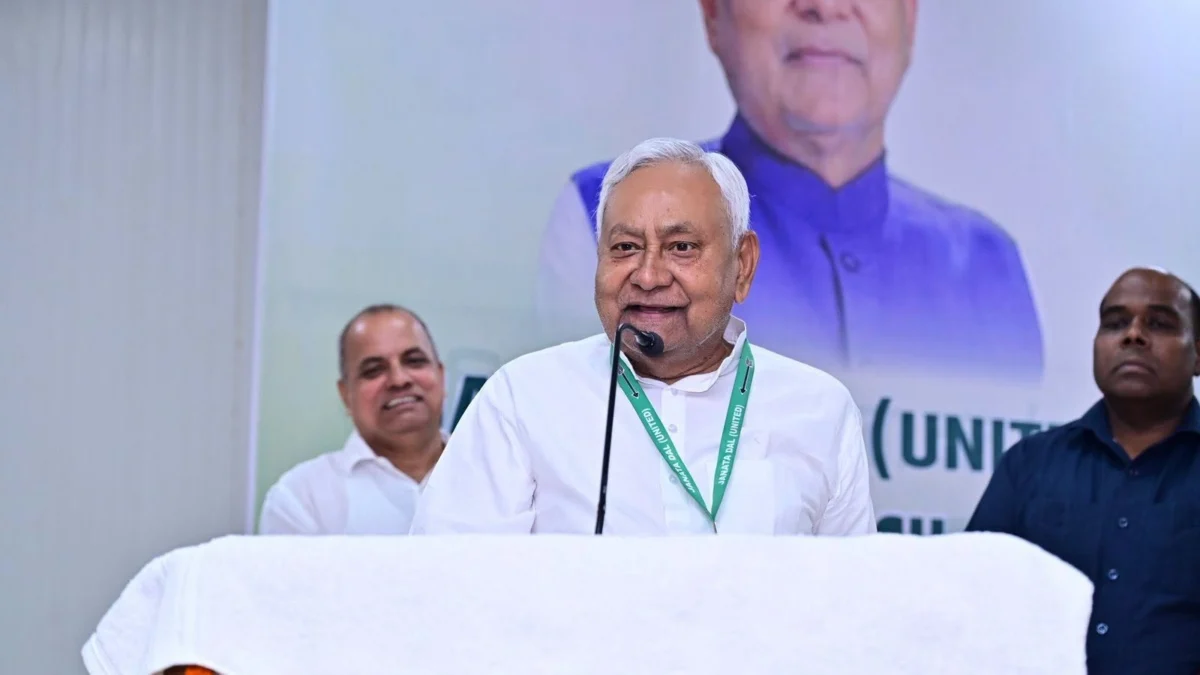
Patna, Bihar – September 17, 2026 – Five months after a significant political reshuffle saw JD(U) president Nitish Kumar relinquish his post as Bihar Chief Minister to usher in BJP leader Samrat Choudhary, the Janata Dal (United) has embarked on an ambitious and multi-pronged campaign to rekindle and reaffirm the extensive legacy of its stalwart leader. The move, coming at a critical juncture for the party, aims to underscore Kumar’s enduring impact on Bihar’s governance, particularly his acclaimed record on social engineering, transformative infrastructure projects, and flagship welfare schemes like Jeevika. This vigorous re-engagement with its foundational principles and past achievements signals JD(U)’s strategic intent to maintain its distinct identity and political leverage within the NDA alliance, even as it navigates complex internal dynamics and external pressures.
The resurgence of Nitish Kumar’s political narrative is not merely a nostalgic look back but a calculated effort to consolidate the party’s traditional vote banks and project continuity in its vision for Bihar. With crucial elections on the horizon and the shifting sands of coalition politics, the JD(U)’s proactive stance reflects a clear determination to cement its position, ensuring that the ‘Nitish Kumar brand’ remains a potent force in the state’s political landscape. This carefully orchestrated campaign involves both ground-level outreach and a renewed emphasis on key policy debates, positioning Nitish Kumar as an irreplaceable figure whose contributions continue to shape the state’s trajectory.
A Legacy Reaffirmed: JD(U)’s Post-Nitish Strategy
The political landscape of Bihar underwent a significant transformation in April 2026 when Nitish Kumar, a seasoned political architect and the state’s long-serving Chief Minister, made the strategic decision to step down. His departure paved the way for Samrat Choudhary of the Bharatiya Janata Party to assume the top executive role, marking a pivotal moment in the power-sharing arrangement between the two alliance partners. This transition, while seemingly smooth on the surface, has inevitably cast a spotlight on the JD(U)’s future trajectory and its ability to maintain political relevance without its charismatic leader at the helm of the state administration.
In response, the JD(U) has launched a concerted effort to invoke and celebrate Nitish Kumar’s legacy, a testament to his indelible imprint on Bihar’s development and governance. The party’s strategy is multifaceted, focusing on three core pillars that have long defined Kumar’s political persona: his innovative approach to social engineering, which brought various communities into the fold of development; his relentless pursuit of infrastructure development, transforming Bihar’s long-neglected physical landscape; and the implementation of pioneering flagship schemes that directly impacted the lives of millions.
The party’s current initiatives are designed to remind the electorate of the tangible improvements brought about under Kumar’s leadership. From constructing vital roads and bridges to electrifying remote villages and championing schemes for marginalized communities, Nitish Kumar’s tenure was marked by a commitment to inclusive growth. This emphasis on his past achievements serves a dual purpose: it aims to galvanize the party’s cadre and supporters, reinforcing their faith in the JD(U)’s ideology, and to counter any narrative that might diminish Kumar’s contributions in the wake of his exit from the Chief Minister’s office. By strategically highlighting these areas, the JD(U) seeks to demonstrate that its vision for Bihar remains deeply intertwined with the principles and policies championed by its president.
"Nitish Samvad": The Farakka Focus
Central to the JD(U)’s current outreach is a novel organizational initiative dubbed "Nitish Samvad," meaning "Nitish Dialogue." This campaign is not just a ceremonial tour but a targeted engagement strategy, focusing initially on 12 districts along the Ganga river. The primary objective of "Nitish Samvad" is to rally public support against the renewal of the Farakka treaty, a critical water-sharing agreement between India and Bangladesh that is slated to expire in December.
The Farakka Barrage, constructed across the Ganga river in West Bengal, has been a contentious issue for Bihar for decades. The state has long argued that the barrage leads to severe siltation in the Ganga, exacerbating flood risks during monsoon seasons and adversely affecting navigation and agriculture in the downstream regions of Bihar. Nitish Kumar has been a vocal and consistent opponent of the barrage, advocating for its decommissioning or a comprehensive review of its operations to mitigate its detrimental effects on Bihar. His long-standing campaign against the Farakka treaty is a powerful symbol of his commitment to the state’s interests and environmental concerns.
While Nitish Kumar, now a Rajya Sabha MP, will not be physically present at these "Nitish Samvad" events, his voice and vision will resonate through carefully curated audio and video messages played at each gathering. This symbolic presence allows the party to leverage his authority and long-held stance on the issue without requiring his direct involvement, a pragmatic approach given his current parliamentary role. The campaign is being spearheaded by Sanjay Kumar Jha, the JD(U)’s national working president and a Rajya Sabha MP himself, who has intermittently led the party’s advocacy against the Farakka barrage. Jha’s leadership underscores the party’s dedication to this particular issue, which is deeply rooted in regional concerns and has the potential to mobilize significant public sentiment.
Neeraj Kumar, JD(U) chief spokesperson, articulated the party’s rationale behind the "Nitish Samvad" initiative, stating, "We have launched ‘Nitish Samvad’ on the Farakka issue because our party chief had consistently opposed the barrage. Even though new CM Choudhary and Deputy CM Vijay Kumar Sinha recently expressed concerns over floods and heavy siltation caused by the Farakka barrage, we are trying to add to the move to reaffirm and reinstate the big legacy and statesmanship of Nitish Kumar." This statement clearly indicates the JD(U)’s intention to claim leadership on this issue, asserting Nitish Kumar’s pioneering role even as other political figures acknowledge the problem. It is a strategic move to distinguish the JD(U)’s long-term commitment from the potentially more recent concerns of its alliance partner.
"Jeevika ke 20 Saal": Celebrating Women’s Empowerment
Beyond environmental and infrastructure concerns, the JD(U) is also placing significant emphasis on celebrating the enduring success of its flagship women’s empowerment program, Jeevika. Umesh Kushwaha, the JD(U) state president, recently announced a comprehensive campaign titled "Jeevika ke 20 Saal" (20 Years of Jeevika), under which party leaders will visit all 38 districts of Bihar. The objective is to "celebrate and review" the scheme, which has transformed the lives of millions of women across the state.
Jeevika, launched during Nitish Kumar’s tenure as Chief Minister, is a pioneering women’s self-employment and empowerment program structured around self-help groups (SHGs). Over the past two decades, it has grown exponentially, boasting an impressive membership of approximately 1.9 crore women in Bihar. The scheme provides micro-financing, skill development, and market linkages, enabling women to become economically independent and socially empowered. Its success has been so profound that the Central government replicated its model, launching a national program called Aajeevika, a testament to Jeevika’s effectiveness and innovative design.
Kushwaha highlighted the significance of the upcoming milestone, stating, "We will be completing 20 years since the launch of Jeevika in Bihar. We are very happy and honoured that the Centre has replicated our model, calling it Aajeevika. We will visit every district to interact with Jeevika workers, get their feedback and see how Nitish Kumar’s dream project can be made even better." This celebratory tone is coupled with a forward-looking perspective, aiming to gather insights and continuously improve the program.
Neeraj Kumar further elaborated on the scheme’s impact, asserting, "Jeevika is one big project everyone talks about everywhere. Bihar now has the biggest female human resource force in the form of Jeevika. Nitish Kumar’s immense contribution towards women’s empowerment is reflected very well through this scheme." The numbers speak volumes: nearly two crore women organized into a formidable force of economic and social change. This extensive network of empowered women constitutes a significant political constituency, one that the JD(U) is keen to nurture and solidify. By celebrating Jeevika, the party not only reinforces Nitish Kumar’s legacy but also reaffirms its commitment to women’s welfare, a demographic that has historically been a strong supporter of the JD(U). The campaign, scheduled to commence on October 2, is expected to be a major grassroots mobilization effort, connecting the party directly with its core beneficiaries.
The Shifting Sands of Alliance: JD(U) and BJP Dynamics
The JD(U)’s efforts to reassert its identity and legacy are taking place within the intricate framework of its alliance with the Bharatiya Janata Party. While both parties are partners in the NDA coalition, underlying tensions and strategic competition are evident, particularly concerning key policy issues and critical vote banks. This dynamic creates a delicate balancing act for the JD(U), which must champion its distinct agenda while maintaining coalition harmony.
The Uniform Civil Code Conundrum
One of the most immediate and potentially divisive issues testing the alliance’s cohesion is the Uniform Civil Code (UCC). Union Home Minister Amit Shah’s recent announcement that the UCC would be implemented in all 21 BJP-led NDA-ruled states before the 2029 Lok Sabha elections has brought the long-debated topic to the forefront. For the JD(U), which draws significant support from minority communities and has historically adopted a more inclusive approach, the UCC presents a complex challenge.
The JD(U) has responded with a distinctly cautious position. Sinha, without explicitly referring to his party’s past stance, stated to reporters, "We will first read the draft (UCC) and then decide. Our national working president Sanjay Jha has already said that he would meet the Home Minister on it." This deferral of judgment, pending a review of the draft, reflects the party’s attempt to navigate a sensitive issue that has profound implications for diverse religious and cultural practices.
Historically, the JD(U) has expressed reservations about a blanket implementation of the UCC. It did not refer to its earlier submission to the National Law Commission, in which it had argued that certain religious practices and traditions should be kept outside the ambit of the UCC. Nitish Kumar himself had previously underlined the absolute necessity for "broad national consensus" on the UCC issue before any steps towards its implementation. This consistent position highlights the JD(U)’s emphasis on consensus-building and respect for diverse customs, potentially putting it at odds with the BJP’s more assertive stance on uniform laws. The looming debate over the UCC could therefore become a significant point of contention, impacting the equilibrium of the JD(U)-BJP relationship and potentially alienating segments of the JD(U)’s voter base. The meeting between Sanjay Jha and the Home Minister will be crucial in determining the path forward for the alliance on this contentious policy.
The Battle for the Women’s Vote Bank
Beyond policy debates, a more subtle but equally intense competition is unfolding between the JD(U) and BJP for the allegiance of a critical demographic: women voters. This segment has been a cornerstone of Nitish Kumar’s political success, largely attributed to schemes like Jeevika and initiatives promoting women’s education and safety. A BJP leader, speaking on condition of anonymity, acknowledged this political reality, stating, "Everyone knows that Nitish Kumar created a big constituency of women. We also acknowledge that the Rs 10,000 grant to Jeevika workers in the last Assembly elections played a big role in our victory." This admission underscores the electoral power of women voters and the direct impact of welfare schemes on their political choices.
The BJP leader further elaborated on the current dynamics, observing, "JD(U) perhaps now looks keen on retaining this big constituency and is showing some desperation as well with BJP having its CM now. We too have cultivated the women’s constituency in a big way. It is a healthy fight between allies." This framing of a "healthy fight" reveals the underlying strategic competition. With the BJP now holding the Chief Ministerial post, it has a more direct avenue to launch its own women-centric programs and claim credit for welfare initiatives. The JD(U)’s intensified focus on Jeevika, therefore, can be seen as a defensive and proactive measure to protect its traditional base and prevent erosion of its support among women, who have been consistently loyal to Nitish Kumar. The battle for the women’s vote bank is not just about numbers; it’s about political narratives, the delivery of welfare, and the perception of which party genuinely champions their empowerment.
Future Leadership and Internal Succession
Amidst these external political maneuverings, internal discussions within the JD(U) are also gaining traction, particularly concerning future leadership and succession planning. With Nitish Kumar having stepped down from the Chief Minister’s office, albeit retaining the party presidency, the question of who will carry forward his extensive legacy looms large.
Nishant Kumar: Stepping into the Limelight?
A significant internal view emerging within the JD(U) is that Nitish Kumar’s son, Nishant Kumar, who currently serves as the state Health Minister, should assume a more prominent organizational role within the party. This sentiment reflects a natural progression of leadership and an aspiration for continuity within the party’s top echelons. A senior party leader articulated this perspective, suggesting Nishant’s direct involvement in the upcoming "Jeevika ke 20 Saal" campaign.
The leader remarked, "We all know the future of JD(U) depends on how Nishant Kumar carries forward Nitish Kumar’s legacy and comes off as an impressive leader in his own right. He should attend the ‘Jeevika ke 20 Saal’ campaign being launched on October 2." This statement underscores the expectation that Nishant will not merely be a cabinet minister but will actively engage with the party’s grassroots initiatives and connect with the electorate on the ground.
While acknowledging Nishant’s current performance, the leader added, "He is performing well as health minister and doing constant reviews of hospitals, but he should also be there on the ground for big party campaigns." This highlights a desire for Nishant to develop a broader political persona beyond his administrative duties. His participation in a high-profile campaign like "Jeevika ke 20 Saal," which directly touches nearly two crore women, would provide an invaluable platform for him to interact with a massive support base, demonstrate leadership qualities, and begin carving out his own identity as a prominent figure within the JD(U) and Bihar politics. The move is seen as crucial for the long-term health and stability of the party, ensuring a smooth transition of leadership and the perpetuation of Nitish Kumar’s vision for Bihar.
Implications and Outlook
The JD(U)’s current strategic initiatives represent a critical effort to redefine its role and solidify its position in a rapidly evolving political landscape. By vigorously invoking Nitish Kumar’s legacy, particularly his achievements in social engineering, infrastructure, and women’s empowerment through Jeevika, the party aims to underscore its distinct identity and enduring relevance. The "Nitish Samvad" on the Farakka issue and the "Jeevika ke 20 Saal" campaign are not merely celebratory events but calculated political maneuvers designed to galvanize support and project continuity of vision.
However, these internal consolidations are unfolding against a backdrop of complex external challenges. The cautious stance on the Uniform Civil Code, juxtaposed with the BJP’s assertive push, highlights potential friction points within the NDA alliance. This divergence on a sensitive policy issue could test the bonds of the coalition and impact the JD(U)’s relationship with its minority vote bank. Similarly, the "healthy fight" for the women’s constituency underscores an underlying strategic competition with the BJP, where both allies are vying for the same crucial demographic.
Furthermore, the growing calls for Nishant Kumar to assume a larger organizational role within the JD(U) signal the party’s long-term thinking regarding succession and future leadership. His active participation in major campaigns like "Jeevika ke 20 Saal" would be a significant step in his political trajectory, crucial for the party’s future stability and its ability to carry forward Nitish Kumar’s legacy effectively.
In conclusion, the JD(U) finds itself at a pivotal juncture. Its current campaigns are a testament to its determination to reaffirm Nitish Kumar’s statesmanship and policy achievements, ensuring that his vision continues to resonate with the electorate. Yet, the party must skillfully navigate the intricate dynamics of its alliance with the BJP, manage sensitive policy debates, and prepare for a generational shift in leadership. The success of these endeavors will ultimately determine the JD(U)’s political trajectory and its continued influence in shaping the future of Bihar.
