

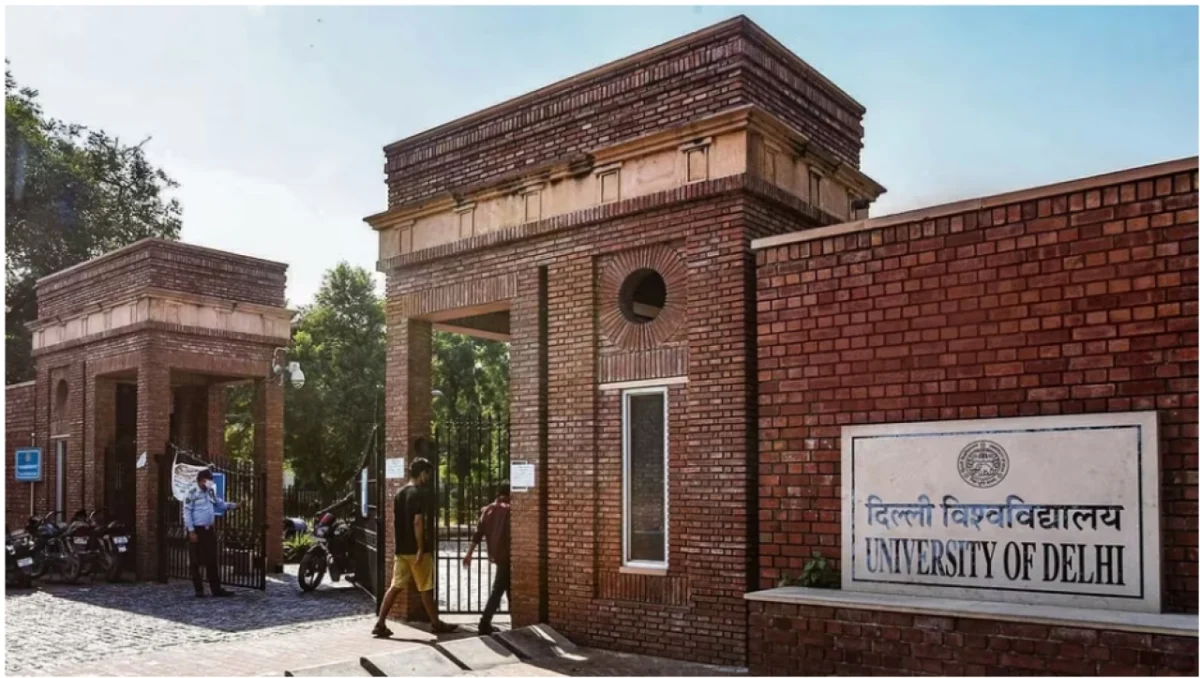
New Delhi, India – The Delhi University Students’ Union (DUSU), a body that now commands national attention during its annual elections, began its journey in the nascent days of independent India with a modest proposal and a mere Rs 150 grant. Its evolution over nearly eight decades mirrors the dynamic and often contentious landscape of student politics in one of India’s premier educational institutions. From a fledgling union grappling with financial instability to a powerful platform that influences campus discourse and beyond, DUSU’s story is a testament to the enduring significance of student representation.
The Genesis of a Student Voice: A Pre-Independence Vision
The roots of DUSU can be traced back to the immediate pre-independence era. On August 6, 1947, just weeks before India unfurled its tricolor as a sovereign nation, the Vice-Chancellor of Delhi University informed the Executive Council of a growing sentiment among students to establish a formal representative body. This proposal, born out of a desire for a unified student voice, was met with principle approval. The university administration, acknowledging the need for a structured approach, mooted the formation of a committee tasked with drafting the union’s constitution and operational procedures. Crucially, a preliminary grant of Rs 150 was earmarked for the initial expenses of this nascent organization, a sum that seems almost symbolic in today’s context but represented a tangible commitment to student empowerment at the time. This initial seed, planted in the fertile ground of a newly independent nation’s aspirations, would blossom into a formidable institution shaping the lives of countless students.
Navigating Early Storms: Financial Woes and Structural Adjustments
The early years of DUSU were far from smooth sailing, particularly concerning its financial viability. The union, like many nascent organizations, faced the perennial challenge of securing adequate funding. Records from March 27, 1953, reveal the Executive Committee deliberating on a request for financial assistance from the University Students’ Union. While the university acknowledged its previous support, having already disbursed Rs 500 to the union that year, it emphasized the imperative for DUSU to strive towards financial self-sufficiency.
This financial precariousness persisted. By March 14, 1954, the fiscal disparity had become starkly evident. Union records indicated expenditures of Rs 1,995 against an income of a mere Rs 815. This significant deficit underscored the urgent need for a more robust financial framework. Coincidentally, these records also marked a significant milestone: the union had adopted a constitution and, for the first time, conducted elections for its office-bearers. To manage the interim period until the subsequent academic year, a caretaker committee was proposed, alongside strictures on further spending. A grant of up to Rs 1,100 was also suggested to cover accrued expenses, contingent upon the meticulous approval of all submitted bills. These early financial struggles, however, did not deter the spirit of student representation, forcing the union to innovate and adapt.
)
A Framework for Governance: The 1973 Constitutional Overhaul
Nearly two decades later, the organizational structure and governance of DUSU underwent a significant transformation. On August 2, 1973, the Executive Council considered a pivotal proposal to abolish the existing constitution and introduce a new, interim framework for the union. This move was aimed at injecting greater discipline and clarity into DUSU’s operations.
The revised constitutional structure brought about crucial financial controls. Under the new provisions, any expenditure exceeding Rs 100 required explicit approval from the union’s Executive Committee, a measure designed to curb unbridled spending and promote fiscal accountability. Beyond financial management, the new framework meticulously defined administrative roles. The Vice-Chancellor of Delhi University was officially designated as the union’s patron, a role that conferred a degree of oversight and guidance. Furthermore, the constitution stipulated the appointment of a staff advisor and a treasurer, to be selected from the university’s esteemed teaching faculty and by the patron respectively.

The cornerstone of the 1973 constitution was the establishment of four key elected office-bearers: President, Vice-President, Secretary, and Assistant Secretary. These positions were to be filled through direct elections by the DUSU members, reinforcing the democratic mandate of the union. This constitutional overhaul marked a significant step towards professionalizing DUSU’s functioning and solidifying its role as a legitimate representative body within the university ecosystem.
The Pillars of Power: Understanding Key DUSU Posts
The democratic machinery of DUSU revolves around four central elected positions that form the executive core of the union: President, Vice-President, Secretary, and Joint Secretary. Each role carries distinct responsibilities that are crucial for the effective functioning of the student body.
)
The President serves as the primary spokesperson and public face of DUSU. This individual represents the union in all official capacities, articulating student concerns and advocating for their rights before university authorities, government bodies, and the wider public. The President’s leadership is pivotal in setting the agenda for the union and steering its various initiatives.
The Vice-President acts as the President’s principal deputy. In the absence of the President, whether due to illness, travel, or other unforeseen circumstances, the Vice-President assumes the full duties and responsibilities of the presidential office, ensuring continuity in leadership and operations.
)
The Secretary is entrusted with the critical task of managing the union’s day-to-day administrative affairs. This involves overseeing official correspondence, maintaining records, coordinating meetings, and ensuring the smooth execution of the union’s operational mandates. The Secretary’s role is indispensable for the organizational backbone of DUSU.
The Joint Secretary, in the current structure, plays a vital role in supporting the Secretary and the wider executive team. Their responsibilities typically encompass communication strategies, event management, and actively engaging with students to address their grievances and concerns. This role ensures that the union remains responsive and accessible to its constituents.
)
Beyond these elected posts, the current DUSU constitution formally enshrines the Vice-Chancellor of Delhi University as the Patron. This role signifies the university administration’s overarching interest and support for the student union. The constitution also clearly articulates DUSU’s core objectives. These include effectively representing the collective interests of students before various university authorities, actively promoting student welfare in all its facets, and fostering a vibrant and inclusive campus environment conducive to academic and personal growth.
A Modest Fee for a Mighty Voice: The Evolution of DUSU Membership Costs
The financial accessibility of DUSU membership has been a consistent feature, with subscription fees remaining remarkably low for decades. This approach has ensured that a broad spectrum of students can become members and participate in the union’s activities.
)
Until the academic year 2012-13, students were required to pay a nominal fee of Rs 5 to become DUSU members. This modest amount facilitated widespread participation and underscored the union’s commitment to inclusivity. Recognizing the need for slight adjustments to keep pace with evolving operational costs, the fee was increased to Rs 20 in the 2013-14 academic year. More recently, in a decision reflecting contemporary economic realities and the increasing scope of DUSU’s activities, the subscription fee was further raised to Rs 40 on June 21, 2024, as reported by university officials. While the fee has seen an increase, it remains a highly affordable sum, ensuring that financial constraints do not impede a student’s right to representation and engagement with their student union.
The Spectacle of Democracy: DUSU Elections as a National Event
Over the decades, DUSU elections have transcended the confines of the Delhi University campus to become a significant event in the broader political and social landscape of India. What began as a simple administrative process has transformed into a fiercely contested battleground for student political ideologies, often mirroring national political narratives.
)
Traditionally, DUSU elections witness the active participation of student organizations with established links to major national political parties. Prominent among these are the Akhil Bharatiya Vidyarthi Parishad (ABVP), affiliated with the Rashtriya Swayamsevak Sangh (RSS), and the National Students’ Union of India (NSUI), the student wing of the Indian National Congress. Alongside these, Left-backed student groups, such as the All India Students’ Association (AISA) and the Students’ Federation of India (SFI), also form significant alliances and field candidates. The presence of independent candidates adds another layer of dynamism to the electoral contest.
The 2026 DUSU election exemplified this intense competition, with candidates vying for the four central posts. The ABVP, NSUI, and an alliance between AISA and SFI emerged as the principal contenders, engaging in a spirited campaign that captured the attention of students and political observers alike. Voting for the election took place on September 18, with the counting of ballots commencing at 8 am on September 19 at the Multipurpose Hall of the University Sports Stadium in North Campus. The election recorded a voter turnout of 40.46%, indicating a substantial engagement from the student electorate despite the complexities of campus politics.
)
The Issues That Resonate: Key Themes in the 2026 DUSU Election
The electoral discourse surrounding the 2026 DUSU elections was shaped by a spectrum of critical issues that directly impact the lives of Delhi University students. Paramount among these were student safety, the availability of affordable accommodation, and the enhancement of essential campus facilities. These concerns resonated deeply with the student community, forming the bedrock of campaign manifestos and student demands.
The tragic collapse of a five-storey building housing a boys’ Paying Guest (PG) accommodation in Satya Niketan, South Delhi, which resulted in the loss of seven lives, including students, cast a long shadow over the election campaign. This devastating incident brought the critical issues of student housing safety and overall student security into sharp focus, amplifying calls for stricter regulations and better enforcement. Candidates and student groups actively addressed the need for safer living conditions, improved infrastructure in student housing, and more robust safety protocols within and around the university.
)
Beyond accommodation and safety, other pressing issues that dominated the campaign trail included improvements in public transportation accessibility for students, the upgrade and expansion of campus infrastructure, and the enhancement of overall campus security measures. The candidates pledged to address these concerns through various initiatives, promising to be vocal advocates for student welfare and to work towards creating a more secure, comfortable, and conducive learning environment.
The Contenders: Who Vied for Power in the 2026 DUSU Election?
The 2026 DUSU elections saw a robust field of candidates representing the major student political outfits. Each party nominated candidates for the four key positions, aiming to secure a decisive mandate from the student electorate.
)
The Akhil Bharatiya Vidyarthi Parishad (ABVP) fielded Yash Dabas for the post of President, Ishu Maurya for Vice-President, Riya Chhawadi for Secretary, and Lakshya Raj Singh for Joint Secretary. The ABVP, known for its nationalist ideology, presented its candidates with a platform focused on student development and nationalistic values.
The National Students’ Union of India (NSUI) nominated Vijay Shankar Meena for President, Vir Chatrath for Vice-President, Namrata Chaudhary for Secretary, and Gopal Choudhary for Joint Secretary. The NSUI, drawing from the legacy of the Congress party, emphasized issues of social justice, inclusivity, and student empowerment.
)
The AISA-SFI alliance, representing a collective of Left-leaning student organizations, put forth Ananya Raturi for President, Akshat Shikhar for Vice-President, Stanzin Deskyong for Secretary, and B Parijaat for Joint Secretary. This alliance typically champions issues related to social equity, secularism, and critical pedagogy.
As the counting of votes progressed on September 19, the leads in the four races saw frequent shifts, underscoring the highly competitive and closely watched nature of the 2026 DUSU election. This dynamic contest highlighted the diverse political currents within the student community and the intense efforts of each group to emerge victorious.
)
A Legacy of Transformation: DUSU’s Enduring Impact
The journey of DUSU, from a tentative proposal for a student union with a Rs 150 grant in 1947 to its current status as a nationally significant electoral event, is a profound narrative of evolution. Over nearly eight decades, student representation at Delhi University has undergone a remarkable metamorphosis. What began as a basic aspiration for a unified voice has blossomed into a complex, structured, and democratically elected body.
DUSU now boasts multiple office-bearers, a formal constitution that governs its operations, and a representative reach that spans across the diverse colleges and faculties of Delhi University. Today, the DUSU elections command attention far beyond the university’s geographical boundaries. Student organizations leverage this platform not merely for internal campus politics but as a crucial forum to articulate and amplify critical issues concerning the quality of education, the safety and security of students, the availability of affordable housing, and the broader spectrum of student rights. The enduring legacy of DUSU lies in its continuous adaptation and its unwavering commitment to being the voice of the student community.
