

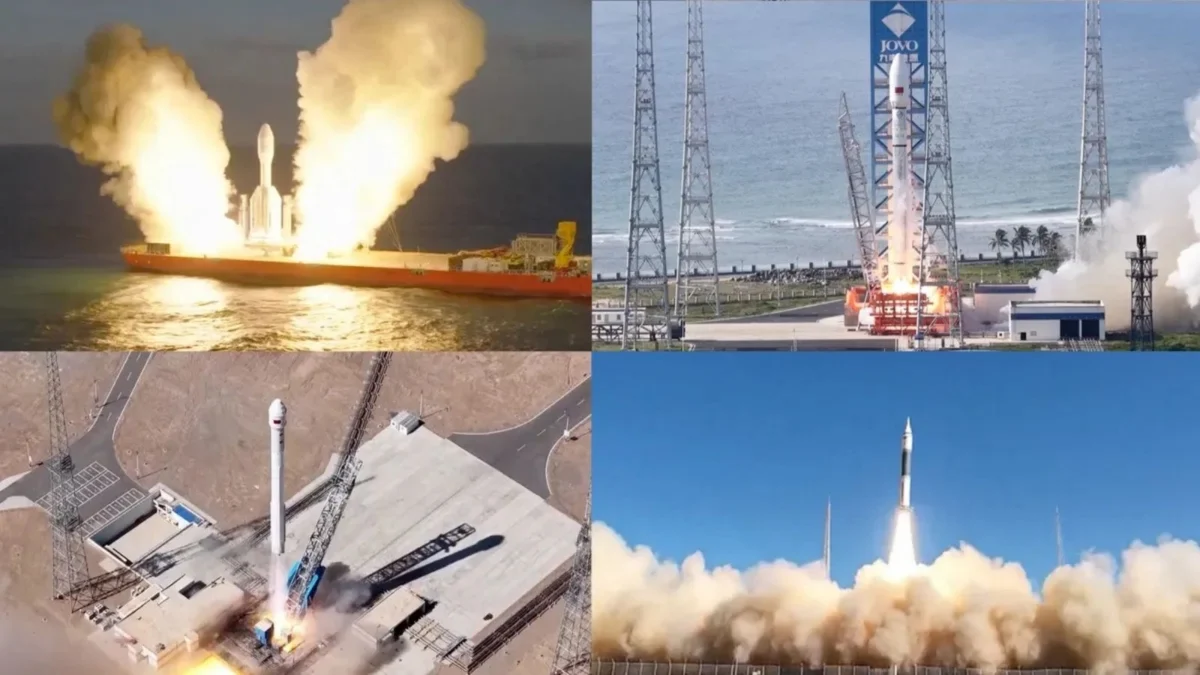
BEIJING – In a display of logistical prowess and industrial scaling that has sent ripples through the global aerospace community, China successfully executed four distinct orbital launches from three different spaceports within a span of just 45 hours. Between September 15 and 16, 2026, the Chinese space sector—comprising a sophisticated mix of state-owned giants and aggressive private "New Space" firms—deployed a total of 32 satellites, reinforcing Beijing’s commitment to building massive low-Earth orbit (LEO) broadband constellations and enhancing its Earth observation capabilities.
The rapid-fire sequence of launches underscores a pivotal shift in China’s space strategy: a transition from sporadic, high-profile scientific missions to a high-cadence, industrialized launch model designed to rival, and perhaps eventually surpass, the operational tempo of Western entities like SpaceX.
The 45-Hour Chronology: A Symphony of Solid and Liquid Propulsion
The mission sequence began in the arid stretches of northwest China and concluded on the tropical shores of Hainan Island, involving four different rocket architectures.
September 15, 02:26 AM EDT: The Methane Pioneer
The marathon commenced at the Jiuquan Satellite Launch Center with the lift-off of the Zhuque-2E, operated by the private firm LandSpace. The Zhuque-2 series holds a place in history as the world’s first methane-liquid oxygen (methalox) rocket to reach orbit. For this mission, the "E" variant carried 10 satellites for the Qianfan (Thousand Sails) constellation. The use of methalox is significant; it is cleaner, more efficient, and more conducive to engine reusability than traditional kerosene-based fuels, aligning China’s private sector with the technological trends seen in SpaceX’s Starship and Blue Origin’s New Glenn.
September 15, 06:00 PM EDT: The Maritime Strike
Less than 16 hours later, the focus shifted to the Yellow Sea, off the coast of Shanghai. Orienspace, another private heavyweight, utilized a mobile sea-based platform to launch its Gravity-1 rocket. Distinguished by its "short and stout" silhouette and powerful solid-fuel boosters, Gravity-1 is currently the world’s most powerful solid-propellant orbital launch vehicle. It successfully delivered an additional nine Qianfan satellites into LEO. Sea launches offer China greater flexibility in launch azimuths and minimize the risk of spent stages falling on populated inland areas.
September 16, 08:32 PM EDT: The State Giant Steps In
As the clock ticked into the second day, the state-owned China Aerospace Science and Technology Corporation (CASC) took center stage at the Wenchang Space Launch Site. The Long March 12, a relatively new addition to the venerable Long March family, roared into the night sky. Its payload consisted of nine spacecraft for SatNet, the central government’s primary LEO broadband megaconstellation. Unlike the private Qianfan project, SatNet is a direct state initiative, often referred to as the "National Team" of Chinese satellite internet.
September 16, 10:40 PM EDT: Closing the Loop
The 45-hour window closed back at Jiuquan. A Kuaizhou-11 rocket, operated by ExPace (a subsidiary of the state-run China Aerospace Science and Industry Corporation, CASIC), launched two high-resolution Earth-observing radar satellites for Spacety. The Kuaizhou-11 is a solid-fueled workhorse designed for rapid response and low-cost deployment, proving that China can maintain a high tempo even for specialized radar imaging missions.
Supporting Data: The Rise of the Megaconstellations
The primary driver behind this sudden surge in launch frequency is the "Megaconstellation Race." China has filed plans with the International Telecommunication Union (ITU) for tens of thousands of satellites, divided primarily into two competing yet complementary projects:
- Qianfan (Thousand Sails / G60): Led by the Shanghai Spacecom Satellite Technology (SSST) with support from the Shanghai municipal government. This project aims for an initial layer of 1,296 satellites, eventually scaling to over 15,000. The 19 satellites launched by LandSpace and Orienspace during this 45-hour window represent a critical acceleration in the deployment phase of this network.
- SatNet (Guowang): Managed by the China Satellite Network Group, this state-level project envisions a constellation of roughly 13,000 satellites. The Long March 12 mission was a key step in populating the orbital planes required for global coverage.
Launch Vehicle Comparison (Sept 15-16 Missions)
| Rocket | Operator | Fuel Type | Primary Payload | Launch Site |
|---|---|---|---|---|
| Zhuque-2E | LandSpace (Private) | Methalox | 10x Qianfan | Jiuquan (Land) |
| Gravity-1 | Orienspace (Private) | Solid | 9x Qianfan | Shanghai (Sea) |
| Long March 12 | CASC (State) | Liquid | 9x SatNet | Wenchang (Land) |
| Kuaizhou-11 | CASIC (State) | Solid | 2x Radar (Spacety) | Jiuquan (Land) |
Official Responses and Strategic Positioning
While official statements from the China National Space Administration (CNSA) remained characteristically focused on the technical success of the missions, internal industry commentary highlights a broader strategic narrative.
A spokesperson for CASC noted that the success of the Long March 12 demonstrates the "maturation of China’s medium-lift capabilities," specifically tailored for the "industrialized production and deployment of satellite internet infrastructure."
Meanwhile, leaders in the private sector have been more vocal about the competitive landscape. A representative from LandSpace suggested that the ability to launch within hours of a state mission proves that "the commercial sector is no longer just a supplement to the national program, but a primary engine of China’s orbital capacity."
International observers, including analysts from the Union of Concerned Scientists and various Western defense agencies, view this surge as a clear signal. "China is demonstrating that it has the ground infrastructure and the rocket diversity to sustain a Starlink-like deployment pace," said one orbital mechanics expert. "To launch from three different sites using four different rocket types in under two days requires a level of logistical coordination that few nations have ever achieved."
Implications: The Road to Reusability and Global Influence
The 45-hour blitz carries several long-term implications for the global space economy and geopolitical stability.
1. The Infrastructure of Reusability
While none of the four rockets in this sequence attempted a vertical landing, the missions served as "stress tests" for the ground crews and tracking networks. China is currently in a transitional phase. Just months prior to this sequence, the Zhuque-3 (LandSpace) and the Long March 10B (CASC) performed successful vertical takeoff and vertical landing (VTVL) tests. The high cadence observed on Sept 15-16 is the "practice run" for a future where reusable boosters return to these sites every few days.
2. Contesting the Low-Earth Orbit
By deploying nearly 30 broadband satellites in two days, China is asserting its right to orbital real estate. As LEO becomes increasingly crowded with SpaceX’s Starlink and Amazon’s Project Kuiper, China is racing to secure its own frequency bands and orbital slots. This is not merely a commercial endeavor; broadband constellations are vital for modern military communications, autonomous drone operations, and maintaining "internet sovereignty."
3. The Commercial-State Synergy
The mix of rockets used—methalox, solid-fuel, and traditional liquid—shows that China is not betting on a single technology. The state handles the heavy-lift and national security payloads, while the private sector (LandSpace, Orienspace) provides the flexibility and cost-reduction needed for mass satellite deployment. This "dual-track" system allows China to absorb the risks of innovation in the private sector while maintaining the reliability of the state-run Long March fleet.
4. Global South Connectivity
The Qianfan and SatNet projects are not intended solely for domestic use. China’s "Digital Silk Road" initiative seeks to provide satellite internet to developing nations across Africa, Southeast Asia, and Latin America. By proving it can launch these networks at a breakneck pace, Beijing is positioning itself as a viable alternative to Western telecommunications providers, potentially gaining significant soft power and data influence globally.
Conclusion: A New Standard for Cadence
The 45 hours between September 15 and 16, 2026, will likely be remembered as the moment China’s space program shifted into high gear. It was a demonstration of variety, volume, and velocity. While the world’s eyes are often on the Moon and Mars, the real battle for space dominance is being fought in the rapid-fire deployment of LEO constellations.
China’s ability to coordinate multiple launch sites, involve both private and state actors, and utilize diverse propulsion technologies suggests that the "Great Space Race" of the 21st century is no longer a sprint or a marathon—it is a high-volume assembly line, and Beijing has just proven its factory is fully operational. As the Qianfan and SatNet constellations grow, the frequency of these "launch clusters" is expected to increase, making the once-extraordinary feat of four launches in two days a routine part of the new orbital economy.
