

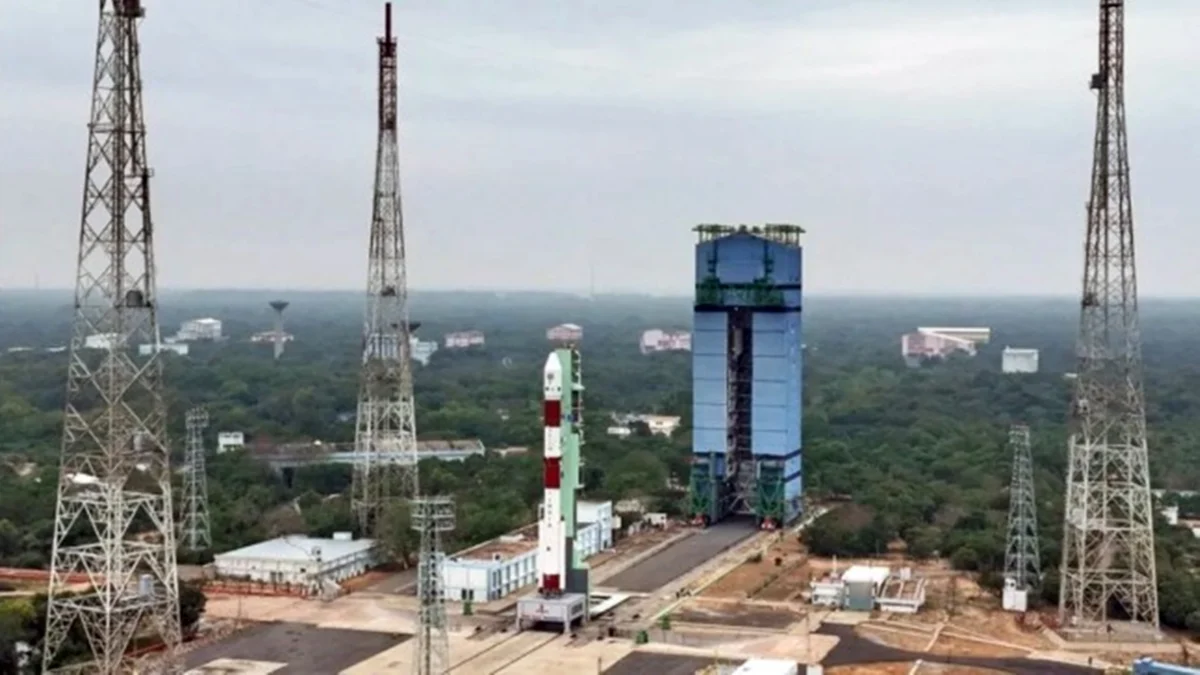
SRIHARIKOTA – The silence that has permeated the Satish Dhawan Space Centre (SDSC) for the better part of 2026 is poised to be broken. After a grueling seven-month operational hiatus—the result of a string of technical setbacks that have tested the resilience of India’s premier space agency—the Indian Space Research Organisation (ISRO) has announced its return to flight.
The upcoming launch of the Geo Imaging Satellite-1A (GISAT-1A), recently redesignated as EOS-05, is scheduled for the first week of September 2026. This mission is not merely a routine deployment; it is a critical "recovery" flight intended to restore confidence in India’s heavy-lift capabilities and provide the nation with a much-needed "eye in the sky" for real-time monitoring of the Indian subcontinent.
Main Facts: The September Resurgence
The GISAT-1A mission represents a pivotal moment for ISRO Chairman Dr. S. Somanath and his team of scientists. The satellite, which has been stationed at the Sriharikota spaceport for several months, is part of a backlog of missions that were stalled following the failure of the PSLV-C62/EOS-N1 mission in January 2026.
The Mission Profile
GISAT-1A is a state-of-the-art Earth Observation Satellite (EOS) designed to operate from a Geostationary Orbit (GEO). Unlike traditional remote sensing satellites that orbit the Earth in a Sun-synchronous Polar Orbit (SSPO) and only pass over a specific location at fixed intervals, GISAT-1A will remain "parked" over the Indian landmass. This allows for near-real-time imaging, a capability that is transformative for disaster management, agricultural monitoring, and national security.
The Launch Vehicle
While ISRO has not officially confirmed the specific configuration of the GSLV (Geosynchronous Satellite Launch Vehicle) for this mission, internal sources suggest a heavily vetted GSLV-Mk II will be employed. The focus remains on the cryogenic upper stage (CUS), which has historically been the "Achilles’ heel" of the GSLV program and was the primary cause of the original GISAT-1 failure in 2021.
Chronology: A Turbulent Two Years for ISRO
To understand the weight of the upcoming September launch, one must look at the timeline of events that led to the current hiatus. The period of 2025-2026 has been one of the most volatile in ISRO’s recent history, characterized by high-stakes missions and unforeseen technical "anomalies."
1. The 2021 Precursor (The GISAT-1 Failure)
The saga began in August 2021, when the original GISAT-1 mission failed. The GSLV-F10 rocket performed nominally through the first and second stages, but the cryogenic upper stage failed to ignite due to a pressure drop in the liquid hydrogen tank. This left a gap in India’s strategic observation capabilities that the upcoming GISAT-1A is specifically designed to fill.
2. The 2025 "Mixed Bag"
In 2025, ISRO attempted six major launches. While three were successful, including a high-profile commercial launch for NewSpace India Limited (NSIL), three others encountered significant issues. These failures were attributed to various factors, ranging from sensor malfunctions in the spacecraft to "non-nominal" performance of the launch vehicle engines.
3. The January 2026 Debacle (PSLV-C62)
The final blow came in January 2026. The PSLV-C62 mission, carrying the EOS-N1 satellite, failed shortly after liftoff. The Polar Satellite Launch Vehicle (PSLV), long considered ISRO’s "workhorse" with an enviable success rate, suffered a rare structural or propulsion anomaly in its second stage. This failure prompted ISRO leadership to implement a "tactical pause" to conduct a comprehensive audit of all flight systems.
4. The Seven-Month Hiatus
From February to August 2026, launch activity at Sriharikota ceased. During this time, ISRO focused on:
- Root Cause Analysis (RCA) of the PSLV-C62 failure.
- Rigorous re-testing of the NVS-03 (Navigation Satellite) and GISAT-1A payloads.
- Recalibration of quality control protocols across its various centers, including the Vikram Sarabhai Space Centre (VSSC) and the Liquid Propulsion Systems Centre (LPSC).
Supporting Data: Technical Specifications and Strategic Value
The GISAT-1A is more than just a replacement; it is an upgraded version of its predecessor, featuring enhanced spectral resolution and faster data transmission capabilities.
| Feature | Specification |
|---|---|
| Satellite Mass | Approx. 2,268 kg |
| Orbit Type | Geostationary (GEO) |
| Operational Life | 10+ Years |
| Imaging Payloads | Multi-spectral, Hyperspectral, and Panchromatic |
| Spatial Resolution | 50m to 1.5km (depending on mode) |
| Temporal Resolution | Near real-time (every 5 to 30 minutes) |
The "Nomenclature" Shift
Under the new naming convention adopted in late 2024, ISRO has moved away from thematic names (like GISAT, Cartosat, or Risat) in favor of a generic "EOS" (Earth Observation Satellite) series. GISAT-1A is officially designated as EOS-05. This shift is intended to streamline the satellite catalog and align with international standards for remote sensing missions.
The Role of NVS-03
While GISAT-1A is the immediate priority, the NVS-03 satellite—part of India’s indigenous GPS equivalent, NavIC (Navigation with Indian Constellation)—also remains in the pipeline. The successful launch of GISAT-1A in September will likely clear the way for NVS-03 to be launched by late October or November 2026, ensuring that India’s regional navigation system remains robust.
Official Responses: Quality Control and Accountability
In the wake of the January failure, the Indian government and ISRO leadership have been under pressure to explain the drop in mission reliability.
Statement from the Department of Space
A senior official from the Department of Space, speaking on condition of anonymity, stated: "The hiatus was a deliberate choice. We are moving from a phase of ‘rapid expansion’ to ‘validated stability.’ The anomalies encountered in 2025 and early 2026 were a wake-up call. We have used these seven months to tighten the screws on our supply chain and manufacturing processes."
The Failure Analysis Committee (FAC) Findings
While the full report on the PSLV-C62 failure remains classified, ISRO has hinted that the "anomaly" was related to a sub-component sourced from a private domestic vendor that did not meet the stringent thermal tolerances required during high-velocity ascent. As a result, ISRO has reportedly overhauled its vendor qualification program.
Dr. S. Somanath, in a recent internal briefing, emphasized that "Space is unforgiving. A single bolt or a minor software glitch can negate years of labor. Our return to flight with GISAT-1A will demonstrate that we have learned from our setbacks and that our systems are now more redundant and resilient than ever."
Implications: Security, Economy, and Global Standing
The success of the GISAT-1A launch carries profound implications for India on multiple fronts.
1. National Security and Border Monitoring
With ongoing tensions along the Line of Actual Control (LAC) and the Line of Control (LoC), the Indian military has expressed an urgent need for persistent surveillance. GISAT-1A’s ability to provide high-resolution images of the same geographic area at frequent intervals is a "force multiplier." It allows security agencies to monitor troop movements, infrastructure development, and potential incursions in real-time, rather than waiting for the next satellite pass.
2. Disaster Management and Agriculture
India is highly susceptible to cyclones, floods, and forest fires. GISAT-1A will allow the Indian Meteorological Department (IMD) and disaster response teams to track the evolution of natural disasters as they happen. Furthermore, the hyperspectral imaging capabilities will assist the Ministry of Agriculture in assessing crop health and soil moisture levels across the country, aiding in food security planning.
3. Commercial Viability and NSIL
The recent failures have cast a shadow over NewSpace India Limited’s (NSIL) efforts to capture a larger share of the global commercial launch market. International clients seek reliability. A successful GISAT-1A mission is essential to reassure global satellite operators that ISRO’s launch vehicles—both the PSLV and the GSLV—remain viable and cost-effective alternatives to SpaceX’s Falcon 9 or the European Ariane 6.
4. The Path to Gaganyaan
Perhaps most importantly, the GISAT-1A mission is a litmus test for the GSLV platform, which is a precursor to the Human-Rated LVM3 (Launch Vehicle Mark 3) used for the Gaganyaan manned space mission. Any further failures in the GSLV/LVM3 family could potentially delay India’s ambitions to send astronauts into orbit, a milestone currently targeted for the 2027-2028 timeframe.
Conclusion: A New Chapter at Sriharikota
As the countdown for the first week of September begins, the eyes of the global space community are on the small island of Sriharikota. The GISAT-1A (EOS-05) mission is more than just a satellite launch; it is a declaration of intent.
After seven months of introspection, rigorous testing, and engineering recalibration, ISRO is ready to prove that its "operational hiatus" was not a sign of stagnation, but a necessary period of refinement. If GISAT-1A reaches its intended geostationary slot successfully, it will signal the beginning of a new, more cautious, yet technologically superior era for the Indian space program—one where the "eye in the sky" finally opens to its full potential.
