

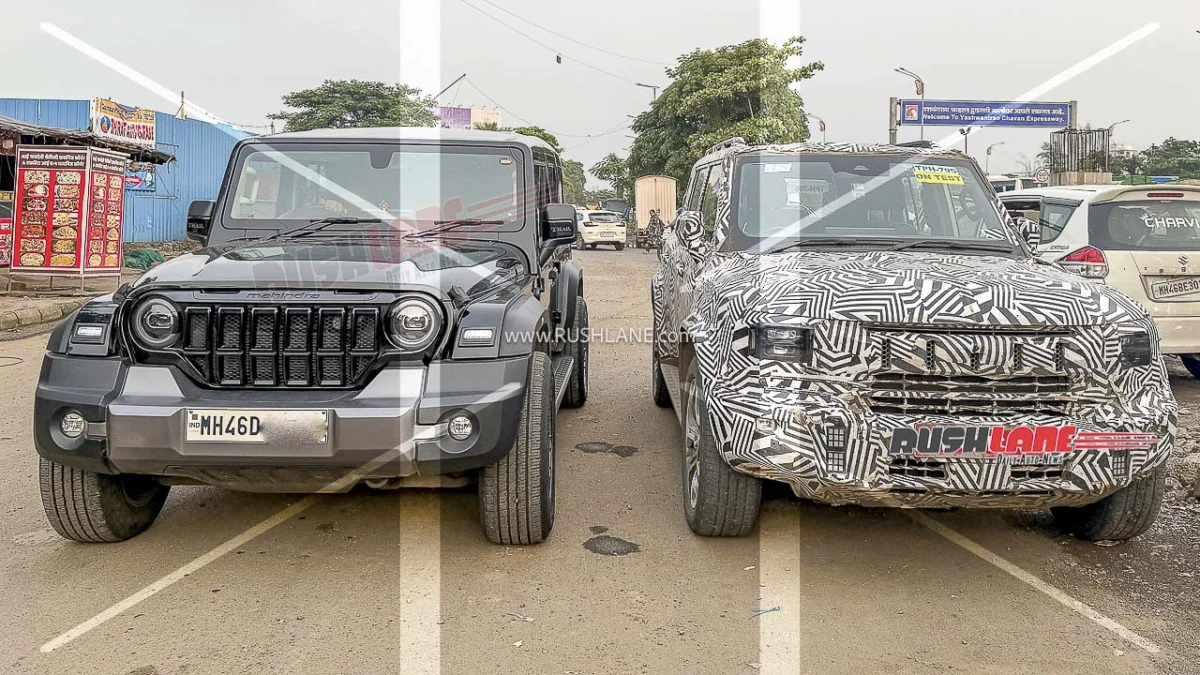
The Indian automotive landscape is currently witnessing a tectonic shift in the lifestyle SUV segment. For years, this niche was dominated by a handful of players, but the entry of aggressive new contenders is redrawing the competitive map. In a recent development that has sent ripples through the industry, a test mule of JSW Motors’ upcoming flagship SUV—widely expected to be christened the JSW Combat—was spotted testing on public roads.
What makes this sighting particularly significant is the context: the vehicle was photographed parked directly alongside a Mahindra Thar Roxx. This serendipitous encounter, captured by enthusiast Rohit Patil, provides the first real-world visual benchmark for the Combat, offering a side-by-side comparison of its proportions, road presence, and design philosophy against the current segment leader.
Main Facts: A New Challenger Emerges
The JSW Combat is not merely a new SUV; it represents the JSW Group’s ambitious foray into the passenger vehicle market under its own branding, leveraging global partnerships to bring high-tech, rugged mobility to India. Based on the Jetour T2 (a sub-brand of the Chinese giant Chery), the Combat is being localized to suit Indian tastes and regulatory requirements.
Visual Comparison and Design Language
The spy shots reveal two vehicles that share a "boxy" DNA but diverge significantly in execution. Both the Thar Roxx and the JSW Combat feature the classic hallmarks of an off-roader: upright windscreens, flat rooflines, pronounced wheel arches, and a tailgate-mounted spare wheel. However, the Combat exudes a more "techno-rugged" aesthetic compared to the Roxx’s "neo-retro" Jeep-inspired look.
The JSW test mule features a broad, flat bonnet that lends it a muscular, planted stance. While the Thar Roxx utilizes circular LED headlamps to maintain its heritage connection, the Combat opts for modern, rectangular headlamp housings. Even under heavy camouflage, the JSW vehicle’s grille appears wider, suggesting a more imposing front-end width.
At the rear, the differences are even more pronounced. The Thar Roxx keeps its spare wheel exposed, emphasizing a raw, utilitarian vibe. In contrast, the JSW Combat test mule features a sophisticated, enclosed spare-wheel cover. The vertical tail-lamp clusters on the Combat appear more integrated into the bodywork, hinting at a premium finish aimed at urban buyers who desire off-road capability without sacrificing sophistication.

The ADAS and Safety Factor
A critical detail captured in the latest photographs is a yellow warning sticker on the rear spare-wheel cover that reads: “Caution: Auto Brake — Keep Safe Distance.” This confirms that JSW is rigorously testing Advanced Driver Assistance Systems (ADAS). While the Thar Roxx also offers Level 2 ADAS, JSW appears to be focusing heavily on the calibration of its autonomous emergency braking (AEB) systems for Indian traffic conditions—a move that aligns with the global Jetour T2’s reputation for high-tech safety suites.
Chronology: The Road to the Festive Launch
The journey of the JSW Combat from a concept to a road-ready test mule has been rapid, reflecting the JSW Group’s "warp speed" approach to the automotive sector.
- Early 2024: The Strategic Pivot: Following JSW’s joint venture with SAIC (MG Motor India), reports began to surface that the Sajjan Jindal-led group was looking to introduce more brands under its umbrella to diversify its portfolio.
- Mid-2024: The Jetour Connection: Rumors were confirmed when test mules of the Jetour T2 were spotted in various parts of India. It became clear that JSW would use this platform for its first independent SUV offering.
- August 2024: The "Combat" Trademark: While not officially confirmed, the "Combat" name surfaced in trademark filings, perfectly capturing the vehicle’s rugged, military-inspired design language.
- September 2024: Real-world Benchmarking: The recent sighting alongside the Thar Roxx indicates that the vehicle is in its final stages of testing, where engineers compare "perceived road presence" and "stance" against primary rivals.
- October 2024 (Expected): The Official Unveil: Industry insiders suggest a launch or major reveal is scheduled for next month, timed to capitalize on the peak festive season demand in India.
Supporting Data: Dimensions and Powertrain
To understand where the JSW Combat fits in the hierarchy, one must look at the specifications of the overseas Jetour T2, which serves as the Combat’s mechanical twin.
Dimensional Comparison
| Feature | JSW Combat (Jetour T2 Ref.) | Mahindra Thar Roxx | Difference |
|---|---|---|---|
| Length | 4,785 mm | 4,428 mm | Combat is +357 mm |
| Width | 2,006 mm | 1,870 mm | Combat is +136 mm |
| Height | 1,870 mm | 1,923 mm | Roxx is +53 mm |
| Wheelbase | 2,800 mm | 2,850 mm | Roxx is +50 mm |
While the JSW Combat is significantly longer and wider—giving it a "big car" feel that Indian buyers covet—the Thar Roxx actually boasts a slightly longer wheelbase. This suggests that while the Combat may have more shoulder room and a larger boot, the Roxx might offer comparable or slightly better legroom for rear passengers. The Combat’s lower height combined with its massive width gives it a squatter, more aggressive "bulldog" stance compared to the tall, lanky profile of the Thar.
The Powertrain Disruptor: Plug-in Hybrid (PHEV)
Perhaps the most significant "data point" regarding the Combat is its expected powertrain. Unlike the Thar Roxx, which relies on traditional 2.0L Turbo Petrol and 2.2L Diesel engines, the JSW Combat is expected to feature a Plug-in Hybrid (PHEV) system.
The global i-DM (Intelligent Dual Drive Hybrid) system combines a 1.5-liter turbocharged petrol engine with an electric motor and a dedicated battery pack. This setup could offer:

- Pure EV Range: Potential for 80-100 km of electric-only driving, ideal for city commutes.
- Combined Range: Over 1,000 km on a full tank and full charge.
- Performance: Combined torque figures that could eclipse the Thar Roxx’s diesel variants.
Official Responses and Corporate Context
While JSW Motors has maintained a level of strategic silence regarding the specific "Combat" branding, their corporate actions speak volumes.
Manufacturing Strategy:
JSW has confirmed that initial production will be handled via local assembly (CKD – Completely Knocked Down units) at their facility in Chhatrapati Sambhajinagar (formerly Aurangabad), Maharashtra. This allows them to maintain high quality while gradually increasing localization to bring down costs.
Market Positioning:
A JSW spokesperson (in previous general briefings) has emphasized the group’s commitment to "Green Mobility." By introducing a PHEV in a segment dominated by diesels, JSW is positioning the Combat as a socially responsible yet uncompromising off-roader.
Pricing Expectations:
Though no official price list exists, analysts expect the JSW Combat to be positioned in the Rs 28 lakh to Rs 35 lakh (ex-showroom) bracket. This places it slightly above the Thar Roxx and the Force Gurkha 5-door, but well below luxury imports like the Land Rover Defender, which it visually mimics.
Implications: A New Era for the Indian SUV Market
The arrival of the JSW Combat has several far-reaching implications for the Indian automotive industry:
1. The Challenge to the "Diesel Hegemony"
The lifestyle SUV segment has long been the fortress of diesel engines due to their high torque and efficiency. By introducing a PHEV, JSW is testing whether Indian buyers are ready to swap the "thrum" of a diesel for the "silent surge" of an electric motor, backed by the safety net of a petrol engine. If successful, it could force Mahindra and Tata to accelerate their own hybrid or EV off-roader programs.

2. The Democratization of Luxury Design
For many, the JSW Combat is a "mini-Defender." By offering world-class design aesthetics at a fraction of the price of European luxury SUVs, JSW is tapping into the aspirational nature of the Indian middle class. The "road presence" factor, as evidenced by the spy shots, is a primary selling point in this demographic.
3. A Stress Test for New Entrants
JSW is a titan in steel and energy, but the passenger vehicle market is a different beast, requiring vast service networks and deep customer trust. The launch of the Combat will be a litmus test for JSW’s ability to build a brand from scratch in a hyper-competitive market.
4. The "Feature War"
With the Combat likely bringing 360-degree cameras, ventilated seats, premium sound systems, and advanced ADAS (as hinted by the "Auto Brake" sticker), the "utilitarian" off-roader is officially dead. The Combat and the Thar Roxx are proving that today’s off-roaders must be as comfortable and tech-laden as a luxury sedan.
Conclusion
The sighting of the JSW Combat alongside the Mahindra Thar Roxx is more than just a lucky photograph; it is a preview of the "SUV War" of 2025. On one side stands the Thar Roxx, a vehicle with deep roots in Indian culture and a proven mechanical pedigree. On the other stands the JSW Combat, a high-tech, wide-bodied challenger looking to disrupt the status quo with hybrid technology and modern flair.
As the festive season approaches, the Indian consumer is the ultimate winner, with more choices, better technology, and bolder designs than ever before. Whether the "Combat" can truly win the battle against the "Roxx" remains to be seen, but one thing is certain: the road ahead for Indian SUVs looks incredibly exciting.
