

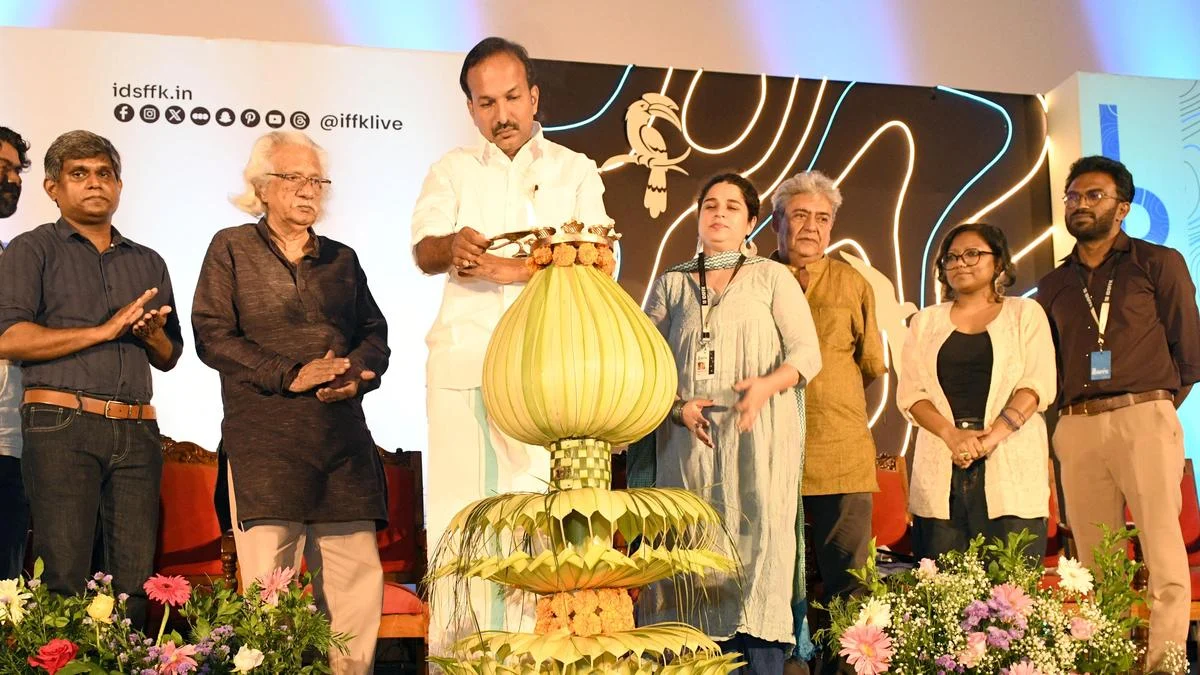
Thiruvananthapuram, Kerala – September 25, 2026 – The vibrant cultural landscape of Kerala was illuminated on Friday with the commencement of the 18th edition of the International Documentary and Short Film Festival of Keralam (IDSFFK) at the historic Kairali theatre in the state capital. However, the celebratory opening was tinged with uncertainty and apprehension as a shadow of censorship loomed large over the festival, with the Union Ministry of Information and Broadcasting (I&B) denying censor exemption to a significant number of films selected for screening.
Minister for Cultural Affairs, P.C. Vishnunadh, inaugurated the prestigious festival, acknowledging the challenges faced by the organizers in ensuring the screening of all curated cinematic works. Addressing the gathering, Minister Vishnunadh assured that the Kerala State Chalachitra Academy, the nodal body for the festival, is actively pursuing all avenues, including legal recourse, to secure the necessary permissions for the disputed films.
The Cloud of Censorship: A Troubling Debut
The 18th IDSFFK, which aims to showcase a diverse array of thought-provoking documentaries and short films from across the globe, has been marred by the Union I&B Ministry’s decision to withhold censor exemptions for 31 films. This has led to the omission of these films from the initially released screening schedule. The Kerala State Chalachitra Academy, in a bid to remain adaptable, has indicated its intention to update the schedule should the permissions be granted.
Sources within the festival organizing committee revealed that the Union I&B Ministry has escalated the scrutiny for these films, forwarding some to the Defence Ministry and others to the External Affairs Ministry for their assessment. This multi-layered review process has cast a pall of uncertainty over the fate of these films and, by extension, the comprehensive artistic vision of the festival.
Minister Vishnunadh articulated the collective desire of the festival organizers: "Our wish is that all the films that the selection committee selected for the festival be screened. They had selected a total of 347 documentaries and short films from out of 1,800 submissions. The I&B Ministry sought detailed synopsis for 40 films, out of which 31 films are now held up." This statement underscores the rigorous selection process undertaken by the festival and the subsequent administrative hurdles that have emerged.
A Platform for Unheard Voices: The Significance of IDSFFK
The International Documentary and Short Film Festival of Keralam holds a unique and vital position in the Indian film circuit. Unlike mainstream commercial cinema, documentaries and short films often struggle to find platforms for exhibition and distribution. They delve into subjects that are often overlooked, giving voice to marginalized communities, exploring complex social issues, and offering critical perspectives on contemporary realities.
Renowned filmmaker Adoor Gopalakrishnan, who graced the occasion as the chief guest, emphasized the festival’s crucial role in fostering aspiring filmmakers. "The festival provides a great platform for viewing and discussing serious works of cinema for aspiring filmmakers," he remarked. He further highlighted Kerala’s pioneering status in hosting a government-run festival dedicated to documentaries and short films, a testament to the state’s commitment to diverse cinematic expressions. "Keralam is the only State to have its own government-run festival for documentaries and short films. We were keen to have such a festival as normally such films don’t get a release in the cinemas nor would any of the channels show documentaries," he added, underscoring the perennial struggle for these cinematic forms to reach a wider audience.
Chronology of Events and Anticipated Developments
The 18th IDSFFK officially commenced on Friday, September 25, 2026, with the inauguration ceremony at the Kairali theatre. The opening day was marked by the screening of the opening film, A Fox Under a Pink Moon, directed by Mehrdad Oskouei. This poignant film chronicles the struggles of Soraya, a 16-year-old Afghan artist navigating the complexities of escaping Iran for Austria. The film’s narrative, focused on artistic aspirations and the pursuit of freedom, sets a tone of resilience and determination that resonates with the festival’s spirit, even amidst the prevailing censorship concerns.
The festival’s competitive sections are scheduled to commence on Saturday, September 26, 2026. The Competition Short Documentary category promises a compelling showcase of diverse narratives, featuring films such as Syed Ahmad Rufai’s Anhad: A Way of Looking, Malavika V.N.’s At Reel’s End (Viraamam), Debalina Majumder’s Friends of Jilipibala, Rahul Sood’s Boulevard – The Royal Route, and Sraiyanti’s Auto Queens.

Similarly, the Competition Short Fiction category will present a strong lineup of imaginative storytelling, with notable entries including Shashank Sahith Nammikanti’s Everything is Connected, Manguirish J. Bandodkar’s Ancessao, Christopher Joseph’s Maayan, Kiran Narayan Dhamale’s Aata Tu Motha Jhalas, and Darwin Annakumar’s Maram Marankothi.
The Competition Long Documentaries section is also set to feature impactful and critically acclaimed works, including Avijit Banerjee’s The Raconteur of the Dark and Kamal K.M.’s Close Up Up Close – The Making of Political Ubu. The diversity and thematic depth of these selected films highlight the festival’s commitment to presenting a rich tapestry of cinematic voices and perspectives.
Official Responses and Future Prospects
Minister P.C. Vishnunadh’s address at the inauguration also touched upon other significant developments in Kerala’s film industry. He reiterated the government’s commitment to granting "industry status" to Malayalam cinema, a move long advocated by filmmakers and industry stakeholders to facilitate infrastructure development, ease of financing, and streamlined regulatory processes. The Minister acknowledged the unique challenge of this initiative, noting that Kerala would be charting new territory as no other Indian state has yet formally conferred industry status upon its film sector. "One of the issues that we have been facing is that we don’t have any models before us, as no other State has granted industry status to cinema," he stated, highlighting the pioneering nature of this endeavor.
Furthermore, the Minister announced plans for a dedicated program aimed at nurturing young documentary filmmakers. This initiative seeks to bridge the gap between academia and film societies, fostering a collaborative environment for the next generation of storytellers. "The government has decided to take decisive steps to promote the film sector. A special program is planned for young documentary filmmakers by bringing together academia and film societies," he affirmed.
While the announcement of the long-awaited chairperson for the chalachitra academy was anticipated at the opening ceremony, Minister Vishnunadh stated that the name would be revealed before the festival’s conclusion. This appointment is seen as crucial for the academy’s future direction and its role in shaping Kerala’s cinematic landscape.
Implications and the Road Ahead
The censorship issue at the 18th IDSFFK raises pertinent questions about creative freedom and the role of government bodies in artistic expression. The decision by the Union I&B Ministry to deny censor exemption to a substantial number of films, particularly those selected by a festival’s jury, can be interpreted as an imposition of external judgment on artistic merit and thematic content. The referral of films to ministries like Defence and External Affairs suggests a concern over content that might be perceived as politically sensitive or critical of national interests, a common concern in countries where artistic expression is closely monitored.
The festival’s organizers’ commitment to pursuing legal avenues reflects a strong resolve to defend the integrity of their selection and to ensure that the audience has access to the full spectrum of films that were deemed worthy of showcasing. The outcome of these efforts will not only determine the screening of these 31 films but could also set a precedent for future film festivals in India, particularly those that aim to push boundaries and engage with challenging socio-political themes.
The 18th IDSFFK, despite the initial setbacks, stands as a testament to Kerala’s enduring commitment to the art of filmmaking and its dedication to providing a platform for diverse and meaningful cinematic narratives. The coming days will be crucial in observing how the festival navigates these challenges and whether it can ultimately fulfill its promise of showcasing a complete and uncompromised artistic vision. The continued support from the state government, as evidenced by Minister Vishnunadh’s address, coupled with the unwavering spirit of filmmakers and cinephiles, offers hope that the spirit of cinematic exploration will ultimately triumph.
