

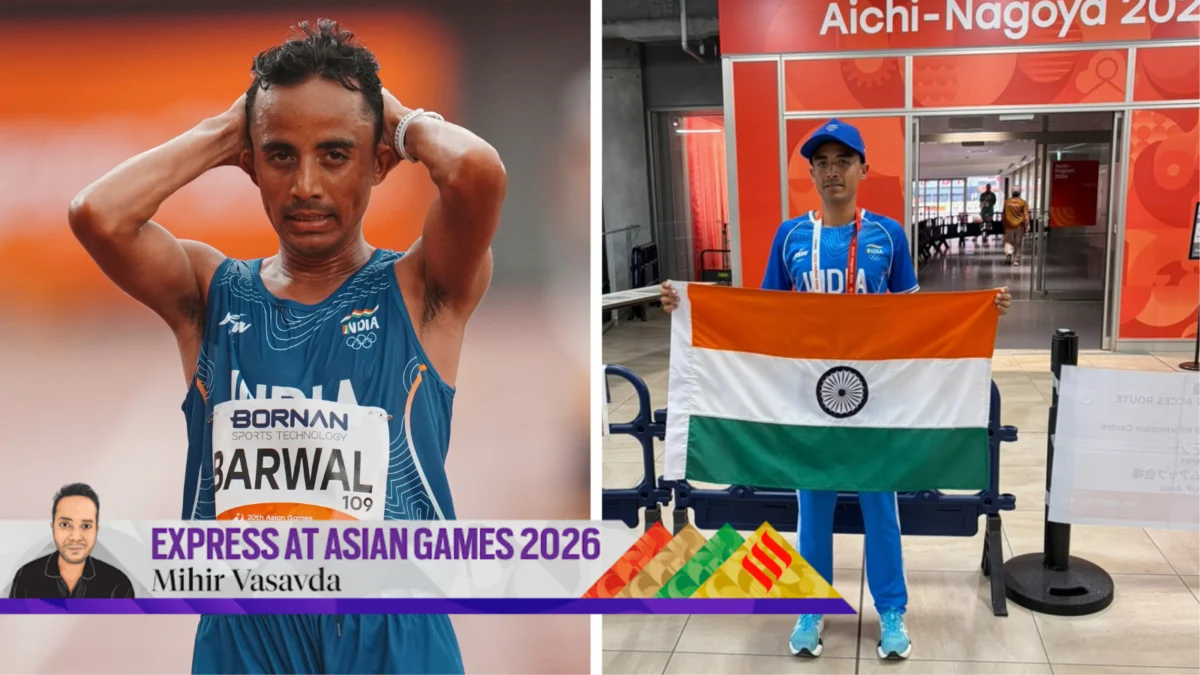
Nagoya, Japan – In a monumental display of grit, strategic brilliance, and sheer endurance, Sawan Barwal etched his name into the annals of Indian athletics history by securing a silver medal in the men’s marathon at the recent Asian Games in Nagoya. His remarkable performance not only shattered India’s 44-year wait for a medal in the prestigious event but also made him the first Indian marathoner to achieve this feat on foreign soil.
Barwal, a 28-year-old athlete with the Indian Army, clocked an astounding 2 hours, 11 minutes, and 37 seconds, a time that not only earned him a place on the podium but also lowered his own national record. While Japan’s Ichitaka Yamashita claimed the gold with a time of 2:10:49, Barwal’s silver was a victory of immense significance, signaling a new era for Indian long-distance running.
"This feels special," Barwal expressed, his voice tinged with emotion after the race. "To win a medal, and set a national record doing it, and ending a long wait for a marathon medal… this was my target." His words encapsulated the magnitude of an achievement that was, for many, an unexpected triumph, yet for Barwal and his coach, the culmination of a meticulously planned and rigorously executed journey.
A Dawn of Destiny: The Main Facts
Sawan Barwal’s historic silver medal in the Asian Games marathon is far more than just a podium finish; it is a narrative woven with dedication, transformation, and the breaking of long-standing barriers. The athlete’s performance in Nagoya brought to an end a 44-year drought for India in the men’s marathon at the Asian Games, a period stretching back to the last time an Indian athlete stood on the podium for this gruelling event. His achievement is particularly notable as it marks the first time an Indian has won a marathon medal outside of home soil, adding another layer to its historical significance.
Barwal’s time of 2:11:37 was not merely a personal best; it was a testament to his rapid ascent in the sport, coming in only his second competitive marathon. This new national record, eclipsing his previous best set earlier this year, firmly establishes him as India’s premier long-distance runner. His journey from a middle-distance specialist to an Asian Games marathon medalist in just over a year underscores an extraordinary transformation, guided by insightful coaching and unwavering commitment. The silver medal is a powerful statement, not just for Barwal, but for the aspirations of Indian athletics on the international stage.
The Race Unfolds: A Chronological Account
The morning of the marathon in Nagoya began long before sunrise for Sawan Barwal. Waking at 3:30 am, he adhered to his pre-race ritual, consuming a banana for essential energy, a small but crucial detail in the meticulous preparation for 42.195 kilometres of intense physical and mental exertion. As dawn broke, a unique set of conditions greeted the competitors on the damp streets of Nagoya. An overcast sky provided some respite from the sun, but a light drizzle and persistent humidity made for challenging running conditions, demanding even greater resilience from the athletes.
Early Pacing and Tactical Discipline (0-15 km)
From the outset, the pace was brisk, as is often the case in championship marathons where contenders seek to establish early dominance or test their rivals. Barwal, however, remained disciplined, adhering to his coach Scott Simmons’ strategic instructions. By the five-kilometre mark, he had comfortably settled into a lead group of six runners, clocking a competitive 15:28, just a second behind China’s Feng Peiyou, who had briefly taken the lead.
The initial quick pace soon gave way to a more undulating rhythm, with the lead group experiencing an ebb and flow. Around the 15-kilometre mark, the pace dipped sharply, with a kilometre covered in 2:53-2:54. This variation demanded constant adjustment and a keen sense of pacing, preventing any single runner from settling into a comfortable rhythm. Despite the shifts, Barwal maintained his composure, remaining tucked within the lead pack, conserving energy and observing his competitors. The field, even at this relatively early stage, had begun to thin, a testament to the demanding conditions and the relentless pace.
Mid-Race Momentum and Strategic Patience (15-30 km)
As the race progressed towards the halfway point, Barwal found himself running shoulder to shoulder with the eventual gold medalist, Ichitaka Yamashita of Japan. Both athletes crossed the halfway mark in an identical 1:05:54. The atmosphere along the streets of Nagoya was electric, with a supportive home crowd rallying behind Yamashita, their cheers providing an audible surge of motivation. Barwal, meanwhile, relied on the internal guidance of Simmons’ instructions, reinforcing his focus and strategy.
"We didn’t want to slow down. The race went fast in the beginning. But after three-four kilometres, it slowed down and remained up and down," Barwal recalled, highlighting the tactical intricacies. His hydration strategy was also meticulous, consuming a mere 120ml of fluids across all eight water stations, a testament to his body’s efficiency and careful planning. "Our target was to stay with the group till the end. If we could maintain that position, the chances of winning the medal would increase," he articulated, emphasizing a strategy less about making a decisive move and more about refusing to make a wrong one. This period was characterized by a patient, watchful approach, conserving energy for the inevitable challenges of the latter stages.
The Decisive Breakaway and Barwal’s Resilience (30-39 km)
The race dramatically shifted after the 30-kilometre mark, a notorious segment in any marathon where fatigue begins to set in and true contenders emerge. As the runners encountered an uphill stretch, the pace suddenly surged. The leading group, which had held together for so long, began to splinter under the increased pressure. Soon, only three or four athletes remained in contention for the medals.
Yamashita, leveraging the home crowd’s energy and his local knowledge, accelerated powerfully up the incline, briefly causing Barwal to lose contact. This moment could have been a turning point for many, leading to panic or a compromised pace. However, Barwal’s mental fortitude, honed through years of training and his previous marathon experience, proved crucial. He did not panic. "After 30 km, when you see the hill and the pace increases, you feel a little different. I got left behind, but when we crossed it, I covered it on the downward slope," he explained, demonstrating his ability to recover strategically and regain lost ground on the downhill section. This resilience ensured he remained firmly in the medal hunt.
The Final Push and Historic Finish (39-42.195 km)
As the race entered its final 10 kilometres, only three runners remained in serious contention. Barwal, mindful of the brutal closing stages of a marathon – a lesson painfully learned from his debut in Rotterdam – exercised immense self-control. He understood the peril of pushing beyond his sustainable limit. "We didn’t try to go too fast. We kept the limit at 2:58 per kilometre," he stated, outlining a strategy focused on controlled aggression rather than an all-out sprint. "Our target was not to go beyond our limit."
Yamashita, finding another gear in the closing stages, began his decisive move. By 39 kilometres, the Japanese runner had started to pull away, steadily increasing his lead. At the 40-kilometre mark, the gap had widened to 26 seconds, making it clear that gold was likely out of Barwal’s reach. Yet, the Indian runner’s silver medal was secure. Yamashita entered the stadium to a thunderous roar from the home crowd, crossing the line victorious in 2:10:51. Barwal followed, maintaining his composure and pace, holding on for a well-deserved second place, simultaneously lowering the national record he had set just months prior. His finish was not just a medal; it was the culmination of a dream, a strategic masterpiece, and a historic moment for Indian athletics.
A Journey of Transformation: Supporting Data and Background
Sawan Barwal’s journey to Asian Games silver is a compelling narrative of athletic evolution. For much of his early career, Barwal had focused on middle- and long-distance track events, requiring a different physiological profile and tactical approach. His entry into the Indian Army in 2019, where he discovered athletics almost by chance, provided the discipline and structure that would eventually propel him to marathon glory.
The pivotal moment came just a year ago when his coach, Scott Simmons, a renowned figure in endurance training, encouraged him to make the challenging switch to marathon running. This was not a minor adjustment; it demanded a fundamental reorientation of his training philosophy and physical conditioning. The explosive speed work characteristic of shorter distances gave way to gruelling, long-duration sessions and an unforgiving weekly mileage. According to Simmons, Barwal now clocks an astonishing 190 kilometres a week, a volume indicative of elite marathon preparation.
This transformation also involved specific tactical and physiological adaptations. In the three months leading up to the Asian Games, Barwal completed three full marathon simulations, meticulously replicating race conditions to build endurance and mental fortitude. Furthermore, a crucial training stint in Colorado Springs, facilitated by the Athletics Federation of India, provided him with access to high-altitude training environments and world-class facilities. Training at altitude enhances the body’s ability to utilize oxygen more efficiently, a critical advantage in endurance events like the marathon. This comprehensive preparation ensured Barwal was not just physically ready but also mentally attuned to the unique demands of the 42.195-kilometre distance.
Breaking Records and Historical Context
Barwal’s silver medal in Nagoya is intrinsically linked to two significant national record-breaking performances. His debut marathon earlier this year at the Rotterdam Marathon was already a breakthrough moment. There, he became the first Indian athlete to complete a marathon in under 2 hours and 12 minutes, clocking 2:11:58. This achievement shattered the legendary Shivnath Singh’s 48-year-old national record of 2:12:00, set in 1973. Singh’s record had stood as a testament to Indian endurance for nearly five decades, making Barwal’s feat in Rotterdam monumental.
In Nagoya, Barwal not only replicated his record-breaking form but improved upon it, lowering his own national best to 2:11:37. This successive improvement underscores his rapid development and potential. The 44-year wait for an Asian Games marathon medal for India highlights the historical significance of his achievement. The last time India secured a medal in this event was in 1978, when Shivnath Singh won silver at the Bangkok Asian Games. Barwal’s medal thus bridges a significant gap, rekindling hope and ambition in a category where India had long struggled to make an international impact. His performance is a powerful reminder of India’s enduring athletic talent and its capacity to excel in global endurance sports.
Official Responses and Strategic Insights
The immediate aftermath of Barwal’s silver medal was filled with relief and profound satisfaction, echoed in his own words. "This feels special. To win a medal, and set a national record doing it and ending a long wait for a marathon medal… this was my target," he reiterated, emphasizing the predetermined nature of his ambition. His journey was not merely about participation but about a calculated assault on the podium.
Coach Scott Simmons’ influence throughout this transformation cannot be overstated. His strategic guidance was evident in every phase of Barwal’s preparation and execution. Simmons recognized Barwal’s potential for the marathon, a demanding event that requires not just physical prowess but also immense mental fortitude and strategic intelligence. The transition from middle-distance to marathon running requires a complete overhaul of training methodologies, focusing on sustained endurance, consistent pacing, and nutritional strategies.
Barwal’s adherence to Simmons’ race-day instructions was a critical factor in his success. His ability to maintain composure during tactical shifts, such as the initial fast pace giving way to ebbs and flows, and his disciplined fluid intake, all point to a well-coached and highly self-aware athlete. The instruction to "stay with the group till the end" and "not to go beyond our limit" during the crucial latter stages of the race highlights a mature understanding of marathon tactics. It was a strategy of calculated risk management, prioritizing a medal finish over an unsustainable pursuit of gold that could jeopardize everything. Barwal’s ability to internalize and execute these instructions under immense pressure speaks volumes about his coach-athlete relationship and his innate racing intelligence.
Implications: A New Chapter for Indian Athletics
Sawan Barwal’s historic silver medal carries profound implications for both his personal career and the broader landscape of Indian athletics. For Barwal, this achievement firmly establishes him as a formidable force in international marathon running. It opens doors to greater opportunities, including potential qualification for major global events like the World Championships and the Olympic Games. The Paris 2024 Olympics, for instance, would now be a realistic and highly ambitious target, demanding continued dedication and potentially further refinement of his training and race strategies. Increased sponsorship and institutional support are also likely to follow, providing Barwal with the resources necessary to sustain and elevate his performance.
For Indian athletics, Barwal’s medal is a much-needed shot in the arm. It signals a potential resurgence in long-distance running, an area where India has traditionally lagged behind global and even Asian powerhouses. The 44-year wait for an Asian Games marathon medal had created a void, and Barwal’s success fills it with hope and inspiration. This achievement can serve as a powerful motivator for aspiring young athletes in India, demonstrating that with focused training, strategic guidance, and unwavering commitment, international success in endurance events is attainable.
Moreover, it might prompt the Athletics Federation of India (AFI) and other sports bodies to invest more heavily in long-distance running programs, talent identification, and coaching development. The success of Barwal’s training regimen, particularly the stint in Colorado Springs under Scott Simmons, highlights the benefits of international exposure and specialized coaching. This model could be replicated to nurture other promising talents, potentially leading to a new generation of Indian marathoners capable of competing at the highest levels. Barwal’s silver medal is not just a personal triumph; it is a beacon of hope, illuminating a new pathway for Indian athletes on the global endurance stage and inspiring a renewed belief in the nation’s potential in marathon running.
