

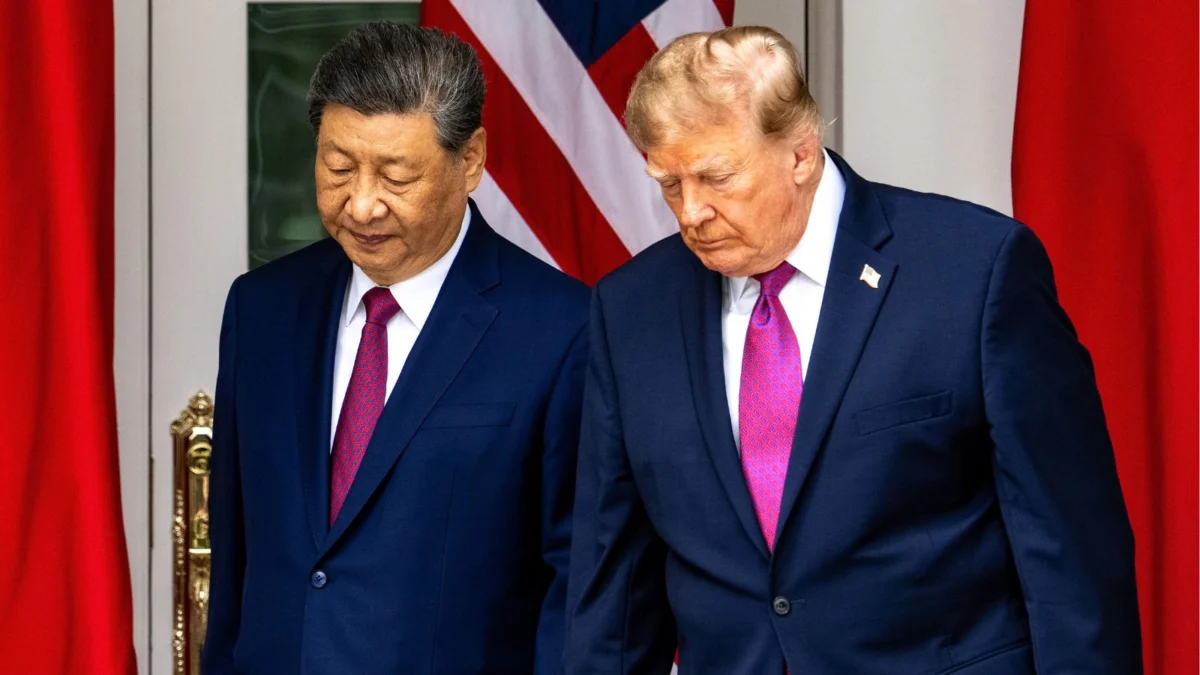
Washington D.C. – For nearly two years, the burgeoning field of artificial intelligence has been shadowed by a simmering dispute over intellectual property. Leading American AI developers, including giants like Anthropic, OpenAI, and Google, have repeatedly accused their Chinese counterparts of unfairly leveraging their cutting-edge AI technologies. This week, as Chinese President Xi Jinping met with President Donald Trump in Washington, these allegations of technological "distillation" surged to the forefront, becoming a critical flashpoint in their high-stakes discussions.
The diplomatic engagement unfolded against a backdrop of escalating global concern over the rapid, often unbridled, ascent of AI. While leaders grappled with the immediate implications of alleged IP theft, broader anxieties about AI’s societal impact — from job displacement to ethical dilemmas and even existential risks — also permeated the discussions. Numerous U.S. officials, prominent tech executives, and everyday citizens have voiced calls for a more cautious, deliberate approach to AI development, advocating for a "slowdown" in the relentless pace of innovation.
In this fiercely competitive arena, American innovators such as Anthropic, renowned for its Claude models, and OpenAI, the creator of ChatGPT, are widely acknowledged as frontrunners in the global AI race. Yet, the lead is far from insurmountable. A dynamic ecosystem of Chinese startups, including emergent players like Z.ai and the ambitious Moonshot AI, are rapidly closing the gap, demonstrating remarkable advancements that challenge the perceived dominance of Silicon Valley. At the heart of this intensifying technological rivalry lies a specific and highly contentious issue: the repeated claims from Silicon Valley that Chinese companies are illicitly copying advanced American AI models using a sophisticated, albeit controversial, technique known as "distillation."
However, the narrative is not without its complexities and dissenting voices. Many experts within the AI community contend that the accusations from companies like Anthropic and OpenAI might be overstated, or at the very least, incomplete. "The narrative that all of the capabilities of the Chinese technologies are simply coming from an Anthropic model is not as true as people say it is," observed Charles O’Neill, a head of model training at Baseten, a U.S. company that facilitates access to Chinese AI technologies. This nuanced perspective suggests that while distillation may play a role, it does not fully account for the independent progress of Chinese AI.
To understand the intricate web of claims and counter-claims, one must delve into the technical underpinnings of distillation, a niche process that has unexpectedly transformed into a significant geopolitical issue, shaping the future of global technological competition and international relations.
A Chronology of Accusations and Escalation
The journey of "distillation" from an obscure academic technique to a diplomatic sticking point traces a fascinating trajectory, mirroring the broader acceleration of AI development itself.
Early 2010s: The Genesis of Efficiency
Distillation was not born out of a desire for competitive advantage or IP circumvention. Its origins lie in the early 2010s within the realm of academic AI research, where it was conceived as an ingenious method to enhance the efficiency of AI systems. Researchers, including figures like Geoffrey Hinton, then a Google researcher who played a pivotal role in its development, sought ways to build smaller, faster, and more economical AI models. The core idea was to train a "student" model by leveraging the knowledge embedded in a larger, more complex "teacher" model, allowing the student to achieve comparable performance on less expensive hardware. Hinton famously described this relationship as "one model as the teacher and the other as a student."
Recent Years: A Shift in Application
As AI models grew in scale and sophistication, and their commercial value skyrocketed, the application of distillation began to evolve. While still used internally by companies to optimize their own models for various deployment scenarios (e.g., mobile devices, edge computing), a new, more contentious use emerged: collecting data from technologies built by others. This marked the pivot point where an efficiency tool started to become a potential instrument of competitive intelligence, and arguably, IP infringement.
Last Year: DeepSeek’s Emergence and OpenAI’s Challenge
The competitive landscape intensified dramatically last year with the emergence of Chinese startup DeepSeek. Its release of a particularly powerful and remarkably efficient AI system sent ripples of surprise and concern through American research and investment circles. The swift progress prompted OpenAI, a leading developer of foundational AI models, to publicly accuse DeepSeek of having distilled its proprietary technologies, suggesting that DeepSeek’s rapid advancements were not purely indigenous.
Past Nine Months: Anthropic Joins the Fray
Following DeepSeek’s controversial debut, and as Chinese AI systems continued their impressive trajectory of improvement over the past nine months, similar accusations began to mount from other U.S. industry leaders. Anthropic, a key competitor to OpenAI, echoed these concerns. In a significant move in June, Anthropic dispatched a formal letter to a bipartisan pair of influential U.S. Senators, Tim Scott (R-S.C.) and Elizabeth Warren (D-Mass.), explicitly accusing Chinese tech behemoth Alibaba of engaging in the distillation of Anthropic’s proprietary AI technologies. These formal complaints elevated the issue from industry gossip to a matter of Congressional attention.
This Week: A Diplomatic Flashpoint
The culmination of these mounting industry accusations and the growing awareness of China’s rapid AI progress came to a head this week. The high-level meeting between Chinese President Xi Jinping and President Donald Trump in Washington provided the perfect, if tense, diplomatic platform. The allegations of AI distillation, symbolizing a broader struggle for technological supremacy and adherence to intellectual property norms, became an unavoidable topic in their bilateral discussions, underscoring the profound geopolitical implications of this technical process.
Ongoing: The Legal Quagmire for US Companies
Adding another layer of complexity, American AI companies themselves are not immune to legal challenges regarding their own data sourcing practices. This ongoing legal quagmire, particularly concerning the use of copyrighted internet data for training their models, creates a complex and sometimes hypocritical narrative around their accusations against Chinese firms.
Supporting Data: Deconstructing Distillation and its Legal Ambiguities
To truly grasp the gravity of the accusations and the nuances of the debate, a detailed understanding of distillation is essential, alongside an exploration of its precarious legal standing.
What Exactly is Distillation?
First developed in the early 2010s, "distillation" was initially conceived by AI researchers as an elegant method for building more efficient and compact AI technologies. At its core, the technique involves transferring knowledge from a large, complex, and computationally expensive "teacher" model to a smaller, simpler "student" model. The student model learns to mimic the behavior and outputs of the teacher, effectively absorbing its learned patterns and capabilities, but requiring significantly less computational power and memory to operate. This allows the new system to run on less expensive hardware, making AI more accessible and scalable. As Geoffrey Hinton, one of its pioneers, aptly described, "Think of one model as the teacher and the other as a student."
Companies continue to utilize distillation for these efficiency-driven purposes. For instance, a developer might train a massive foundational model on a supercomputer, then distill its knowledge into a more compact version suitable for deployment on a smartphone or a web application.
However, more recently, the technique has acquired a more contentious application: enabling companies to collect and leverage data from technologies built and owned by others. This is where the accusations of unfair copying arise. In this scenario, an outside company aiming to distill a competitor’s proprietary system will typically set up numerous accounts on the competitor’s publicly accessible service. For example, they might interact extensively with Anthropic’s Claude or OpenAI’s GPT models. The distilling company will then systematically assign these established AI systems to perform a wide array of specific tasks, ranging from complex computer coding challenges and advanced mathematical problems to nuanced natural language generation or creative writing prompts.
The key step then involves meticulously collecting and analyzing the vast amounts of information and outputs generated by these established AI systems. This collected data – which includes generated text, code, images, or even the probabilities assigned to different outputs – effectively represents the "knowledge" or "behavioral patterns" of the proprietary model. The distiller can then use this rich dataset to help train a new AI system of their own, guiding their student model to replicate the sophisticated responses and capabilities observed in the teacher model. This process allows them to accelerate their own development significantly, potentially bypassing years of costly and resource-intensive research and training.
Is Distillation Illegal? A Murky Legal Landscape
The legality of AI distillation remains a deeply ambiguous and largely untested area of law, presenting significant challenges to existing intellectual property frameworks.
Some legal scholars argue that certain forms of distillation, particularly those involving the systematic extraction of proprietary knowledge and capabilities, could potentially violate the Defend Trade Secrets Act (DTSA). This federal law, enacted in 2016, empowers companies to sue over the theft of trade secrets, defined broadly as information that derives independent economic value from not being generally known or readily ascertainable, and is subject to reasonable measures to keep it secret. If a company can prove that a competitor deliberately accessed and used its AI model’s outputs in a way that constitutes misappropriation of a trade secret – effectively stealing the "secret sauce" of the model’s design or training methodology without direct access to the code – then a DTSA claim might hold water. However, U.S. courts have yet to definitively rule on this specific issue in the context of AI model distillation, leaving a critical legal vacuum.
Copyright law, traditionally the bedrock of protecting creative works, does not easily apply to distillation in the same straightforward manner. This is primarily because distillation is fundamentally an effort to copy the general behavior, capabilities, and learned patterns of an AI system, rather than to copy its text, code, or specific expressive outputs word for word. Copyright protects specific expressions, not abstract ideas, functionalities, or the underlying "intelligence" of a model. While the outputs generated by a distilled model might resemble those of the teacher model, the act of learning from and replicating behavior without direct textual or code copying falls into a gray area that current copyright statutes struggle to address. This distinction makes it difficult to apply existing copyright protections directly.
Adding a layer of profound irony and complexity to the accusations leveled by American AI companies is their own fraught history with intellectual property rights. Critics of Anthropic and OpenAI are quick to point out that these very companies have themselves engaged in practices that have drawn intense legal scrutiny and led to accusations of illegally using copyrighted internet data to train their massive AI systems.
Anthropic, for instance, is currently facing multiple lawsuits accusing the San Francisco startup of precisely this – illegally ingesting vast swathes of copyrighted material from the internet without permission or compensation. In a landmark legal development last year, the company agreed to a staggering $1.5 billion settlement with a consortium of authors and publishers. This unprecedented payout came after a judge ruled that Anthropic had indeed illegally downloaded and stored millions of copyrighted books, effectively using them as raw material for its AI models. This settlement stands as the largest payout in the history of U.S. copyright cases, casting a long shadow over Anthropic’s claims of being a victim of IP theft.
Similarly, OpenAI and its strategic partner Microsoft are embroiled in a series of high-profile lawsuits, including a significant one brought by The New York Times in late 2023. This suit contends that OpenAI and Microsoft systematically used millions of articles published by The Times – a significant investment in original journalism – to train their advanced chatbots. The Times argues that these chatbots now directly compete with the news outlet as a primary source of information, effectively cannibalizing its business model using its own copyrighted content. OpenAI and Microsoft vehemently deny these claims, asserting their use falls under fair use. These ongoing legal battles underscore a fundamental tension within the AI industry: the immense appetite for data necessary to train powerful models often clashes directly with existing intellectual property rights, creating a complex and ethically challenging environment for all players, regardless of their nationality.
Are Chinese Companies Really Copying American Systems?
While the precise extent and methods remain somewhat opaque, there is a strong consensus among American researchers and intelligence analysts that Chinese firms have most likely engaged in the distillation of proprietary American AI systems. The evidence, though circumstantial, points towards a pattern of behavior and rapid advancement that is difficult to explain solely through independent innovation.
The most prominent example emerged last year when Chinese startup DeepSeek unveiled an AI system that, to the surprise of many American researchers and investors, was exceptionally powerful and efficient. The rapid leap in capability prompted OpenAI to publicly accuse DeepSeek of having distilled its proprietary technologies, suggesting that DeepSeek’s impressive performance bore too strong a resemblance to OpenAI’s own models to be coincidental.
This pattern continued as Chinese AI systems demonstrated consistent and significant improvements over the past nine months. Anthropic, another leading U.S. AI firm, made similar allegations. In a notable formal communication in June, Anthropic dispatched a letter to Senators Tim Scott and Elizabeth Warren, explicitly accusing Chinese tech giant Alibaba of distilling its technologies. These accusations, coming from two of the most advanced AI companies in the world, suggest a widespread concern about systematic intellectual property encroachment.
To date, the accused Chinese companies, including DeepSeek and Alibaba, have not issued public responses to these specific accusations. Their silence, from the perspective of their American accusers, is often interpreted as an implicit acknowledgment or a strategic refusal to engage in a public debate that could further solidify the claims against them.
Does Distillation Alone Explain How China’s Models Remain Competitive?
Despite the serious nature of the distillation accusations, experts largely agree that this technique alone does not fully explain the rapid advancements and competitive standing of China’s AI models. While distillation can undeniably provide a significant acceleration to development, it is not a magical shortcut that bypasses the fundamental requirements of building advanced AI.
When companies distill a proprietary system, they gain access only to its outputs – the words, characters, images, code, and other data generated by the system in response to various prompts. They do not gain access to the system’s underlying computer code, its architectural design, its proprietary training datasets, or the specific weights and biases of its neural network. This is a crucial distinction. In contrast, with an open-source technology, developers would have full access to the source code, allowing for deep modification and understanding.
Using outputs from a proprietary system, such as Anthropic’s Claude Fable, can certainly help a Chinese company accelerate the development and refinement of its own technology. It provides a powerful "teacher signal" that guides the student model’s learning process. However, these outputs are only one part of a much larger and more complex puzzle.
"You are not getting access to everything you would use when you are distilling your model in-house," explained Rehaan Ahmad, a co-founder of Silicon Valley startup alphaXiv, a company dedicated to tracking the latest AI research. This means that while distillation can fine-tune and improve an existing model, it cannot create a powerful foundational model from scratch.
Before a Chinese company can effectively leverage distillation, it must first possess a system that is already quite powerful in its own right. This requires a substantial initial investment in research, development, and engineering talent to build a robust base model. Through distillation, this base model can then be honed and improved in important ways, learning sophisticated behaviors and capabilities from the teacher model. But this iterative process of refinement and optimization still demands significant additional work, considerable financial investment, vast computing power, and a highly skilled talent pool. Therefore, while distillation is a potent tool for accelerating development and closing capability gaps, it serves as a powerful enhancer rather than a sole engine of innovation, meaning China’s advancements are also underpinned by substantial indigenous effort.
Can Anthropic and OpenAI Stop Companies From Distilling?
The short answer, according to many experts, is that while they can curb the practice, completely stopping distillation is an almost insurmountable challenge. And indeed, Anthropic and OpenAI have already implemented measures to combat it.
Their primary defense mechanism involves monitoring user behavior for patterns indicative of distillation. If Anthropic or OpenAI detect suspicious activity – such as an account making an unusually high volume of queries in rapid succession, or systematically probing the model for specific types of information in a manner inconsistent with typical human interaction – they may flag the account and subsequently shut it down. This acts as a deterrent and can temporarily disrupt distillation efforts.
However, this approach is akin to a digital whack-a-mole. If one account is shut down, others will most likely surface, often utilizing proxy servers, VPNs, or newly generated credentials to bypass detection. Furthermore, companies like Anthropic and OpenAI face a delicate balancing act: overly aggressive account closures risk alienating or accidentally barring legitimate users who might have high-volume or unusual usage patterns for perfectly valid reasons. This potential for false positives forces them to err on the side of caution, creating loopholes for determined distillers.
"It is basically impossible to stop distillation," stated Lino Le Van, another researcher at alphaXiv, underscoring the technical difficulty of identifying and permanently preventing such activities. The nature of public APIs and accessible AI models means that as long as a service is offered, its outputs can be queried, collected, and potentially used for training, making a foolproof defense system incredibly challenging to implement.
Official Responses: A Diplomatic and Corporate Standoff
The "distillation" controversy has elicited varied responses from governments and corporations, highlighting the complex geopolitical and economic stakes involved.
U.S. Government:
The U.S. government, under President Trump’s administration, has implicitly elevated the issue by raising it directly with President Xi Jinping. This signifies a recognition of AI intellectual property theft as a national security and economic concern, not merely a commercial dispute. Congressional figures, such as Senators Scott and Warren, have also expressed deep concern, spurred by direct appeals from U.S. tech companies. This bipartisan attention signals a growing consensus that robust measures may be needed to protect American AI leadership and prevent unfair competition. The broader implication for the U.S. is the maintenance of its technological edge and the safeguarding of trillions of dollars in future economic value tied to AI innovation.
Chinese Government:
The Chinese government has maintained official silence on the specific accusations of distillation against its companies. This silence is strategic, allowing Beijing to avoid legitimizing the claims while continuing to champion indigenous innovation and technological self-reliance. Historically, China has been accused of lax intellectual property enforcement, a criticism that often accompanies its rapid technological ascent. While China has passed more robust IP laws in recent years, their enforcement, particularly in cases involving state-backed enterprises or national strategic interests, remains a point of contention for foreign companies. From Beijing’s perspective, the "open" nature of AI development and the concept of learning from existing models could be framed as legitimate competitive research, or even a form of "fair use" of publicly accessible APIs, without directly infringing on trade secrets or copyright.
U.S. Companies (Anthropic, OpenAI, Google):
The leading American AI firms have been vocal in their accusations, leveraging their influence to alert government officials and draw public attention to the issue. Their efforts to curb distillation, primarily through account monitoring and suspension, reflect their determination to protect their massive investments in R&D. However, their position is complicated by their own legal battles. The multi-billion-dollar settlement paid by Anthropic and the ongoing lawsuits against OpenAI and Microsoft for using copyrighted data to train their models undermine their moral authority. This creates a perception of hypocrisy, making it harder for them to garner unreserved sympathy from lawmakers and the public, and fueling arguments that the rules they seek to enforce against others should also apply to themselves.
Chinese Companies (Z.ai, Moonshot, DeepSeek, Alibaba):
Chinese AI companies, while publicly silent on the specific allegations, have clearly demonstrated their rapid technological advancement. Their swift rise in capability, despite the accusations, underscores their commitment to challenging Western dominance in AI. Their silence could be interpreted as a strategic decision to focus on development rather than engaging in a potentially unwinnable public relations battle, or perhaps as a subtle rejection of the premise of the accusations themselves. Should the legal landscape shift or international pressure mount, it is conceivable that these companies, or the Chinese government, could issue counter-statements or even counter-accusations regarding data usage by U.S. firms.
Implications: Shaping the Future of AI and Global Power Dynamics
The "distillation" controversy extends far beyond a mere technical squabble; it carries profound implications for geopolitics, economic competition, legal precedents, and the very future trajectory of AI development.
Geopolitical Ramifications:
The accusations of AI distillation further escalate the already tense technological "cold war" between the U.S. and China. It transforms AI from a realm of scientific collaboration into a battleground for national supremacy, potentially leading to increased trade friction, retaliatory measures, or even the imposition of sanctions targeting specific Chinese AI firms or the export of critical AI hardware to China. This dispute also directly impacts the nascent discussions around global AI governance and ethical standards. If foundational AI models are seen as vulnerable to unregulated distillation, it complicates efforts to establish shared norms for responsible AI development and deployment, potentially leading to a fragmentation of global AI ecosystems.
Economic Impact:
The economic stakes are astronomical. The development of foundational AI models requires billions of dollars in investment, cutting-edge research, and years of dedicated effort. If competitors can significantly reduce their R&D costs and accelerate their timelines through distillation, it fundamentally undermines the incentives for innovation and fair competition. This could devalue the intellectual property of leading AI companies, making it harder for them to recoup their investments and potentially stifling future breakthrough research. For the startup ecosystems in both countries, the ability to protect core technological advantages will determine their viability and growth trajectories.
Legal Precedents and the Need for New Frameworks:
The current legal ambiguity surrounding distillation highlights a critical deficit in existing intellectual property law. The distinction between copying "behavior" versus "text" or "code" is becoming increasingly blurred in the age of AI. There is an urgent need for new laws, or at least novel interpretations of existing statutes like the Defend Trade Secrets Act, that are specifically tailored to the unique characteristics of AI models and their "knowledge." This could involve creating new categories of intellectual property protection or refining definitions of "misappropriation" to account for the indirect extraction of capabilities from AI systems. The outcomes of any future court cases involving distillation will set crucial precedents that will shape the legal landscape for AI innovation for decades to come.
Technological Future and Protection Mechanisms:
The inability to fully prevent distillation could force AI developers to adopt more protective, or even restrictive, strategies. This might lead to a more closed-source development environment, where companies are less willing to expose their models through public APIs or share research findings, out of fear of being exploited. Alternatively, it could spur the development of new technological countermeasures designed to detect and deter distillation more effectively, such as advanced watermarking techniques for AI outputs or more sophisticated behavioral analytics to identify non-human querying patterns. The "arms race" dynamic in AI will likely extend to the development of both offensive (distillation) and defensive (anti-distillation) technologies.
Ethical Considerations and the Open-Source Debate:
The controversy also reignites the fundamental ethical debate surrounding fairness in AI development and the balance between proprietary innovation and open-source collaboration. If powerful models are built using vast amounts of public or copyrighted data, is it truly "theirs" to protect exclusively? The allegations against U.S. companies for their own data sourcing practices add a layer of ethical complexity, prompting questions about who truly "owns" the knowledge embedded in these models and how that ownership should be regulated globally. This debate will be central to defining what constitutes responsible and equitable AI development in a hyper-connected, competitive world.
In conclusion, the "distillation" debate is far more than a technical footnote; it is a microcosm of the broader struggle for technological leadership and influence in the 21st century. As AI continues its transformative ascent, the resolution of this and similar intellectual property disputes will not only shape the future of artificial intelligence itself but also profoundly impact the geopolitical landscape, international trade relations, and the very notion of innovation in a globally interconnected world. The outcome remains uncertain, but its significance is undeniable.
