

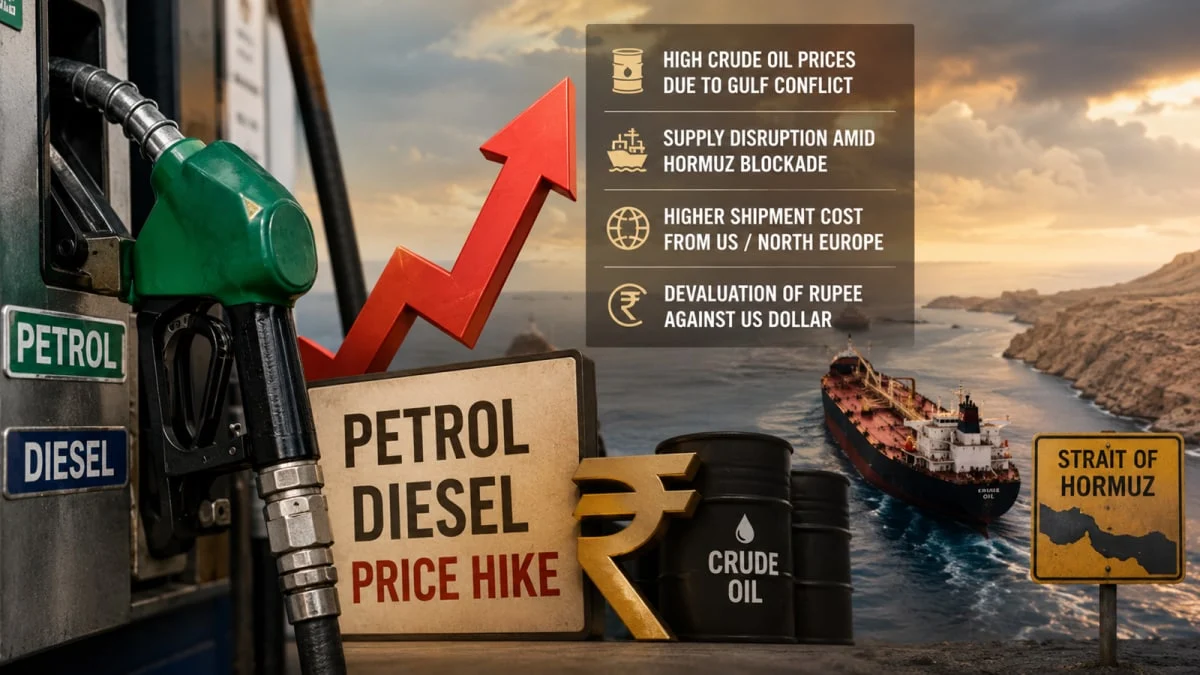
New Delhi, India – May 15, 2026 – Indian consumers are facing renewed economic strain as petrol and diesel prices were hiked by approximately Rs 3 per litre across the nation today. The significant increase, implemented by oil marketing companies (OMCs), comes amidst a volatile global energy landscape, primarily fueled by the intensifying Iran war and its profound ripple effects on crude oil markets and international shipping. This latest surge marks a critical juncture for India, a nation heavily reliant on oil imports, as it grapples with inflationary pressures, a weakening rupee, and the daunting challenge of maintaining energy security.
The upward revision pushes retail fuel prices to unprecedented levels, raising immediate concerns about a broader inflationary impact on daily essentials, transportation, and industrial operations. Brent crude, the international benchmark, is currently hovering around $107 per barrel, having touched highs of $120 in recent weeks, a direct consequence of the escalating conflict in the Gulf region and the perceived threat to global oil supplies. The cumulative effect of these international dynamics, coupled with a struggling Indian rupee, has left OMCs with no recourse but to pass on a portion of their mounting costs to the end consumer.
Main Facts: A Confluence of Crises Driving Fuel Costs
The Rs 3 per litre hike in petrol and diesel prices across India today, May 15, 2026, is a stark reflection of a complex and deteriorating global energy environment. This decision by India’s state-owned oil marketing companies – Indian Oil Corporation (IOC), Bharat Petroleum Corporation (BPCL), and Hindustan Petroleum Corporation (HPCL) – underscores the immense pressure they face from international crude oil prices, which have remained stubbornly high. The primary driver is the protracted and intensifying conflict involving Iran, which has not only pushed up crude benchmarks but also created severe supply chain disruptions and elevated shipping costs.
Adding to this precarious situation is the significant depreciation of the Indian rupee against the US dollar. As the world’s third-largest oil consumer and a nation importing over 85% of its crude oil requirements, India’s economy is acutely sensitive to these external shocks. The weakening rupee makes dollar-denominated oil imports substantially more expensive, exacerbating the financial burden on OMCs and, by extension, on Indian consumers. This hike, therefore, is not an isolated event but a consequence of a multi-faceted crisis impacting global geopolitics, trade logistics, and currency markets, all converging to exert inflationary pressure on India’s economy.
Chronology of Escalation: From Tensions to Price Shocks
The current fuel price hike is the culmination of a series of geopolitical and economic events that have unfolded over the past several months, intensifying into a full-blown crisis by early 2026.
Late 2025 – Early 2026: Genesis of Gulf Tensions
The seeds of the current crisis were sown in late 2025, with a noticeable uptick in regional hostilities in the Persian Gulf. What began as sporadic skirmishes and heightened rhetoric between the US and Iran over various strategic interests, including nuclear program advancements and regional proxy conflicts, began to escalate. Naval exercises by both sides in the Strait of Hormuz became more frequent and assertive, signaling a dangerous shift in geopolitical dynamics.
February 2026: The Onset of the "Iran War"
By February 2026, the simmering tensions boiled over into what is now widely referred to as the "Iran War." Reports indicated targeted strikes on oil infrastructure and shipping lanes, though specific details remain fluid amidst conflicting reports. This direct military engagement immediately sent shockwaves through global energy markets. Brent crude, which had been trading in a relatively stable range of $75-85 per barrel, began its steep ascent, crossing the $90 mark within days. Traders and analysts alike began pricing in significant supply disruption risks.
March 2026: Supply Chain Disruptions and Rupee Weakness Accelerate
As the conflict intensified, so did the concerns over the Strait of Hormuz. Reports of increased naval patrols, threats of blockade, and actual incidents impacting commercial shipping vessels began to emerge. This created a palpable fear of a major disruption to global oil flows, further pushing crude prices upwards. Concurrently, the Indian rupee, already under pressure from a strengthening US dollar due to global risk aversion, began to accelerate its decline. Investor sentiment towards emerging markets, particularly those heavily reliant on imports, soured considerably.
March 22, 2026: Brent Crude Breaches $100
In a significant development, Brent crude prices officially crossed the psychological $100 per barrel mark, a level not seen consistently in years. This milestone underscored the severity of the supply shock fears and the market’s expectation of prolonged geopolitical instability.
March 27, 2026: Government Intervenes with Excise Duty Cut
Recognizing the escalating crisis and its potential impact on domestic inflation, the Indian government announced a pre-emptive measure. It reduced the excise duty on both petrol and diesel by Rs 10 per litre. This move, however, was not passed on as a direct price cut to consumers. Instead, it was designed to cushion the rapidly increasing "under-recoveries" of the OMCs, allowing them to absorb a portion of the rising international crude costs without immediately hiking retail prices. This provided a temporary reprieve but highlighted the growing financial strain on the public sector oil companies.
April 2026: Crude Nears $120, OMC Under-recoveries Mount
Throughout April, the situation worsened. Brent crude continued its upward trajectory, peaking near $120 per barrel as fears of a full-scale regional conflict and prolonged oil supply disruptions intensified. Despite the excise duty cut, the gap between the cost of importing and refining crude and the regulated retail selling price widened drastically for OMCs. Their daily under-recoveries soared to unsustainable levels, creating immense pressure for a price revision.
Early May 2026: Final Preparations for Price Hike
With Brent crude stabilizing around $107 per barrel but still at an elevated level, and the rupee continuing its slide, OMCs reportedly held internal consultations and communicated their untenable financial position to the government. The cumulative daily under-recoveries had reached a critical threshold, making a price adjustment unavoidable to maintain their financial health and ensure uninterrupted fuel supply.
May 15, 2026: The Price Hike Announcement
Today, the inevitable decision was made. Petrol and diesel prices were hiked by Rs 3 per litre, reflecting the persistent high global crude prices, increased shipping costs, and the depreciated rupee. This marks a significant moment, as the government’s previous cushioning measure has now been overwhelmed by the magnitude of the international crisis, forcing consumers to bear a more direct impact of global instability.
Supporting Data and In-Depth Analysis: The Four Pillars of the Price Surge
The Rs 3 per litre fuel price hike is not a singular event but a complex interplay of four critical factors, each contributing significantly to the escalating costs.
1. US-Iran Conflict Pushes Crude Oil Prices Higher: Brent’s Ascent to $120
The most dominant factor behind the fuel price hike is the dramatic surge in global crude oil prices, directly attributable to the escalating conflict between the United States and Iran. Brent crude, the international benchmark, which forms the basis for India’s crude oil purchases, has seen its value climb from under $80 per barrel to a peak of $120 per barrel in recent weeks, before settling around $107. This steep ascent is a direct consequence of market anxieties surrounding potential disruptions to oil supplies from the Middle East, a region that accounts for a significant portion of global crude production and exports.
The ongoing "Iran War" has introduced unprecedented levels of uncertainty. Traders are pricing in a substantial "war premium" due to the risk of direct attacks on oil fields, refineries, and export terminals, as well as the broader instability impacting production capabilities. Furthermore, the conflict has complicated diplomatic efforts to bring more Iranian oil into the market, even if sanctions were to be eased, thereby keeping supply tight. India, importing over 85% of its crude, is disproportionately affected by this global price volatility. Every dollar increase in crude oil prices adds billions to India’s annual import bill, directly translating to higher domestic fuel costs. The elasticity of demand for oil in a developing economy like India is relatively low in the short term, meaning consumers continue to purchase fuel despite price increases, albeit with significant financial strain, further empowering OMCs to pass on costs.
2. Hormuz Blockade Concerns Trigger Supply Disruption Fears
The Strait of Hormuz, a narrow waterway connecting the Persian Gulf with the Arabian Sea, has emerged as a critical flashpoint in the ongoing conflict. It is arguably the world’s most vital oil transit choke point, through which approximately 20% of the world’s total petroleum liquids pass daily. For India, its strategic importance is even greater, with an estimated 30% of the nation’s crude oil imports traversing this strait.
Reports and credible threats of potential blockades, increased naval presence, and even actual incidents involving commercial vessels in the vicinity have sent jitters through global energy markets. The fear is not just of a physical closure but also of heightened security risks making shipping through the strait prohibitively expensive or dangerous. This translates into a significant "risk premium" on crude oil originating from the Gulf. Ship owners and insurers demand higher rates for vessels navigating these contested waters, directly increasing the cost of crude even before it reaches India’s shores. Any disruption here poses a direct and existential threat to India’s energy security and its economic stability.
3. Shipment Costs Have Increased Sharply
Beyond the price of crude itself, the logistics of transporting oil have become substantially more expensive. The geopolitical tensions emanating from the Gulf have had a cascading effect on global shipping costs. War risk insurance premiums for vessels operating in the Middle East have skyrocketed, reflecting the heightened probability of incidents. Ship owners are demanding higher freight rates to compensate for increased operational risks, longer transit times (as some opt for alternative, safer but longer routes), and the general uncertainty.
Furthermore, the global shipping industry has faced other pressures, including rising bunker fuel costs (which are themselves tied to crude prices), crew wages, and occasional port congestion. The combination of these factors means that even if the crude oil price remained stable, the cost of bringing that oil to India’s refineries would still have increased significantly. These additional logistical burdens, encompassing freight, insurance, and security surcharges, are ultimately factored into the landing cost of crude for Indian refiners, inevitably reflecting in the retail prices paid by consumers at the pump.
4. Weak Rupee Adds To India’s Import Bill
The depreciation of the Indian rupee against the US dollar is the fourth, but equally critical, factor contributing to the fuel price hike. The rupee has performed poorly this year, registering a loss of over 6% against the dollar, making it one of the worst-performing currencies in Asia. This decline is a multi-faceted issue, driven primarily by:
- Elevated Crude Oil Prices: As India imports the vast majority of its oil, a higher crude price translates to a greater demand for US dollars to pay for these imports. This increased dollar outflow puts downward pressure on the rupee.
- Strong US Dollar: Amid global geopolitical instability and rising interest rates by the US Federal Reserve, the dollar has emerged as a safe-haven currency. This global strengthening of the dollar inherently weakens other currencies, including the rupee.
- Investor Sentiment and Capital Flight: Concerns over the West Asia crisis, coupled with persistent inflation and potential slowdown in global growth, have led to a cautious approach by foreign institutional investors. Capital outflows from emerging markets like India further weaken the rupee.
- Interest Rate Differentials: While the Reserve Bank of India (RBI) has taken measures to control inflation, the pace and magnitude of interest rate hikes by central banks in developed economies, particularly the US, can make dollar-denominated assets more attractive, leading to capital flight from India.
Since crude oil is universally traded in US dollars, a weaker rupee directly inflates India’s import bill. Even if the international crude price were to remain constant in dollar terms, a falling rupee means Indian OMCs have to shell out more rupees for the same quantity of crude. This increased input cost is then partially transferred to consumers through higher retail prices, acting as a multiplier to the global crude price shock.
Official Responses and Industry Outlook: Navigating a Tightrope
The fuel price hike has elicited a mixed response, highlighting the complex balancing act between economic stability, consumer welfare, and the financial health of public sector undertakings.
Government’s Stance and Previous Interventions
The Indian government has consistently emphasized its commitment to mitigating the impact of global energy shocks on its citizens. The March 27th excise duty reduction of Rs 10 per litre on both petrol and diesel was a significant, albeit indirect, intervention. Finance Ministry officials clarified that this measure was primarily aimed at cushioning the mounting under-recoveries of the OMCs, rather than a direct price cut at the pump. "Our priority was to ensure the financial viability of our public sector oil companies, which were absorbing unprecedented losses to keep retail prices stable amidst global volatility," stated a senior official from the Ministry of Petroleum and Natural Gas, speaking anonymously. This move effectively offset a portion of the OMCs’ daily losses, which at the time stood at approximately Rs 26 per litre on petrol and Rs 81.90 per litre on diesel, with a combined daily under-recovery nearing Rs 2,400 crore.
However, the latest Rs 3 hike indicates that even this substantial fiscal relief was insufficient to absorb the continuous upward pressure from international markets. The government now faces renewed calls for further intervention, potentially through additional tax cuts or subsidies, but such measures would come at a significant cost to the national exchequer and could exacerbate the fiscal deficit. Sources within the Finance Ministry suggest that while all options are on the table, the government is wary of knee-jerk reactions that could undermine long-term fiscal prudence. "We are monitoring the situation closely and evaluating various scenarios. Any further intervention would be carefully calibrated to balance consumer relief with fiscal responsibility," commented an official.
Oil Marketing Companies’ Perspective
For Indian Oil Corporation, Bharat Petroleum Corporation, and Hindustan Petroleum Corporation, the price hike was a "necessary and unavoidable step." Industry insiders indicate that the OMCs had been absorbing losses for an extended period, leading to a severe strain on their balance sheets. "The sustained high crude prices, coupled with the sharp depreciation of the rupee and increased operational costs, made continued absorption of under-recoveries unsustainable," stated a spokesperson from one of the OMCs, requesting anonymity due to company policy. "This revision is crucial for maintaining our financial health, ensuring continuous supply of fuel across the country, and allowing for future investments in refining and distribution infrastructure." The OMCs are essentially operating under a delicate mandate: to ensure fuel availability at "affordable" prices while remaining financially solvent. The current global conditions have stretched this mandate to its breaking point.
Economic Expert Views and Outlook
Economists and energy analysts largely concur that the price hike was inevitable given the prevailing market conditions. Dr. Priya Sharma, a leading energy economist, noted, "The government’s excise duty cut bought some time, but it couldn’t indefinitely insulate the domestic market from global realities. The Iran war and the rupee’s weakness are powerful external shocks. We can expect this hike to fuel broader inflation, especially in logistics and food prices." She also highlighted the global context, where fuel prices have risen significantly – 30% to 50% across South and South-East Asian countries, 30% in North America, and 20% in Europe – since the onset of the current crisis.
The outlook remains uncertain. Analysts predict continued volatility as long as the geopolitical situation in the Gulf remains unstable. Future price revisions will depend heavily on the trajectory of Brent crude, the rupee’s performance, and any potential de-escalation of the Iran conflict. Some experts suggest that India might need to accelerate its strategic petroleum reserves program and further diversify its crude oil import sources to build greater resilience against such shocks in the future.
Implications: A Ripple Effect Across the Economy
The Rs 3 per litre hike in petrol and diesel prices is set to trigger a wide array of implications, impacting every segment of the Indian economy and the daily lives of its citizens.
For Consumers: Increased Household Burden and Inflationary Pressure
The most immediate and direct impact will be felt by households. Transport costs, whether for personal vehicles or public transit, will rise significantly. This directly translates to an increased burden on monthly budgets, particularly for middle and lower-income families who allocate a larger proportion of their income to essential expenditures. Beyond direct fuel costs, the hike will cascade into higher prices for almost all goods and services. Transportation is an integral part of the supply chain for food, consumer goods, and industrial products. As logistics costs increase, retailers will pass these on to consumers, leading to an inflationary spiral. Food prices, already a sensitive issue, are expected to climb further, impacting dietary choices and nutritional security. Discretionary spending, which fuels other sectors of the economy, is likely to shrink as households prioritize essential spending.
For Businesses: Supply Chain Disruptions and Reduced Competitiveness
Businesses, especially those heavily reliant on logistics and transportation, will face substantial challenges. Trucking companies, e-commerce delivery services, and public transport operators will see their operational costs jump, forcing them to either absorb losses or increase freight and ticket charges. Manufacturing units, particularly those in energy-intensive sectors, will grapple with higher input costs, eroding profit margins. Small and Medium Enterprises (SMEs), often operating on tighter margins, will be particularly vulnerable, potentially leading to business closures and job losses. The agriculture sector, heavily dependent on diesel for tractors, irrigation pumps, and transportation of produce, will also see increased costs, which could affect food production and farmers’ incomes, ultimately impacting food prices. The overall competitiveness of Indian exports might also be affected as higher domestic costs make products less attractive on the international market.
For the Indian Economy: Macroeconomic Headwinds
At a macroeconomic level, the fuel price hike presents significant headwinds for the Indian economy:
- Inflation: The most prominent concern is an acceleration in both Consumer Price Index (CPI) and Wholesale Price Index (WPI) inflation. This could force the Reserve Bank of India (RBI) to adopt a more hawkish monetary policy, potentially involving further interest rate hikes, which in turn could stifle economic growth.
- Current Account Deficit (CAD): With crude oil being the largest component of India’s import bill, higher global prices and a weaker rupee will inevitably widen the Current Account Deficit. A larger CAD puts pressure on the rupee and makes the economy more vulnerable to external shocks.
- GDP Growth: Elevated inflation and potentially higher interest rates could dampen consumer demand and investment, leading to a deceleration in India’s Gross Domestic Product (GDP) growth projections. Businesses may postpone expansion plans, and consumer spending could slow down.
- Fiscal Challenges: While the government previously cut excise duty, the ongoing crisis presents a dilemma. Further tax cuts to alleviate consumer burden would strain government finances, exacerbating the fiscal deficit. Conversely, inaction could lead to public discontent and severe economic hardship.
- Energy Security: The crisis underscores India’s acute vulnerability to global energy price shocks and geopolitical instability. It will likely intensify discussions and accelerate efforts towards enhancing energy security through diversification of energy sources, increased domestic production (including renewables), and strategic petroleum reserves.
Global Implications: India’s Role in a Volatile World
As a major global energy consumer, India’s economic stability has ripple effects on international markets. Its demand patterns, import strategies, and policy responses can influence global oil prices and trade dynamics. The current crisis highlights the interconnectedness of global economies and the far-reaching consequences of geopolitical conflicts. For India, it also means navigating a complex geopolitical landscape, balancing its energy needs with its diplomatic relations and strategic partnerships in a world increasingly characterized by volatility and uncertainty. The implications are profound, demanding astute policy-making and long-term strategic vision to insulate the nation from future shocks.
