

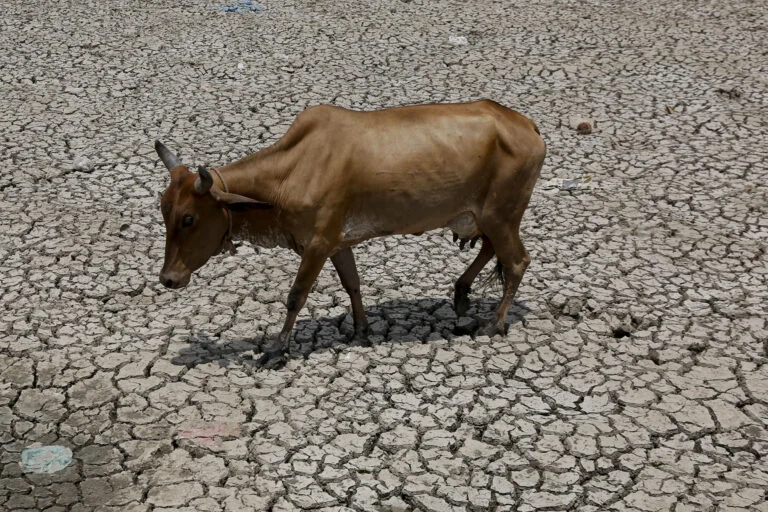
SULTANPUR, UTTAR PRADESH – For Jagdish Agrahari, a resident of Sultanpur in Uttar Pradesh, the dream of a stable secondary income through dairy farming turned into a financial nightmare in the spring of 2025. Having invested in four Jersey cows, a Holstein Friesian, and three buffaloes, Agrahari watched helplessly as the "weather-changing season" of March brought a sudden, brutal spike in temperature. His high-yield Jersey cows, unaccustomed to the searing heat, collapsed.
The resulting veterinary bill reached ₹20,000—a staggering sum for a rural household. Agrahari only managed to stay afloat because of a family-run scrap shop. However, for the majority of India’s 80 million rural households who rely exclusively on cattle rearing, such climate-induced shocks are becoming insurmountable.
India, the world’s largest milk producer since 1998, is facing a structural crisis. As global temperatures rise, the very animals that powered the country’s "White Revolution" are struggling to survive. From reduced milk yields and "silent heat" reproductive failures to the skyrocketing cost of fodder, the backbone of India’s rural economy is under unprecedented strain.
I. Main Facts: The Biological and Economic Toll of Heat Stress
The impact of climate change on India’s bovine population is not a distant threat; it is a current reality. According to a landmark study by the Council on Energy, Environment and Water (CEEW), more than half (54%) of buffalo rearers and 50% of those rearing crossbred or exotic cattle report significant climate-related impacts on their livestock.
The Biological Breaking Point
Cattle, particularly high-yield crossbred varieties like Holstein Friesians and Jerseys, have a narrow thermal neutral zone. When temperatures exceed this range, the animals enter a state of metabolic stress. Buffaloes are even more vulnerable due to their physiology. Their thick, dark skin absorbs more solar radiation, and they possess fewer sweat glands than cows, making it difficult for them to dissipate heat.

Veterinarians across Uttar Pradesh report a consistent set of symptoms during heatwaves:
- Reduced Productivity: Milk yields typically drop by 25% to 33% during peak summer months.
- Physical Distress: Increased respiratory rates (breathlessness), restlessness, and higher calf mortality.
- Quality Degradation: Farmers report "sour milk" and changes in fat content. In extreme cases, heat stress causes physical trauma, with some farmers reporting traces of blood in the milk.
The Profit Margin Squeeze
The financial impact is twofold: rising costs and falling income. Nipendra Kumar, a dairy farmer in Moradabad and a member of the Banas Dairy cooperative, notes that his yield drops by four liters per animal per day during the summer. Simultaneously, the cost of cooling the animals—through fans, extra water, and specialized nutrition—rises.
"In winters, I might make a profit of ₹50,000. In the summer, that drops to ₹25,000," Kumar explains. For small-scale farmers, this 50% reduction in profit can mean the difference between solvency and debt.
II. Chronology: From Growth to Climate-Induced Stagnation
To understand the gravity of the current crisis, one must look at the trajectory of the Indian dairy sector over the last quarter-century.
- 2000–2020: The Era of Expansion. India’s milk production saw a meteoric rise, growing from approximately 80 million tonnes in 2000 to 239 million tonnes by 2023. This growth was fueled by the adoption of high-yield crossbred cattle and the expansion of cooperative networks like Amul and Parag.
- 2022: The Warning Shot. Extreme weather events began to take a visible toll. In 2022 alone, more than 69,000 livestock animals were killed across India due to extreme weather, according to the Centre for Science and Environment (CSE).
- 2024–2025: The New Normal. Heatwaves in northwestern India became more frequent and prolonged. The "weather-changing seasons"—the transition periods between winter and summer—shortened, leaving animals no time to acclimatize to 40°C+ temperatures.
- The Future Projection: A Lancet study projects that by 2085, milk production in India’s arid and semi-arid regions could slash by an additional 25% if current warming trends continue.
III. Supporting Data: The Fodder Crisis and Land Loss
The climate crisis is compounded by a resource crisis. Heat stress does not just affect the animal; it destroys the ecosystem required to sustain it.
The Fodder Deficit
As temperatures rise, green fodder—the primary source of nutrition for healthy milk production—becomes scarce. Farmers are forced to rely on dry husk or sugarcane waste, which is fibrous and low in protein.
- Unaffordability: The CEEW study reveals that 48% of cattle-rearing households in Uttar Pradesh find green fodder unaffordable.
- Dry Fodder Strain: Nearly 70% of households report that dry fodder prices have reached levels they can no longer sustain.
The Disappearance of Common Lands
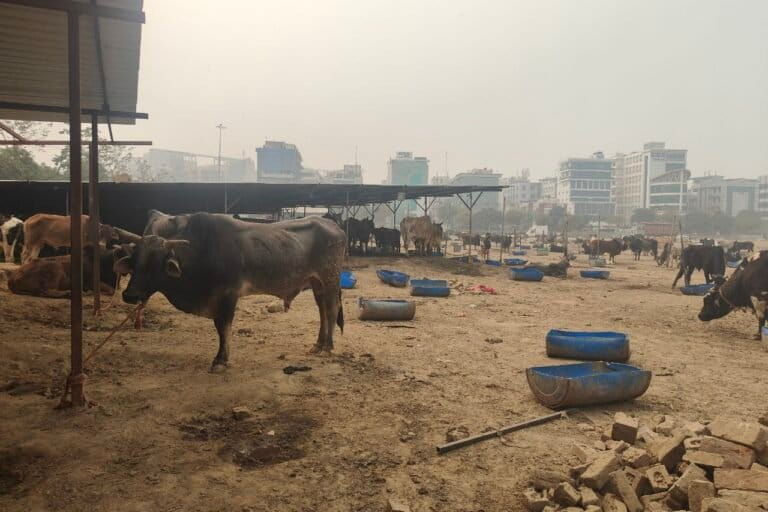
Historically, cattle were cooled by grazing in open fields and wallowing in local ponds. However, urbanization and infrastructure projects, such as the Purvanchal Expressway, have swallowed traditional grazing lands.
- Encroachment: In Uttar Pradesh, 33% of households report they no longer have access to land for fodder cultivation—double the national average.
- The "Heat Trap" Housing: Without open grazing lands, cattle are confined to brick sheds with tin or cement roofs. These structures act as heat traps, further elevating the animal’s body temperature and necessitating expensive, energy-consuming cooling measures like ceiling fans.
IV. Official Responses and Adaptation Strategies
Government bodies and agricultural scientists are attempting to pivot the industry toward "climate-resilient" dairying, though implementation remains a challenge.
Artificial Insemination (AI) and Breed Selection
The Department of Animal Husbandry and Dairying (DAHD) is aggressively promoting Artificial Insemination. The goal is twofold:
- Genetic Resilience: Breeding animals that can withstand higher temperatures while maintaining decent yields.
- Population Control: Using sex-sorted semen to produce female calves, thereby reducing the economic burden of "unproductive" male cattle, which often end up as stray animals.
However, a gap exists between awareness and adoption. While 94% of UP farmers are aware of AI, only 48% currently utilize it.
The Shift to Indigenous Breeds
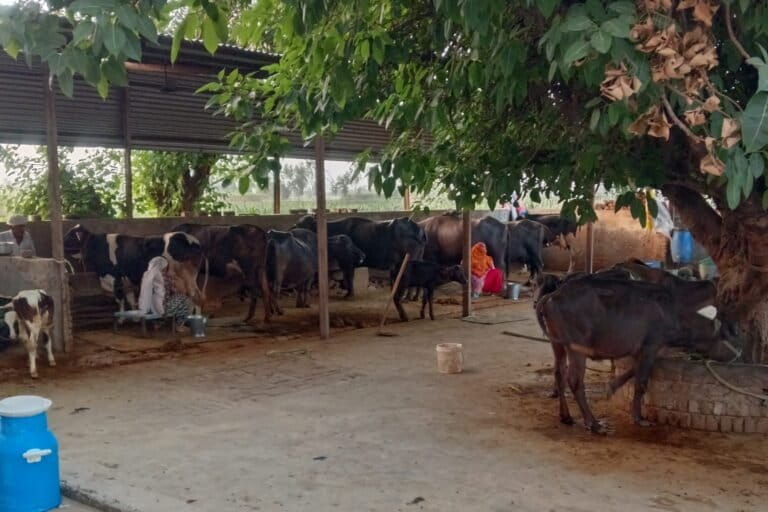
Experts like Ashutosh Tripathi, Assistant Professor at Sardar Vallabhbhai Patel University of Agriculture and Technology, are advocating for a return to indigenous Indian breeds (such as Sahiwal or Gir).
"Indigenous cattle have built climate resilience over generations," Tripathi says. "I have seen indigenous cattle conceive even in the peak heat of May and June—something nearly impossible for Holstein Friesians." His recommendation to farmers is a shift in philosophy: chasing "average yield with average resources" rather than peak output that requires costly, fragile interventions.
Heat Action Plans (HAPs)
On paper, Uttar Pradesh is part of a national effort to mitigate heatwaves. However, a landscape review by the Vasudha Foundation found that out of 75 districts in the state, only 44 have district-level heat action plans or advisories, and only two have comprehensive climate action plans.
V. Implications: Livelihood Security and the Stray Cattle Problem
The disruption of the cattle economy has ripple effects that extend far beyond the dairy pail.
Nutritional and Financial Security
For many small farmers, livestock acts as a "living bank account." When crops fail due to erratic monsoons, selling milk or an animal provides an emergency cash buffer. As climate change erodes the health of these animals, this safety net is fraying. This poses a direct threat to the nutritional security of rural India, where milk is a primary protein source.
The Reproductive Crisis: "Silent Heat"
One of the most insidious impacts of rising temperatures is the disruption of the bovine reproductive cycle. Heat stress leads to "silent heat," where an animal ovulates but shows no outward behavioral signs (such as grunting or mounting).
"Heat suppresses these signals, making it nearly impossible for farmers to time artificial insemination correctly," explains Professor Tripathi. This leads to longer non-productive periods, where the farmer must continue to feed and house an animal that is neither producing milk nor pregnant.

The Stray Cattle Cycle
When a cow becomes unproductive due to age, disease, or reproductive failure, and the farmer can no longer afford the skyrocketing cost of fodder, the animal is often abandoned. This has led to a massive stray cattle problem in Uttar Pradesh, where wandering herds damage crops and cause road accidents, creating a secondary socio-economic crisis.
Conclusion: A Final Toll
The story of Jagdish Agrahari ended in tragedy. By the final week of April 2025, despite spending ₹20,000 on medical care, his Jersey cow succumbed to the heat. Her death is a microcosm of a larger national challenge.
As the India Meteorological Department warns of more frequent El Niño events and longer heatwaves, the dairy sector stands at a crossroads. Without rapid investment in heat-resilient infrastructure, a shift back to indigenous breeds, and better fodder management, the "White Revolution" that transformed rural India may find itself evaporated by the very sun that once nourished its pastures. The warming of the planet is no longer an abstract scientific projection; for 80 million Indian households, the heat has reached the stable door.
