

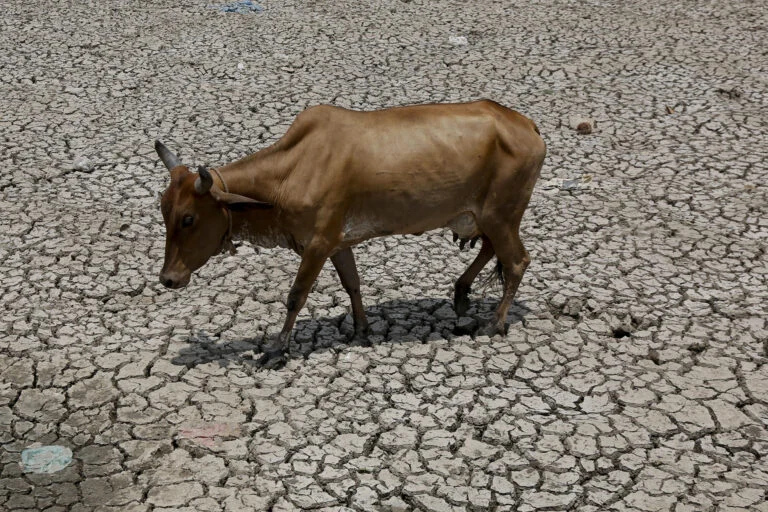
SULTANPUR, UTTAR PRADESH – For Jagdish Agrahari, a resident of Sultanpur in Uttar Pradesh’s Ayodhya district, the dairy business was supposed to be a lifeline. In August 2025, he invested in a diverse herd—four Jersey cows, one Holstein Friesian, and three buffaloes—hoping to supplement his family’s income. However, by March, the "weather-changing season" brought a brutal realization. A sudden, unseasonal spike in temperature left his high-yielding Jersey cows listless and diseased. Despite a ₹20,000 treatment bill, one of his cows eventually succumbed to the heat.
Agrahari’s story is not an isolated tragedy; it is a microcosm of a brewing national crisis. India, the world’s largest milk producer since 1998, is seeing the foundations of its "White Revolution" scorched by rising temperatures. As climate change accelerates, the 80 million rural households that rely on cattle rearing are finding that their primary safety net is fraying under the weight of heat stress, fodder scarcity, and reproductive failure.
Main Facts: A Sector at the Breaking Point
India’s dairy sector has seen meteoric growth over the last two decades, with milk production surging from 80 million tonnes in 2000 to a staggering 239 million tonnes in 2023. This growth has been driven largely by small-scale farmers and the adoption of high-yield crossbred cattle. However, these gains are now under unprecedented pressure.
A landmark study by the Council on Energy, Environment and Water (CEEW) reveals the depth of the distress: 54% of buffalo rearers and 50% of those rearing crossbred or exotic cattle report significant climate-related impacts on their livestock. The consequences are multifaceted, ranging from increased mortality and disease rates to a sharp decline in milk productivity.

In Uttar Pradesh—the nation’s leading milk-producing state—the stakes are particularly high. The state’s bovine population is facing a "triple threat": physiological heat stress, a collapsing fodder supply chain, and a disrupted reproductive cycle. For the millions of marginal farmers who lack the capital for cooling infrastructure, the "insurance" provided by livestock is becoming a liability.
Chronology: From Seasonal Fluctuations to Year-Round Crisis
Traditionally, the Indian dairy cycle followed predictable seasonal patterns. Winter was the "flush season," characterized by high milk yields and successful breeding. Summer brought a manageable dip in production. However, this chronology has been disrupted by the erratic onset of extreme heat.
- The Early Heat Spike (March-April): As seen in the case of Jagdish Agrahari, the transition from winter to summer has become dangerously abrupt. In March 2024 and 2025, temperatures spiked well before animals could acclimatize, leading to immediate health shocks in exotic breeds like Jersey and Holstein Friesian, which are biologically ill-equipped for the Indian heat.
- The Prolonged Summer (May-June): Extended heatwaves, now lasting longer and reaching higher peaks, have turned the "lean season" into a period of survival. Dairy cooperatives in districts like Agra and Moradabad report that daily yields per animal drop by as much as 25% to 40% during these months.
- The Breeding Stall (April-September): The traditional breeding window is narrowing. Farmers now report that the "silent heat" phenomenon—where animals ovulate without showing physical signs—has rendered the period between April and September almost entirely unproductive for buffalo breeding.
- The 2085 Projection: Looking forward, a Lancet study projects that if current trends continue, milk production in India’s arid and semi-arid regions could slash by 25% by 2085, marking a permanent decline in the sector’s viability.
Supporting Data: The Physiology and Economics of Heat Stress
1. The Biological Toll
The impact of heat on a bovine’s body is profound. Buffaloes are particularly vulnerable due to their thick, dark skin which absorbs more solar radiation and their relative lack of sweat glands compared to cows. According to the CEEW, this limits their ability to thermoregulate, leading to respiratory distress and "blood in the milk," a phenomenon reported by farmers in Moradabad.
Anil Tyagi, who runs a dairy cooperative in Agra, provides the hard numbers: a buffalo that typically produces five liters a day drops to three liters during peak summer. For a farmer with ten animals, this represents a loss of 20 liters per day—a catastrophic blow to daily cash flow.
2. The Fodder Crisis
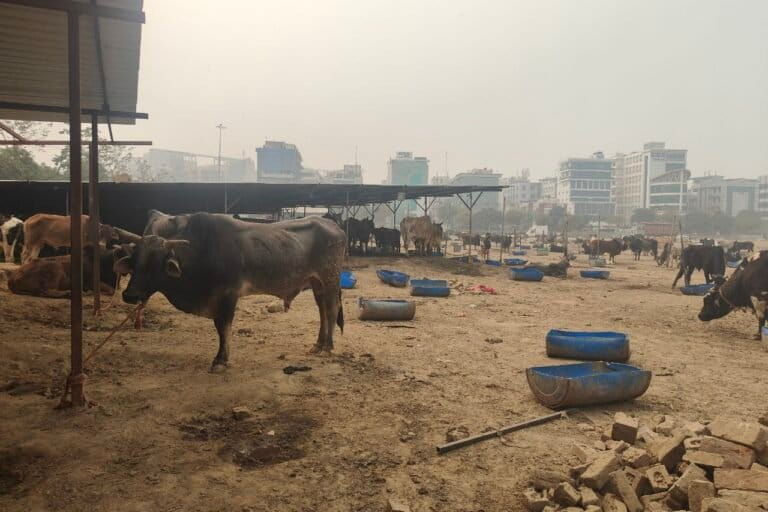
Heat stress does not act in isolation; it is compounded by a nutritional deficit. As temperatures rise, green fodder becomes scarce. In Uttar Pradesh, 48% of cattle-rearing households find green fodder unaffordable, while 70% report that dry fodder (husk) prices have become prohibitive.
The loss of "commons"—grazing lands and local water bodies—has exacerbated this. Dhananjay Goutam from Ghazipur notes that the encroachment of common lands for infrastructure projects like the Purvanchal Expressway has robbed cattle of natural cooling spots. Deprived of ponds and shade, animals are confined to brick sheds with tin roofs that act as ovens, trapping heat and further depressing their appetite and health.
3. Reproductive Failure and "Silent Heat"
Perhaps the most insidious impact is on the reproductive cycle. Ashutosh Tripathi, Assistant Professor at Sardar Vallabhbhai Patel University of Agriculture and Technology, explains that heat suppresses the behavioral signs of estrus. Cows and buffaloes stop grunting or mounting—signals farmers use to time artificial insemination (AI). This leads to "wasted" cycles, where a farmer pays for AI multiple times without success, increasing the cost of maintaining a non-productive animal.
Official Responses: Policy Gaps and Technical Solutions
The Indian government and various state agencies have recognized the threat, but implementation remains inconsistent.
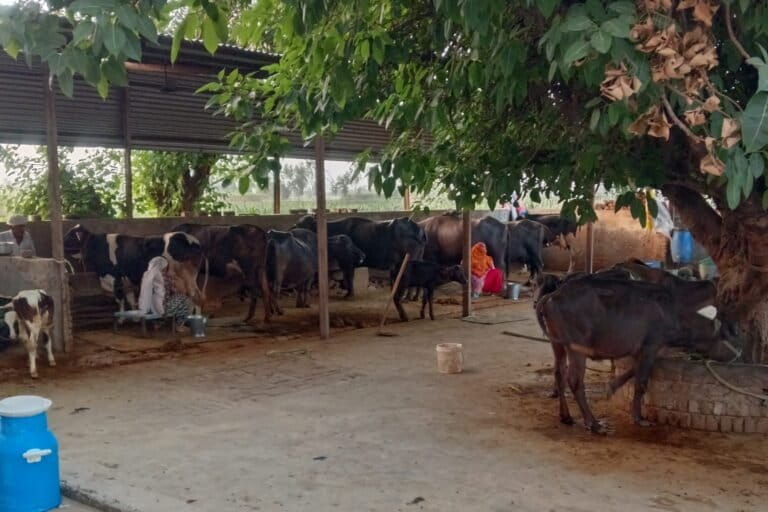
- Artificial Insemination (AI) Initiatives: The Department of Animal Husbandry and Dairying (DAHD) is aggressively promoting AI, not just for productivity but as a climate adaptation tool. The goal is to produce high-quality female calves that are more resilient. However, the CEEW study finds a "knowledge-action gap": while 94% of UP farmers know about AI, only 48% utilize it, often due to the high failure rates during heatwaves.
- Heat Action Plans (HAPs): While the India Meteorological Department (IMD) has identified 23 states as heatwave-prone, local implementation is lagging. In Uttar Pradesh, only 44 of the 75 districts have formal heat advisories, and only two have comprehensive climate action plans.
- The Shift to Indigenous Breeds: Experts like Tripathi are increasingly advocating for a return to indigenous (Desi) breeds. Unlike exotic breeds that chase peak output but collapse in the heat, indigenous cattle possess natural thermotolerance and disease resistance. "Average yield with average resources, sustained over a lifetime," is becoming the new mantra for climate-smart dairying.
Implications: A Threat to Rural Stability
The disruption of the cattle economy has far-reaching consequences for India’s socio-economic fabric.
1. The Stray Cattle Problem
When an animal’s productive life is cut short by heat-induced infertility or illness, it becomes an economic burden. Marginal farmers, unable to afford the "maintenance" of a dry cow, often abandon them. This has led to a surge in the stray cattle population in Uttar Pradesh, creating a secondary crisis of crop damage and road accidents.
2. Nutritional and Financial Security
For millions of households, livestock is "liquid gold"—an asset that can be sold during crop failure. However, as extreme weather events increase (69,000 livestock were killed by extreme weather in India in 2022 alone), this buffer is vanishing. When the livestock itself is the victim of climate change, the farmer is left with no safety net.
3. Logistics and Supply Chain Stress
The heat is also forcing a redesign of the dairy supply chain. Rahul Kumar, a procurement officer in Amroha, describes a frantic race against time. To prevent milk from souring in the 45°C heat, collection routes are being shortened, and transit times for unloading have been slashed from ten minutes to seven. Every minute in the sun is a risk to the quality of the "white gold."

Conclusion
The death of Jagdish Agrahari’s Jersey cow is a stark reminder that for India’s dairy farmers, climate change is not a future projection—it is a current expense. The country’s status as a global dairy leader depends on its ability to protect the 80 million households at the base of the pyramid. Without localized Heat Action Plans, better access to affordable fodder, and a strategic shift toward climate-resilient indigenous breeds, the heat may soon prove too much for India’s milk pails to bear.
