

In the cultural fabric of India, a home is rarely viewed as a mere physical structure of concrete and steel. Instead, it is regarded as a living entity—a sanctuary that breathes and interacts with the cosmic energies surrounding it. According to ancient Hindu traditions and the principles of Vastu Shastra, the transition into a new residence is a pivotal life event that requires divine alignment. This transition, known as Griha Pravesh, is the ceremonial act of entering a new home for the first time.
To ensure that this new beginning is shrouded in peace, prosperity, and health, selecting an auspicious time, or Shubh Muhurat, is considered non-negotiable. As we look toward the 2026-2027 lunar cycle, understanding the astrological nuances and the specific dates sanctioned by the Hindu Panchang is essential for homeowners planning their move.
1. Main Facts: The Philosophy of Griha Pravesh
The term "Griha Pravesh" is derived from two Sanskrit words: Griha (house) and Pravesh (entry). The ceremony is more than a housewarming party; it is a spiritual "cleansing" of the space.
The Vastu Connection
Vastu Shastra, the ancient Indian science of architecture, posits that every space has a "Vastu Purusha" (the deity of the house). Performing the ceremony during a Shubh Muhurat ensures that the five elements—Earth, Water, Fire, Air, and Space—are in perfect harmony. This balance is believed to:
- Neutralize Vastu Doshas: Eradicate any architectural or directional flaws.
- Purify the Atmosphere: Drive away negative energies left behind by construction or previous occupants.
- Invite Prosperity: Align the occupants’ energy with the planetary positions to attract wealth and well-being.
Three Types of Griha Pravesh
Traditional scholars categorize the ceremony into three distinct types:
- Apurva: Entering a newly constructed house on a newly selected land.
- Sapurva: Re-entering a house after a long period of absence or migration.
- Dwandwah: Re-entering a house after reconstruction or renovation following a natural calamity or damage.
2. Chronology: Auspicious Griha Pravesh Dates (2026-2027)
Selecting a date involves a complex calculation of the Hindu Lunar Calendar (Panchang), considering the Tithi (Lunar day), Nakshatra (Star constellation), and Yoga. Below is the chronological breakdown of the most favourable dates from May 2026 through April 2027.
May 2026
May offers several strong windows for relocation, primarily under the influence of the Anuradha and Uttara Ashadha constellations.
- May 4 (Monday): 05:49 AM to 09:58 AM (Tritiya; Anuradha)
- May 8 (Friday): 12:21 PM to 09:20 PM (Saptami; Uttara Ashadha)
- May 13 (Wednesday): 05:45 AM to 01:29 PM (Ekadashi; Uttara Bhadrapada)
June 2026
- June 24 (Wednesday): 05:44 AM to 01:59 PM (Dashami; Chitra)
- June 26 (Friday): 10:22 PM to 05:44 AM, Jun 27 (Trayodashi; Anuradha)
- June 27 (Saturday): 05:44 AM to 10:11 PM (Trayodashi; Anuradha)
July 2026
- July 1 (Wednesday): 06:51 AM to 05:46 AM, Jul 02 (Dwitiya; Uttara Ashadha)
- July 2 (Thursday): 05:46 AM to 09:27 AM (Dwitiya; Uttara Ashadha)
- July 6 (Monday): 04:07 PM to 05:47 AM, Jul 07 (Saptami; Uttara Bhadrapada)
The "Zero" Period: August to October 2026
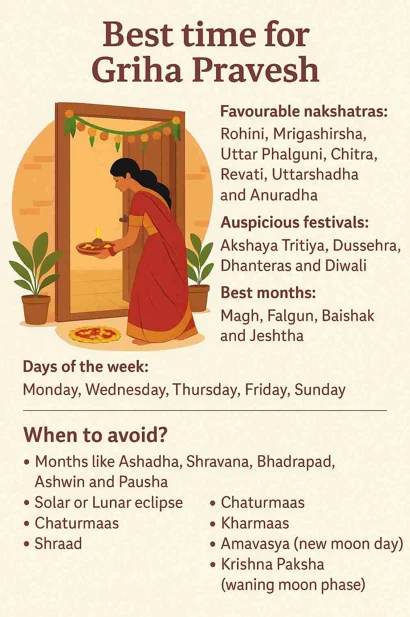
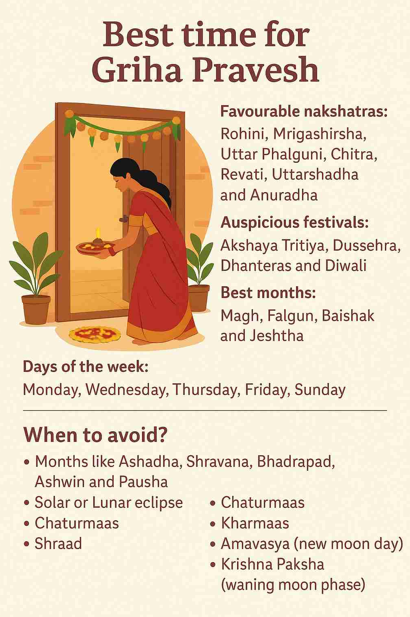
During these three months, there are no auspicious dates available. This period often coincides with Bhadrapada and Ashvin months, including the Pitru Paksha (a period dedicated to ancestors) and Chaturmas, where major religious ceremonies are traditionally paused.
November 2026
November sees a resurgence of favorable alignments, particularly around the Diwali season.

- November 11 (Wednesday): 06:19 AM to 11:38 AM (Dwitiya; Anuradha)
- November 14 (Saturday): 08:24 PM to 11:23 PM (Panchami; Uttara Ashadha)
- November 20 (Friday): 06:56 AM to 06:24 AM, Nov 21 (Ekadashi; Uttara Bhadrapada)
- November 25 (Wednesday): 06:27 AM to 06:27 AM, Nov 26 (Pratipada; Rohini)
- November 26 (Thursday): 06:27 AM to 05:47 PM (Dwitiya; Mrigashira)
December 2026
- December 2 & 3: Under Uttara Phalguni Nakshatra.
- December 11 & 12: Under Uttara Ashadha Nakshatra.
- December 18 & 19: Under Revati Nakshatra.
- December 30 (Wednesday): 06:46 AM to 12:36 PM (Saptami; Uttara Phalguni)
Early 2027 Highlights
- January 1, 2027: A rare New Year’s Day alignment (Dashami; Chitra).
- February 2027: Multiple dates including Feb 10, 11, 15, and 22, focusing on Rohini and Mrigashira Nakshatras.
- March 2027: A high-frequency month with over 10 auspicious dates, including March 3, 10, 15, and 24.
- April 1, 2027: The final major window before the Kharmas period begins.
3. Supporting Data: The Science of Selection
The selection of these dates is not arbitrary. Experts in Vedic astrology and Vastu use several data points to determine the "strength" of a day.
The Role of Nakshatras
There are 27 Nakshatras, but only a few are considered "stable" or "fixed" enough for a housewarming.
- Uttara Bhadrapada, Uttara Phalguni, and Uttara Ashadha: These are considered extremely auspicious for long-term residency.
- Rohini and Mrigashira: Associated with growth and prosperity.
- Anuradha and Chitra: Favourable for harmony among family members.
Auspicious Tithis (Lunar Days)
The Shukla Paksha (Bright fortnight) is generally preferred over the Krishna Paksha (Dark fortnight). Specifically, the 2nd, 3rd, 5th, 7th, 10th, 11th, and 13th days of the lunar cycle are prioritized.
The "Avoid" List: Rahu Kaal
Even on an auspicious day, certain hours are considered "poisonous." Rahu Kaal is a specific window each day when no new work should begin. For instance, on Tuesdays, Rahu Kaal falls between 3:00 PM and 4:30 PM. Homeowners are advised to ensure the actual entry into the house happens outside these windows.
4. Rituals and Their Significance: More Than Tradition
The Griha Pravesh ceremony involves several micro-rituals, each with a specific psychological and spiritual purpose.
The Boiling of Milk
One of the most recognizable traditions is boiling a pot of fresh milk on a new stove until it overflows.
- Symbolism: The overflowing milk represents an abundance of food, wealth, and happiness.
- Scientific Nuance: Historically, this acted as a way to "season" the kitchen and ensure the hearth was functional.
Vastu Shanti and Graha Shanti
A Havan (fire ritual) is usually performed. This is not just religious; it is an atmospheric purification. The herbs and wood burned in the Havan are believed to have medicinal properties that cleanse the air of pollutants and bacteria post-construction.
Entry with the Right Foot
The head of the family is traditionally expected to enter the house with the right foot first. This is a symbolic gesture of "starting on the right foot," ensuring that positive momentum carries the family forward in their new journey.
5. Official Responses and Expert Views: Professional Guidance
Vastu consultants and priests emphasize that "one size does not fit all." While general calendars provide a baseline, a Personalized Muhurat is often recommended.
Expert Insights
According to prominent Vastu experts, the Lagna (Ascendant sign) of the owner must be compatible with the day’s planetary positions. For example, if the Moon is transiting through the 4th, 8th, or 12th house of the owner’s horoscope, that specific day should be avoided regardless of the general calendar.
Modern Adaptations
In a globalized world, priests have adapted to the needs of the diaspora.
- Digital Pujas: Many families now perform "E-Griha Pravesh," where a priest guides the family via video call.
- English Liturgy: There is a growing trend of priests explaining the Sanskrit shlokas in English to ensure the younger generation and non-Indian residents understand the vows they are taking.
6. Implications: The Long-term Impact of a Proper Entry
The implications of a well-timed Griha Pravesh extend beyond the day of the move. It sets the psychological and energetic tone for the family’s future.
Psychological Well-being
Moving is one of life’s most stressful events. The rituals of Griha Pravesh provide a sense of closure to the construction phase and a "blessed" beginning to the residency phase, significantly reducing the anxiety associated with a new environment.
Community and Social Bonds
The ceremony serves as a formal introduction of the family to their new neighbors and community. It reinforces social ties and creates a support system in the new locality.
Environmental Consciousness
A new trend for 2026-2027 is the Eco-friendly Griha Pravesh. Homeowners are increasingly opting for natural dyes for Rangolis, fresh flowers over plastic decor, and organic Samagri for the Havan, aligning the ancient respect for nature with modern sustainability goals.
Conclusion
Planning a Griha Pravesh in 2026 or 2027 requires a blend of ancient wisdom and practical logistics. While the dates provided by the Hindu Panchang offer a roadmap, the true essence of the ceremony lies in the intention—filling a new space with gratitude, love, and positive vibrations. By adhering to the Shubh Muhurats and respecting the Vastu protocols, homeowners can ensure that their new property is not just a house, but a prosperous and peaceful home for generations to come.
