

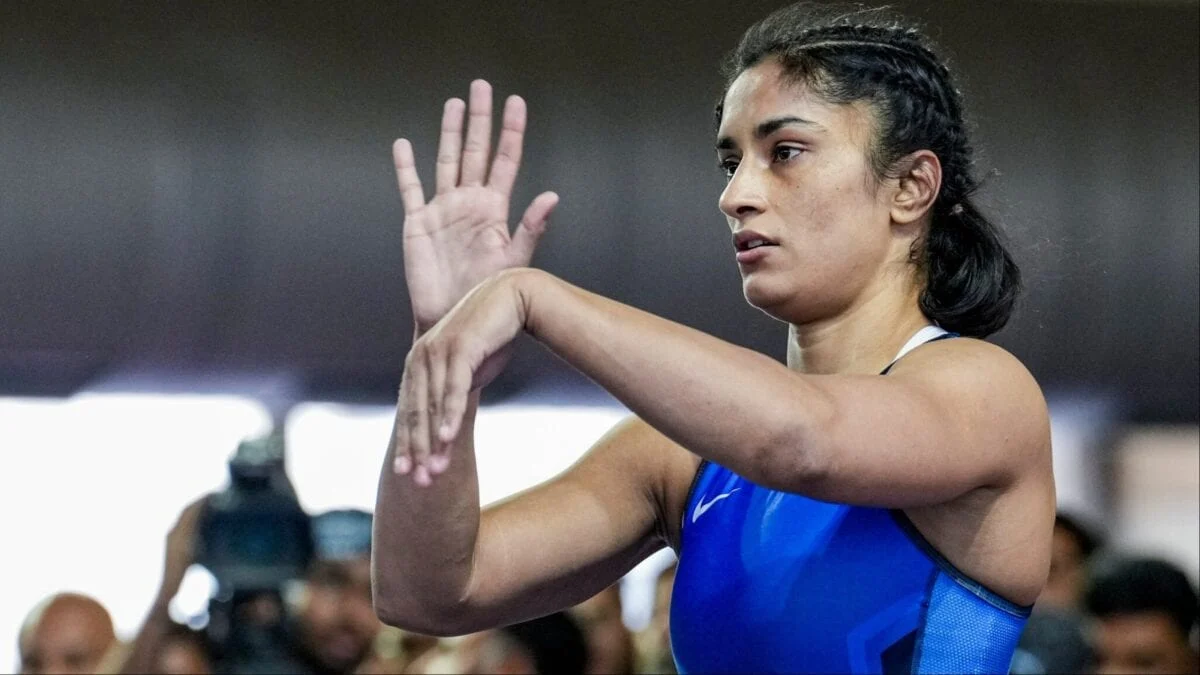
New Delhi, India – May 30, 2026 – Star Indian wrestler Vinesh Phogat, a formidable force in the world of wrestling, faced a stunning setback on Saturday evening, suffering a heartbreaking defeat in the semifinal of the 53kg selection trials for the upcoming Asian Games 2026. The loss, a narrow 4-6 decision against Meenakshi Goyat in a tense and controversial bout, has not only dashed her immediate hopes of securing a berth at the prestigious Aichi-Nagoya Games in Japan later this year but has also reignited her vocal accusations of systemic bias and unfair treatment within the Wrestling Federation of India (WFI).
Emerging from the mat with a mixture of raw emotion and defiant resolve, Phogat declared, "Main wapis aaungi, wapis aaungi iss mat par (I will return, I will return to this mat)." Her statement, delivered amidst a storm of controversy surrounding the selection process and her pre-bout struggles with the federation, underscores a fierce determination to overcome what she perceives as institutional hurdles rather than a mere sporting defeat. While she vowed to continue her preparation, the specific arena for her next competitive appearance remains unspecified, adding another layer of intrigue to her already dramatic career trajectory.
A Shocking Upset at the Trials
The atmosphere at the selection trials in New Delhi was charged with anticipation, particularly around the women’s 53kg category, where Vinesh Phogat was expected to dominate. A multiple Commonwealth and Asian Games gold medalist and a World Championships bronze medalist, Phogat carries the weight of national expectations and a reputation for fierce competitiveness. However, her journey through the trials was anything but straightforward.
The semifinal bout against Meenakshi Goyat proved to be a grueling contest, marked by tactical exchanges and moments of intense physicality. Goyat, a talented and determined challenger, matched Phogat’s aggression, skillfully countering her moves and exploiting openings. The final score of 4-6 in Goyat’s favor sent shockwaves through the wrestling fraternity, marking one of the most significant upsets in recent Indian wrestling history. For Phogat, who has largely been accustomed to victory, the defeat was a bitter pill, effectively ending her direct path to the Asian Games 2026. The Asian Games, often considered a mini-Olympics in terms of competition level and prestige, would have offered Phogat a crucial platform to reaffirm her dominance on the continental stage, especially with the 2028 Los Angeles Olympics on the horizon. The absence of a wrestler of Phogat’s calibre will undoubtedly be felt by the Indian contingent.
Vinesh Phogat’s Defiant Vow: "I Will Return"
In the immediate aftermath of her defeat, Vinesh Phogat’s reaction transcended the typical disappointment of an athlete losing a match. Her words, "Main wapis aaungi, wapis aaungi iss mat par," were not just a promise to herself but a public declaration of resilience in the face of perceived adversity. This defiant stance is characteristic of Phogat, who has often transformed personal setbacks into powerful comebacks throughout her career.
More pointedly, Phogat asserted that her exit from the trials was not a "failure" in the conventional sense. "I have not failed," she declared emphatically. "I was fighting a whole system, I was on one side and everyone else on the other." This powerful statement directly linked her performance and the outcome of the trials to her long-standing and highly publicized battle with the Wrestling Federation of India. Her reference to fighting "a whole system" underscored her belief that the playing field was not level, and that external pressures and biases influenced the circumstances of her competition. "I had to fight for every point, I was not given a fair deal," she added, alluding to perceived injustices that extended beyond the wrestling mat itself. This narrative positions her not merely as a defeated athlete but as a warrior confronting systemic issues, a role she has embraced with increasing prominence over the past couple of years.
Allegations of Systemic Bias and Unfair Treatment
Vinesh Phogat’s accusations of fighting "a whole system" are not new, nor are they made in a vacuum. They are deeply rooted in a turbulent period for Indian wrestling, marked by widespread protests, legal battles, and accusations of sexual harassment and mismanagement against the sport’s governing body. Phogat, along with several other top Indian wrestlers, has been at the forefront of this movement, demanding accountability and reform within the WFI. Their protests, which garnered significant national and international attention, highlighted issues ranging from alleged sexual harassment by former WFI President Brij Bhushan Sharan Singh to broader concerns about athlete welfare, transparency in selection processes, and administrative fairness.
Phogat’s latest comments suggest that, despite changes in leadership and ongoing legal processes, the underlying issues of bias and unfairness persist in her view. Her feeling of being "on one side and everyone else on the other" reflects a deep-seated mistrust and alienation from the federation’s establishment. This sentiment is critical, as it suggests that the environment for athletes, particularly those who have spoken out, remains challenging and potentially hostile. The implication is that the struggle extends beyond individual performance to a broader fight for justice and equitable treatment within the sport.
The Weight Category Controversy: A Pre-Bout Drama
Adding fuel to Phogat’s allegations was a dramatic pre-bout controversy surrounding her weight category. On the morning of the trials, during the official weigh-in, Phogat was initially informed that she would only be permitted to compete in the 50kg division. This decision, conveyed by WFI officials, was reportedly based on her participation in that weight class in her last four international events, including the Paris Olympics.
Phogat vehemently objected to this restriction, arguing that it was discriminatory and denied her the opportunity to compete in her preferred 53kg category. Sources present at the venue described a tense escalation of the matter, with Phogat strongly asserting her right to choose her weight class. The situation reached a critical point before WFI President Sanjay Singh intervened. Following the heated exchange, Singh ultimately reversed the federation’s initial stance, allowing Phogat to enter the 53kg trials as well.
WFI President Sanjay Singh, in his comments to PTI, offered the federation’s perspective on the incident. "We allowed her after she threw accusations and asked the officials to take her weight," Singh stated. He further added, "We do not want to discriminate against anyone. She did not inform us of which category she wants to compete and still letting her." Phogat subsequently weighed in at 53.9kg, confirming her eligibility and allowing her to be accommodated in the 53kg draw. While the WFI claims to have acted fairly by ultimately allowing her to compete in her desired category, the initial restriction and the need for a public confrontation to resolve it only served to reinforce Phogat’s perception of unfairness and systemic hurdles. The episode underscored the lingering tensions between the athletes and the federation, highlighting a lack of clear communication and trust.
Chronology of a Tumultuous Day
The day of the Asian Games selection trials for Vinesh Phogat unfolded like a wrestling drama, with multiple acts of contention leading up to her eventual defeat.
- Morning (Weigh-in Session): The day began with high stakes during the official weigh-in. Vinesh Phogat arrived prepared to compete in the 53kg category, a division she has often excelled in. However, WFI officials initially informed her that she was restricted to the 50kg category, citing her recent international appearances. This decision immediately triggered a fierce protest from Phogat, who saw it as an attempt to undermine her participation and a clear act of discrimination. The confrontation escalated, drawing the attention of other athletes, coaches, and media. WFI President Sanjay Singh’s intervention led to the reversal, allowing Phogat to weigh in at 53.9kg and secure her spot in the 53kg draw. While seemingly resolved, this early morning drama undoubtedly added psychological pressure and mental fatigue, potentially impacting her focus later in the day.
- Afternoon/Evening (Semifinal Bout): With the weigh-in controversy behind her, Phogat stepped onto the mat for her semifinal bout against Meenakshi Goyat. The match itself was a testament to both wrestlers’ grit. Phogat, known for her aggressive style and powerful takedowns, faced a resilient Goyat who capitalized on openings and maintained her composure. The 4-6 scoreline reflected a closely fought contest, but ultimately saw Goyat emerge victorious.
- Post-Match (Defiance and Accusations): Immediately after the loss, Phogat’s public statements transformed a sporting defeat into a renewed call for justice. Her defiant "Main wapis aaungi" and her powerful accusations of fighting "a whole system" and being denied a "fair deal" quickly dominated headlines, shifting the narrative from a simple loss to a deeper discussion about governance and fairness in Indian wrestling. Her reference to the Supreme Court and Delhi High Court, as shared in the PTI tweet, further contextualized her struggle within the broader legal and social landscape of the athlete protests.
Supporting Data and Background
Vinesh Phogat’s career is decorated with an impressive array of achievements, solidifying her status as one of India’s most celebrated wrestlers. She is a two-time Commonwealth Games gold medalist (2014, 2018), an Asian Games gold medalist (2018), and a multiple World Championships medalist, including a bronze in 2019. She has represented India at multiple Olympic Games, making her a seasoned international competitor. This rich pedigree makes her recent defeat and her subsequent allegations all the more significant, as it highlights a conflict between a top-tier athlete and her national federation.
The Asian Games 2026, scheduled to be held in Aichi-Nagoya, Japan, are a critical event in the international wrestling calendar. Beyond the prestige of winning a continental title, these games often serve as a vital stepping stone or a direct qualification event for the Olympic Games. For India, a strong performance at the Asian Games is crucial for maintaining its standing in global wrestling and securing Olympic berths. Vinesh’s absence in the 53kg category leaves a void that other wrestlers will now attempt to fill, but her experience and medal-winning potential are difficult to replace.
Meenakshi Goyat, while not as internationally renowned as Phogat, is a promising talent who has been steadily making her mark on the national circuit. Her victory over Phogat is a significant milestone in her career, propelling her into the spotlight and demonstrating the depth of talent within Indian wrestling. This upset win could be a turning point for Goyat, opening doors to greater international exposure and opportunities.
The context of the WFI protests is crucial to understanding Phogat’s current statements. For months leading up to these trials, Vinesh Phogat, along with Bajrang Punia and Sakshi Malik, spearheaded protests against the then-WFI President, Brij Bhushan Sharan Singh, alleging sexual harassment and demanding his arrest. The protests led to widespread public support, intervention from the Indian Olympic Association (IOA), and ultimately, Singh’s stepping down from the WFI presidency. The election of Sanjay Singh, a close aide of Brij Bhushan, as the new WFI President in December 2023 was met with renewed concerns by the protesting wrestlers, who saw it as a continuation of the old guard’s influence. This history informs Vinesh’s perception of an ongoing "system" that she believes she is fighting against.
Official Responses and Counter-Arguments
The official response from the WFI, primarily through its President Sanjay Singh, has consistently aimed to project an image of fairness and adherence to rules, while also acknowledging the need to manage high-profile athletes. Regarding the weight category dispute, Singh’s comments to PTI reflect a stance that the federation ultimately accommodated Phogat despite procedural lapses on her part. His assertion that "We do not want to discriminate against anyone" directly counters Phogat’s core allegation of bias.
The WFI’s position often emphasizes the importance of following established protocols for informing the federation about preferred weight categories for trials. While they eventually allowed Vinesh to compete in 53kg, their initial resistance and Singh’s framing of it as a concession ("We allowed her after she threw accusations") suggest a narrative where the athlete created the conflict, and the federation acted magnanimously. This narrative attempts to deflect accusations of systemic bias by focusing on individual procedural details. However, it fails to fully address the deeper concerns raised by Phogat regarding the overall fairness and transparency of the selection process, especially in light of the ongoing tensions following the protests. The WFI is under immense scrutiny to prove its impartiality, and incidents like this, regardless of the eventual outcome, contribute to a perception of continued friction.
Implications for Indian Wrestling and Vinesh’s Future
Vinesh Phogat’s defeat at the Asian Games trials carries significant implications for both her individual career and the broader landscape of Indian wrestling.
For Phogat, the immediate consequence is missing out on the Asian Games 2026. This setback might force her to re-evaluate her competitive calendar, potentially targeting other international events or focusing squarely on preparing for the 2028 Los Angeles Olympics, assuming she chooses to continue her wrestling journey. Her vow to "return" indicates her intention to remain active, but the platform for her comeback remains a crucial unanswered question. Will she seek opportunities in non-WFI sanctioned events if possible, or will she continue to navigate the challenging waters of the national federation? The psychological toll of these ongoing battles, coupled with competitive pressures, is immense, and her ability to sustain peak performance amidst such an environment will be a testament to her mental fortitude.
For Indian wrestling, Phogat’s absence from the Asian Games 53kg category removes a strong medal contender. While Meenakshi Goyat’s victory showcases emerging talent, the experience and proven medal-winning ability of Phogat are invaluable. The continued public friction between top athletes and the WFI also casts a shadow over the sport, potentially deterring young aspirants and eroding public trust. The controversies surrounding selection processes and allegations of bias can create an unstable environment, distracting from athletic performance and hindering the overall development of the sport. The WFI faces the challenge of rebuilding trust and demonstrating transparent, equitable governance to ensure that such pre-bout dramas do not overshadow the spirit of fair competition.
Furthermore, the saga highlights the ongoing power struggle and tensions between elite athletes who demand accountability and the sport’s administrative bodies. The questions raised by Phogat about systemic fairness resonate beyond wrestling, touching upon broader issues of athlete rights and governance in Indian sports. The legal and social dimensions of this conflict are likely to persist, influencing how future generations of athletes interact with their federations.
Conclusion: A Saga Continues
Vinesh Phogat’s defeat at the Asian Games selection trials is more than just a loss on the wrestling mat; it is another chapter in a deeply entrenched saga of athletic ambition colliding with administrative challenges and allegations of systemic injustice. Her defiant promise to return, coupled with her pointed accusations, ensures that the spotlight will remain firmly on her, and by extension, on the functioning of the Wrestling Federation of India.
As the Indian wrestling contingent prepares for the Asian Games in Aichi-Nagoya, the absence of one of its brightest stars will be conspicuous. Meanwhile, Vinesh Phogat, true to her resilient nature, will undoubtedly be strategizing her next move. Whether her return will be on the same mat, under the same federation, or in a different arena entirely, remains to be seen. What is clear is that Vinesh Phogat, a warrior both on and off the mat, is far from finished with her fight, both for personal glory and for what she believes is a fairer system for all Indian wrestlers. The echoes of "Main wapis aaungi" will undoubtedly reverberate through the Indian sporting landscape for months to come.
